
diff options
| -rw-r--r-- | .gitignore | 1 | ||||
| -rw-r--r-- | python-astrobase.spec | 897 | ||||
| -rw-r--r-- | sources | 1 |
3 files changed, 899 insertions, 0 deletions
@@ -0,0 +1 @@ +/astrobase-0.5.3.tar.gz diff --git a/python-astrobase.spec b/python-astrobase.spec new file mode 100644 index 0000000..7ca881e --- /dev/null +++ b/python-astrobase.spec @@ -0,0 +1,897 @@ +%global _empty_manifest_terminate_build 0 +Name: python-astrobase +Version: 0.5.3 +Release: 1 +Summary: Python modules and scripts useful for variable star work in astronomy. +License: MIT +URL: https://github.com/waqasbhatti/astrobase +Source0: https://mirrors.nju.edu.cn/pypi/web/packages/ee/39/35b98fc1b57ce23ea5017b335cc09821290844452306e5be8e1a0aa86b09/astrobase-0.5.3.tar.gz +BuildArch: noarch + +Requires: python3-numpy +Requires: python3-scipy +Requires: python3-astropy +Requires: python3-matplotlib +Requires: python3-Pillow +Requires: python3-jplephem +Requires: python3-requests +Requires: python3-tornado +Requires: python3-pyeebls +Requires: python3-tqdm +Requires: python3-scikit-learn +Requires: python3-psycopg2-binary +Requires: python3-emcee +Requires: python3-h5py +Requires: python3-batman-package +Requires: python3-corner +Requires: python3-transitleastsquares +Requires: python3-paramiko +Requires: python3-boto3 +Requires: python3-awscli +Requires: python3-google-api-python-client +Requires: python3-google-cloud-storage +Requires: python3-google-cloud-pubsub +Requires: python3-paramiko +Requires: python3-boto3 +Requires: python3-awscli +Requires: python3-paramiko +Requires: python3-google-api-python-client +Requires: python3-google-cloud-storage +Requires: python3-google-cloud-pubsub +Requires: python3-emcee +Requires: python3-h5py +Requires: python3-batman-package +Requires: python3-corner +Requires: python3-emcee +Requires: python3-h5py +Requires: python3-batman-package +Requires: python3-transitleastsquares +Requires: python3-corner + +%description +[](https://zenodo.org/badge/latestdoi/75150575) [](https://astrobase.readthedocs.io/en/latest/?badge=latest) + +Astrobase is a Python package for analyzing light curves and finding variable +stars. It includes implementations of several period-finding algorithms, batch +work drivers for working on large collections of light curves, and a small +web-app useful for reviewing and classifying light curves by stellar variability +type. + +Most functions in this package that deal with light curves usually require three +Numpy ndarrays as input: `times`, `mags`, and `errs`, so they should work with +any time-series data that can be represented in this form. If you have flux time +series measurements, most functions also take a `magsarefluxes` keyword argument +that makes them handle flux light curves correctly. + +- Read the docs: https://astrobase.readthedocs.io/en/latest/ +- Jupyter notebooks that demonstrate some of the functionality are available in + the [astrobase-notebooks](https://github.com/waqasbhatti/astrobase-notebooks) + repository. +- A [overview](#contents) of the modules and subpackages is provided below. + +Install **[astrobase](https://pypi.org/project/astrobase/)** from the +Python Package Index (PyPI): + +```bash +$ pip install numpy # needed to set up Fortran wrappers +$ pip install astrobase +``` + +See the [installation instructions](#installation) below for details. This +package requires Python >= 3.5 as of version 0.5.0. Use `pip install +astrobase<0.5.0` for older Python versions. + +Python 3.6: [](https://ci.wbhatti.org/job/astrobase-py3) +Python 3.7: [](https://ci.wbhatti.org/job/astrobase-py37) +Python 3.8: [](https://ci.wbhatti.org/job/astrobase-py38) +Python 3.9: [](https://ci.wbhatti.org/job/astrobase-py39) + +# Contents + +- **[astrokep](https://astrobase.readthedocs.io/en/latest/astrobase.astrokep.html)**: + contains functions for dealing with Kepler and K2 Mission light curves from + STScI MAST (reading the FITS files, consolidating light curves for objects + over quarters), and some basic operations (converting fluxes to mags, + decorrelation of light curves, filtering light curves, and fitting object + centroids for eclipse analysis, etc.) + +- **[astrotess](https://astrobase.readthedocs.io/en/latest/astrobase.astrotess.html)**: + contains functions for dealing with TESS 2-minute cadence light curves from + STScI MAST (reading the FITS files, consolidating light curves for objects + over sectors), and some basic operations (converting fluxes to mags, filtering + light curves, etc.) + +- **[checkplot](https://astrobase.readthedocs.io/en/latest/astrobase.checkplot.html)**: + contains functions to make checkplots: a grid of plots used to quickly decide + if a period search for a possibly variable object was successful. Checkplots + come in two forms: + + Python pickles: If you want to interactively browse through large numbers of + checkplots (e.g., as part of a large variable star classification project), + you can use the `checkplotserver` webapp that works on checkplot pickle + files. This interface allows you to review all phased light curves from all + period-finder methods applied, set and save variability tags, object type + tags, best periods and epochs, and comments for each object using a + browser-based UI (see below). The information entered can then be exported as + CSV or JSON for the next stage of a variable star classification pipeline. + + The + [lightcurves-and-checkplots](https://nbviewer.jupyter.org/github/waqasbhatti/astrobase-notebooks/blob/master/lightcurves-and-checkplots.ipynb) + Jupyter notebook outlines how to do this. A more detailed example using light + curves of an arbitrary format is available in the + [lc-collection-work](https://nbviewer.jupyter.org/github/waqasbhatti/astrobase-notebooks/blob/master/lc-collection-work.ipynb) + notebook, which shows how to add in support for a custom LC format, add + neighbor, cross-match, and color-mag diagram info to checkplots, and visualize + these with the checkplotserver. + + 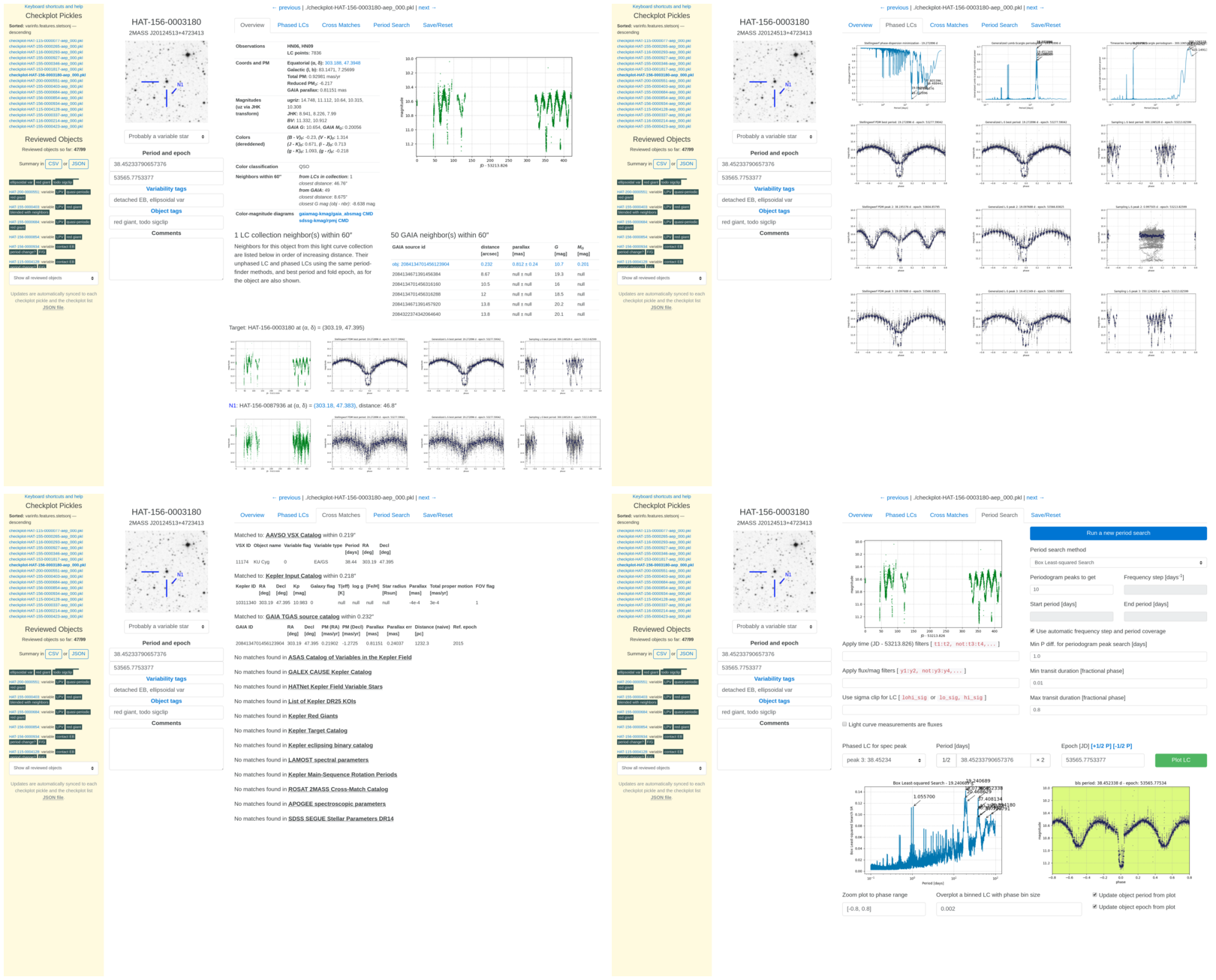 + + PNG images: Alternatively, if you want to simply glance through lots of + checkplots (e.g. for an initial look at a collection of light curves), there's + a `checkplot-viewer` webapp available that operates on checkplot PNG + images. The + [lightcurve-work](https://nbviewer.jupyter.org/github/waqasbhatti/astrobase-notebooks/blob/master/lightcurve-work.ipynb) + Jupyter notebook goes through an example of generating these checkplot PNGs + for light curves. See the + [checkplot-viewer.js](https://github.com/waqasbhatti/astrobase/blob/master/astrobase/cpserver/checkplot-viewer.js) file for more + instructions and [checkplot-viewer.png](https://raw.githubusercontent.com/waqasbhatti/astrobase/master/astrobase/data/checkplot-viewer.png) + for a screenshot. + +- **[coordutils](https://astrobase.readthedocs.io/en/latest/astrobase.coordutils.html)**: + functions for dealing with coordinates (conversions, distances, proper motion) + +- **[fakelcs](https://astrobase.readthedocs.io/en/latest/astrobase.fakelcs.html)**: + modules and functions to conduct an end-to-end variable star recovery + simulation. + +- **[hatsurveys](https://astrobase.readthedocs.io/en/latest/astrobase.hatsurveys.html)**: + modules to read, filter, and normalize light curves from various HAT surveys. + +- **[lcfit](https://astrobase.readthedocs.io/en/latest/astrobase.lcfit.html)**: + functions for fitting light curve models to observations, including + sinusoidal, trapezoidal and full Mandel-Agol planet transits, eclipses, and + splines. + +- **[lcmath](https://astrobase.readthedocs.io/en/latest/astrobase.lcmath.html)**: functions for light curve operations such + as phasing, normalization, binning (in time and phase), sigma-clipping, + external parameter decorrelation (EPD), etc. + +- **[lcmodels](https://astrobase.readthedocs.io/en/latest/astrobase.lcmodels.html)**: + first order models for fast fitting (for the purposes of variable + classification) to various periodic variable types, including sinusoidal + variables, eclipsing binaries, transiting planets, and flares. + +- **[lcproc](https://astrobase.readthedocs.io/en/latest/astrobase.lcproc.html)**: + driver functions for running an end-to-end pipeline including: (i) object + selection from a collection of light curves by position, cross-matching to + external catalogs, or light curve objectinfo keys, (ii) running variability + feature calculation and detection, (iii) running period-finding, and (iv) + object review using the checkplotserver webapp for variability + classification. + +- **[periodbase](https://astrobase.readthedocs.io/en/latest/astrobase.periodbase.html)**: parallelized functions (using + `multiprocessing.map`) to run fast period searches on light curves, including: + the generalized Lomb-Scargle algorithm from Zechmeister & Kurster + ([2008](http://adsabs.harvard.edu/abs/2009A%26A...496..577Z); + **[periodbase.zgls](https://astrobase.readthedocs.io/en/latest/astrobase.periodbase.zgls.html)**), the phase dispersion + minimization algorithm from Stellingwerf + ([1978](http://adsabs.harvard.edu/abs/1978ApJ...224..953S), + [2011](http://adsabs.harvard.edu/abs/2011rrls.conf...47S); + **[periodbase.spdm](https://astrobase.readthedocs.io/en/latest/astrobase.periodbase.spdm.html)**), the AoV and + AoV-multiharmonic algorithms from Schwarzenberg-Czerny + ([1989](http://adsabs.harvard.edu/abs/1989MNRAS.241..153S), + [1996](http://adsabs.harvard.edu/abs/1996ApJ...460L.107S); + **[periodbase.saov](https://astrobase.readthedocs.io/en/latest/astrobase.periodbase.saov.html)**, + **[periodbase.smav](https://astrobase.readthedocs.io/en/latest/astrobase.periodbase.smav.html)**), the BLS algorithm from + Kovacs et al. ([2002](http://adsabs.harvard.edu/abs/2002A%26A...391..369K); + **[periodbase.kbls](https://astrobase.readthedocs.io/en/latest/astrobase.periodbase.kbls.html)** + and **[periodbase.abls](https://astrobase.readthedocs.io/en/latest/astrobase.periodbase.abls.html)**), + the similar TLS algorithm from Hippke & Heller + ([2019](https://ui.adsabs.harvard.edu/abs/2019A%26A...623A..39H/abstract); + **[periodbase.htls](https://astrobase.readthedocs.io/en/latest/astrobase.periodbase.htls.html)**), + and the ACF period-finding algorithm from McQuillan et al. + ([2013a](http://adsabs.harvard.edu/abs/2013MNRAS.432.1203M), + [2014](http://adsabs.harvard.edu/abs/2014ApJS..211...24M); + **[periodbase.macf](https://astrobase.readthedocs.io/en/latest/astrobase.periodbase.macf.html)**). + +- **[plotbase](https://astrobase.readthedocs.io/en/latest/astrobase.plotbase.html)**: functions to plot light curves, phased + light curves, periodograms, and download Digitized Sky Survey cutouts from the + NASA SkyView service. + +- **[services](https://astrobase.readthedocs.io/en/latest/astrobase.services.html)**: modules and functions to query various + astronomical catalogs and data services, including GAIA, SIMBAD, TRILEGAL, + NASA SkyView, and 2MASS DUST. + +- **[timeutils](https://astrobase.readthedocs.io/en/latest/astrobase.timeutils.html)**: functions for converting from + Julian dates to Baryocentric Julian dates, and precessing coordinates between + equinoxes and due to proper motion; this will automatically download and save + the JPL ephemerides **de430.bsp** from JPL upon first import. + +- **[varbase](https://astrobase.readthedocs.io/en/latest/astrobase.varbase.html)**: + functions for calculating auto-correlation features, masking and pre-whitening + periodic signals in light curves, and planet transit specific tools. + +- **[varclass](https://astrobase.readthedocs.io/en/latest/astrobase.varclass.html)**: functions for calculating various + variability, stellar color and motion, and neighbor proximity features, along + with a Random Forest based classifier. + + +# Changelog + +Please see https://github.com/waqasbhatti/astrobase/blob/master/CHANGELOG.md for +a list of changes applicable to tagged release versions. + + +# Installation + +## Requirements + +This package requires the following other packages: + +- numpy +- scipy +- astropy +- matplotlib +- Pillow +- jplephem +- requests +- tornado +- pyeebls +- tqdm +- scikit-learn + +For optional functionality, some additional packages are required: + +- for `astrobase.lcdb` to work, you'll need `psycopg2-binary`. +- for `lcfit.transits.mandelagol_fit_magseries`, you'll need `batman-package`, + `emcee`, `corner`, and `h5py`. +- for `lcproc.awsrun`, you'll need `paramiko`, `boto3`, and `awscli`. +- for `periodbase.tls`, you'll need `transitleastsquares` + +## Installing with pip + +If you're using: + +- 64-bit Linux and Python 2.7, 3.4, 3.5, 3.6, 3.7 +- 64-bit Mac OSX 10.12+ with Python 2.7 or 3.6 +- 64-bit Windows with Python 2.7 and 3.6 + +You can simply install astrobase with: + +```bash + +(venv)$ pip install astrobase +``` + +Otherwise, you'll need to make sure that a Fortran compiler and numpy are +installed beforehand to compile the pyeebls package that astrobase depends on: + +```bash +## you'll need a Fortran compiler. ## +## on Linux: dnf/yum/apt install gcc gfortran ## +## on OSX (using homebrew): brew install gcc && brew link gcc ## + +## make sure numpy is installed as well! ## +## this is required for the pyeebls module installation ## + +(venv)$ pip install numpy # in a virtualenv +# or use dnf/yum/apt install numpy to install systemwide +``` + +Once that's done, install astrobase. + +```bash +(venv)$ pip install astrobase +``` + +### Other installation methods + +Install all the optional dependencies as well: + +```bash +(venv)$ pip install astrobase[all] +``` + +Install the latest version (may be unstable at times): + +```bash +$ git clone https://github.com/waqasbhatti/astrobase +$ cd astrobase +$ python setup.py install +$ # or use pip install . to install requirements automatically +$ # or use pip install -e . to install in develop mode along with requirements +$ # or use pip install -e .[all] to install in develop mode along with all requirements +``` + +# License + +`astrobase` is provided under the MIT License. See the LICENSE file for the full +text. + + + + +%package -n python3-astrobase +Summary: Python modules and scripts useful for variable star work in astronomy. +Provides: python-astrobase +BuildRequires: python3-devel +BuildRequires: python3-setuptools +BuildRequires: python3-pip +%description -n python3-astrobase +[](https://zenodo.org/badge/latestdoi/75150575) [](https://astrobase.readthedocs.io/en/latest/?badge=latest) + +Astrobase is a Python package for analyzing light curves and finding variable +stars. It includes implementations of several period-finding algorithms, batch +work drivers for working on large collections of light curves, and a small +web-app useful for reviewing and classifying light curves by stellar variability +type. + +Most functions in this package that deal with light curves usually require three +Numpy ndarrays as input: `times`, `mags`, and `errs`, so they should work with +any time-series data that can be represented in this form. If you have flux time +series measurements, most functions also take a `magsarefluxes` keyword argument +that makes them handle flux light curves correctly. + +- Read the docs: https://astrobase.readthedocs.io/en/latest/ +- Jupyter notebooks that demonstrate some of the functionality are available in + the [astrobase-notebooks](https://github.com/waqasbhatti/astrobase-notebooks) + repository. +- A [overview](#contents) of the modules and subpackages is provided below. + +Install **[astrobase](https://pypi.org/project/astrobase/)** from the +Python Package Index (PyPI): + +```bash +$ pip install numpy # needed to set up Fortran wrappers +$ pip install astrobase +``` + +See the [installation instructions](#installation) below for details. This +package requires Python >= 3.5 as of version 0.5.0. Use `pip install +astrobase<0.5.0` for older Python versions. + +Python 3.6: [](https://ci.wbhatti.org/job/astrobase-py3) +Python 3.7: [](https://ci.wbhatti.org/job/astrobase-py37) +Python 3.8: [](https://ci.wbhatti.org/job/astrobase-py38) +Python 3.9: [](https://ci.wbhatti.org/job/astrobase-py39) + +# Contents + +- **[astrokep](https://astrobase.readthedocs.io/en/latest/astrobase.astrokep.html)**: + contains functions for dealing with Kepler and K2 Mission light curves from + STScI MAST (reading the FITS files, consolidating light curves for objects + over quarters), and some basic operations (converting fluxes to mags, + decorrelation of light curves, filtering light curves, and fitting object + centroids for eclipse analysis, etc.) + +- **[astrotess](https://astrobase.readthedocs.io/en/latest/astrobase.astrotess.html)**: + contains functions for dealing with TESS 2-minute cadence light curves from + STScI MAST (reading the FITS files, consolidating light curves for objects + over sectors), and some basic operations (converting fluxes to mags, filtering + light curves, etc.) + +- **[checkplot](https://astrobase.readthedocs.io/en/latest/astrobase.checkplot.html)**: + contains functions to make checkplots: a grid of plots used to quickly decide + if a period search for a possibly variable object was successful. Checkplots + come in two forms: + + Python pickles: If you want to interactively browse through large numbers of + checkplots (e.g., as part of a large variable star classification project), + you can use the `checkplotserver` webapp that works on checkplot pickle + files. This interface allows you to review all phased light curves from all + period-finder methods applied, set and save variability tags, object type + tags, best periods and epochs, and comments for each object using a + browser-based UI (see below). The information entered can then be exported as + CSV or JSON for the next stage of a variable star classification pipeline. + + The + [lightcurves-and-checkplots](https://nbviewer.jupyter.org/github/waqasbhatti/astrobase-notebooks/blob/master/lightcurves-and-checkplots.ipynb) + Jupyter notebook outlines how to do this. A more detailed example using light + curves of an arbitrary format is available in the + [lc-collection-work](https://nbviewer.jupyter.org/github/waqasbhatti/astrobase-notebooks/blob/master/lc-collection-work.ipynb) + notebook, which shows how to add in support for a custom LC format, add + neighbor, cross-match, and color-mag diagram info to checkplots, and visualize + these with the checkplotserver. + +  + + PNG images: Alternatively, if you want to simply glance through lots of + checkplots (e.g. for an initial look at a collection of light curves), there's + a `checkplot-viewer` webapp available that operates on checkplot PNG + images. The + [lightcurve-work](https://nbviewer.jupyter.org/github/waqasbhatti/astrobase-notebooks/blob/master/lightcurve-work.ipynb) + Jupyter notebook goes through an example of generating these checkplot PNGs + for light curves. See the + [checkplot-viewer.js](https://github.com/waqasbhatti/astrobase/blob/master/astrobase/cpserver/checkplot-viewer.js) file for more + instructions and [checkplot-viewer.png](https://raw.githubusercontent.com/waqasbhatti/astrobase/master/astrobase/data/checkplot-viewer.png) + for a screenshot. + +- **[coordutils](https://astrobase.readthedocs.io/en/latest/astrobase.coordutils.html)**: + functions for dealing with coordinates (conversions, distances, proper motion) + +- **[fakelcs](https://astrobase.readthedocs.io/en/latest/astrobase.fakelcs.html)**: + modules and functions to conduct an end-to-end variable star recovery + simulation. + +- **[hatsurveys](https://astrobase.readthedocs.io/en/latest/astrobase.hatsurveys.html)**: + modules to read, filter, and normalize light curves from various HAT surveys. + +- **[lcfit](https://astrobase.readthedocs.io/en/latest/astrobase.lcfit.html)**: + functions for fitting light curve models to observations, including + sinusoidal, trapezoidal and full Mandel-Agol planet transits, eclipses, and + splines. + +- **[lcmath](https://astrobase.readthedocs.io/en/latest/astrobase.lcmath.html)**: functions for light curve operations such + as phasing, normalization, binning (in time and phase), sigma-clipping, + external parameter decorrelation (EPD), etc. + +- **[lcmodels](https://astrobase.readthedocs.io/en/latest/astrobase.lcmodels.html)**: + first order models for fast fitting (for the purposes of variable + classification) to various periodic variable types, including sinusoidal + variables, eclipsing binaries, transiting planets, and flares. + +- **[lcproc](https://astrobase.readthedocs.io/en/latest/astrobase.lcproc.html)**: + driver functions for running an end-to-end pipeline including: (i) object + selection from a collection of light curves by position, cross-matching to + external catalogs, or light curve objectinfo keys, (ii) running variability + feature calculation and detection, (iii) running period-finding, and (iv) + object review using the checkplotserver webapp for variability + classification. + +- **[periodbase](https://astrobase.readthedocs.io/en/latest/astrobase.periodbase.html)**: parallelized functions (using + `multiprocessing.map`) to run fast period searches on light curves, including: + the generalized Lomb-Scargle algorithm from Zechmeister & Kurster + ([2008](http://adsabs.harvard.edu/abs/2009A%26A...496..577Z); + **[periodbase.zgls](https://astrobase.readthedocs.io/en/latest/astrobase.periodbase.zgls.html)**), the phase dispersion + minimization algorithm from Stellingwerf + ([1978](http://adsabs.harvard.edu/abs/1978ApJ...224..953S), + [2011](http://adsabs.harvard.edu/abs/2011rrls.conf...47S); + **[periodbase.spdm](https://astrobase.readthedocs.io/en/latest/astrobase.periodbase.spdm.html)**), the AoV and + AoV-multiharmonic algorithms from Schwarzenberg-Czerny + ([1989](http://adsabs.harvard.edu/abs/1989MNRAS.241..153S), + [1996](http://adsabs.harvard.edu/abs/1996ApJ...460L.107S); + **[periodbase.saov](https://astrobase.readthedocs.io/en/latest/astrobase.periodbase.saov.html)**, + **[periodbase.smav](https://astrobase.readthedocs.io/en/latest/astrobase.periodbase.smav.html)**), the BLS algorithm from + Kovacs et al. ([2002](http://adsabs.harvard.edu/abs/2002A%26A...391..369K); + **[periodbase.kbls](https://astrobase.readthedocs.io/en/latest/astrobase.periodbase.kbls.html)** + and **[periodbase.abls](https://astrobase.readthedocs.io/en/latest/astrobase.periodbase.abls.html)**), + the similar TLS algorithm from Hippke & Heller + ([2019](https://ui.adsabs.harvard.edu/abs/2019A%26A...623A..39H/abstract); + **[periodbase.htls](https://astrobase.readthedocs.io/en/latest/astrobase.periodbase.htls.html)**), + and the ACF period-finding algorithm from McQuillan et al. + ([2013a](http://adsabs.harvard.edu/abs/2013MNRAS.432.1203M), + [2014](http://adsabs.harvard.edu/abs/2014ApJS..211...24M); + **[periodbase.macf](https://astrobase.readthedocs.io/en/latest/astrobase.periodbase.macf.html)**). + +- **[plotbase](https://astrobase.readthedocs.io/en/latest/astrobase.plotbase.html)**: functions to plot light curves, phased + light curves, periodograms, and download Digitized Sky Survey cutouts from the + NASA SkyView service. + +- **[services](https://astrobase.readthedocs.io/en/latest/astrobase.services.html)**: modules and functions to query various + astronomical catalogs and data services, including GAIA, SIMBAD, TRILEGAL, + NASA SkyView, and 2MASS DUST. + +- **[timeutils](https://astrobase.readthedocs.io/en/latest/astrobase.timeutils.html)**: functions for converting from + Julian dates to Baryocentric Julian dates, and precessing coordinates between + equinoxes and due to proper motion; this will automatically download and save + the JPL ephemerides **de430.bsp** from JPL upon first import. + +- **[varbase](https://astrobase.readthedocs.io/en/latest/astrobase.varbase.html)**: + functions for calculating auto-correlation features, masking and pre-whitening + periodic signals in light curves, and planet transit specific tools. + +- **[varclass](https://astrobase.readthedocs.io/en/latest/astrobase.varclass.html)**: functions for calculating various + variability, stellar color and motion, and neighbor proximity features, along + with a Random Forest based classifier. + + +# Changelog + +Please see https://github.com/waqasbhatti/astrobase/blob/master/CHANGELOG.md for +a list of changes applicable to tagged release versions. + + +# Installation + +## Requirements + +This package requires the following other packages: + +- numpy +- scipy +- astropy +- matplotlib +- Pillow +- jplephem +- requests +- tornado +- pyeebls +- tqdm +- scikit-learn + +For optional functionality, some additional packages are required: + +- for `astrobase.lcdb` to work, you'll need `psycopg2-binary`. +- for `lcfit.transits.mandelagol_fit_magseries`, you'll need `batman-package`, + `emcee`, `corner`, and `h5py`. +- for `lcproc.awsrun`, you'll need `paramiko`, `boto3`, and `awscli`. +- for `periodbase.tls`, you'll need `transitleastsquares` + +## Installing with pip + +If you're using: + +- 64-bit Linux and Python 2.7, 3.4, 3.5, 3.6, 3.7 +- 64-bit Mac OSX 10.12+ with Python 2.7 or 3.6 +- 64-bit Windows with Python 2.7 and 3.6 + +You can simply install astrobase with: + +```bash + +(venv)$ pip install astrobase +``` + +Otherwise, you'll need to make sure that a Fortran compiler and numpy are +installed beforehand to compile the pyeebls package that astrobase depends on: + +```bash +## you'll need a Fortran compiler. ## +## on Linux: dnf/yum/apt install gcc gfortran ## +## on OSX (using homebrew): brew install gcc && brew link gcc ## + +## make sure numpy is installed as well! ## +## this is required for the pyeebls module installation ## + +(venv)$ pip install numpy # in a virtualenv +# or use dnf/yum/apt install numpy to install systemwide +``` + +Once that's done, install astrobase. + +```bash +(venv)$ pip install astrobase +``` + +### Other installation methods + +Install all the optional dependencies as well: + +```bash +(venv)$ pip install astrobase[all] +``` + +Install the latest version (may be unstable at times): + +```bash +$ git clone https://github.com/waqasbhatti/astrobase +$ cd astrobase +$ python setup.py install +$ # or use pip install . to install requirements automatically +$ # or use pip install -e . to install in develop mode along with requirements +$ # or use pip install -e .[all] to install in develop mode along with all requirements +``` + +# License + +`astrobase` is provided under the MIT License. See the LICENSE file for the full +text. + + + + +%package help +Summary: Development documents and examples for astrobase +Provides: python3-astrobase-doc +%description help +[](https://zenodo.org/badge/latestdoi/75150575) [](https://astrobase.readthedocs.io/en/latest/?badge=latest) + +Astrobase is a Python package for analyzing light curves and finding variable +stars. It includes implementations of several period-finding algorithms, batch +work drivers for working on large collections of light curves, and a small +web-app useful for reviewing and classifying light curves by stellar variability +type. + +Most functions in this package that deal with light curves usually require three +Numpy ndarrays as input: `times`, `mags`, and `errs`, so they should work with +any time-series data that can be represented in this form. If you have flux time +series measurements, most functions also take a `magsarefluxes` keyword argument +that makes them handle flux light curves correctly. + +- Read the docs: https://astrobase.readthedocs.io/en/latest/ +- Jupyter notebooks that demonstrate some of the functionality are available in + the [astrobase-notebooks](https://github.com/waqasbhatti/astrobase-notebooks) + repository. +- A [overview](#contents) of the modules and subpackages is provided below. + +Install **[astrobase](https://pypi.org/project/astrobase/)** from the +Python Package Index (PyPI): + +```bash +$ pip install numpy # needed to set up Fortran wrappers +$ pip install astrobase +``` + +See the [installation instructions](#installation) below for details. This +package requires Python >= 3.5 as of version 0.5.0. Use `pip install +astrobase<0.5.0` for older Python versions. + +Python 3.6: [](https://ci.wbhatti.org/job/astrobase-py3) +Python 3.7: [](https://ci.wbhatti.org/job/astrobase-py37) +Python 3.8: [](https://ci.wbhatti.org/job/astrobase-py38) +Python 3.9: [](https://ci.wbhatti.org/job/astrobase-py39) + +# Contents + +- **[astrokep](https://astrobase.readthedocs.io/en/latest/astrobase.astrokep.html)**: + contains functions for dealing with Kepler and K2 Mission light curves from + STScI MAST (reading the FITS files, consolidating light curves for objects + over quarters), and some basic operations (converting fluxes to mags, + decorrelation of light curves, filtering light curves, and fitting object + centroids for eclipse analysis, etc.) + +- **[astrotess](https://astrobase.readthedocs.io/en/latest/astrobase.astrotess.html)**: + contains functions for dealing with TESS 2-minute cadence light curves from + STScI MAST (reading the FITS files, consolidating light curves for objects + over sectors), and some basic operations (converting fluxes to mags, filtering + light curves, etc.) + +- **[checkplot](https://astrobase.readthedocs.io/en/latest/astrobase.checkplot.html)**: + contains functions to make checkplots: a grid of plots used to quickly decide + if a period search for a possibly variable object was successful. Checkplots + come in two forms: + + Python pickles: If you want to interactively browse through large numbers of + checkplots (e.g., as part of a large variable star classification project), + you can use the `checkplotserver` webapp that works on checkplot pickle + files. This interface allows you to review all phased light curves from all + period-finder methods applied, set and save variability tags, object type + tags, best periods and epochs, and comments for each object using a + browser-based UI (see below). The information entered can then be exported as + CSV or JSON for the next stage of a variable star classification pipeline. + + The + [lightcurves-and-checkplots](https://nbviewer.jupyter.org/github/waqasbhatti/astrobase-notebooks/blob/master/lightcurves-and-checkplots.ipynb) + Jupyter notebook outlines how to do this. A more detailed example using light + curves of an arbitrary format is available in the + [lc-collection-work](https://nbviewer.jupyter.org/github/waqasbhatti/astrobase-notebooks/blob/master/lc-collection-work.ipynb) + notebook, which shows how to add in support for a custom LC format, add + neighbor, cross-match, and color-mag diagram info to checkplots, and visualize + these with the checkplotserver. + +  + + PNG images: Alternatively, if you want to simply glance through lots of + checkplots (e.g. for an initial look at a collection of light curves), there's + a `checkplot-viewer` webapp available that operates on checkplot PNG + images. The + [lightcurve-work](https://nbviewer.jupyter.org/github/waqasbhatti/astrobase-notebooks/blob/master/lightcurve-work.ipynb) + Jupyter notebook goes through an example of generating these checkplot PNGs + for light curves. See the + [checkplot-viewer.js](https://github.com/waqasbhatti/astrobase/blob/master/astrobase/cpserver/checkplot-viewer.js) file for more + instructions and [checkplot-viewer.png](https://raw.githubusercontent.com/waqasbhatti/astrobase/master/astrobase/data/checkplot-viewer.png) + for a screenshot. + +- **[coordutils](https://astrobase.readthedocs.io/en/latest/astrobase.coordutils.html)**: + functions for dealing with coordinates (conversions, distances, proper motion) + +- **[fakelcs](https://astrobase.readthedocs.io/en/latest/astrobase.fakelcs.html)**: + modules and functions to conduct an end-to-end variable star recovery + simulation. + +- **[hatsurveys](https://astrobase.readthedocs.io/en/latest/astrobase.hatsurveys.html)**: + modules to read, filter, and normalize light curves from various HAT surveys. + +- **[lcfit](https://astrobase.readthedocs.io/en/latest/astrobase.lcfit.html)**: + functions for fitting light curve models to observations, including + sinusoidal, trapezoidal and full Mandel-Agol planet transits, eclipses, and + splines. + +- **[lcmath](https://astrobase.readthedocs.io/en/latest/astrobase.lcmath.html)**: functions for light curve operations such + as phasing, normalization, binning (in time and phase), sigma-clipping, + external parameter decorrelation (EPD), etc. + +- **[lcmodels](https://astrobase.readthedocs.io/en/latest/astrobase.lcmodels.html)**: + first order models for fast fitting (for the purposes of variable + classification) to various periodic variable types, including sinusoidal + variables, eclipsing binaries, transiting planets, and flares. + +- **[lcproc](https://astrobase.readthedocs.io/en/latest/astrobase.lcproc.html)**: + driver functions for running an end-to-end pipeline including: (i) object + selection from a collection of light curves by position, cross-matching to + external catalogs, or light curve objectinfo keys, (ii) running variability + feature calculation and detection, (iii) running period-finding, and (iv) + object review using the checkplotserver webapp for variability + classification. + +- **[periodbase](https://astrobase.readthedocs.io/en/latest/astrobase.periodbase.html)**: parallelized functions (using + `multiprocessing.map`) to run fast period searches on light curves, including: + the generalized Lomb-Scargle algorithm from Zechmeister & Kurster + ([2008](http://adsabs.harvard.edu/abs/2009A%26A...496..577Z); + **[periodbase.zgls](https://astrobase.readthedocs.io/en/latest/astrobase.periodbase.zgls.html)**), the phase dispersion + minimization algorithm from Stellingwerf + ([1978](http://adsabs.harvard.edu/abs/1978ApJ...224..953S), + [2011](http://adsabs.harvard.edu/abs/2011rrls.conf...47S); + **[periodbase.spdm](https://astrobase.readthedocs.io/en/latest/astrobase.periodbase.spdm.html)**), the AoV and + AoV-multiharmonic algorithms from Schwarzenberg-Czerny + ([1989](http://adsabs.harvard.edu/abs/1989MNRAS.241..153S), + [1996](http://adsabs.harvard.edu/abs/1996ApJ...460L.107S); + **[periodbase.saov](https://astrobase.readthedocs.io/en/latest/astrobase.periodbase.saov.html)**, + **[periodbase.smav](https://astrobase.readthedocs.io/en/latest/astrobase.periodbase.smav.html)**), the BLS algorithm from + Kovacs et al. ([2002](http://adsabs.harvard.edu/abs/2002A%26A...391..369K); + **[periodbase.kbls](https://astrobase.readthedocs.io/en/latest/astrobase.periodbase.kbls.html)** + and **[periodbase.abls](https://astrobase.readthedocs.io/en/latest/astrobase.periodbase.abls.html)**), + the similar TLS algorithm from Hippke & Heller + ([2019](https://ui.adsabs.harvard.edu/abs/2019A%26A...623A..39H/abstract); + **[periodbase.htls](https://astrobase.readthedocs.io/en/latest/astrobase.periodbase.htls.html)**), + and the ACF period-finding algorithm from McQuillan et al. + ([2013a](http://adsabs.harvard.edu/abs/2013MNRAS.432.1203M), + [2014](http://adsabs.harvard.edu/abs/2014ApJS..211...24M); + **[periodbase.macf](https://astrobase.readthedocs.io/en/latest/astrobase.periodbase.macf.html)**). + +- **[plotbase](https://astrobase.readthedocs.io/en/latest/astrobase.plotbase.html)**: functions to plot light curves, phased + light curves, periodograms, and download Digitized Sky Survey cutouts from the + NASA SkyView service. + +- **[services](https://astrobase.readthedocs.io/en/latest/astrobase.services.html)**: modules and functions to query various + astronomical catalogs and data services, including GAIA, SIMBAD, TRILEGAL, + NASA SkyView, and 2MASS DUST. + +- **[timeutils](https://astrobase.readthedocs.io/en/latest/astrobase.timeutils.html)**: functions for converting from + Julian dates to Baryocentric Julian dates, and precessing coordinates between + equinoxes and due to proper motion; this will automatically download and save + the JPL ephemerides **de430.bsp** from JPL upon first import. + +- **[varbase](https://astrobase.readthedocs.io/en/latest/astrobase.varbase.html)**: + functions for calculating auto-correlation features, masking and pre-whitening + periodic signals in light curves, and planet transit specific tools. + +- **[varclass](https://astrobase.readthedocs.io/en/latest/astrobase.varclass.html)**: functions for calculating various + variability, stellar color and motion, and neighbor proximity features, along + with a Random Forest based classifier. + + +# Changelog + +Please see https://github.com/waqasbhatti/astrobase/blob/master/CHANGELOG.md for +a list of changes applicable to tagged release versions. + + +# Installation + +## Requirements + +This package requires the following other packages: + +- numpy +- scipy +- astropy +- matplotlib +- Pillow +- jplephem +- requests +- tornado +- pyeebls +- tqdm +- scikit-learn + +For optional functionality, some additional packages are required: + +- for `astrobase.lcdb` to work, you'll need `psycopg2-binary`. +- for `lcfit.transits.mandelagol_fit_magseries`, you'll need `batman-package`, + `emcee`, `corner`, and `h5py`. +- for `lcproc.awsrun`, you'll need `paramiko`, `boto3`, and `awscli`. +- for `periodbase.tls`, you'll need `transitleastsquares` + +## Installing with pip + +If you're using: + +- 64-bit Linux and Python 2.7, 3.4, 3.5, 3.6, 3.7 +- 64-bit Mac OSX 10.12+ with Python 2.7 or 3.6 +- 64-bit Windows with Python 2.7 and 3.6 + +You can simply install astrobase with: + +```bash + +(venv)$ pip install astrobase +``` + +Otherwise, you'll need to make sure that a Fortran compiler and numpy are +installed beforehand to compile the pyeebls package that astrobase depends on: + +```bash +## you'll need a Fortran compiler. ## +## on Linux: dnf/yum/apt install gcc gfortran ## +## on OSX (using homebrew): brew install gcc && brew link gcc ## + +## make sure numpy is installed as well! ## +## this is required for the pyeebls module installation ## + +(venv)$ pip install numpy # in a virtualenv +# or use dnf/yum/apt install numpy to install systemwide +``` + +Once that's done, install astrobase. + +```bash +(venv)$ pip install astrobase +``` + +### Other installation methods + +Install all the optional dependencies as well: + +```bash +(venv)$ pip install astrobase[all] +``` + +Install the latest version (may be unstable at times): + +```bash +$ git clone https://github.com/waqasbhatti/astrobase +$ cd astrobase +$ python setup.py install +$ # or use pip install . to install requirements automatically +$ # or use pip install -e . to install in develop mode along with requirements +$ # or use pip install -e .[all] to install in develop mode along with all requirements +``` + +# License + +`astrobase` is provided under the MIT License. See the LICENSE file for the full +text. + + + + +%prep +%autosetup -n astrobase-0.5.3 + +%build +%py3_build + +%install +%py3_install +install -d -m755 %{buildroot}/%{_pkgdocdir} +if [ -d doc ]; then cp -arf doc %{buildroot}/%{_pkgdocdir}; fi +if [ -d docs ]; then cp -arf docs %{buildroot}/%{_pkgdocdir}; fi +if [ -d example ]; then cp -arf example %{buildroot}/%{_pkgdocdir}; fi +if [ -d examples ]; then cp -arf examples %{buildroot}/%{_pkgdocdir}; fi +pushd %{buildroot} +if [ -d usr/lib ]; then + find usr/lib -type f -printf "/%h/%f\n" >> filelist.lst +fi +if [ -d usr/lib64 ]; then + find usr/lib64 -type f -printf "/%h/%f\n" >> filelist.lst +fi +if [ -d usr/bin ]; then + find usr/bin -type f -printf "/%h/%f\n" >> filelist.lst +fi +if [ -d usr/sbin ]; then + find usr/sbin -type f -printf "/%h/%f\n" >> filelist.lst +fi +touch doclist.lst +if [ -d usr/share/man ]; then + find usr/share/man -type f -printf "/%h/%f.gz\n" >> doclist.lst +fi +popd +mv %{buildroot}/filelist.lst . +mv %{buildroot}/doclist.lst . + +%files -n python3-astrobase -f filelist.lst +%dir %{python3_sitelib}/* + +%files help -f doclist.lst +%{_docdir}/* + +%changelog +* Wed May 10 2023 Python_Bot <Python_Bot@openeuler.org> - 0.5.3-1 +- Package Spec generated @@ -0,0 +1 @@ +87f529994abd9a57473249b3e9237ede astrobase-0.5.3.tar.gz |