1
2
3
4
5
6
7
8
9
10
11
12
13
14
15
16
17
18
19
20
21
22
23
24
25
26
27
28
29
30
31
32
33
34
35
36
37
38
39
40
41
42
43
44
45
46
47
48
49
50
51
52
53
54
55
56
57
58
59
60
61
62
63
64
65
66
67
68
69
70
71
72
73
74
75
76
77
78
79
80
81
82
83
84
85
86
87
88
89
90
91
92
93
94
95
96
97
98
99
100
101
102
103
104
105
106
107
108
109
110
111
112
113
114
115
116
117
118
119
120
121
122
123
124
125
126
127
128
129
130
131
132
133
134
135
136
137
138
139
140
141
142
143
144
145
146
147
148
149
150
151
152
153
154
155
156
157
158
159
160
161
162
163
164
165
166
167
168
169
170
171
172
173
174
175
176
177
178
179
180
181
182
183
184
185
186
187
188
189
190
191
192
193
194
195
196
197
198
199
200
201
202
203
204
205
206
207
208
209
210
211
212
213
214
215
216
217
218
219
220
221
222
223
224
225
226
227
228
229
230
231
232
233
234
235
236
237
238
239
240
241
242
243
244
245
246
247
248
249
250
251
252
253
254
255
256
257
258
259
260
261
262
263
264
265
266
267
268
269
270
271
272
273
274
275
276
277
278
279
280
281
282
283
284
285
286
287
288
289
290
291
292
293
294
295
296
297
298
299
300
301
302
303
304
305
306
307
308
309
310
311
312
313
314
315
316
317
318
319
320
321
322
323
324
325
326
|
%global _empty_manifest_terminate_build 0
Name: python-diffsync
Version: 1.8.0
Release: 1
Summary: Library to easily sync/diff/update 2 different data sources
License: Apache-2.0
URL: https://diffsync.readthedocs.io
Source0: https://mirrors.nju.edu.cn/pypi/web/packages/b9/77/0014454eb345b18ebb23305a3f378edaa7798b1741c30c7f14e2e413417d/diffsync-1.8.0.tar.gz
BuildArch: noarch
Requires: python3-colorama
Requires: python3-packaging
Requires: python3-pydantic
Requires: python3-redis
Requires: python3-structlog
%description
# DiffSync
DiffSync is a utility library that can be used to compare and synchronize different datasets.
For example, it can be used to compare a list of devices from 2 inventory systems and, if required, synchronize them in either direction.
# Primary Use Cases
DiffSync is at its most useful when you have multiple sources or sets of data to compare and/or synchronize, and especially if any of the following are true:
- If you need to repeatedly compare or synchronize the data sets as one or both change over time.
- If you need to account for not only the creation of new records, but also changes to and deletion of existing records as well.
- If various types of data in your data set naturally form a tree-like or parent-child relationship with other data.
- If the different data sets have some attributes in common and other attributes that are exclusive to one or the other.
# Overview of DiffSync
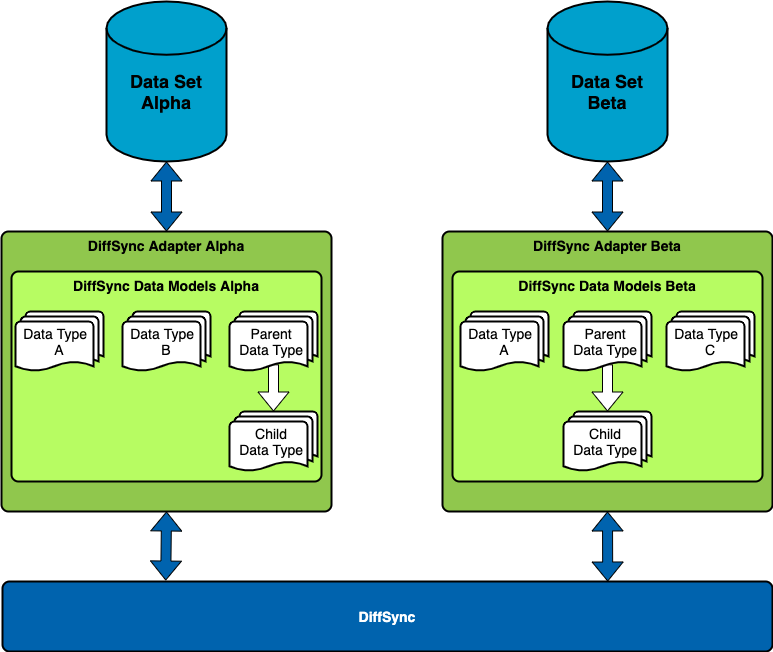
DiffSync acts as an intermediate translation layer between all of the data sets you are diffing and/or syncing. In practical terms, this means that to use DiffSync, you will define a set of data models as well as the “adapters” needed to translate between each base data source and the data model. In Python terms, the adapters will be subclasses of the `DiffSync` class, and each data model class will be a subclass of the `DiffSyncModel` class.
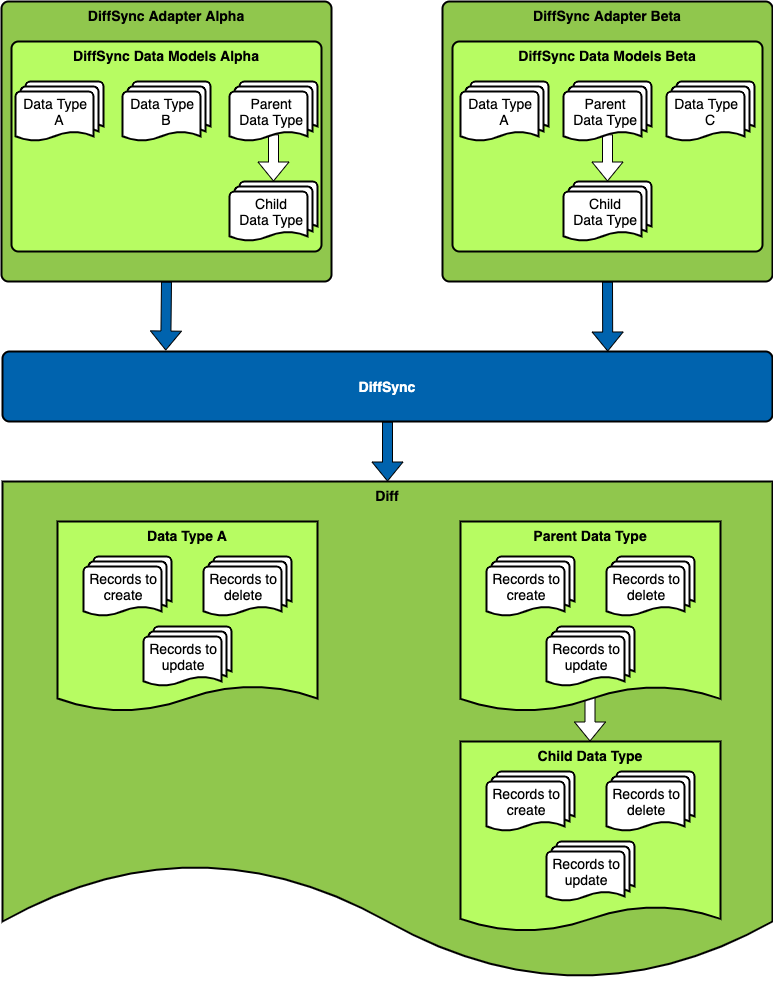
Once you have used each adapter to load each data source into a collection of data model records, you can then ask DiffSync to “diff” the two data sets, and it will produce a structured representation of the difference between them. In Python, this is accomplished by calling the `diff_to()` or `diff_from()` method on one adapter and passing the other adapter as a parameter.
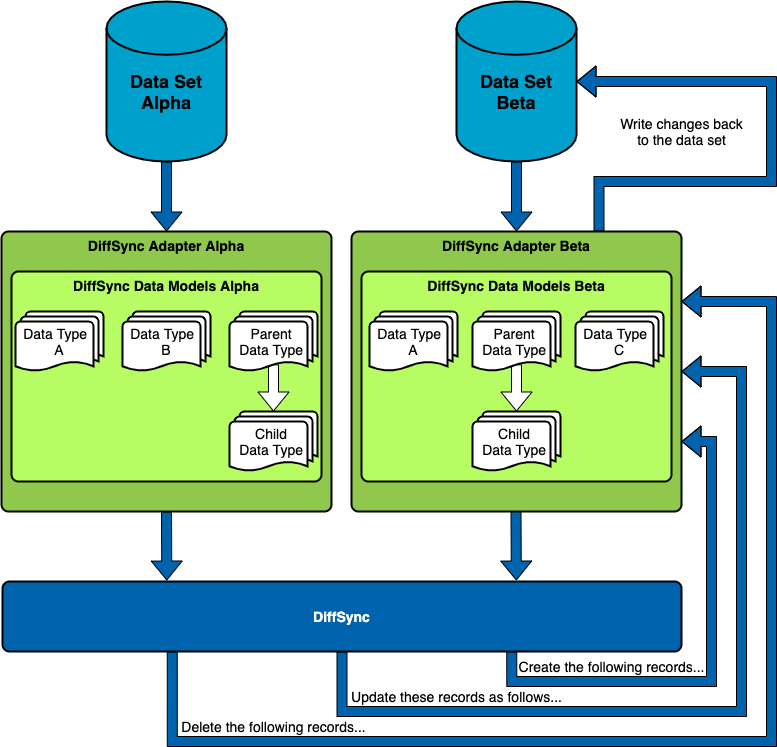
You can also ask DiffSync to “sync” one data set onto the other, and it will instruct your adapter as to the steps it needs to take to make sure that its data set accurately reflects the other. In Python, this is accomplished by calling the `sync_to()` or `sync_from()` method on one adapter and passing the other adapter as a parameter.
# Simple Example
```python
A = DiffSyncSystemA()
B = DiffSyncSystemB()
A.load()
B.load()
# Show the difference between both systems, that is, what would change if we applied changes from System B to System A
diff_a_b = A.diff_from(B)
print(diff_a_b.str())
# Update System A to align with the current status of system B
A.sync_from(B)
# Update System B to align with the current status of system A
A.sync_to(B)
```
> You may wish to peruse the `diffsync` [GitHub topic](https://github.com/topics/diffsync) for examples of projects using this library.
# Documentation
The documentation is available [on Read The Docs](https://diffsync.readthedocs.io/en/latest/index.html).
# Installation
### Option 1: Install from PyPI.
```
$ pip install diffsync
```
### Option 2: Install from a GitHub branch, such as main as shown below.
```
$ pip install git+https://github.com/networktocode/diffsync.git@main
```
# Contributing
Pull requests are welcomed and automatically built and tested against multiple versions of Python through GitHub Actions.
The project is following Network to Code software development guidelines and are leveraging the following:
- Black, Pylint, Bandit, flake8, and pydocstyle, mypy for Python linting, formatting and type hint checking.
- pytest, coverage, and unittest for unit tests.
You can ensure your contribution adheres to these checks by running `invoke tests` from the CLI.
The command `invoke build` builds a docker container with all the necessary dependencies (including the redis backend) locally to facilitate the execution of these tests.
# Questions
Please see the [documentation](https://diffsync.readthedocs.io/en/latest/index.html) for detailed documentation on how to use `diffsync`. For any additional questions or comments, feel free to swing by the [Network to Code slack channel](https://networktocode.slack.com/) (channel #networktocode). Sign up [here](http://slack.networktocode.com/)
%package -n python3-diffsync
Summary: Library to easily sync/diff/update 2 different data sources
Provides: python-diffsync
BuildRequires: python3-devel
BuildRequires: python3-setuptools
BuildRequires: python3-pip
%description -n python3-diffsync
# DiffSync
DiffSync is a utility library that can be used to compare and synchronize different datasets.
For example, it can be used to compare a list of devices from 2 inventory systems and, if required, synchronize them in either direction.
# Primary Use Cases
DiffSync is at its most useful when you have multiple sources or sets of data to compare and/or synchronize, and especially if any of the following are true:
- If you need to repeatedly compare or synchronize the data sets as one or both change over time.
- If you need to account for not only the creation of new records, but also changes to and deletion of existing records as well.
- If various types of data in your data set naturally form a tree-like or parent-child relationship with other data.
- If the different data sets have some attributes in common and other attributes that are exclusive to one or the other.
# Overview of DiffSync
DiffSync acts as an intermediate translation layer between all of the data sets you are diffing and/or syncing. In practical terms, this means that to use DiffSync, you will define a set of data models as well as the “adapters” needed to translate between each base data source and the data model. In Python terms, the adapters will be subclasses of the `DiffSync` class, and each data model class will be a subclass of the `DiffSyncModel` class.

Once you have used each adapter to load each data source into a collection of data model records, you can then ask DiffSync to “diff” the two data sets, and it will produce a structured representation of the difference between them. In Python, this is accomplished by calling the `diff_to()` or `diff_from()` method on one adapter and passing the other adapter as a parameter.

You can also ask DiffSync to “sync” one data set onto the other, and it will instruct your adapter as to the steps it needs to take to make sure that its data set accurately reflects the other. In Python, this is accomplished by calling the `sync_to()` or `sync_from()` method on one adapter and passing the other adapter as a parameter.

# Simple Example
```python
A = DiffSyncSystemA()
B = DiffSyncSystemB()
A.load()
B.load()
# Show the difference between both systems, that is, what would change if we applied changes from System B to System A
diff_a_b = A.diff_from(B)
print(diff_a_b.str())
# Update System A to align with the current status of system B
A.sync_from(B)
# Update System B to align with the current status of system A
A.sync_to(B)
```
> You may wish to peruse the `diffsync` [GitHub topic](https://github.com/topics/diffsync) for examples of projects using this library.
# Documentation
The documentation is available [on Read The Docs](https://diffsync.readthedocs.io/en/latest/index.html).
# Installation
### Option 1: Install from PyPI.
```
$ pip install diffsync
```
### Option 2: Install from a GitHub branch, such as main as shown below.
```
$ pip install git+https://github.com/networktocode/diffsync.git@main
```
# Contributing
Pull requests are welcomed and automatically built and tested against multiple versions of Python through GitHub Actions.
The project is following Network to Code software development guidelines and are leveraging the following:
- Black, Pylint, Bandit, flake8, and pydocstyle, mypy for Python linting, formatting and type hint checking.
- pytest, coverage, and unittest for unit tests.
You can ensure your contribution adheres to these checks by running `invoke tests` from the CLI.
The command `invoke build` builds a docker container with all the necessary dependencies (including the redis backend) locally to facilitate the execution of these tests.
# Questions
Please see the [documentation](https://diffsync.readthedocs.io/en/latest/index.html) for detailed documentation on how to use `diffsync`. For any additional questions or comments, feel free to swing by the [Network to Code slack channel](https://networktocode.slack.com/) (channel #networktocode). Sign up [here](http://slack.networktocode.com/)
%package help
Summary: Development documents and examples for diffsync
Provides: python3-diffsync-doc
%description help
# DiffSync
DiffSync is a utility library that can be used to compare and synchronize different datasets.
For example, it can be used to compare a list of devices from 2 inventory systems and, if required, synchronize them in either direction.
# Primary Use Cases
DiffSync is at its most useful when you have multiple sources or sets of data to compare and/or synchronize, and especially if any of the following are true:
- If you need to repeatedly compare or synchronize the data sets as one or both change over time.
- If you need to account for not only the creation of new records, but also changes to and deletion of existing records as well.
- If various types of data in your data set naturally form a tree-like or parent-child relationship with other data.
- If the different data sets have some attributes in common and other attributes that are exclusive to one or the other.
# Overview of DiffSync
DiffSync acts as an intermediate translation layer between all of the data sets you are diffing and/or syncing. In practical terms, this means that to use DiffSync, you will define a set of data models as well as the “adapters” needed to translate between each base data source and the data model. In Python terms, the adapters will be subclasses of the `DiffSync` class, and each data model class will be a subclass of the `DiffSyncModel` class.

Once you have used each adapter to load each data source into a collection of data model records, you can then ask DiffSync to “diff” the two data sets, and it will produce a structured representation of the difference between them. In Python, this is accomplished by calling the `diff_to()` or `diff_from()` method on one adapter and passing the other adapter as a parameter.

You can also ask DiffSync to “sync” one data set onto the other, and it will instruct your adapter as to the steps it needs to take to make sure that its data set accurately reflects the other. In Python, this is accomplished by calling the `sync_to()` or `sync_from()` method on one adapter and passing the other adapter as a parameter.

# Simple Example
```python
A = DiffSyncSystemA()
B = DiffSyncSystemB()
A.load()
B.load()
# Show the difference between both systems, that is, what would change if we applied changes from System B to System A
diff_a_b = A.diff_from(B)
print(diff_a_b.str())
# Update System A to align with the current status of system B
A.sync_from(B)
# Update System B to align with the current status of system A
A.sync_to(B)
```
> You may wish to peruse the `diffsync` [GitHub topic](https://github.com/topics/diffsync) for examples of projects using this library.
# Documentation
The documentation is available [on Read The Docs](https://diffsync.readthedocs.io/en/latest/index.html).
# Installation
### Option 1: Install from PyPI.
```
$ pip install diffsync
```
### Option 2: Install from a GitHub branch, such as main as shown below.
```
$ pip install git+https://github.com/networktocode/diffsync.git@main
```
# Contributing
Pull requests are welcomed and automatically built and tested against multiple versions of Python through GitHub Actions.
The project is following Network to Code software development guidelines and are leveraging the following:
- Black, Pylint, Bandit, flake8, and pydocstyle, mypy for Python linting, formatting and type hint checking.
- pytest, coverage, and unittest for unit tests.
You can ensure your contribution adheres to these checks by running `invoke tests` from the CLI.
The command `invoke build` builds a docker container with all the necessary dependencies (including the redis backend) locally to facilitate the execution of these tests.
# Questions
Please see the [documentation](https://diffsync.readthedocs.io/en/latest/index.html) for detailed documentation on how to use `diffsync`. For any additional questions or comments, feel free to swing by the [Network to Code slack channel](https://networktocode.slack.com/) (channel #networktocode). Sign up [here](http://slack.networktocode.com/)
%prep
%autosetup -n diffsync-1.8.0
%build
%py3_build
%install
%py3_install
install -d -m755 %{buildroot}/%{_pkgdocdir}
if [ -d doc ]; then cp -arf doc %{buildroot}/%{_pkgdocdir}; fi
if [ -d docs ]; then cp -arf docs %{buildroot}/%{_pkgdocdir}; fi
if [ -d example ]; then cp -arf example %{buildroot}/%{_pkgdocdir}; fi
if [ -d examples ]; then cp -arf examples %{buildroot}/%{_pkgdocdir}; fi
pushd %{buildroot}
if [ -d usr/lib ]; then
find usr/lib -type f -printf "/%h/%f\n" >> filelist.lst
fi
if [ -d usr/lib64 ]; then
find usr/lib64 -type f -printf "/%h/%f\n" >> filelist.lst
fi
if [ -d usr/bin ]; then
find usr/bin -type f -printf "/%h/%f\n" >> filelist.lst
fi
if [ -d usr/sbin ]; then
find usr/sbin -type f -printf "/%h/%f\n" >> filelist.lst
fi
touch doclist.lst
if [ -d usr/share/man ]; then
find usr/share/man -type f -printf "/%h/%f.gz\n" >> doclist.lst
fi
popd
mv %{buildroot}/filelist.lst .
mv %{buildroot}/doclist.lst .
%files -n python3-diffsync -f filelist.lst
%dir %{python3_sitelib}/*
%files help -f doclist.lst
%{_docdir}/*
%changelog
* Tue May 30 2023 Python_Bot <Python_Bot@openeuler.org> - 1.8.0-1
- Package Spec generated
|
