%global _empty_manifest_terminate_build 0
Name: python-empyrial
Version: 2.0.1
Release: 1
Summary: An Open Source Portfolio Management Framework for Everyone 投资组合管理
License: MIT
URL: https://github.com/ssantoshp/Empyrial
Source0: https://mirrors.nju.edu.cn/pypi/web/packages/0e/b1/18cfd6aff0494c7476da16f2163520a76a39b88dd89710679397800c8522/empyrial-2.0.1.tar.gz
BuildArch: noarch
Requires: python3-numpy
Requires: python3-matplotlib
Requires: python3-datetime
Requires: python3-empyrical
Requires: python3-quantstats
Requires: python3-yfinance
Requires: python3-ipython
Requires: python3-fpdf
Requires: python3-pyportfolioopt
%description
# By Investors, For Investors.







[](https://colab.research.google.com/drive/1NqTkkP2u1p1g8W8erU-Y-rSSVbPUDvq2?usp=sharing)
Empyrial is a Python-based **open-source quantitative investment** library dedicated to **financial institutions** and **retail investors**, officially released in March 2021. Already used by **thousands of people working in the finance industry**, Empyrial aims to become an all-in-one platform for **portfolio management**, **analysis**, and **optimization**.
Empyrial **empowers portfolio management** by bringing the best of **performance and risk analysis** in an **easy-to-understand**, **flexible** and **powerful framework**.
With Empyrial, you can easily analyze security or a portfolio in order to **get the best insights from it**.
| Table of Contents 📖 |
| --
| 1. [Installation](#installation) |
| 2. [Features](#features) |
| 3. [Documentation](#documentation) |
| 4. [Usage example](#usage) |
| 5. [Download the tearsheet](#download-the-tearsheet) |
| 6. [Contribution and Issues](#contribution-and-issues) |
| 7. [Contributors](#contributors) |
| 8. [Contact](#contact) |
| 9. [License](#license) |
## Installation
You can install Empyrial using pip:
```
pip install empyrial
```
For a better experience, **we advise you to use Empyrial on a notebook** (e.g., Jupyter, Google Colab)
_Note: macOS users will need to install [Xcode Command Line Tools](https://osxdaily.com/2014/02/12/install-command-line-tools-mac-os-x/)._
_Note: Windows users will need to install C++. ([download](https://visualstudio.microsoft.com/thank-you-downloading-visual-studio/?sku=BuildTools&rel=16), [install instructions](https://drive.google.com/file/d/0B4GsMXCRaSSIOWpYQkstajlYZ0tPVkNQSElmTWh1dXFaYkJr/view))_
## Features
| Feature 📰 | Status |
| -- | ------ |
| Engine (backtesting + performance analysis) | :star: [Released](https://github.com/ssantoshp/Empyrial/releases/tag/1.2.4) on May 30, 2021 |
| Optimizer | :star: [Released](https://github.com/ssantoshp/Empyrial/releases/tag/1.3.6) on Jun 7, 2021 |
| Rebalancing | :star: [Released](https://github.com/ssantoshp/Empyrial/releases/tag/1.5.0) on Jun 27, 2021 |
| Risk manager | :star: [Released](https://github.com/ssantoshp/Empyrial/releases/tag/v1.7.3) on Jul 5, 2021 |
| Sandbox | :star: [Released](https://github.com/ssantoshp/Empyrial/releases/tag/v1.9.1) on Jul 17, 2021 |
## Documentation
[Full documentation](https://empyrial.gitbook.io/empyrial/) (website)
[Full documentation](https://github.com/ssantoshp/Empyrial/blob/main/empyrial_documentation.pdf) (PDF)
## Usage
### Empyrial Engine
```py
from empyrial import empyrial, Engine
portfolio = Engine(
start_date = "2018-06-09",
portfolio = ["BABA", "PDD", "KO", "AMD","^IXIC"],
weights = [0.2, 0.2, 0.2, 0.2, 0.2], # equal weighting is set by default
benchmark = ["SPY"] # SPY is set by default
)
empyrial(portfolio)
```
### Calendar Rebalancing
A portfolio can be rebalanced for either a specific time period or for specific dates using the `rebalance` option.
#### Rebalance for Time Period
Time periods available for rebalancing are
`2y`, `1y`, `6mo`, `quarterly`, `monthly`
```py
from empyrial import empyrial, Engine
portfolio = Engine(
start_date = "2018-06-09",
portfolio = ["BABA", "PDD", "KO", "AMD","^IXIC"],
weights = [0.2, 0.2, 0.2, 0.2, 0.2], # equal weighting is set by default
benchmark = ["SPY"], # SPY is set by default
rebalance = "1y"
)
empyrial(portfolio)
```
#### Rebalance for Custom Dates
You can rebalance a portfolio by specifying a list of custom dates.
⚠️ When using custom dates, the first date of the list must correspond with the `start_date` and the last element should correspond to the `end_date` which is **today's date** by default.
```py
from empyrial import empyrial, Engine
portfolio = Engine(
start_date = "2018-06-09",
portfolio = ["BABA", "PDD", "KO", "AMD","^IXIC"],
weights = [0.2, 0.2, 0.2, 0.2, 0.2], # equal weighting is set by default
benchmark = ["SPY"], # SPY is set by default
rebalance = ["2018-06-09", "2019-01-01", "2020-01-01", "2021-01-01"]
)
empyrial(portfolio)
```
### Optimizer
The default optimizer is **equal weighting**. You can specify custom weights, if desired.
```py
from empyrial import empyrial, Engine
portfolio = Engine(
start_date = "2018-01-01",
portfolio = ["BABA", "PDD", "KO", "AMD","^IXIC"],
weights = [0.1, 0.3, 0.15, 0.25, 0.2], # custom weights
rebalance = "1y" # rebalance every year
)
empyrial(portfolio)
```
You can also use the **built-in optimizers**. There are 4 optimizers available:
- `"EF"`: **Global Efficient Frontier** [Example](https://empyrial.gitbook.io/empyrial/optimization/global-efficient-frontier)
- `"MEANVAR"`: **Mean-Variance** [Example](https://empyrial.gitbook.io/empyrial/optimization/mean-variance)
- `"HRP"`: **Hierarchical Risk Parity** [Example](https://empyrial.gitbook.io/empyrial/optimization/hierarchical-risk-parity)
- `"MINVAR"`: **Minimum-Variance** [Example](https://empyrial.gitbook.io/empyrial/optimization/minimum-variance)
```py
from empyrial import empyrial, Engine
portfolio = Engine(
start_date = "2018-01-01",
portfolio = ["BABA", "PDD", "KO", "AMD","^IXIC"],
optimizer = "EF",
rebalance = "1y" # rebalance every year
)
portfolio.weights
```
> Output:
```
[0.0, 0.0, 0.0348, 0.9652, 0.0]
```
We can see that the allocation has been optimized.
### Risk Manager
3 Risk Managers are available:
- **Max Drawdown**: `{"Max Drawdown" : -0.3}` [Example](https://empyrial.gitbook.io/empyrial/risk-management/max-drawdown)
- **Take Profit**: `{"Take Profit" : 0.4}` [Example](https://empyrial.gitbook.io/empyrial/risk-management/take-profit)
- **Stop Loss**: `{"Stop Loss" : -0.2}` [Example](https://empyrial.gitbook.io/empyrial/risk-management/stop-loss)
```py
from empyrial import empyrial, Engine
portfolio = Engine(
start_date = "2018-01-01",
portfolio= ["BABA", "PDD", "KO", "AMD","^IXIC"],
optimizer = "EF",
rebalance = "1y", # rebalance every year
risk_manager = {"Max Drawdown" : -0.2} # Stop the investment when the drawdown becomes superior to -20%
)
empyrial(portfolio)
```
### Empyrial Outputs


## Download the Tearsheet
You can use the `get_report()` function of Empyrial to generate a tearsheet, and then download this as a PDF document.
```py
from empyrial import get_report, Engine
portfolio = Engine(
start_date = "2018-01-01",
portfolio = ["BABA", "PDD", "KO", "AMD","^IXIC"],
optimizer = "EF",
rebalance = "1y", #rebalance every year
risk_manager = {"Stop Loss" : -0.2}
)
get_report(portfolio)
```
> Output:

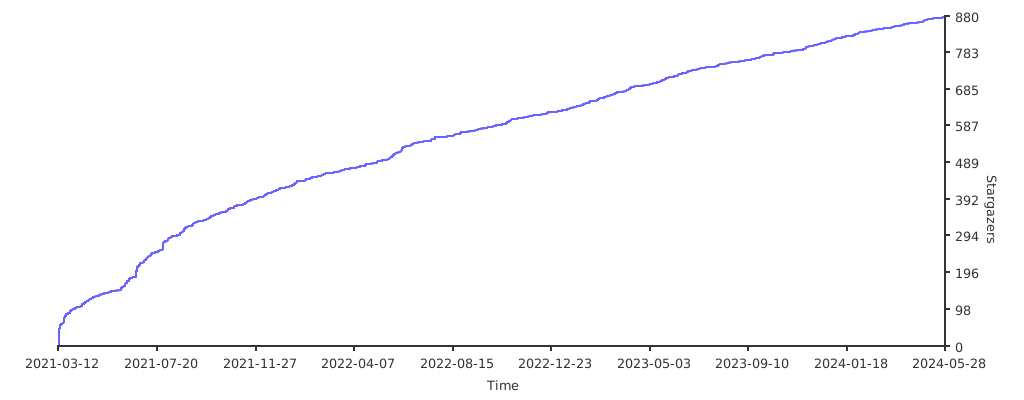
## Stargazers over time
## Contribution and Issues
Empyrial uses GitHub to host its source code. _Learn more about the [Github flow](https://docs.github.com/en/get-started/quickstart/github-flow)._
For larger changes (e.g., new feature request, large refactoring), please open an issue to discuss first.
- If you wish to create a new Issue, then [click here to create a new issue](https://github.com/ssantoshp/Empyrial/issues/new/choose).
Smaller improvements (e.g., document improvements, bugfixes) can be handled by the Pull Request process of GitHub: [pull requests](https://github.com/ssantoshp/Empyrial/pulls).
- To contribute to the code, you will need to do the following:
- [Fork](https://docs.github.com/en/get-started/quickstart/fork-a-repo#forking-a-repository) [Empyrial](https://github.com/ssantoshp/Empyrial) - Click the **Fork** button at the upper right corner of this page.
- [Clone your own fork](https://docs.github.com/en/get-started/quickstart/fork-a-repo#cloning-your-forked-repository). E.g., `git clone https://github.com/ssantoshp/Empyrial.git`
_If your fork is out of date, then will you need to manually sync your fork: [Synchronization method](https://help.github.com/articles/syncing-a-fork/)_
- [Create a Pull Request](https://github.com/ssantoshp/Empyrial/pulls) using **your fork** as the `compare head repository`.
You contributions will be reviewed, potentially modified, and hopefully merged into Empyrial.
## Contributors
Thanks goes to these wonderful people ([emoji key](https://allcontributors.org/docs/en/emoji-key)):
[](#contributors-)
This project follows the [all-contributors](https://github.com/all-contributors/all-contributors) specification. **Contributions of any kind are welcome!**
## Contact
You are welcome to contact us by email at **santoshpassoubady@gmail.com** or in Empyrial's [discussion space](https://github.com/ssantoshp/Empyrial/discussions)
## License
MIT
%package -n python3-empyrial
Summary: An Open Source Portfolio Management Framework for Everyone 投资组合管理
Provides: python-empyrial
BuildRequires: python3-devel
BuildRequires: python3-setuptools
BuildRequires: python3-pip
%description -n python3-empyrial
# By Investors, For Investors.






[](https://colab.research.google.com/drive/1NqTkkP2u1p1g8W8erU-Y-rSSVbPUDvq2?usp=sharing)
Empyrial is a Python-based **open-source quantitative investment** library dedicated to **financial institutions** and **retail investors**, officially released in March 2021. Already used by **thousands of people working in the finance industry**, Empyrial aims to become an all-in-one platform for **portfolio management**, **analysis**, and **optimization**.
Empyrial **empowers portfolio management** by bringing the best of **performance and risk analysis** in an **easy-to-understand**, **flexible** and **powerful framework**.
With Empyrial, you can easily analyze security or a portfolio in order to **get the best insights from it**.
| Table of Contents 📖 |
| --
| 1. [Installation](#installation) |
| 2. [Features](#features) |
| 3. [Documentation](#documentation) |
| 4. [Usage example](#usage) |
| 5. [Download the tearsheet](#download-the-tearsheet) |
| 6. [Contribution and Issues](#contribution-and-issues) |
| 7. [Contributors](#contributors) |
| 8. [Contact](#contact) |
| 9. [License](#license) |
## Installation
You can install Empyrial using pip:
```
pip install empyrial
```
For a better experience, **we advise you to use Empyrial on a notebook** (e.g., Jupyter, Google Colab)
_Note: macOS users will need to install [Xcode Command Line Tools](https://osxdaily.com/2014/02/12/install-command-line-tools-mac-os-x/)._
_Note: Windows users will need to install C++. ([download](https://visualstudio.microsoft.com/thank-you-downloading-visual-studio/?sku=BuildTools&rel=16), [install instructions](https://drive.google.com/file/d/0B4GsMXCRaSSIOWpYQkstajlYZ0tPVkNQSElmTWh1dXFaYkJr/view))_
## Features
| Feature 📰 | Status |
| -- | ------ |
| Engine (backtesting + performance analysis) | :star: [Released](https://github.com/ssantoshp/Empyrial/releases/tag/1.2.4) on May 30, 2021 |
| Optimizer | :star: [Released](https://github.com/ssantoshp/Empyrial/releases/tag/1.3.6) on Jun 7, 2021 |
| Rebalancing | :star: [Released](https://github.com/ssantoshp/Empyrial/releases/tag/1.5.0) on Jun 27, 2021 |
| Risk manager | :star: [Released](https://github.com/ssantoshp/Empyrial/releases/tag/v1.7.3) on Jul 5, 2021 |
| Sandbox | :star: [Released](https://github.com/ssantoshp/Empyrial/releases/tag/v1.9.1) on Jul 17, 2021 |
## Documentation
[Full documentation](https://empyrial.gitbook.io/empyrial/) (website)
[Full documentation](https://github.com/ssantoshp/Empyrial/blob/main/empyrial_documentation.pdf) (PDF)
## Usage
### Empyrial Engine
```py
from empyrial import empyrial, Engine
portfolio = Engine(
start_date = "2018-06-09",
portfolio = ["BABA", "PDD", "KO", "AMD","^IXIC"],
weights = [0.2, 0.2, 0.2, 0.2, 0.2], # equal weighting is set by default
benchmark = ["SPY"] # SPY is set by default
)
empyrial(portfolio)
```
### Calendar Rebalancing
A portfolio can be rebalanced for either a specific time period or for specific dates using the `rebalance` option.
#### Rebalance for Time Period
Time periods available for rebalancing are
`2y`, `1y`, `6mo`, `quarterly`, `monthly`
```py
from empyrial import empyrial, Engine
portfolio = Engine(
start_date = "2018-06-09",
portfolio = ["BABA", "PDD", "KO", "AMD","^IXIC"],
weights = [0.2, 0.2, 0.2, 0.2, 0.2], # equal weighting is set by default
benchmark = ["SPY"], # SPY is set by default
rebalance = "1y"
)
empyrial(portfolio)
```
#### Rebalance for Custom Dates
You can rebalance a portfolio by specifying a list of custom dates.
⚠️ When using custom dates, the first date of the list must correspond with the `start_date` and the last element should correspond to the `end_date` which is **today's date** by default.
```py
from empyrial import empyrial, Engine
portfolio = Engine(
start_date = "2018-06-09",
portfolio = ["BABA", "PDD", "KO", "AMD","^IXIC"],
weights = [0.2, 0.2, 0.2, 0.2, 0.2], # equal weighting is set by default
benchmark = ["SPY"], # SPY is set by default
rebalance = ["2018-06-09", "2019-01-01", "2020-01-01", "2021-01-01"]
)
empyrial(portfolio)
```
### Optimizer
The default optimizer is **equal weighting**. You can specify custom weights, if desired.
```py
from empyrial import empyrial, Engine
portfolio = Engine(
start_date = "2018-01-01",
portfolio = ["BABA", "PDD", "KO", "AMD","^IXIC"],
weights = [0.1, 0.3, 0.15, 0.25, 0.2], # custom weights
rebalance = "1y" # rebalance every year
)
empyrial(portfolio)
```
You can also use the **built-in optimizers**. There are 4 optimizers available:
- `"EF"`: **Global Efficient Frontier** [Example](https://empyrial.gitbook.io/empyrial/optimization/global-efficient-frontier)
- `"MEANVAR"`: **Mean-Variance** [Example](https://empyrial.gitbook.io/empyrial/optimization/mean-variance)
- `"HRP"`: **Hierarchical Risk Parity** [Example](https://empyrial.gitbook.io/empyrial/optimization/hierarchical-risk-parity)
- `"MINVAR"`: **Minimum-Variance** [Example](https://empyrial.gitbook.io/empyrial/optimization/minimum-variance)
```py
from empyrial import empyrial, Engine
portfolio = Engine(
start_date = "2018-01-01",
portfolio = ["BABA", "PDD", "KO", "AMD","^IXIC"],
optimizer = "EF",
rebalance = "1y" # rebalance every year
)
portfolio.weights
```
> Output:
```
[0.0, 0.0, 0.0348, 0.9652, 0.0]
```
We can see that the allocation has been optimized.
### Risk Manager
3 Risk Managers are available:
- **Max Drawdown**: `{"Max Drawdown" : -0.3}` [Example](https://empyrial.gitbook.io/empyrial/risk-management/max-drawdown)
- **Take Profit**: `{"Take Profit" : 0.4}` [Example](https://empyrial.gitbook.io/empyrial/risk-management/take-profit)
- **Stop Loss**: `{"Stop Loss" : -0.2}` [Example](https://empyrial.gitbook.io/empyrial/risk-management/stop-loss)
```py
from empyrial import empyrial, Engine
portfolio = Engine(
start_date = "2018-01-01",
portfolio= ["BABA", "PDD", "KO", "AMD","^IXIC"],
optimizer = "EF",
rebalance = "1y", # rebalance every year
risk_manager = {"Max Drawdown" : -0.2} # Stop the investment when the drawdown becomes superior to -20%
)
empyrial(portfolio)
```
### Empyrial Outputs


## Download the Tearsheet
You can use the `get_report()` function of Empyrial to generate a tearsheet, and then download this as a PDF document.
```py
from empyrial import get_report, Engine
portfolio = Engine(
start_date = "2018-01-01",
portfolio = ["BABA", "PDD", "KO", "AMD","^IXIC"],
optimizer = "EF",
rebalance = "1y", #rebalance every year
risk_manager = {"Stop Loss" : -0.2}
)
get_report(portfolio)
```
> Output:

## Stargazers over time

## Contribution and Issues
Empyrial uses GitHub to host its source code. _Learn more about the [Github flow](https://docs.github.com/en/get-started/quickstart/github-flow)._
For larger changes (e.g., new feature request, large refactoring), please open an issue to discuss first.
- If you wish to create a new Issue, then [click here to create a new issue](https://github.com/ssantoshp/Empyrial/issues/new/choose).
Smaller improvements (e.g., document improvements, bugfixes) can be handled by the Pull Request process of GitHub: [pull requests](https://github.com/ssantoshp/Empyrial/pulls).
- To contribute to the code, you will need to do the following:
- [Fork](https://docs.github.com/en/get-started/quickstart/fork-a-repo#forking-a-repository) [Empyrial](https://github.com/ssantoshp/Empyrial) - Click the **Fork** button at the upper right corner of this page.
- [Clone your own fork](https://docs.github.com/en/get-started/quickstart/fork-a-repo#cloning-your-forked-repository). E.g., `git clone https://github.com/ssantoshp/Empyrial.git`
_If your fork is out of date, then will you need to manually sync your fork: [Synchronization method](https://help.github.com/articles/syncing-a-fork/)_
- [Create a Pull Request](https://github.com/ssantoshp/Empyrial/pulls) using **your fork** as the `compare head repository`.
You contributions will be reviewed, potentially modified, and hopefully merged into Empyrial.
## Contributors
Thanks goes to these wonderful people ([emoji key](https://allcontributors.org/docs/en/emoji-key)):
[](#contributors-)
This project follows the [all-contributors](https://github.com/all-contributors/all-contributors) specification. **Contributions of any kind are welcome!**
## Contact
You are welcome to contact us by email at **santoshpassoubady@gmail.com** or in Empyrial's [discussion space](https://github.com/ssantoshp/Empyrial/discussions)
## License
MIT
%package help
Summary: Development documents and examples for empyrial
Provides: python3-empyrial-doc
%description help
# By Investors, For Investors.






[](https://colab.research.google.com/drive/1NqTkkP2u1p1g8W8erU-Y-rSSVbPUDvq2?usp=sharing)
Empyrial is a Python-based **open-source quantitative investment** library dedicated to **financial institutions** and **retail investors**, officially released in March 2021. Already used by **thousands of people working in the finance industry**, Empyrial aims to become an all-in-one platform for **portfolio management**, **analysis**, and **optimization**.
Empyrial **empowers portfolio management** by bringing the best of **performance and risk analysis** in an **easy-to-understand**, **flexible** and **powerful framework**.
With Empyrial, you can easily analyze security or a portfolio in order to **get the best insights from it**.
| Table of Contents 📖 |
| --
| 1. [Installation](#installation) |
| 2. [Features](#features) |
| 3. [Documentation](#documentation) |
| 4. [Usage example](#usage) |
| 5. [Download the tearsheet](#download-the-tearsheet) |
| 6. [Contribution and Issues](#contribution-and-issues) |
| 7. [Contributors](#contributors) |
| 8. [Contact](#contact) |
| 9. [License](#license) |
## Installation
You can install Empyrial using pip:
```
pip install empyrial
```
For a better experience, **we advise you to use Empyrial on a notebook** (e.g., Jupyter, Google Colab)
_Note: macOS users will need to install [Xcode Command Line Tools](https://osxdaily.com/2014/02/12/install-command-line-tools-mac-os-x/)._
_Note: Windows users will need to install C++. ([download](https://visualstudio.microsoft.com/thank-you-downloading-visual-studio/?sku=BuildTools&rel=16), [install instructions](https://drive.google.com/file/d/0B4GsMXCRaSSIOWpYQkstajlYZ0tPVkNQSElmTWh1dXFaYkJr/view))_
## Features
| Feature 📰 | Status |
| -- | ------ |
| Engine (backtesting + performance analysis) | :star: [Released](https://github.com/ssantoshp/Empyrial/releases/tag/1.2.4) on May 30, 2021 |
| Optimizer | :star: [Released](https://github.com/ssantoshp/Empyrial/releases/tag/1.3.6) on Jun 7, 2021 |
| Rebalancing | :star: [Released](https://github.com/ssantoshp/Empyrial/releases/tag/1.5.0) on Jun 27, 2021 |
| Risk manager | :star: [Released](https://github.com/ssantoshp/Empyrial/releases/tag/v1.7.3) on Jul 5, 2021 |
| Sandbox | :star: [Released](https://github.com/ssantoshp/Empyrial/releases/tag/v1.9.1) on Jul 17, 2021 |
## Documentation
[Full documentation](https://empyrial.gitbook.io/empyrial/) (website)
[Full documentation](https://github.com/ssantoshp/Empyrial/blob/main/empyrial_documentation.pdf) (PDF)
## Usage
### Empyrial Engine
```py
from empyrial import empyrial, Engine
portfolio = Engine(
start_date = "2018-06-09",
portfolio = ["BABA", "PDD", "KO", "AMD","^IXIC"],
weights = [0.2, 0.2, 0.2, 0.2, 0.2], # equal weighting is set by default
benchmark = ["SPY"] # SPY is set by default
)
empyrial(portfolio)
```
### Calendar Rebalancing
A portfolio can be rebalanced for either a specific time period or for specific dates using the `rebalance` option.
#### Rebalance for Time Period
Time periods available for rebalancing are
`2y`, `1y`, `6mo`, `quarterly`, `monthly`
```py
from empyrial import empyrial, Engine
portfolio = Engine(
start_date = "2018-06-09",
portfolio = ["BABA", "PDD", "KO", "AMD","^IXIC"],
weights = [0.2, 0.2, 0.2, 0.2, 0.2], # equal weighting is set by default
benchmark = ["SPY"], # SPY is set by default
rebalance = "1y"
)
empyrial(portfolio)
```
#### Rebalance for Custom Dates
You can rebalance a portfolio by specifying a list of custom dates.
⚠️ When using custom dates, the first date of the list must correspond with the `start_date` and the last element should correspond to the `end_date` which is **today's date** by default.
```py
from empyrial import empyrial, Engine
portfolio = Engine(
start_date = "2018-06-09",
portfolio = ["BABA", "PDD", "KO", "AMD","^IXIC"],
weights = [0.2, 0.2, 0.2, 0.2, 0.2], # equal weighting is set by default
benchmark = ["SPY"], # SPY is set by default
rebalance = ["2018-06-09", "2019-01-01", "2020-01-01", "2021-01-01"]
)
empyrial(portfolio)
```
### Optimizer
The default optimizer is **equal weighting**. You can specify custom weights, if desired.
```py
from empyrial import empyrial, Engine
portfolio = Engine(
start_date = "2018-01-01",
portfolio = ["BABA", "PDD", "KO", "AMD","^IXIC"],
weights = [0.1, 0.3, 0.15, 0.25, 0.2], # custom weights
rebalance = "1y" # rebalance every year
)
empyrial(portfolio)
```
You can also use the **built-in optimizers**. There are 4 optimizers available:
- `"EF"`: **Global Efficient Frontier** [Example](https://empyrial.gitbook.io/empyrial/optimization/global-efficient-frontier)
- `"MEANVAR"`: **Mean-Variance** [Example](https://empyrial.gitbook.io/empyrial/optimization/mean-variance)
- `"HRP"`: **Hierarchical Risk Parity** [Example](https://empyrial.gitbook.io/empyrial/optimization/hierarchical-risk-parity)
- `"MINVAR"`: **Minimum-Variance** [Example](https://empyrial.gitbook.io/empyrial/optimization/minimum-variance)
```py
from empyrial import empyrial, Engine
portfolio = Engine(
start_date = "2018-01-01",
portfolio = ["BABA", "PDD", "KO", "AMD","^IXIC"],
optimizer = "EF",
rebalance = "1y" # rebalance every year
)
portfolio.weights
```
> Output:
```
[0.0, 0.0, 0.0348, 0.9652, 0.0]
```
We can see that the allocation has been optimized.
### Risk Manager
3 Risk Managers are available:
- **Max Drawdown**: `{"Max Drawdown" : -0.3}` [Example](https://empyrial.gitbook.io/empyrial/risk-management/max-drawdown)
- **Take Profit**: `{"Take Profit" : 0.4}` [Example](https://empyrial.gitbook.io/empyrial/risk-management/take-profit)
- **Stop Loss**: `{"Stop Loss" : -0.2}` [Example](https://empyrial.gitbook.io/empyrial/risk-management/stop-loss)
```py
from empyrial import empyrial, Engine
portfolio = Engine(
start_date = "2018-01-01",
portfolio= ["BABA", "PDD", "KO", "AMD","^IXIC"],
optimizer = "EF",
rebalance = "1y", # rebalance every year
risk_manager = {"Max Drawdown" : -0.2} # Stop the investment when the drawdown becomes superior to -20%
)
empyrial(portfolio)
```
### Empyrial Outputs


## Download the Tearsheet
You can use the `get_report()` function of Empyrial to generate a tearsheet, and then download this as a PDF document.
```py
from empyrial import get_report, Engine
portfolio = Engine(
start_date = "2018-01-01",
portfolio = ["BABA", "PDD", "KO", "AMD","^IXIC"],
optimizer = "EF",
rebalance = "1y", #rebalance every year
risk_manager = {"Stop Loss" : -0.2}
)
get_report(portfolio)
```
> Output:

## Stargazers over time

## Contribution and Issues
Empyrial uses GitHub to host its source code. _Learn more about the [Github flow](https://docs.github.com/en/get-started/quickstart/github-flow)._
For larger changes (e.g., new feature request, large refactoring), please open an issue to discuss first.
- If you wish to create a new Issue, then [click here to create a new issue](https://github.com/ssantoshp/Empyrial/issues/new/choose).
Smaller improvements (e.g., document improvements, bugfixes) can be handled by the Pull Request process of GitHub: [pull requests](https://github.com/ssantoshp/Empyrial/pulls).
- To contribute to the code, you will need to do the following:
- [Fork](https://docs.github.com/en/get-started/quickstart/fork-a-repo#forking-a-repository) [Empyrial](https://github.com/ssantoshp/Empyrial) - Click the **Fork** button at the upper right corner of this page.
- [Clone your own fork](https://docs.github.com/en/get-started/quickstart/fork-a-repo#cloning-your-forked-repository). E.g., `git clone https://github.com/ssantoshp/Empyrial.git`
_If your fork is out of date, then will you need to manually sync your fork: [Synchronization method](https://help.github.com/articles/syncing-a-fork/)_
- [Create a Pull Request](https://github.com/ssantoshp/Empyrial/pulls) using **your fork** as the `compare head repository`.
You contributions will be reviewed, potentially modified, and hopefully merged into Empyrial.
## Contributors
Thanks goes to these wonderful people ([emoji key](https://allcontributors.org/docs/en/emoji-key)):
[](#contributors-)
This project follows the [all-contributors](https://github.com/all-contributors/all-contributors) specification. **Contributions of any kind are welcome!**
## Contact
You are welcome to contact us by email at **santoshpassoubady@gmail.com** or in Empyrial's [discussion space](https://github.com/ssantoshp/Empyrial/discussions)
## License
MIT
%prep
%autosetup -n empyrial-2.0.1
%build
%py3_build
%install
%py3_install
install -d -m755 %{buildroot}/%{_pkgdocdir}
if [ -d doc ]; then cp -arf doc %{buildroot}/%{_pkgdocdir}; fi
if [ -d docs ]; then cp -arf docs %{buildroot}/%{_pkgdocdir}; fi
if [ -d example ]; then cp -arf example %{buildroot}/%{_pkgdocdir}; fi
if [ -d examples ]; then cp -arf examples %{buildroot}/%{_pkgdocdir}; fi
pushd %{buildroot}
if [ -d usr/lib ]; then
find usr/lib -type f -printf "/%h/%f\n" >> filelist.lst
fi
if [ -d usr/lib64 ]; then
find usr/lib64 -type f -printf "/%h/%f\n" >> filelist.lst
fi
if [ -d usr/bin ]; then
find usr/bin -type f -printf "/%h/%f\n" >> filelist.lst
fi
if [ -d usr/sbin ]; then
find usr/sbin -type f -printf "/%h/%f\n" >> filelist.lst
fi
touch doclist.lst
if [ -d usr/share/man ]; then
find usr/share/man -type f -printf "/%h/%f.gz\n" >> doclist.lst
fi
popd
mv %{buildroot}/filelist.lst .
mv %{buildroot}/doclist.lst .
%files -n python3-empyrial -f filelist.lst
%dir %{python3_sitelib}/*
%files help -f doclist.lst
%{_docdir}/*
%changelog
* Fri May 05 2023 Python_Bot - 2.0.1-1
- Package Spec generated