
diff options
Diffstat (limited to 'python-optuna.spec')
| -rw-r--r-- | python-optuna.spec | 654 |
1 files changed, 654 insertions, 0 deletions
diff --git a/python-optuna.spec b/python-optuna.spec new file mode 100644 index 0000000..25f22f0 --- /dev/null +++ b/python-optuna.spec @@ -0,0 +1,654 @@ +%global _empty_manifest_terminate_build 0 +Name: python-optuna +Version: 3.1.1 +Release: 1 +Summary: A hyperparameter optimization framework +License: MIT License +URL: https://optuna.org/ +Source0: https://mirrors.nju.edu.cn/pypi/web/packages/bc/7a/71669cf69272c09f3a918a9e0367f4d9c4455348448dc268d5fdd0a2d319/optuna-3.1.1.tar.gz +BuildArch: noarch + +Requires: python3-alembic +Requires: python3-cmaes +Requires: python3-colorlog +Requires: python3-numpy +Requires: python3-packaging +Requires: python3-sqlalchemy +Requires: python3-tqdm +Requires: python3-PyYAML +Requires: python3-asv +Requires: python3-botorch +Requires: python3-cma +Requires: python3-scikit-optimize +Requires: python3-virtualenv +Requires: python3-black +Requires: python3-blackdoc +Requires: python3-hacking +Requires: python3-isort +Requires: python3-mypy +Requires: python3-types-PyYAML +Requires: python3-types-redis +Requires: python3-types-setuptools +Requires: python3-typing-extensions +Requires: python3-cma +Requires: python3-distributed +Requires: python3-fvcore +Requires: python3-lightgbm +Requires: python3-matplotlib +Requires: python3-mlflow +Requires: python3-pandas +Requires: python3-pillow +Requires: python3-plotly +Requires: python3-scikit-learn +Requires: python3-scikit-optimize +Requires: python3-sphinx +Requires: python3-sphinx-copybutton +Requires: python3-sphinx-gallery +Requires: python3-sphinx-plotly-directive +Requires: python3-sphinx-rtd-theme +Requires: python3-torch +Requires: python3-torchaudio +Requires: python3-torchvision +Requires: python3-chainer +Requires: python3-cma +Requires: python3-distributed +Requires: python3-mpi4py +Requires: python3-pandas +Requires: python3-scikit-learn +Requires: python3-wandb +Requires: python3-xgboost +Requires: python3-allennlp +Requires: python3-cached-path +Requires: python3-botorch +Requires: python3-catalyst +Requires: python3-catboost +Requires: python3-fastai +Requires: python3-lightgbm +Requires: python3-mlflow +Requires: python3-mxnet +Requires: python3-pytorch-ignite +Requires: python3-pytorch-lightning +Requires: python3-scikit-optimize +Requires: python3-shap +Requires: python3-skorch +Requires: python3-tensorflow +Requires: python3-tensorflow-datasets +Requires: python3-torch +Requires: python3-torchaudio +Requires: python3-torchvision +Requires: python3-matplotlib +Requires: python3-pandas +Requires: python3-plotly +Requires: python3-redis +Requires: python3-scikit-learn +Requires: python3-codecov +Requires: python3-fakeredis[lua] +Requires: python3-kaleido +Requires: python3-pytest +Requires: python3-scipy + +%description +<div align="center"><img src="https://raw.githubusercontent.com/optuna/optuna/master/docs/image/optuna-logo.png" width="800"/></div> + +# Optuna: A hyperparameter optimization framework + +[](https://www.python.org) +[](https://pypi.python.org/pypi/optuna) +[](https://anaconda.org/conda-forge/optuna) +[](https://github.com/optuna/optuna) +[](https://optuna.readthedocs.io/en/stable/) +[](https://codecov.io/gh/optuna/optuna/branch/master) + +[**Website**](https://optuna.org/) +| [**Docs**](https://optuna.readthedocs.io/en/stable/) +| [**Install Guide**](https://optuna.readthedocs.io/en/stable/installation.html) +| [**Tutorial**](https://optuna.readthedocs.io/en/stable/tutorial/index.html) +| [**Examples**](https://github.com/optuna/optuna-examples) + +*Optuna* is an automatic hyperparameter optimization software framework, particularly designed +for machine learning. It features an imperative, *define-by-run* style user API. Thanks to our +*define-by-run* API, the code written with Optuna enjoys high modularity, and the user of +Optuna can dynamically construct the search spaces for the hyperparameters. + +## Key Features + +Optuna has modern functionalities as follows: + +- [Lightweight, versatile, and platform agnostic architecture](https://optuna.readthedocs.io/en/stable/tutorial/10_key_features/001_first.html) + - Handle a wide variety of tasks with a simple installation that has few requirements. +- [Pythonic search spaces](https://optuna.readthedocs.io/en/stable/tutorial/10_key_features/002_configurations.html) + - Define search spaces using familiar Python syntax including conditionals and loops. +- [Efficient optimization algorithms](https://optuna.readthedocs.io/en/stable/tutorial/10_key_features/003_efficient_optimization_algorithms.html) + - Adopt state-of-the-art algorithms for sampling hyperparameters and efficiently pruning unpromising trials. +- [Easy parallelization](https://optuna.readthedocs.io/en/stable/tutorial/10_key_features/004_distributed.html) + - Scale studies to tens or hundreds or workers with little or no changes to the code. +- [Quick visualization](https://optuna.readthedocs.io/en/stable/tutorial/10_key_features/005_visualization.html) + - Inspect optimization histories from a variety of plotting functions. + + +## Basic Concepts + +We use the terms *study* and *trial* as follows: + +- Study: optimization based on an objective function +- Trial: a single execution of the objective function + +Please refer to sample code below. The goal of a *study* is to find out the optimal set of +hyperparameter values (e.g., `regressor` and `svr_c`) through multiple *trials* (e.g., +`n_trials=100`). Optuna is a framework designed for the automation and the acceleration of the +optimization *studies*. + +[](http://colab.research.google.com/github/optuna/optuna-examples/blob/main/quickstart.ipynb) + +```python +import ... + +# Define an objective function to be minimized. +def objective(trial): + + # Invoke suggest methods of a Trial object to generate hyperparameters. + regressor_name = trial.suggest_categorical('regressor', ['SVR', 'RandomForest']) + if regressor_name == 'SVR': + svr_c = trial.suggest_float('svr_c', 1e-10, 1e10, log=True) + regressor_obj = sklearn.svm.SVR(C=svr_c) + else: + rf_max_depth = trial.suggest_int('rf_max_depth', 2, 32) + regressor_obj = sklearn.ensemble.RandomForestRegressor(max_depth=rf_max_depth) + + X, y = sklearn.datasets.fetch_california_housing(return_X_y=True) + X_train, X_val, y_train, y_val = sklearn.model_selection.train_test_split(X, y, random_state=0) + + regressor_obj.fit(X_train, y_train) + y_pred = regressor_obj.predict(X_val) + + error = sklearn.metrics.mean_squared_error(y_val, y_pred) + + return error # An objective value linked with the Trial object. + +study = optuna.create_study() # Create a new study. +study.optimize(objective, n_trials=100) # Invoke optimization of the objective function. +``` + +## Examples + +Examples can be found in [optuna/optuna-examples](https://github.com/optuna/optuna-examples). + +## Integrations + +[Integrations modules](https://optuna.readthedocs.io/en/stable/tutorial/10_key_features/003_efficient_optimization_algorithms.html#integration-modules-for-pruning), which allow pruning, or early stopping, of unpromising trials are available for the following libraries: + +* [AllenNLP](https://github.com/optuna/optuna-examples/tree/main/allennlp) +* [Catalyst](https://github.com/optuna/optuna-examples/tree/main/pytorch/catalyst_simple.py) +* [Catboost](https://github.com/optuna/optuna-examples/tree/main/catboost/catboost_pruning.py) +* [Chainer](https://github.com/optuna/optuna-examples/tree/main/chainer/chainer_integration.py) +* FastAI ([V1](https://github.com/optuna/optuna-examples/tree/main/fastai/fastaiv1_simple.py), [V2](https://github.com/optuna/optuna-examples/tree/main/fastai/fastaiv2_simple.py)) +* [Keras](https://github.com/optuna/optuna-examples/tree/main/keras/keras_integration.py) +* [LightGBM](https://github.com/optuna/optuna-examples/tree/main/lightgbm/lightgbm_integration.py) +* [MXNet](https://github.com/optuna/optuna-examples/tree/main/mxnet/mxnet_integration.py) +* [PyTorch](https://github.com/optuna/optuna-examples/tree/main/pytorch/pytorch_simple.py) +* [PyTorch Ignite](https://github.com/optuna/optuna-examples/tree/main/pytorch/pytorch_ignite_simple.py) +* [PyTorch Lightning](https://github.com/optuna/optuna-examples/tree/main/pytorch/pytorch_lightning_simple.py) +* [TensorFlow](https://github.com/optuna/optuna-examples/tree/main/tensorflow/tensorflow_estimator_integration.py) +* [tf.keras](https://github.com/optuna/optuna-examples/tree/main/tfkeras/tfkeras_integration.py) +* [XGBoost](https://github.com/optuna/optuna-examples/tree/main/xgboost/xgboost_integration.py) + + +## Web Dashboard + +[Optuna Dashboard](https://github.com/optuna/optuna-dashboard) is a real-time web dashboard for Optuna. +You can check the optimization history, hyperparameter importances, etc. in graphs and tables. +You don't need to create a Python script to call [Optuna's visualization](https://optuna.readthedocs.io/en/stable/reference/visualization/index.html) functions. +Feature requests and bug reports welcome! + +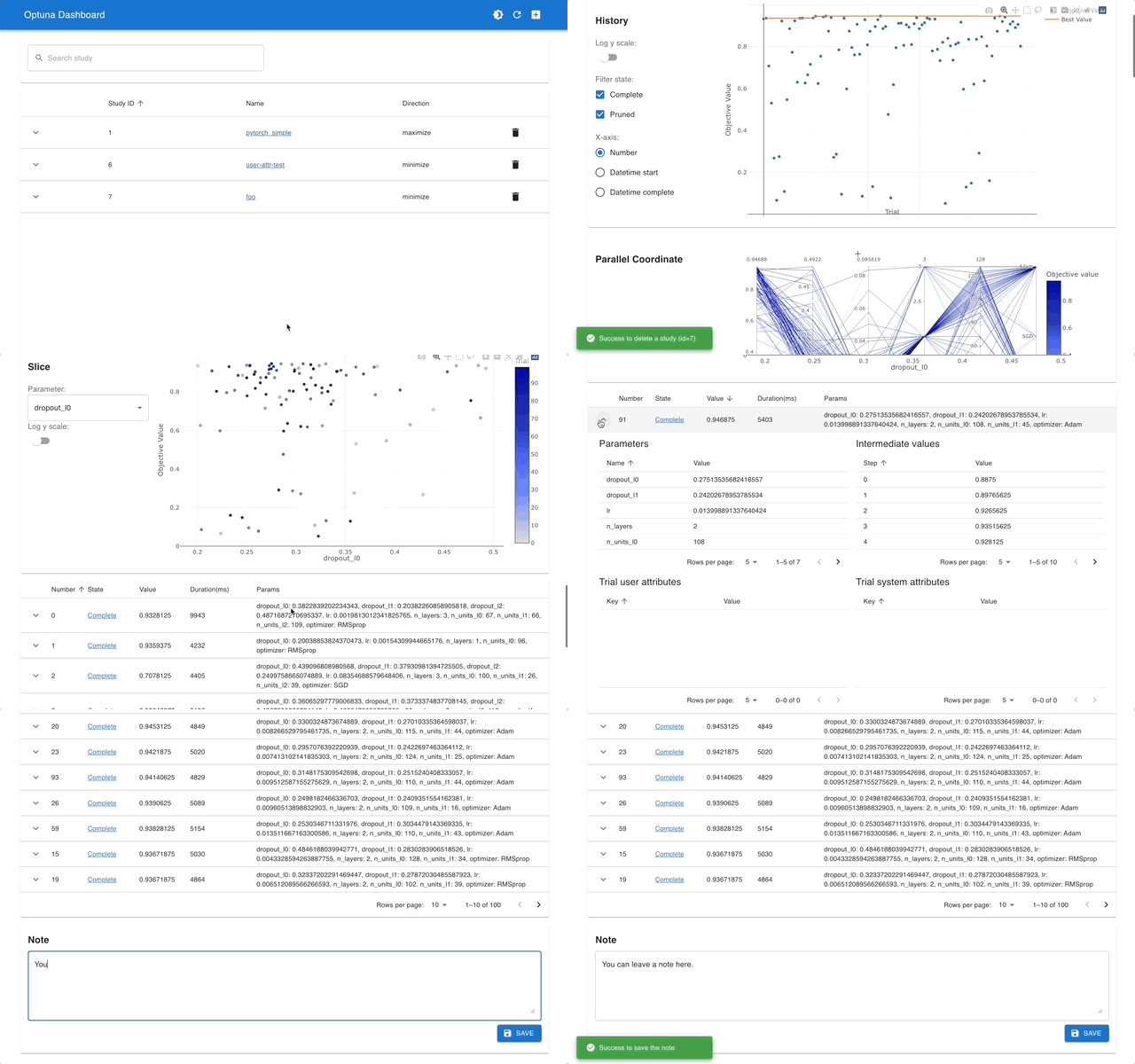 + +Install `optuna-dashboard` via pip: + +``` +$ pip install optuna-dashboard +$ optuna-dashboard sqlite:///db.sqlite3 +... +Listening on http://localhost:8080/ +Hit Ctrl-C to quit. +``` + +## Installation + +Optuna is available at [the Python Package Index](https://pypi.org/project/optuna/) and on [Anaconda Cloud](https://anaconda.org/conda-forge/optuna). + +```bash +# PyPI +$ pip install optuna +``` + +```bash +# Anaconda Cloud +$ conda install -c conda-forge optuna +``` + +Optuna supports Python 3.7 or newer. + +Also, we also provide Optuna docker images on [DockerHub](https://hub.docker.com/r/optuna/optuna). + +## Communication + +- [GitHub Discussions] for questions. +- [GitHub Issues] for bug reports and feature requests. + +[GitHub Discussions]: https://github.com/optuna/optuna/discussions +[GitHub issues]: https://github.com/optuna/optuna/issues + + +## Contribution + +Any contributions to Optuna are more than welcome! + +If you are new to Optuna, please check the [good first issues](https://github.com/optuna/optuna/labels/good%20first%20issue). They are relatively simple, well-defined and are often good starting points for you to get familiar with the contribution workflow and other developers. + +If you already have contributed to Optuna, we recommend the other [contribution-welcome issues](https://github.com/optuna/optuna/labels/contribution-welcome). + +For general guidelines how to contribute to the project, take a look at [CONTRIBUTING.md](./CONTRIBUTING.md). + + +## Reference + +Takuya Akiba, Shotaro Sano, Toshihiko Yanase, Takeru Ohta, and Masanori Koyama. 2019. +Optuna: A Next-generation Hyperparameter Optimization Framework. In KDD ([arXiv](https://arxiv.org/abs/1907.10902)). + + + + +%package -n python3-optuna +Summary: A hyperparameter optimization framework +Provides: python-optuna +BuildRequires: python3-devel +BuildRequires: python3-setuptools +BuildRequires: python3-pip +%description -n python3-optuna +<div align="center"><img src="https://raw.githubusercontent.com/optuna/optuna/master/docs/image/optuna-logo.png" width="800"/></div> + +# Optuna: A hyperparameter optimization framework + +[](https://www.python.org) +[](https://pypi.python.org/pypi/optuna) +[](https://anaconda.org/conda-forge/optuna) +[](https://github.com/optuna/optuna) +[](https://optuna.readthedocs.io/en/stable/) +[](https://codecov.io/gh/optuna/optuna/branch/master) + +[**Website**](https://optuna.org/) +| [**Docs**](https://optuna.readthedocs.io/en/stable/) +| [**Install Guide**](https://optuna.readthedocs.io/en/stable/installation.html) +| [**Tutorial**](https://optuna.readthedocs.io/en/stable/tutorial/index.html) +| [**Examples**](https://github.com/optuna/optuna-examples) + +*Optuna* is an automatic hyperparameter optimization software framework, particularly designed +for machine learning. It features an imperative, *define-by-run* style user API. Thanks to our +*define-by-run* API, the code written with Optuna enjoys high modularity, and the user of +Optuna can dynamically construct the search spaces for the hyperparameters. + +## Key Features + +Optuna has modern functionalities as follows: + +- [Lightweight, versatile, and platform agnostic architecture](https://optuna.readthedocs.io/en/stable/tutorial/10_key_features/001_first.html) + - Handle a wide variety of tasks with a simple installation that has few requirements. +- [Pythonic search spaces](https://optuna.readthedocs.io/en/stable/tutorial/10_key_features/002_configurations.html) + - Define search spaces using familiar Python syntax including conditionals and loops. +- [Efficient optimization algorithms](https://optuna.readthedocs.io/en/stable/tutorial/10_key_features/003_efficient_optimization_algorithms.html) + - Adopt state-of-the-art algorithms for sampling hyperparameters and efficiently pruning unpromising trials. +- [Easy parallelization](https://optuna.readthedocs.io/en/stable/tutorial/10_key_features/004_distributed.html) + - Scale studies to tens or hundreds or workers with little or no changes to the code. +- [Quick visualization](https://optuna.readthedocs.io/en/stable/tutorial/10_key_features/005_visualization.html) + - Inspect optimization histories from a variety of plotting functions. + + +## Basic Concepts + +We use the terms *study* and *trial* as follows: + +- Study: optimization based on an objective function +- Trial: a single execution of the objective function + +Please refer to sample code below. The goal of a *study* is to find out the optimal set of +hyperparameter values (e.g., `regressor` and `svr_c`) through multiple *trials* (e.g., +`n_trials=100`). Optuna is a framework designed for the automation and the acceleration of the +optimization *studies*. + +[](http://colab.research.google.com/github/optuna/optuna-examples/blob/main/quickstart.ipynb) + +```python +import ... + +# Define an objective function to be minimized. +def objective(trial): + + # Invoke suggest methods of a Trial object to generate hyperparameters. + regressor_name = trial.suggest_categorical('regressor', ['SVR', 'RandomForest']) + if regressor_name == 'SVR': + svr_c = trial.suggest_float('svr_c', 1e-10, 1e10, log=True) + regressor_obj = sklearn.svm.SVR(C=svr_c) + else: + rf_max_depth = trial.suggest_int('rf_max_depth', 2, 32) + regressor_obj = sklearn.ensemble.RandomForestRegressor(max_depth=rf_max_depth) + + X, y = sklearn.datasets.fetch_california_housing(return_X_y=True) + X_train, X_val, y_train, y_val = sklearn.model_selection.train_test_split(X, y, random_state=0) + + regressor_obj.fit(X_train, y_train) + y_pred = regressor_obj.predict(X_val) + + error = sklearn.metrics.mean_squared_error(y_val, y_pred) + + return error # An objective value linked with the Trial object. + +study = optuna.create_study() # Create a new study. +study.optimize(objective, n_trials=100) # Invoke optimization of the objective function. +``` + +## Examples + +Examples can be found in [optuna/optuna-examples](https://github.com/optuna/optuna-examples). + +## Integrations + +[Integrations modules](https://optuna.readthedocs.io/en/stable/tutorial/10_key_features/003_efficient_optimization_algorithms.html#integration-modules-for-pruning), which allow pruning, or early stopping, of unpromising trials are available for the following libraries: + +* [AllenNLP](https://github.com/optuna/optuna-examples/tree/main/allennlp) +* [Catalyst](https://github.com/optuna/optuna-examples/tree/main/pytorch/catalyst_simple.py) +* [Catboost](https://github.com/optuna/optuna-examples/tree/main/catboost/catboost_pruning.py) +* [Chainer](https://github.com/optuna/optuna-examples/tree/main/chainer/chainer_integration.py) +* FastAI ([V1](https://github.com/optuna/optuna-examples/tree/main/fastai/fastaiv1_simple.py), [V2](https://github.com/optuna/optuna-examples/tree/main/fastai/fastaiv2_simple.py)) +* [Keras](https://github.com/optuna/optuna-examples/tree/main/keras/keras_integration.py) +* [LightGBM](https://github.com/optuna/optuna-examples/tree/main/lightgbm/lightgbm_integration.py) +* [MXNet](https://github.com/optuna/optuna-examples/tree/main/mxnet/mxnet_integration.py) +* [PyTorch](https://github.com/optuna/optuna-examples/tree/main/pytorch/pytorch_simple.py) +* [PyTorch Ignite](https://github.com/optuna/optuna-examples/tree/main/pytorch/pytorch_ignite_simple.py) +* [PyTorch Lightning](https://github.com/optuna/optuna-examples/tree/main/pytorch/pytorch_lightning_simple.py) +* [TensorFlow](https://github.com/optuna/optuna-examples/tree/main/tensorflow/tensorflow_estimator_integration.py) +* [tf.keras](https://github.com/optuna/optuna-examples/tree/main/tfkeras/tfkeras_integration.py) +* [XGBoost](https://github.com/optuna/optuna-examples/tree/main/xgboost/xgboost_integration.py) + + +## Web Dashboard + +[Optuna Dashboard](https://github.com/optuna/optuna-dashboard) is a real-time web dashboard for Optuna. +You can check the optimization history, hyperparameter importances, etc. in graphs and tables. +You don't need to create a Python script to call [Optuna's visualization](https://optuna.readthedocs.io/en/stable/reference/visualization/index.html) functions. +Feature requests and bug reports welcome! + + + +Install `optuna-dashboard` via pip: + +``` +$ pip install optuna-dashboard +$ optuna-dashboard sqlite:///db.sqlite3 +... +Listening on http://localhost:8080/ +Hit Ctrl-C to quit. +``` + +## Installation + +Optuna is available at [the Python Package Index](https://pypi.org/project/optuna/) and on [Anaconda Cloud](https://anaconda.org/conda-forge/optuna). + +```bash +# PyPI +$ pip install optuna +``` + +```bash +# Anaconda Cloud +$ conda install -c conda-forge optuna +``` + +Optuna supports Python 3.7 or newer. + +Also, we also provide Optuna docker images on [DockerHub](https://hub.docker.com/r/optuna/optuna). + +## Communication + +- [GitHub Discussions] for questions. +- [GitHub Issues] for bug reports and feature requests. + +[GitHub Discussions]: https://github.com/optuna/optuna/discussions +[GitHub issues]: https://github.com/optuna/optuna/issues + + +## Contribution + +Any contributions to Optuna are more than welcome! + +If you are new to Optuna, please check the [good first issues](https://github.com/optuna/optuna/labels/good%20first%20issue). They are relatively simple, well-defined and are often good starting points for you to get familiar with the contribution workflow and other developers. + +If you already have contributed to Optuna, we recommend the other [contribution-welcome issues](https://github.com/optuna/optuna/labels/contribution-welcome). + +For general guidelines how to contribute to the project, take a look at [CONTRIBUTING.md](./CONTRIBUTING.md). + + +## Reference + +Takuya Akiba, Shotaro Sano, Toshihiko Yanase, Takeru Ohta, and Masanori Koyama. 2019. +Optuna: A Next-generation Hyperparameter Optimization Framework. In KDD ([arXiv](https://arxiv.org/abs/1907.10902)). + + + + +%package help +Summary: Development documents and examples for optuna +Provides: python3-optuna-doc +%description help +<div align="center"><img src="https://raw.githubusercontent.com/optuna/optuna/master/docs/image/optuna-logo.png" width="800"/></div> + +# Optuna: A hyperparameter optimization framework + +[](https://www.python.org) +[](https://pypi.python.org/pypi/optuna) +[](https://anaconda.org/conda-forge/optuna) +[](https://github.com/optuna/optuna) +[](https://optuna.readthedocs.io/en/stable/) +[](https://codecov.io/gh/optuna/optuna/branch/master) + +[**Website**](https://optuna.org/) +| [**Docs**](https://optuna.readthedocs.io/en/stable/) +| [**Install Guide**](https://optuna.readthedocs.io/en/stable/installation.html) +| [**Tutorial**](https://optuna.readthedocs.io/en/stable/tutorial/index.html) +| [**Examples**](https://github.com/optuna/optuna-examples) + +*Optuna* is an automatic hyperparameter optimization software framework, particularly designed +for machine learning. It features an imperative, *define-by-run* style user API. Thanks to our +*define-by-run* API, the code written with Optuna enjoys high modularity, and the user of +Optuna can dynamically construct the search spaces for the hyperparameters. + +## Key Features + +Optuna has modern functionalities as follows: + +- [Lightweight, versatile, and platform agnostic architecture](https://optuna.readthedocs.io/en/stable/tutorial/10_key_features/001_first.html) + - Handle a wide variety of tasks with a simple installation that has few requirements. +- [Pythonic search spaces](https://optuna.readthedocs.io/en/stable/tutorial/10_key_features/002_configurations.html) + - Define search spaces using familiar Python syntax including conditionals and loops. +- [Efficient optimization algorithms](https://optuna.readthedocs.io/en/stable/tutorial/10_key_features/003_efficient_optimization_algorithms.html) + - Adopt state-of-the-art algorithms for sampling hyperparameters and efficiently pruning unpromising trials. +- [Easy parallelization](https://optuna.readthedocs.io/en/stable/tutorial/10_key_features/004_distributed.html) + - Scale studies to tens or hundreds or workers with little or no changes to the code. +- [Quick visualization](https://optuna.readthedocs.io/en/stable/tutorial/10_key_features/005_visualization.html) + - Inspect optimization histories from a variety of plotting functions. + + +## Basic Concepts + +We use the terms *study* and *trial* as follows: + +- Study: optimization based on an objective function +- Trial: a single execution of the objective function + +Please refer to sample code below. The goal of a *study* is to find out the optimal set of +hyperparameter values (e.g., `regressor` and `svr_c`) through multiple *trials* (e.g., +`n_trials=100`). Optuna is a framework designed for the automation and the acceleration of the +optimization *studies*. + +[](http://colab.research.google.com/github/optuna/optuna-examples/blob/main/quickstart.ipynb) + +```python +import ... + +# Define an objective function to be minimized. +def objective(trial): + + # Invoke suggest methods of a Trial object to generate hyperparameters. + regressor_name = trial.suggest_categorical('regressor', ['SVR', 'RandomForest']) + if regressor_name == 'SVR': + svr_c = trial.suggest_float('svr_c', 1e-10, 1e10, log=True) + regressor_obj = sklearn.svm.SVR(C=svr_c) + else: + rf_max_depth = trial.suggest_int('rf_max_depth', 2, 32) + regressor_obj = sklearn.ensemble.RandomForestRegressor(max_depth=rf_max_depth) + + X, y = sklearn.datasets.fetch_california_housing(return_X_y=True) + X_train, X_val, y_train, y_val = sklearn.model_selection.train_test_split(X, y, random_state=0) + + regressor_obj.fit(X_train, y_train) + y_pred = regressor_obj.predict(X_val) + + error = sklearn.metrics.mean_squared_error(y_val, y_pred) + + return error # An objective value linked with the Trial object. + +study = optuna.create_study() # Create a new study. +study.optimize(objective, n_trials=100) # Invoke optimization of the objective function. +``` + +## Examples + +Examples can be found in [optuna/optuna-examples](https://github.com/optuna/optuna-examples). + +## Integrations + +[Integrations modules](https://optuna.readthedocs.io/en/stable/tutorial/10_key_features/003_efficient_optimization_algorithms.html#integration-modules-for-pruning), which allow pruning, or early stopping, of unpromising trials are available for the following libraries: + +* [AllenNLP](https://github.com/optuna/optuna-examples/tree/main/allennlp) +* [Catalyst](https://github.com/optuna/optuna-examples/tree/main/pytorch/catalyst_simple.py) +* [Catboost](https://github.com/optuna/optuna-examples/tree/main/catboost/catboost_pruning.py) +* [Chainer](https://github.com/optuna/optuna-examples/tree/main/chainer/chainer_integration.py) +* FastAI ([V1](https://github.com/optuna/optuna-examples/tree/main/fastai/fastaiv1_simple.py), [V2](https://github.com/optuna/optuna-examples/tree/main/fastai/fastaiv2_simple.py)) +* [Keras](https://github.com/optuna/optuna-examples/tree/main/keras/keras_integration.py) +* [LightGBM](https://github.com/optuna/optuna-examples/tree/main/lightgbm/lightgbm_integration.py) +* [MXNet](https://github.com/optuna/optuna-examples/tree/main/mxnet/mxnet_integration.py) +* [PyTorch](https://github.com/optuna/optuna-examples/tree/main/pytorch/pytorch_simple.py) +* [PyTorch Ignite](https://github.com/optuna/optuna-examples/tree/main/pytorch/pytorch_ignite_simple.py) +* [PyTorch Lightning](https://github.com/optuna/optuna-examples/tree/main/pytorch/pytorch_lightning_simple.py) +* [TensorFlow](https://github.com/optuna/optuna-examples/tree/main/tensorflow/tensorflow_estimator_integration.py) +* [tf.keras](https://github.com/optuna/optuna-examples/tree/main/tfkeras/tfkeras_integration.py) +* [XGBoost](https://github.com/optuna/optuna-examples/tree/main/xgboost/xgboost_integration.py) + + +## Web Dashboard + +[Optuna Dashboard](https://github.com/optuna/optuna-dashboard) is a real-time web dashboard for Optuna. +You can check the optimization history, hyperparameter importances, etc. in graphs and tables. +You don't need to create a Python script to call [Optuna's visualization](https://optuna.readthedocs.io/en/stable/reference/visualization/index.html) functions. +Feature requests and bug reports welcome! + + + +Install `optuna-dashboard` via pip: + +``` +$ pip install optuna-dashboard +$ optuna-dashboard sqlite:///db.sqlite3 +... +Listening on http://localhost:8080/ +Hit Ctrl-C to quit. +``` + +## Installation + +Optuna is available at [the Python Package Index](https://pypi.org/project/optuna/) and on [Anaconda Cloud](https://anaconda.org/conda-forge/optuna). + +```bash +# PyPI +$ pip install optuna +``` + +```bash +# Anaconda Cloud +$ conda install -c conda-forge optuna +``` + +Optuna supports Python 3.7 or newer. + +Also, we also provide Optuna docker images on [DockerHub](https://hub.docker.com/r/optuna/optuna). + +## Communication + +- [GitHub Discussions] for questions. +- [GitHub Issues] for bug reports and feature requests. + +[GitHub Discussions]: https://github.com/optuna/optuna/discussions +[GitHub issues]: https://github.com/optuna/optuna/issues + + +## Contribution + +Any contributions to Optuna are more than welcome! + +If you are new to Optuna, please check the [good first issues](https://github.com/optuna/optuna/labels/good%20first%20issue). They are relatively simple, well-defined and are often good starting points for you to get familiar with the contribution workflow and other developers. + +If you already have contributed to Optuna, we recommend the other [contribution-welcome issues](https://github.com/optuna/optuna/labels/contribution-welcome). + +For general guidelines how to contribute to the project, take a look at [CONTRIBUTING.md](./CONTRIBUTING.md). + + +## Reference + +Takuya Akiba, Shotaro Sano, Toshihiko Yanase, Takeru Ohta, and Masanori Koyama. 2019. +Optuna: A Next-generation Hyperparameter Optimization Framework. In KDD ([arXiv](https://arxiv.org/abs/1907.10902)). + + + + +%prep +%autosetup -n optuna-3.1.1 + +%build +%py3_build + +%install +%py3_install +install -d -m755 %{buildroot}/%{_pkgdocdir} +if [ -d doc ]; then cp -arf doc %{buildroot}/%{_pkgdocdir}; fi +if [ -d docs ]; then cp -arf docs %{buildroot}/%{_pkgdocdir}; fi +if [ -d example ]; then cp -arf example %{buildroot}/%{_pkgdocdir}; fi +if [ -d examples ]; then cp -arf examples %{buildroot}/%{_pkgdocdir}; fi +pushd %{buildroot} +if [ -d usr/lib ]; then + find usr/lib -type f -printf "/%h/%f\n" >> filelist.lst +fi +if [ -d usr/lib64 ]; then + find usr/lib64 -type f -printf "/%h/%f\n" >> filelist.lst +fi +if [ -d usr/bin ]; then + find usr/bin -type f -printf "/%h/%f\n" >> filelist.lst +fi +if [ -d usr/sbin ]; then + find usr/sbin -type f -printf "/%h/%f\n" >> filelist.lst +fi +touch doclist.lst +if [ -d usr/share/man ]; then + find usr/share/man -type f -printf "/%h/%f.gz\n" >> doclist.lst +fi +popd +mv %{buildroot}/filelist.lst . +mv %{buildroot}/doclist.lst . + +%files -n python3-optuna -f filelist.lst +%dir %{python3_sitelib}/* + +%files help -f doclist.lst +%{_docdir}/* + +%changelog +* Mon Apr 10 2023 Python_Bot <Python_Bot@openeuler.org> - 3.1.1-1 +- Package Spec generated |