
diff options
| -rw-r--r-- | .gitignore | 1 | ||||
| -rw-r--r-- | python-perfplot.spec | 437 | ||||
| -rw-r--r-- | sources | 1 |
3 files changed, 439 insertions, 0 deletions
@@ -0,0 +1 @@ +/perfplot-0.10.2.tar.gz diff --git a/python-perfplot.spec b/python-perfplot.spec new file mode 100644 index 0000000..f4a9765 --- /dev/null +++ b/python-perfplot.spec @@ -0,0 +1,437 @@ +%global _empty_manifest_terminate_build 0 +Name: python-perfplot +Version: 0.10.2 +Release: 1 +Summary: Performance plots for Python code snippets +License: GNU General Public License v3 or later (GPLv3+) +URL: https://pypi.org/project/perfplot/ +Source0: https://mirrors.nju.edu.cn/pypi/web/packages/97/41/51d8b9caa150a050de16a229f627e4b37515dbff0075259e4e75aff7218b/perfplot-0.10.2.tar.gz +BuildArch: noarch + +Requires: python3-matplotlib +Requires: python3-matplotx +Requires: python3-numpy +Requires: python3-rich +Requires: python3-typing_extensions + +%description +<p align="center"> + <a href="https://github.com/nschloe/perfplot"><img alt="perfplot" src="https://nschloe.github.io/perfplot/logo-perfplot.svg" width="60%"></a> +</p> + +[](https://pypi.org/project/perfplot) +[](https://pypi.org/pypi/perfplot/) +[](https://github.com/nschloe/perfplot) +[](https://pepy.tech/project/perfplot) + +<!--[](https://pypistats.org/packages/perfplot)--> + +[](https://discord.gg/hnTJ5MRX2Y) + +[](https://github.com/nschloe/perfplot/actions?query=workflow%3Aci) +[](https://codecov.io/gh/nschloe/perfplot) +[](https://lgtm.com/projects/g/nschloe/perfplot) +[](https://github.com/psf/black) + +perfplot extends Python's [timeit](https://docs.python.org/3/library/timeit.html) by +testing snippets with input parameters (e.g., the size of an array) and plotting the +results. + +For example, to compare different NumPy array concatenation methods, the script + +```python +import numpy as np +import perfplot + +perfplot.show( + setup=lambda n: np.random.rand(n), # or setup=np.random.rand + kernels=[ + lambda a: np.c_[a, a], + lambda a: np.stack([a, a]).T, + lambda a: np.vstack([a, a]).T, + lambda a: np.column_stack([a, a]), + lambda a: np.concatenate([a[:, None], a[:, None]], axis=1), + ], + labels=["c_", "stack", "vstack", "column_stack", "concat"], + n_range=[2**k for k in range(25)], + xlabel="len(a)", + # More optional arguments with their default values: + # logx="auto", # set to True or False to force scaling + # logy="auto", + # equality_check=np.allclose, # set to None to disable "correctness" assertion + # show_progress=True, + # target_time_per_measurement=1.0, + # max_time=None, # maximum time per measurement + # time_unit="s", # set to one of ("auto", "s", "ms", "us", or "ns") to force plot units + # relative_to=1, # plot the timings relative to one of the measurements + # flops=lambda n: 3*n, # FLOPS plots +) +``` + +produces + +| 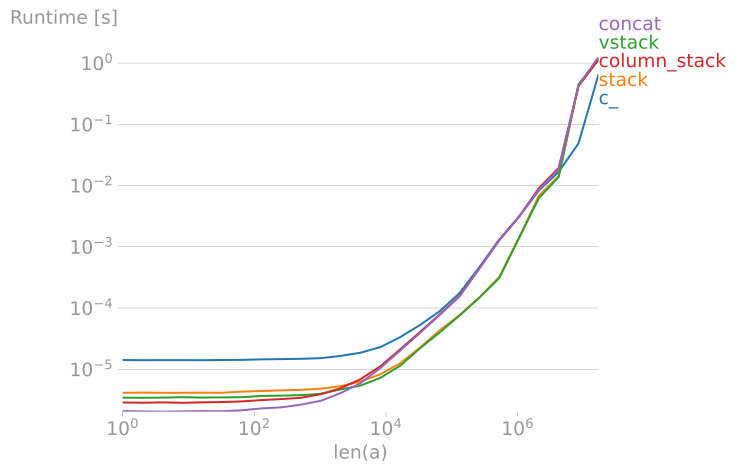 | 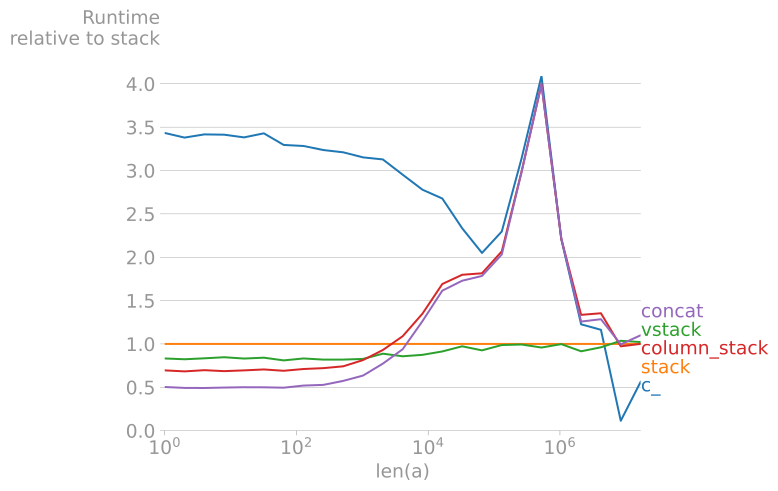 | +| -------------------------------------------------- | ---------------------------------------------------- | + +Clearly, `stack` and `vstack` are the best options for large arrays. + +(By default, perfplot asserts the equality of the output of all snippets, too.) + +If your plot takes a while to generate, you can also use + +<!--pytest-codeblocks:skip--> + +```python +perfplot.live( + # ... +) +``` + +<img alt="live" src="https://nschloe.github.io/perfplot/live.gif" width="40%"> + +with the same arguments as above. It will plot the updates live. + +Benchmarking and plotting can be separated. This allows multiple plots of the same data, +for example: + +<!--pytest-codeblocks:skip--> + +```python +out = perfplot.bench( + # same arguments as above (except the plot-related ones, like time_unit or log*) +) +out.show() +out.save("perf.png", transparent=True, bbox_inches="tight") +``` + +Other examples: + +- [Making a flat list out of list of lists in Python](https://stackoverflow.com/a/45323085/353337) +- [Most efficient way to map function over numpy array](https://stackoverflow.com/a/46470401/353337) +- [numpy: most efficient frequency counts for unique values in an array](https://stackoverflow.com/a/43096495/353337) +- [Most efficient way to reverse a numpy array](https://stackoverflow.com/a/44921013/353337) +- [How to add an extra column to an numpy array](https://stackoverflow.com/a/40218298/353337) +- [Initializing numpy matrix to something other than zero or one](https://stackoverflow.com/a/45006691/353337) + +### Installation + +perfplot is [available from the Python Package +Index](https://pypi.org/project/perfplot/), so simply do + +``` +pip install perfplot +``` + +to install. + +### Testing + +To run the perfplot unit tests, check out this repository and type + +``` +tox +``` + +### License + +This software is published under the [GPLv3 license](https://www.gnu.org/licenses/gpl-3.0.en.html). + + +%package -n python3-perfplot +Summary: Performance plots for Python code snippets +Provides: python-perfplot +BuildRequires: python3-devel +BuildRequires: python3-setuptools +BuildRequires: python3-pip +%description -n python3-perfplot +<p align="center"> + <a href="https://github.com/nschloe/perfplot"><img alt="perfplot" src="https://nschloe.github.io/perfplot/logo-perfplot.svg" width="60%"></a> +</p> + +[](https://pypi.org/project/perfplot) +[](https://pypi.org/pypi/perfplot/) +[](https://github.com/nschloe/perfplot) +[](https://pepy.tech/project/perfplot) + +<!--[](https://pypistats.org/packages/perfplot)--> + +[](https://discord.gg/hnTJ5MRX2Y) + +[](https://github.com/nschloe/perfplot/actions?query=workflow%3Aci) +[](https://codecov.io/gh/nschloe/perfplot) +[](https://lgtm.com/projects/g/nschloe/perfplot) +[](https://github.com/psf/black) + +perfplot extends Python's [timeit](https://docs.python.org/3/library/timeit.html) by +testing snippets with input parameters (e.g., the size of an array) and plotting the +results. + +For example, to compare different NumPy array concatenation methods, the script + +```python +import numpy as np +import perfplot + +perfplot.show( + setup=lambda n: np.random.rand(n), # or setup=np.random.rand + kernels=[ + lambda a: np.c_[a, a], + lambda a: np.stack([a, a]).T, + lambda a: np.vstack([a, a]).T, + lambda a: np.column_stack([a, a]), + lambda a: np.concatenate([a[:, None], a[:, None]], axis=1), + ], + labels=["c_", "stack", "vstack", "column_stack", "concat"], + n_range=[2**k for k in range(25)], + xlabel="len(a)", + # More optional arguments with their default values: + # logx="auto", # set to True or False to force scaling + # logy="auto", + # equality_check=np.allclose, # set to None to disable "correctness" assertion + # show_progress=True, + # target_time_per_measurement=1.0, + # max_time=None, # maximum time per measurement + # time_unit="s", # set to one of ("auto", "s", "ms", "us", or "ns") to force plot units + # relative_to=1, # plot the timings relative to one of the measurements + # flops=lambda n: 3*n, # FLOPS plots +) +``` + +produces + +|  |  | +| -------------------------------------------------- | ---------------------------------------------------- | + +Clearly, `stack` and `vstack` are the best options for large arrays. + +(By default, perfplot asserts the equality of the output of all snippets, too.) + +If your plot takes a while to generate, you can also use + +<!--pytest-codeblocks:skip--> + +```python +perfplot.live( + # ... +) +``` + +<img alt="live" src="https://nschloe.github.io/perfplot/live.gif" width="40%"> + +with the same arguments as above. It will plot the updates live. + +Benchmarking and plotting can be separated. This allows multiple plots of the same data, +for example: + +<!--pytest-codeblocks:skip--> + +```python +out = perfplot.bench( + # same arguments as above (except the plot-related ones, like time_unit or log*) +) +out.show() +out.save("perf.png", transparent=True, bbox_inches="tight") +``` + +Other examples: + +- [Making a flat list out of list of lists in Python](https://stackoverflow.com/a/45323085/353337) +- [Most efficient way to map function over numpy array](https://stackoverflow.com/a/46470401/353337) +- [numpy: most efficient frequency counts for unique values in an array](https://stackoverflow.com/a/43096495/353337) +- [Most efficient way to reverse a numpy array](https://stackoverflow.com/a/44921013/353337) +- [How to add an extra column to an numpy array](https://stackoverflow.com/a/40218298/353337) +- [Initializing numpy matrix to something other than zero or one](https://stackoverflow.com/a/45006691/353337) + +### Installation + +perfplot is [available from the Python Package +Index](https://pypi.org/project/perfplot/), so simply do + +``` +pip install perfplot +``` + +to install. + +### Testing + +To run the perfplot unit tests, check out this repository and type + +``` +tox +``` + +### License + +This software is published under the [GPLv3 license](https://www.gnu.org/licenses/gpl-3.0.en.html). + + +%package help +Summary: Development documents and examples for perfplot +Provides: python3-perfplot-doc +%description help +<p align="center"> + <a href="https://github.com/nschloe/perfplot"><img alt="perfplot" src="https://nschloe.github.io/perfplot/logo-perfplot.svg" width="60%"></a> +</p> + +[](https://pypi.org/project/perfplot) +[](https://pypi.org/pypi/perfplot/) +[](https://github.com/nschloe/perfplot) +[](https://pepy.tech/project/perfplot) + +<!--[](https://pypistats.org/packages/perfplot)--> + +[](https://discord.gg/hnTJ5MRX2Y) + +[](https://github.com/nschloe/perfplot/actions?query=workflow%3Aci) +[](https://codecov.io/gh/nschloe/perfplot) +[](https://lgtm.com/projects/g/nschloe/perfplot) +[](https://github.com/psf/black) + +perfplot extends Python's [timeit](https://docs.python.org/3/library/timeit.html) by +testing snippets with input parameters (e.g., the size of an array) and plotting the +results. + +For example, to compare different NumPy array concatenation methods, the script + +```python +import numpy as np +import perfplot + +perfplot.show( + setup=lambda n: np.random.rand(n), # or setup=np.random.rand + kernels=[ + lambda a: np.c_[a, a], + lambda a: np.stack([a, a]).T, + lambda a: np.vstack([a, a]).T, + lambda a: np.column_stack([a, a]), + lambda a: np.concatenate([a[:, None], a[:, None]], axis=1), + ], + labels=["c_", "stack", "vstack", "column_stack", "concat"], + n_range=[2**k for k in range(25)], + xlabel="len(a)", + # More optional arguments with their default values: + # logx="auto", # set to True or False to force scaling + # logy="auto", + # equality_check=np.allclose, # set to None to disable "correctness" assertion + # show_progress=True, + # target_time_per_measurement=1.0, + # max_time=None, # maximum time per measurement + # time_unit="s", # set to one of ("auto", "s", "ms", "us", or "ns") to force plot units + # relative_to=1, # plot the timings relative to one of the measurements + # flops=lambda n: 3*n, # FLOPS plots +) +``` + +produces + +|  |  | +| -------------------------------------------------- | ---------------------------------------------------- | + +Clearly, `stack` and `vstack` are the best options for large arrays. + +(By default, perfplot asserts the equality of the output of all snippets, too.) + +If your plot takes a while to generate, you can also use + +<!--pytest-codeblocks:skip--> + +```python +perfplot.live( + # ... +) +``` + +<img alt="live" src="https://nschloe.github.io/perfplot/live.gif" width="40%"> + +with the same arguments as above. It will plot the updates live. + +Benchmarking and plotting can be separated. This allows multiple plots of the same data, +for example: + +<!--pytest-codeblocks:skip--> + +```python +out = perfplot.bench( + # same arguments as above (except the plot-related ones, like time_unit or log*) +) +out.show() +out.save("perf.png", transparent=True, bbox_inches="tight") +``` + +Other examples: + +- [Making a flat list out of list of lists in Python](https://stackoverflow.com/a/45323085/353337) +- [Most efficient way to map function over numpy array](https://stackoverflow.com/a/46470401/353337) +- [numpy: most efficient frequency counts for unique values in an array](https://stackoverflow.com/a/43096495/353337) +- [Most efficient way to reverse a numpy array](https://stackoverflow.com/a/44921013/353337) +- [How to add an extra column to an numpy array](https://stackoverflow.com/a/40218298/353337) +- [Initializing numpy matrix to something other than zero or one](https://stackoverflow.com/a/45006691/353337) + +### Installation + +perfplot is [available from the Python Package +Index](https://pypi.org/project/perfplot/), so simply do + +``` +pip install perfplot +``` + +to install. + +### Testing + +To run the perfplot unit tests, check out this repository and type + +``` +tox +``` + +### License + +This software is published under the [GPLv3 license](https://www.gnu.org/licenses/gpl-3.0.en.html). + + +%prep +%autosetup -n perfplot-0.10.2 + +%build +%py3_build + +%install +%py3_install +install -d -m755 %{buildroot}/%{_pkgdocdir} +if [ -d doc ]; then cp -arf doc %{buildroot}/%{_pkgdocdir}; fi +if [ -d docs ]; then cp -arf docs %{buildroot}/%{_pkgdocdir}; fi +if [ -d example ]; then cp -arf example %{buildroot}/%{_pkgdocdir}; fi +if [ -d examples ]; then cp -arf examples %{buildroot}/%{_pkgdocdir}; fi +pushd %{buildroot} +if [ -d usr/lib ]; then + find usr/lib -type f -printf "/%h/%f\n" >> filelist.lst +fi +if [ -d usr/lib64 ]; then + find usr/lib64 -type f -printf "/%h/%f\n" >> filelist.lst +fi +if [ -d usr/bin ]; then + find usr/bin -type f -printf "/%h/%f\n" >> filelist.lst +fi +if [ -d usr/sbin ]; then + find usr/sbin -type f -printf "/%h/%f\n" >> filelist.lst +fi +touch doclist.lst +if [ -d usr/share/man ]; then + find usr/share/man -type f -printf "/%h/%f.gz\n" >> doclist.lst +fi +popd +mv %{buildroot}/filelist.lst . +mv %{buildroot}/doclist.lst . + +%files -n python3-perfplot -f filelist.lst +%dir %{python3_sitelib}/* + +%files help -f doclist.lst +%{_docdir}/* + +%changelog +* Thu May 18 2023 Python_Bot <Python_Bot@openeuler.org> - 0.10.2-1 +- Package Spec generated @@ -0,0 +1 @@ +9ce15ea9cc24617444108f007f41727d perfplot-0.10.2.tar.gz |