1
2
3
4
5
6
7
8
9
10
11
12
13
14
15
16
17
18
19
20
21
22
23
24
25
26
27
28
29
30
31
32
33
34
35
36
37
38
39
40
41
42
43
44
45
46
47
48
49
50
51
52
53
54
55
56
57
58
59
60
61
62
63
64
65
66
67
68
69
70
71
72
73
74
75
76
77
78
79
80
81
82
83
84
85
86
87
88
89
90
91
92
93
94
95
96
97
98
99
100
101
102
103
104
105
106
107
108
109
110
111
112
113
114
115
116
117
118
119
120
121
122
123
124
125
126
127
128
129
130
131
132
133
134
135
136
137
138
139
140
141
142
143
144
145
146
147
148
149
150
151
152
153
154
155
156
157
158
159
160
161
162
163
164
165
166
167
168
169
170
171
172
173
174
175
176
177
178
179
180
181
182
183
184
185
186
187
188
189
190
191
192
193
194
195
196
197
198
199
200
201
202
203
204
205
206
207
208
209
210
211
212
213
214
215
216
217
218
219
220
221
222
223
224
225
226
227
228
229
230
231
232
233
234
235
236
237
238
239
240
241
242
243
244
245
246
247
248
249
250
251
252
253
254
255
256
257
258
259
260
261
262
263
264
265
266
267
268
269
270
271
272
273
274
275
276
277
278
279
280
281
282
283
284
285
286
287
288
289
290
291
292
293
294
295
296
297
298
299
300
301
302
303
304
305
306
307
308
309
310
311
312
313
314
315
316
317
318
319
320
321
322
323
324
325
326
327
328
329
330
331
332
333
334
335
336
337
338
339
340
341
342
343
344
345
346
347
348
349
350
351
352
353
354
355
356
357
358
359
360
361
362
363
364
365
366
367
368
369
370
371
372
373
374
375
376
377
378
379
380
381
382
383
384
385
386
387
388
389
390
391
392
393
394
395
396
397
398
399
400
401
402
403
404
405
406
407
408
409
410
411
412
413
414
415
416
417
418
419
420
421
422
423
424
425
426
427
428
429
430
431
432
433
434
435
436
437
438
439
440
441
442
443
444
445
446
447
448
449
450
451
452
453
454
455
456
457
458
459
460
461
462
463
464
465
466
467
468
469
470
471
472
473
474
475
476
477
478
479
480
481
482
483
484
485
486
487
488
489
490
491
492
493
494
495
496
497
498
499
500
501
502
503
504
505
506
507
508
509
510
511
512
513
514
515
516
517
518
519
520
521
522
523
524
525
526
527
528
529
530
531
532
533
534
535
536
537
538
539
540
541
542
543
544
545
546
547
548
549
550
551
552
553
554
555
556
557
558
559
560
561
562
563
564
565
566
567
568
569
570
571
572
573
574
575
576
577
578
579
580
581
|
%global _empty_manifest_terminate_build 0
Name: python-puppetboard
Version: 4.3.0
Release: 1
Summary: Web frontend for PuppetDB
License: Apache License 2.0
URL: https://github.com/voxpupuli/puppetboard
Source0: https://mirrors.nju.edu.cn/pypi/web/packages/ba/37/d2e9982f5f62f6d3743dba153b4d35eeaf478e12d6345bf87b4681657062/puppetboard-4.3.0.tar.gz
BuildArch: noarch
Requires: python3-certifi
Requires: python3-charset-normalizer
Requires: python3-click
Requires: python3-commonmark
Requires: python3-Flask
Requires: python3-Flask-APScheduler
Requires: python3-Flask-Caching
Requires: python3-Flask-WTF
Requires: python3-idna
Requires: python3-itsdangerous
Requires: python3-Jinja2
Requires: python3-MarkupSafe
Requires: python3-packaging
Requires: python3-pyparsing
Requires: python3-pypuppetdb
Requires: python3-requests
Requires: python3-typing-extensions
Requires: python3-urllib3
Requires: python3-Werkzeug
Requires: python3-WTForms
Requires: python3-zipp
Requires: python3-pep8
Requires: python3-coverage
Requires: python3-mock
Requires: python3-pytest
Requires: python3-pylint
Requires: python3-pytest-pylint
Requires: python3-pytest-cov
Requires: python3-pytest-mock
Requires: python3-pytest-mypy
Requires: python3-pytest-randomly
Requires: python3-cov-core
Requires: python3-beautifulsoup4
Requires: python3-bandit
Requires: python3-mypy
Requires: python3-types-requests
Requires: python3-types-setuptools
Requires: python3-types-toml
%description
```
```
PUPPETDB_CERT=LS0tLS1CRUdJTiBSU0EgUFJJVkFURSBLRVktLS0tLQouLi4KLS0tLS1FTkQgQ0VSVElGSUNBVEUtLS0tLQ==
```
For information about how to generate the correct keys please refer to the
[pypuppetdb documentation](https://pypuppetdb.readthedocs.io/en/latest/connecting.html#ssl). Alternatively it is possible
to explicitly specify the protocol to be used setting the `PUPPETDB_PROTO` variable.
Other settings that might be interesting, in no particular order:
- `FAVORITE_ENVS`: an ordered list of Puppet environment names that will be shown immediately after "All Environments"
and before other environments (which are sorted by name) in the dropdown for choosing the environment shown
in the top-right of the UI. Environments listed here that do not really exist in your deployment are silently ignored.
- `SHOW_ERROR_AS`: `friendly` or `raw`. The former makes Puppet run errors in Report and Failures views shown
in a modified, (arguably) more user-friendly form. The latter shows them as they are.
Defaults to `friendly`.
- `CODE_PREFIX_TO_REMOVE`: what code path that should be shortened in "Friendly errors" to "…" for readability.
A regexp. Defaults to `/etc/puppetlabs/code/environments(/.*?/modules)?`.
- `SECRET_KEY`: Refer to [Flask documentation](https://flask.palletsprojects.com/en/2.0.x/quickstart/#sessions),
section "How to generate good secret keys" for more info. Defaults to a random 64-char string generated by `secrets.token_hex(32)`, prepended with a `default-` string. **Warning** Leaving SECRET_KEY set to a default value WILL cause issues when the app is restarted or has more than 1 replica (f.e. uWSGI workers, k8s replicas etc.) and some features (in particular: queries) are used. Please set SECRET_KEY to your own value, the same for all app replicas. This will be REQUIRED starting with Puppetboard 5.x which will NOT contain the default value anymore. Please see [#721](https://github.com/voxpupuli/puppetboard/issues/721) for more info.
- `PUPPETDB_TIMEOUT`: Defaults to 20 seconds, but you might need to increase this value. It depends on how big the
results are when querying PuppetDB. This behaviour will change in a future release when pagination will be introduced.
- `UNRESPONSIVE_HOURS`: The amount of hours since the last check-in after which a node is considered unresponsive.
- `LOGLEVEL`: A string representing the loglevel. It defaults to `'info'` but can be changed to `'warning'` or
`'critical'` for less verbose logging or `'debug'` for more information.
- `ENABLE_QUERY`: Defaults to `True` causing a Query tab to show up in the web interface allowing users to write
and execute arbitrary queries against a set of endpoints in PuppetDB. Change this to `False` to disable this.
See `ENABLED_QUERY_ENDPOINTS` to fine-tune which endpoints are allowed.
- `ENABLED_QUERY_ENDPOINTS`: If `ENABLE_QUERY` is `True`, allow to fine tune the endpoints of PuppetDB APIs that
can be queried. It must be a list of strings of PuppetDB endpoints for which the query is enabled.
See the `QUERY_ENDPOINTS` constant in the `puppetboard.app` module for a list of the available endpoints.
- `GRAPH_TYPE`: Specify the type of graph to display. Default is
pie, other good option is donut. Other choices can be found here:
\_C3JS\_documentation\`
- `GRAPH_FACTS`: A list of fact names to tell PuppetBoard to generate a pie-chart on the fact page. With some fact
values being unique per node, like ipaddress, uuid, and serial number, as well as structured facts it was no longer
feasible to generate a graph for everything.
- `INVENTORY_FACTS`: A list of tuples that serve as the column header and the fact name to search for to create
the inventory page. If a fact is not found for a node then `undef` is printed.
- `INVENTORY_FACT_TEMPLATES`: A mapping between fact name and jinja template to customize display
- `ENABLE_CATALOG`: If set to `True` allows the user to view a node's latest catalog. This includes all managed
resources, their file-system locations and their relationships, if available. Defaults to `False`.
- `REFRESH_RATE`: Defaults to `30` the number of seconds to wait until the index page is automatically refreshed.
- `DEFAULT_ENVIRONMENT`: Defaults to `'production'`, as the name suggests, load all information filtered by this
environment value.
- `REPORTS_COUNT`: Defaults to `10` the limit of the number of reports to load on the node or any reports page.
- `OFFLINE_MODE`: If set to `True` load static assets (jquery, semantic-ui, etc) from the local web server instead
of a CDN. Defaults to `False`.
- `DAILY_REPORTS_CHART_ENABLED`: Enable the use of daily chart graphs when looking at dashboard and node view.
- `DAILY_REPORTS_CHART_DAYS`: Number of days to show history for on the daily report graphs.
- `DISPLAYED_METRICS`: Metrics to show when displaying node summary. Example: `'resources.total'`, `'events.noop'`.
- `TABLE_COUNT_SELECTOR`: Configure the dropdown to limit number of hosts to show per page.
- `LITTLE_TABLE_COUNT`: Default number of reports to show when when looking at a node.
- `NORMAL_TABLE_COUNT`: Default number of nodes to show when displaying reports and catalog nodes.
- `LOCALISE_TIMESTAMP`: If set to `True` then timestamps are shown using your browser's timezone. Otherwise UTC is used. Defaults to `True`.
- `WITH_EVENT_NUMBERS`: If set to `True` then Overview and Nodes list shows exact number of changed resources
in the last report. Otherwise shows only 'some' string if there are resources with given status. Setting this
to `False` gives performance benefits, especially in big Puppet environments (more than few hundreds of nodes).
Defaults to `True`.
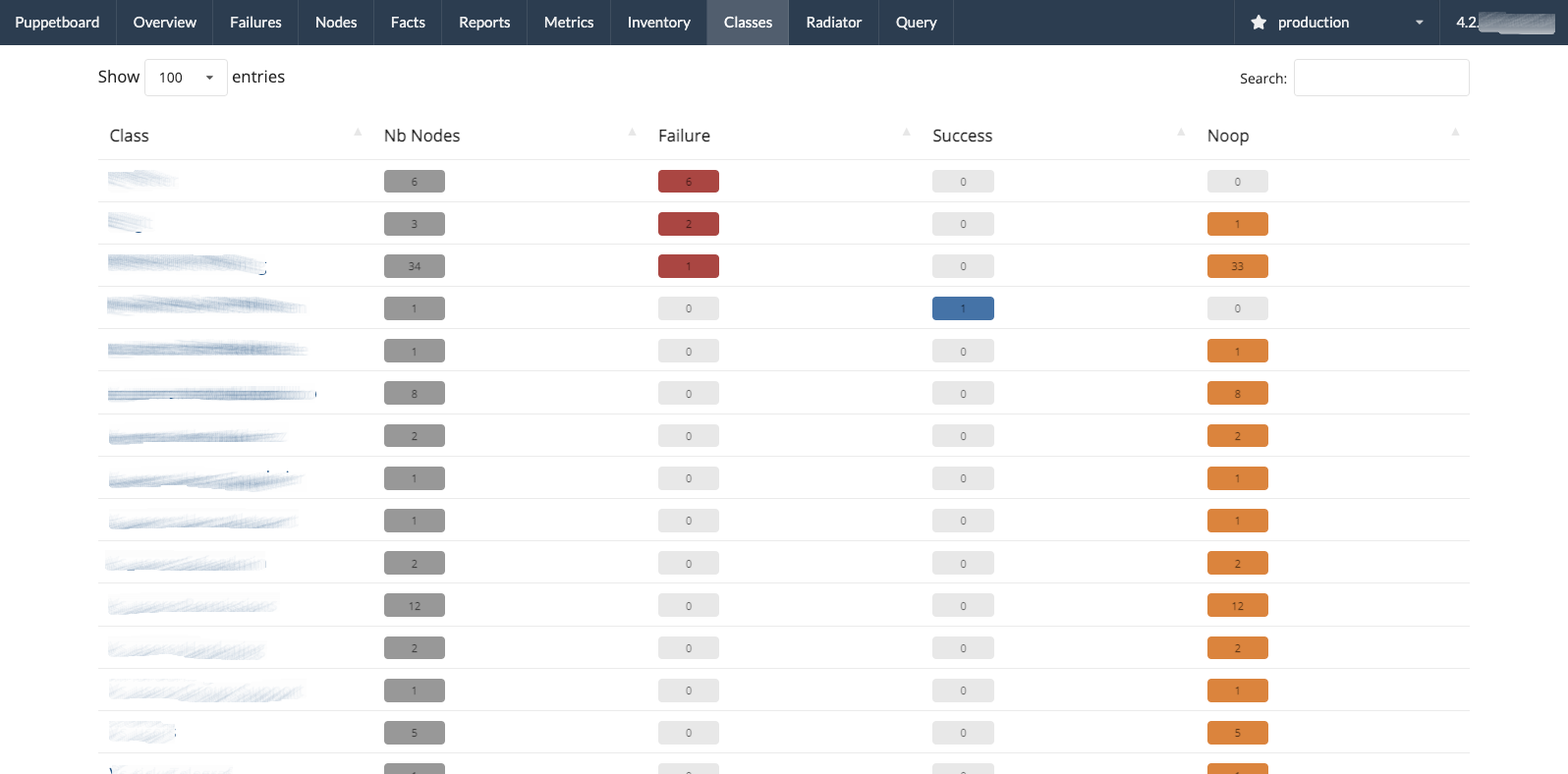
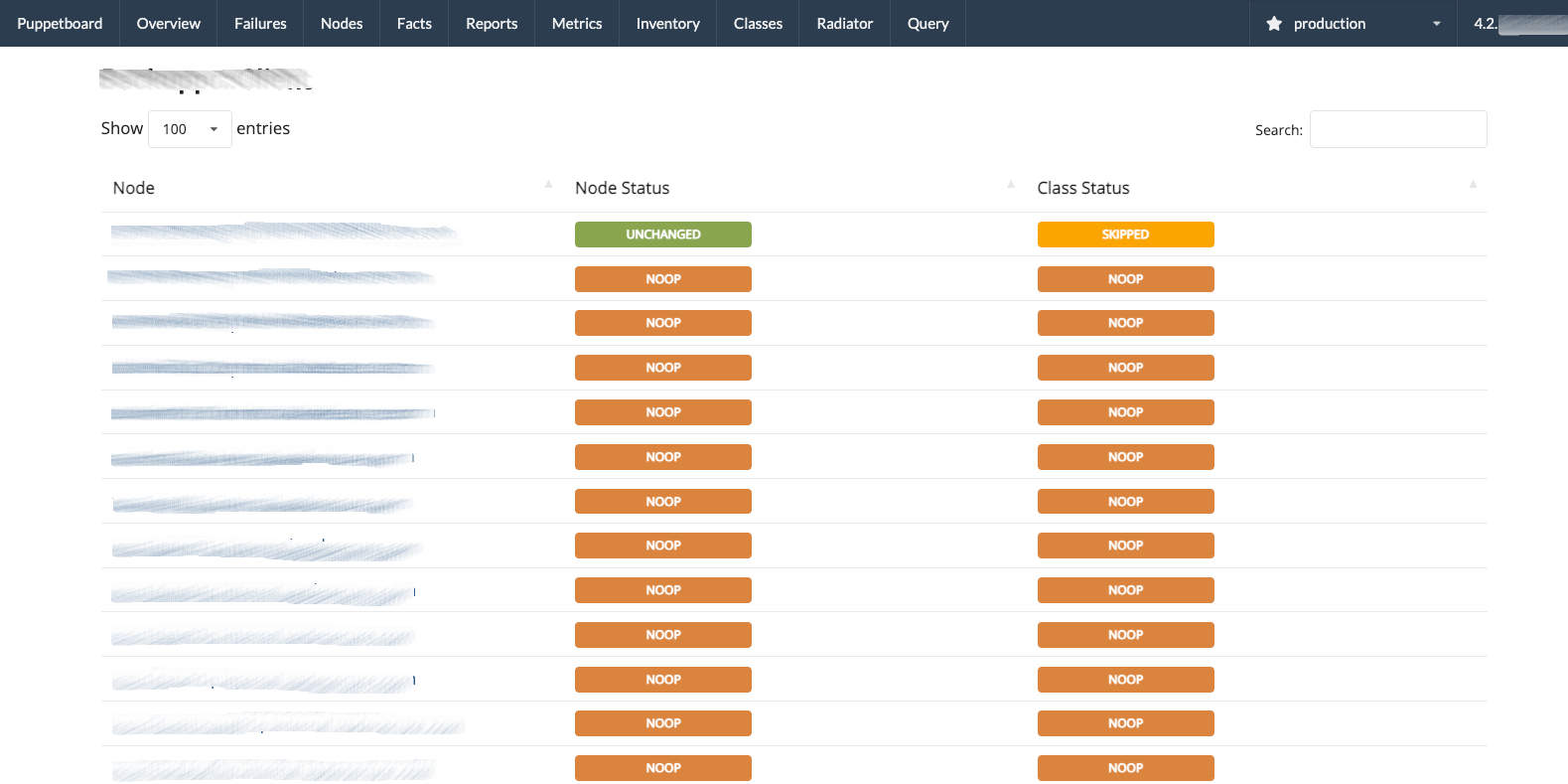
- `ENABLE_CLASS`: If set to `True` allows the user to view the number of resource events (number of changed resources in the last report) grouped by class.
The resource events are grouped by their status ('failure', 'success', 'noop').
- `CLASS_EVENTS_STATUS_COLUMNS`: A mapping between the status of the resource events and the name of the columns of the table to display.
- `CACHE_TYPE`: Specifies which type of caching object to use when `SCHEDULER_ENABLED` is set to `True`.
The cache is used for the classes view (`ENABLE_CLASS` is set to `True`) which requires parsing the events of all the latest reports to group them by Puppet class.
If the last report is present in the cache, we do not parse the events, which avoids unnecessary processing.
If you configure more than one worker, you must use a shared backend (e.g. `MemcachedCache`) to allow the sharing of the cache between the processes.
Indeed, the `SimpleCache` type does not allow sharing the cache between processes, it uses the process memory to store the cache.
Defaults to `SimpleCache`.
- `CACHE_DEFAULT_TIMEOUT`: Cache lifetime in second. Defaults to `3600`.
- `SCHEDULER_ENABLED`: If set to `True` then a scheduler instance is created in order to execute scheduled jobs. Defaults to `False`.
- `SCHEDULER_JOBS`: List of the scheduled jobs to trigger within a worker.
A job can for example be used to compute a result to be cached. This is the case for the classes view which uses a job to pre-compute at regular intervals the results to be displayed.
Each scheduled job must contain the following fields: `id`, `func`, `trigger`, `seconds`.
- `SCHEDULER_LOCK_BIND_PORT`: Specifies an available port that allows a single worker to listen on it.
This allows to configure scheduled jobs in a single worker. Defaults to `49100`.
## Getting Help<a id="getting-help"></a>
For questions or bug reports you can file an [issue](https://github.com/voxpupuli/puppetboard/issues).
## Contributing<a id="contributing"></a>
### Development
Puppetboard relies on the [pypuppetdb](https://pypi.org/project/pypuppetdb/) library to fetch data from PuppetDB
and is built with the help of the [Flask](https://flask.palletsprojects.com) microframework.
If you wish to hack on Puppetboard you should fork/clone the Github repository and then install the requirements through:
```bash
pip install --upgrade wheel setuptools
python setup.py develop
pip install --upgrade -r requirements-test.txt
mypy --install-types --non-interactive puppetboard/ test/
```
You're advised to do this inside a virtualenv specifically created to work on Puppetboard as to not pollute your global Python installation.
You can run the tests with:
```bash
pytest --cov=. --cov-report=xml --strict-markers --mypy puppetboard test
pylint --errors-only puppetboard test
```
You can run the app it in development mode by simply executing:
```bash
flask run
```
You can specify listening host and port with environment variables or command line otions:
```bash
export FLASK_RUN_HOST=0.0.0.0
export FLASK_RUN_PORT=8000
flask run
```
or
```bash
flask run --host '0.0.0.0' --port '8000'
```
Use `PUPPETBOARD_SETTINGS` to change the different settings or patch `default_settings.py` directly.
Take care not to include your local changes on that file when submitting patches for Puppetboard.
Place a `settings.py` file inside the base directory of the git repository that will be used, if the environment
variable is not set.
We welcome contributions to this project. However, there are a few ground rules contributors should be aware of.
### License
This project is licensed under the Apache v2.0 License. As such, your contributions, once accepted, are automatically
covered by this license.
### Commit messages
Write decent commit messages. Don't use swear words and refrain from uninformative commit messages as 'fixed typo'.
The preferred format of a commit message:
docs/quickstart: Fixed a typo in the Nodes section.
If needed, elaborate further on this commit. Feel free to write a
complete blog post here if that helps us understand what this is
all about.
Fixes #4 and resolves #2.
If you'd like a more elaborate guide on how to write and format your commit messages have a look at [this post
by Tim Pope](https://tbaggery.com/2008/04/19/a-note-about-git-commit-messages.html).
## More Screenshots<a id="more-screenshots"></a>
* Overview / Index / Homepage
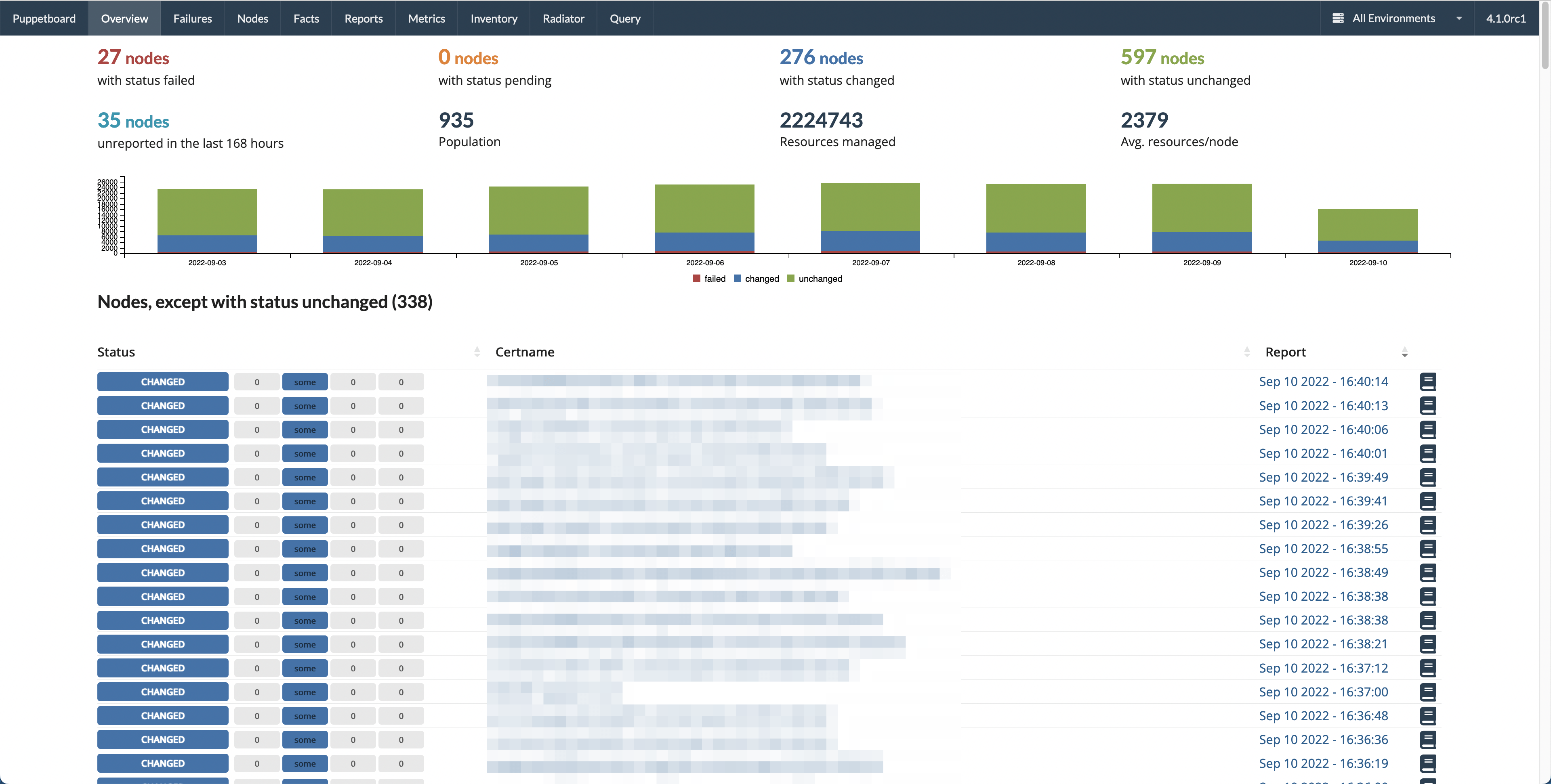
* Nodes view, all active nodes
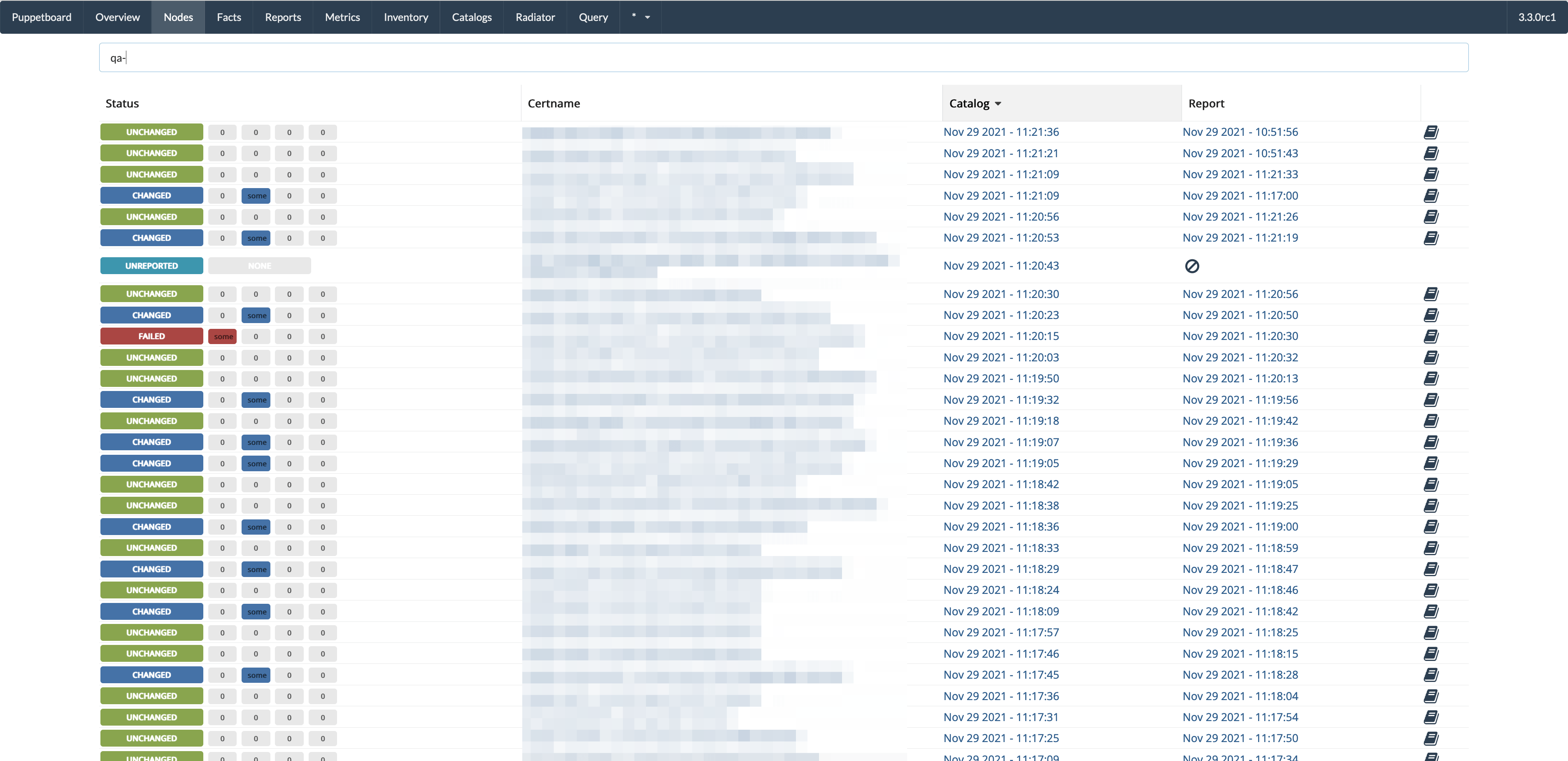
* Single node page / overview
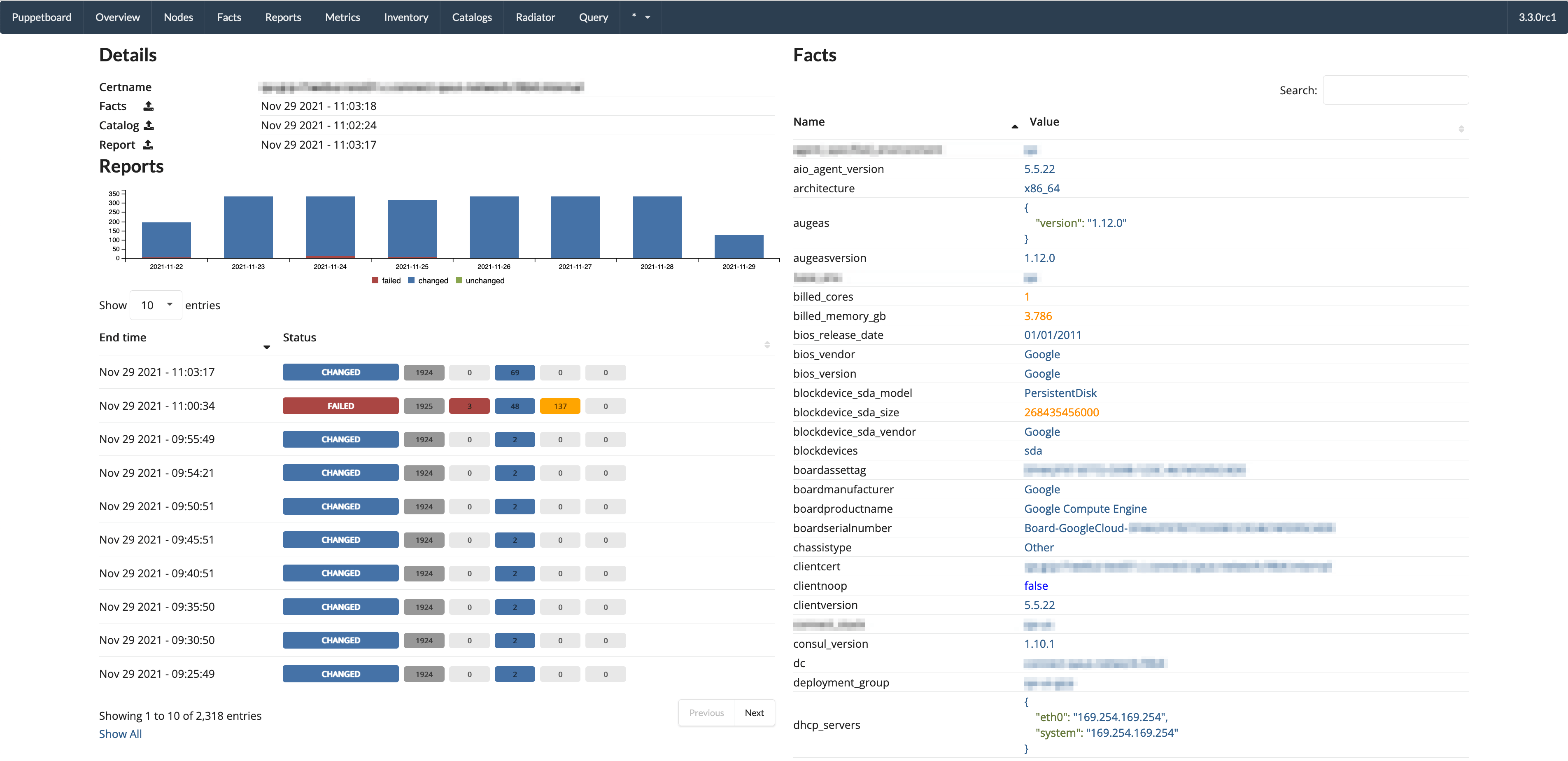
* Report view
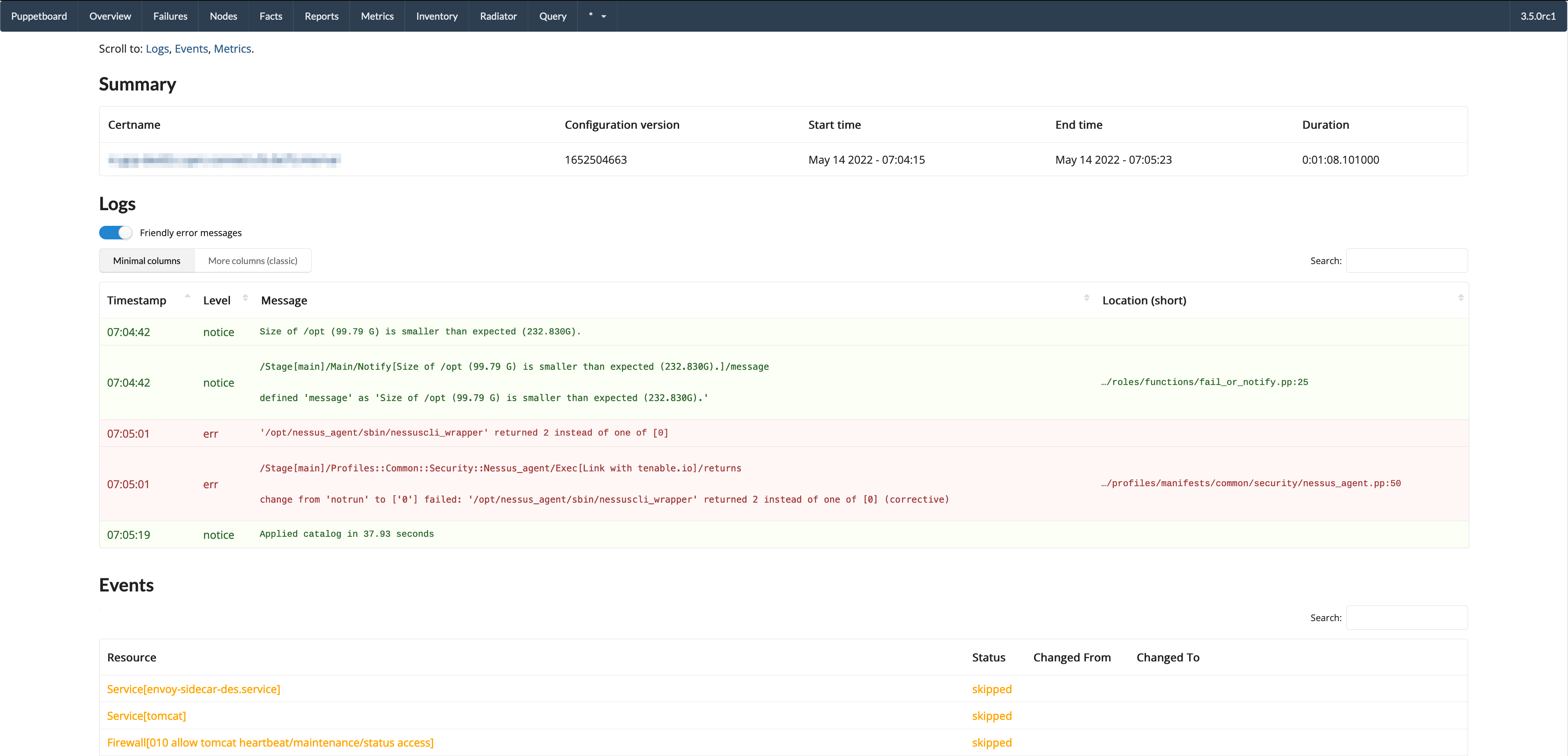
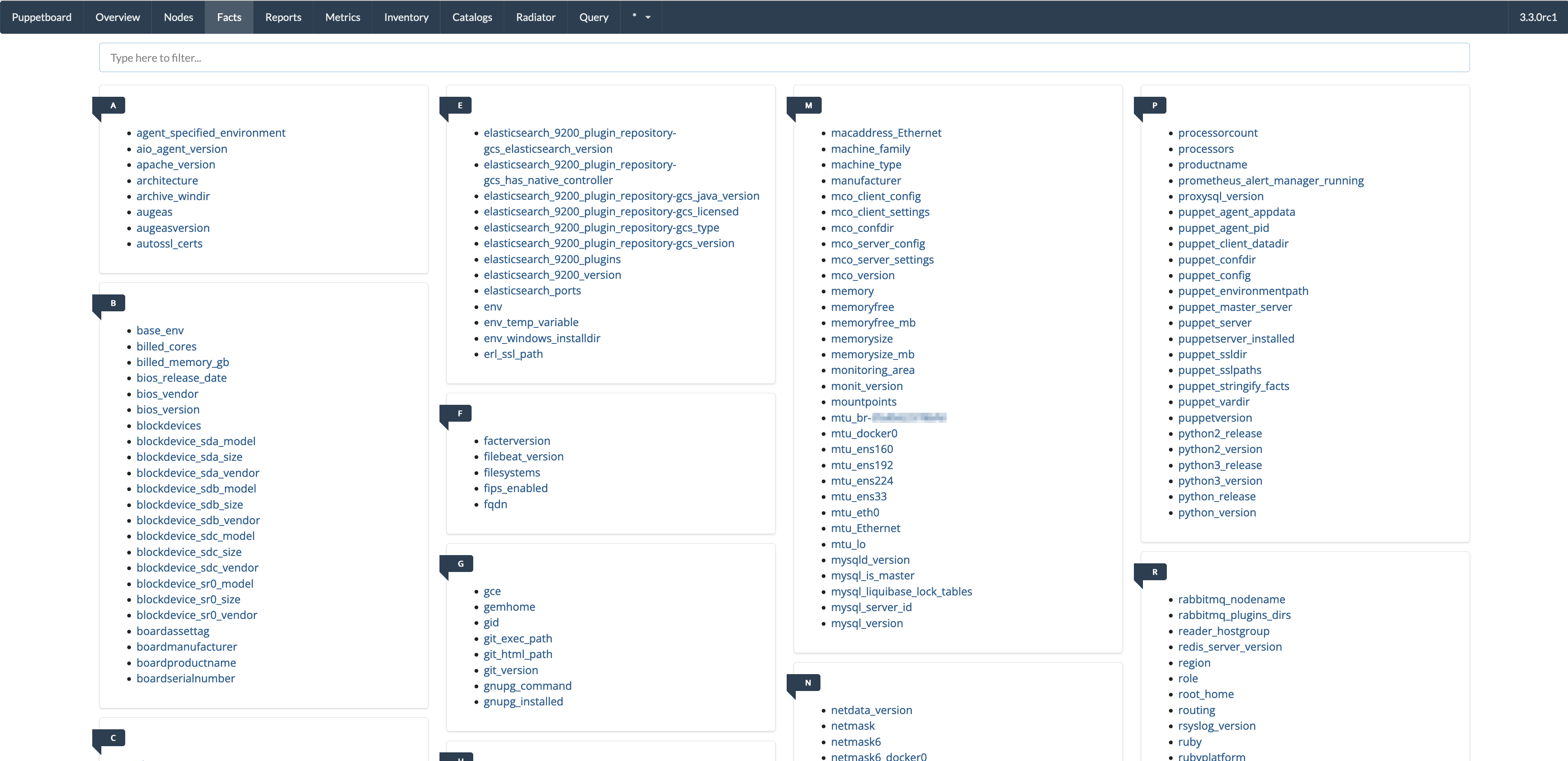
* Facts view
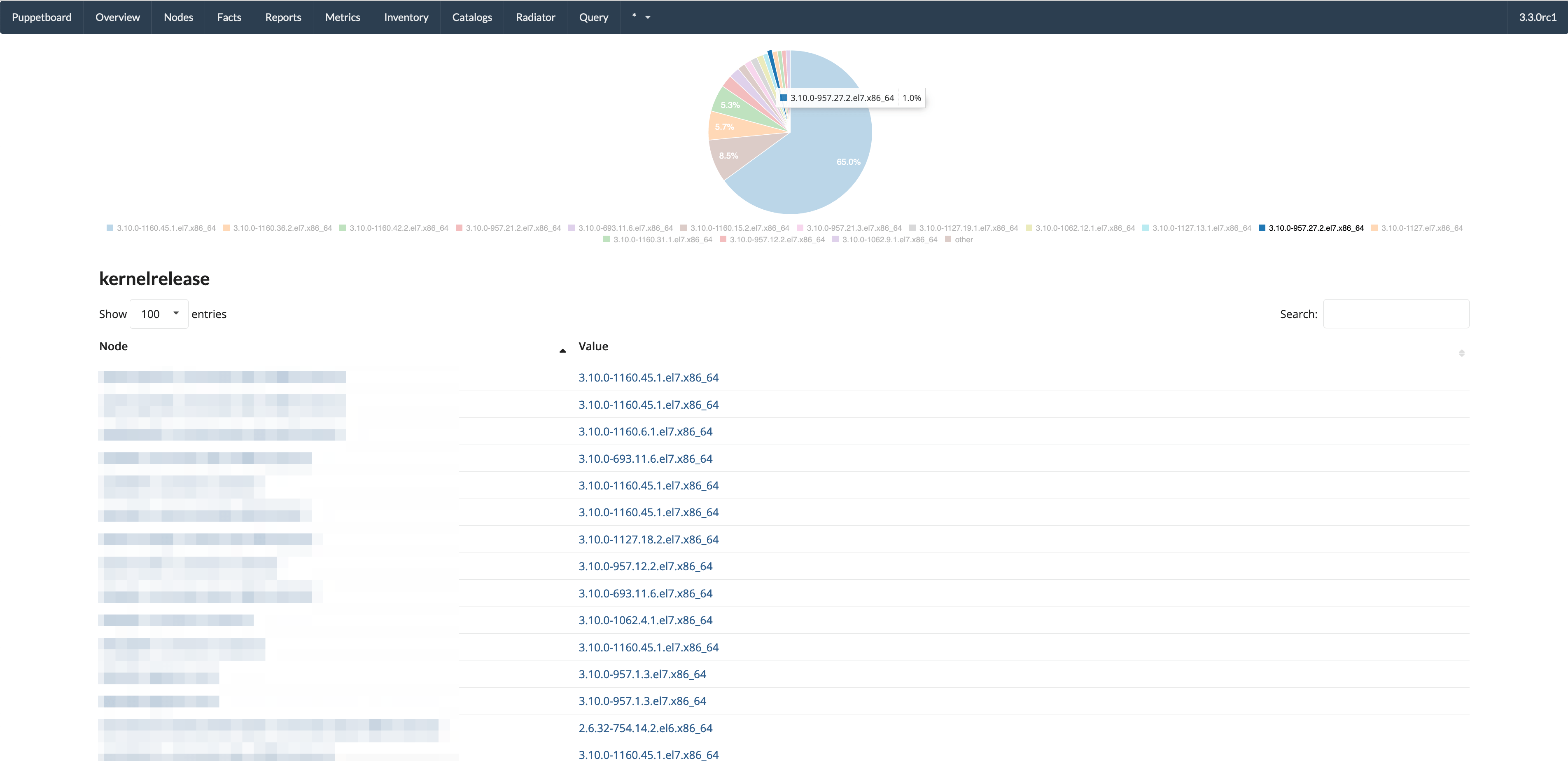
* Single fact, with graphs
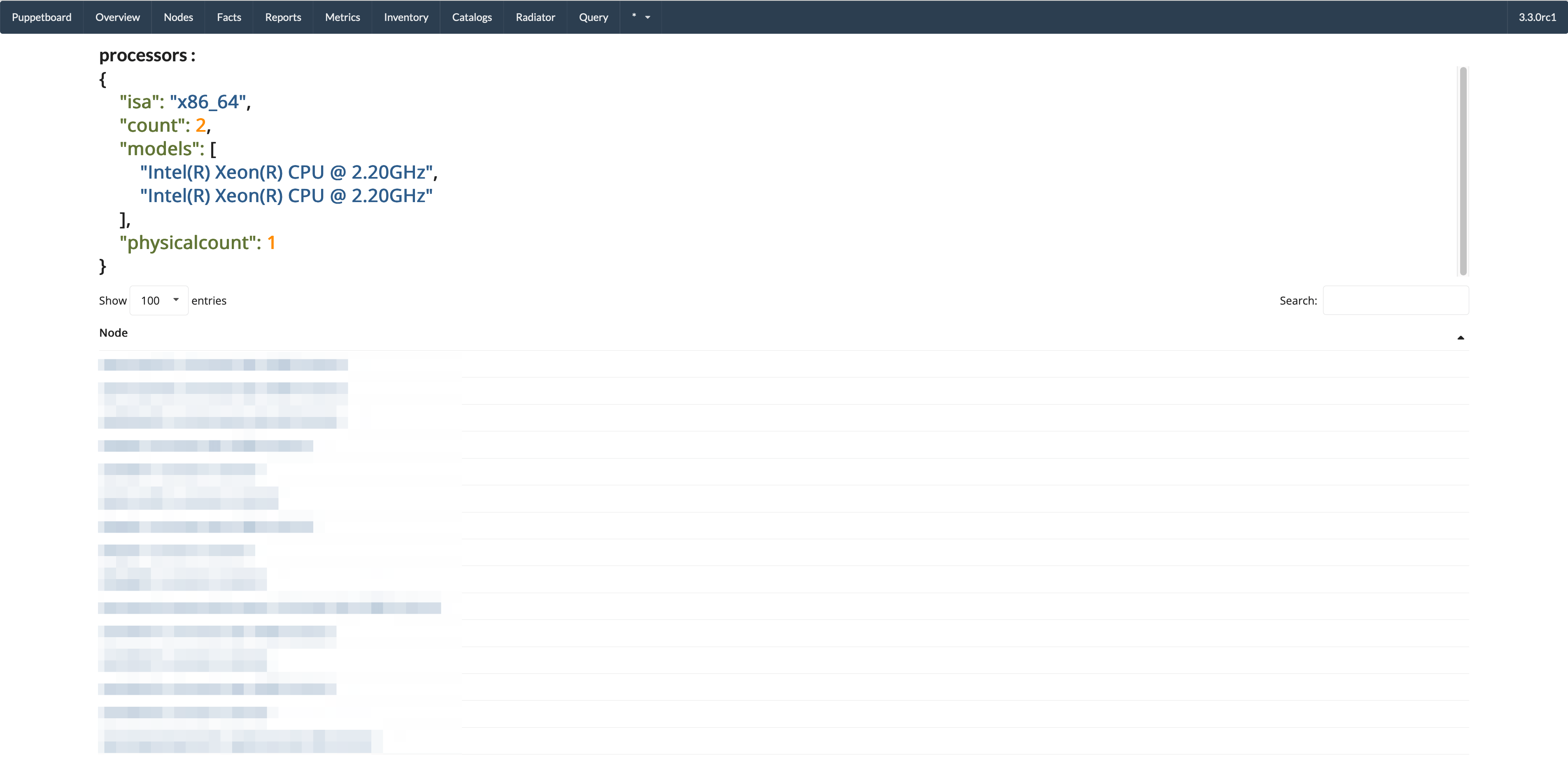
* All nodes that have this fact with that value
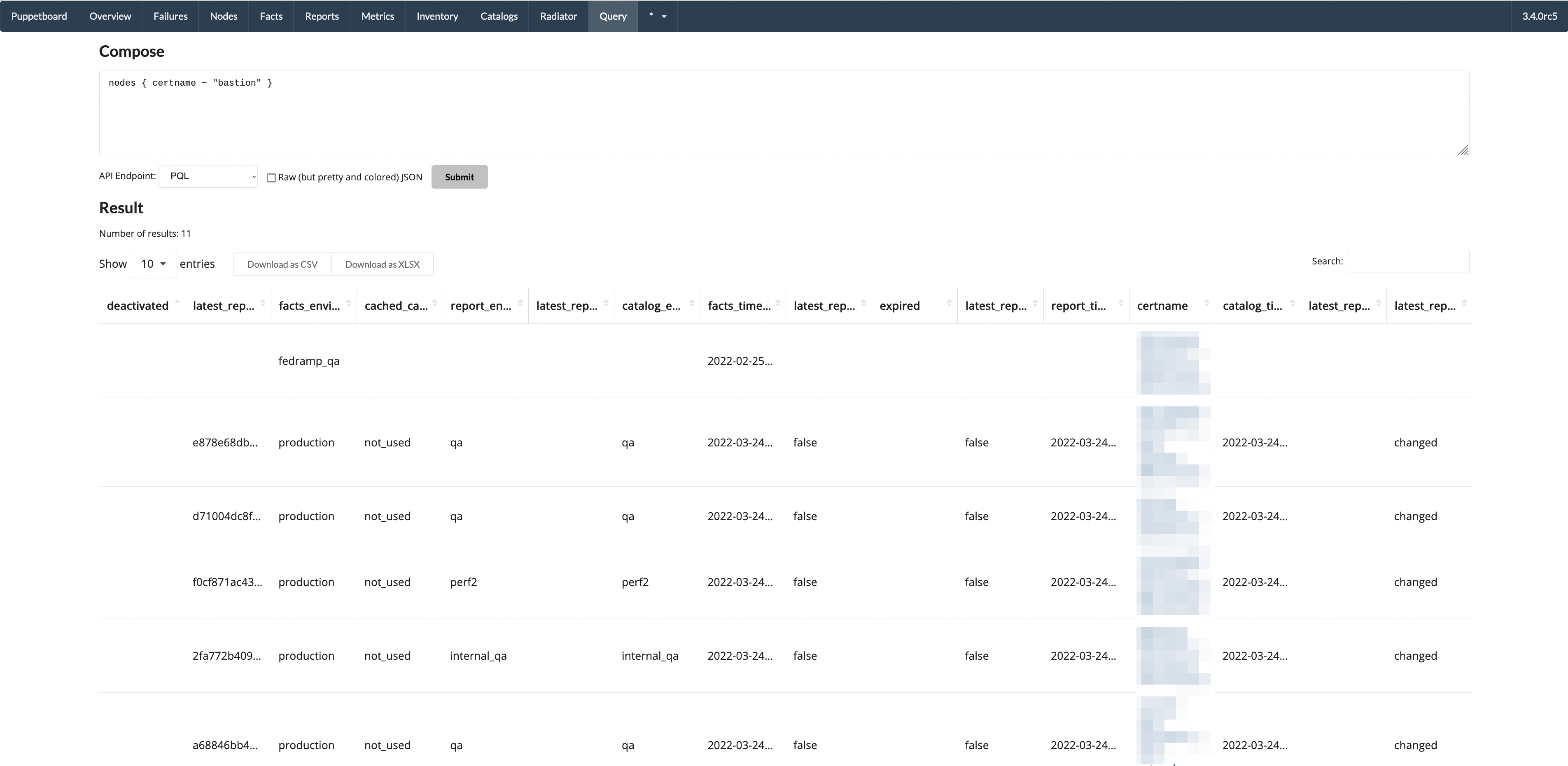
* Query view - results as table
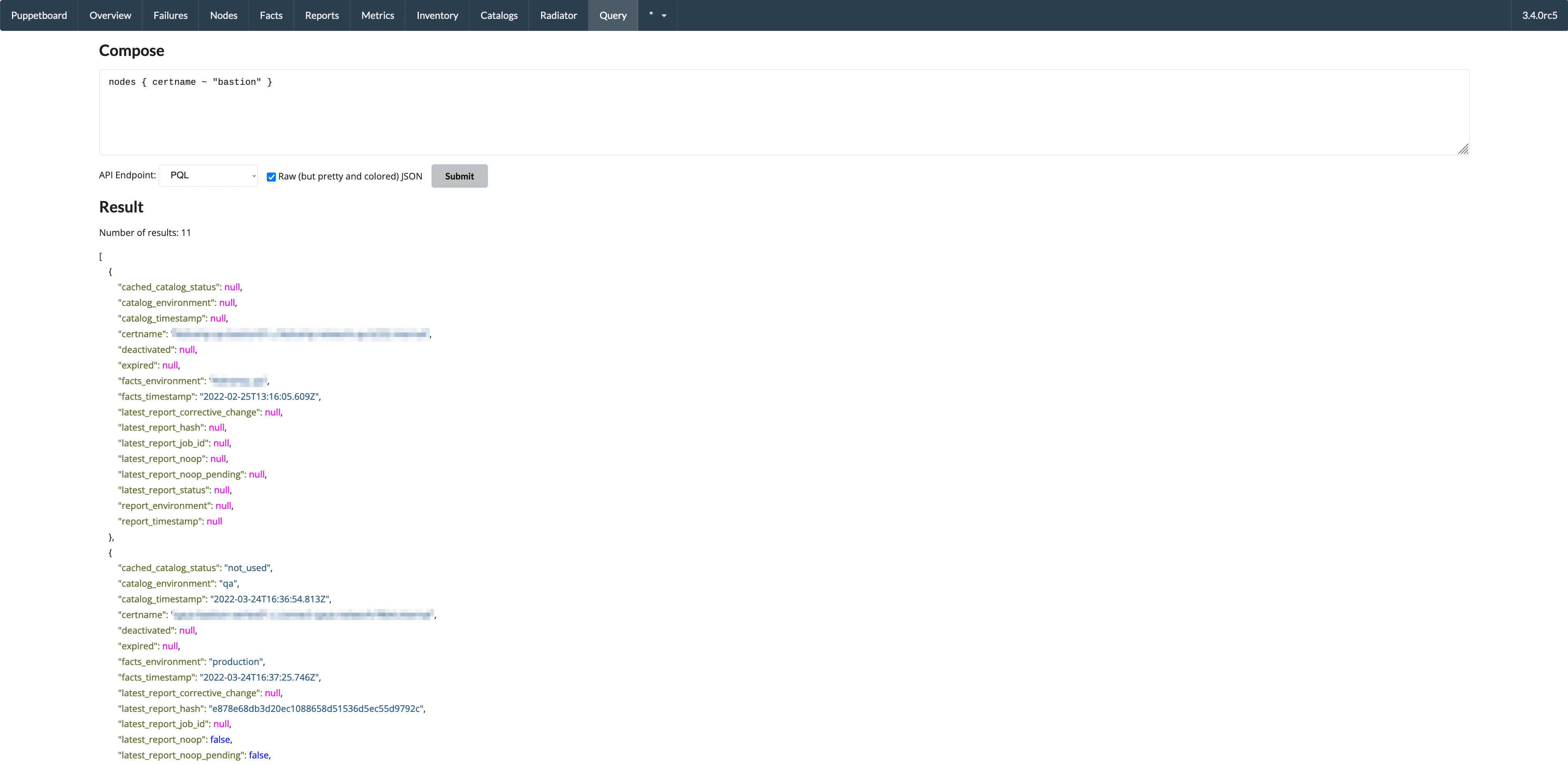
* Query view - results as JSON
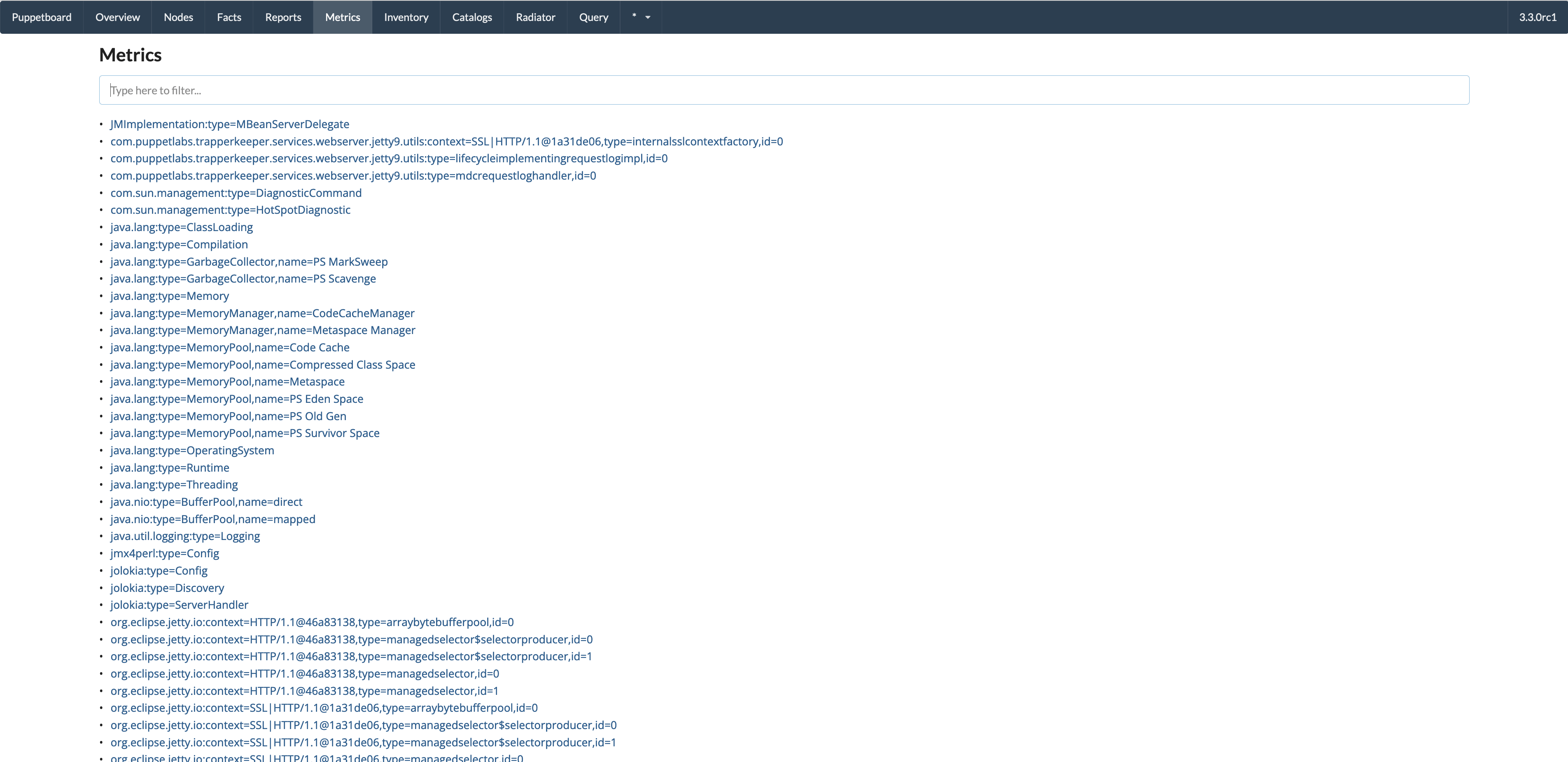
* Metrics view
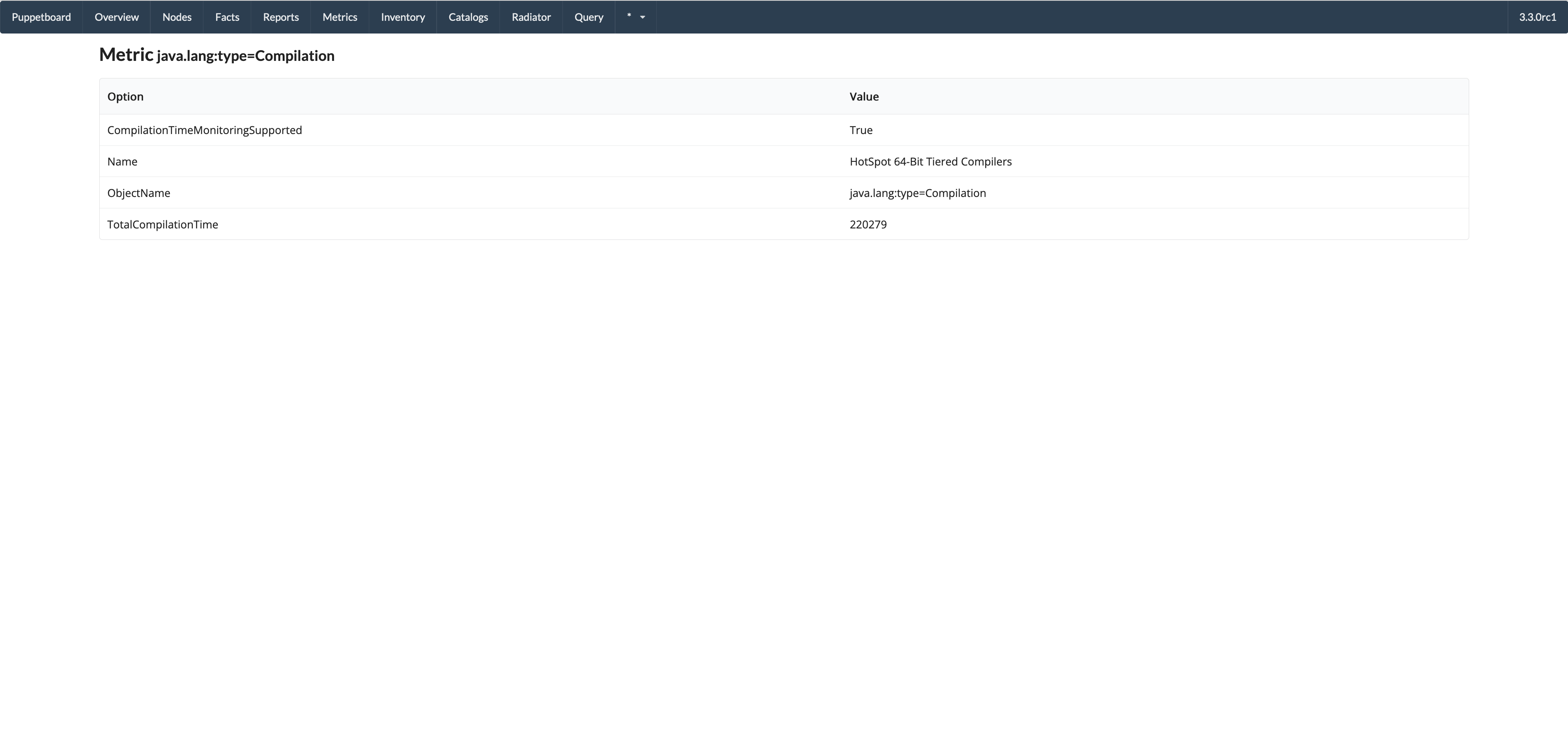
* Single metric
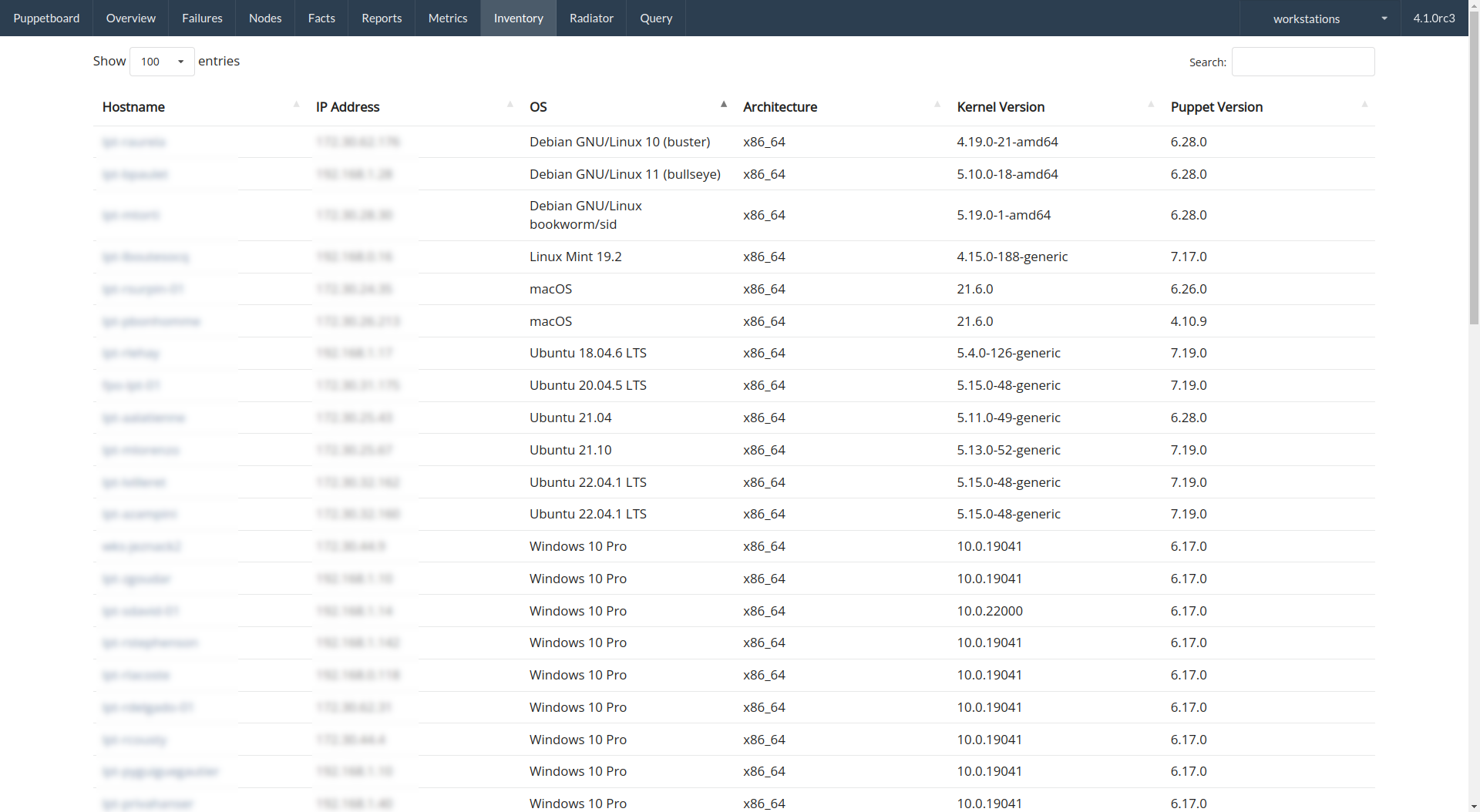
* Inventory view
* Classes view, group the resource events of the last reports by Puppet class
* Class view, list the nodes with almost one resource event for a given class
# Legal<a id="legal"></a>
The app code is licensed under the [Apache License, Version 2.0](./LICENSE).
The favicon has been created based on the icon created by [Jonathan Coutiño](https://thenounproject.com/ralts01/)
under the [Attribution 3.0 Unported (CC BY 3.0) license](https://creativecommons.org/licenses/by/3.0/),
downloaded from the [Noun Project](https://thenounproject.com).
%package -n python3-puppetboard
Summary: Web frontend for PuppetDB
Provides: python-puppetboard
BuildRequires: python3-devel
BuildRequires: python3-setuptools
BuildRequires: python3-pip
%description -n python3-puppetboard
```
```
PUPPETDB_CERT=LS0tLS1CRUdJTiBSU0EgUFJJVkFURSBLRVktLS0tLQouLi4KLS0tLS1FTkQgQ0VSVElGSUNBVEUtLS0tLQ==
```
For information about how to generate the correct keys please refer to the
[pypuppetdb documentation](https://pypuppetdb.readthedocs.io/en/latest/connecting.html#ssl). Alternatively it is possible
to explicitly specify the protocol to be used setting the `PUPPETDB_PROTO` variable.
Other settings that might be interesting, in no particular order:
- `FAVORITE_ENVS`: an ordered list of Puppet environment names that will be shown immediately after "All Environments"
and before other environments (which are sorted by name) in the dropdown for choosing the environment shown
in the top-right of the UI. Environments listed here that do not really exist in your deployment are silently ignored.
- `SHOW_ERROR_AS`: `friendly` or `raw`. The former makes Puppet run errors in Report and Failures views shown
in a modified, (arguably) more user-friendly form. The latter shows them as they are.
Defaults to `friendly`.
- `CODE_PREFIX_TO_REMOVE`: what code path that should be shortened in "Friendly errors" to "…" for readability.
A regexp. Defaults to `/etc/puppetlabs/code/environments(/.*?/modules)?`.
- `SECRET_KEY`: Refer to [Flask documentation](https://flask.palletsprojects.com/en/2.0.x/quickstart/#sessions),
section "How to generate good secret keys" for more info. Defaults to a random 64-char string generated by `secrets.token_hex(32)`, prepended with a `default-` string. **Warning** Leaving SECRET_KEY set to a default value WILL cause issues when the app is restarted or has more than 1 replica (f.e. uWSGI workers, k8s replicas etc.) and some features (in particular: queries) are used. Please set SECRET_KEY to your own value, the same for all app replicas. This will be REQUIRED starting with Puppetboard 5.x which will NOT contain the default value anymore. Please see [#721](https://github.com/voxpupuli/puppetboard/issues/721) for more info.
- `PUPPETDB_TIMEOUT`: Defaults to 20 seconds, but you might need to increase this value. It depends on how big the
results are when querying PuppetDB. This behaviour will change in a future release when pagination will be introduced.
- `UNRESPONSIVE_HOURS`: The amount of hours since the last check-in after which a node is considered unresponsive.
- `LOGLEVEL`: A string representing the loglevel. It defaults to `'info'` but can be changed to `'warning'` or
`'critical'` for less verbose logging or `'debug'` for more information.
- `ENABLE_QUERY`: Defaults to `True` causing a Query tab to show up in the web interface allowing users to write
and execute arbitrary queries against a set of endpoints in PuppetDB. Change this to `False` to disable this.
See `ENABLED_QUERY_ENDPOINTS` to fine-tune which endpoints are allowed.
- `ENABLED_QUERY_ENDPOINTS`: If `ENABLE_QUERY` is `True`, allow to fine tune the endpoints of PuppetDB APIs that
can be queried. It must be a list of strings of PuppetDB endpoints for which the query is enabled.
See the `QUERY_ENDPOINTS` constant in the `puppetboard.app` module for a list of the available endpoints.
- `GRAPH_TYPE`: Specify the type of graph to display. Default is
pie, other good option is donut. Other choices can be found here:
\_C3JS\_documentation\`
- `GRAPH_FACTS`: A list of fact names to tell PuppetBoard to generate a pie-chart on the fact page. With some fact
values being unique per node, like ipaddress, uuid, and serial number, as well as structured facts it was no longer
feasible to generate a graph for everything.
- `INVENTORY_FACTS`: A list of tuples that serve as the column header and the fact name to search for to create
the inventory page. If a fact is not found for a node then `undef` is printed.
- `INVENTORY_FACT_TEMPLATES`: A mapping between fact name and jinja template to customize display
- `ENABLE_CATALOG`: If set to `True` allows the user to view a node's latest catalog. This includes all managed
resources, their file-system locations and their relationships, if available. Defaults to `False`.
- `REFRESH_RATE`: Defaults to `30` the number of seconds to wait until the index page is automatically refreshed.
- `DEFAULT_ENVIRONMENT`: Defaults to `'production'`, as the name suggests, load all information filtered by this
environment value.
- `REPORTS_COUNT`: Defaults to `10` the limit of the number of reports to load on the node or any reports page.
- `OFFLINE_MODE`: If set to `True` load static assets (jquery, semantic-ui, etc) from the local web server instead
of a CDN. Defaults to `False`.
- `DAILY_REPORTS_CHART_ENABLED`: Enable the use of daily chart graphs when looking at dashboard and node view.
- `DAILY_REPORTS_CHART_DAYS`: Number of days to show history for on the daily report graphs.
- `DISPLAYED_METRICS`: Metrics to show when displaying node summary. Example: `'resources.total'`, `'events.noop'`.
- `TABLE_COUNT_SELECTOR`: Configure the dropdown to limit number of hosts to show per page.
- `LITTLE_TABLE_COUNT`: Default number of reports to show when when looking at a node.
- `NORMAL_TABLE_COUNT`: Default number of nodes to show when displaying reports and catalog nodes.
- `LOCALISE_TIMESTAMP`: If set to `True` then timestamps are shown using your browser's timezone. Otherwise UTC is used. Defaults to `True`.
- `WITH_EVENT_NUMBERS`: If set to `True` then Overview and Nodes list shows exact number of changed resources
in the last report. Otherwise shows only 'some' string if there are resources with given status. Setting this
to `False` gives performance benefits, especially in big Puppet environments (more than few hundreds of nodes).
Defaults to `True`.
- `ENABLE_CLASS`: If set to `True` allows the user to view the number of resource events (number of changed resources in the last report) grouped by class.
The resource events are grouped by their status ('failure', 'success', 'noop').
- `CLASS_EVENTS_STATUS_COLUMNS`: A mapping between the status of the resource events and the name of the columns of the table to display.
- `CACHE_TYPE`: Specifies which type of caching object to use when `SCHEDULER_ENABLED` is set to `True`.
The cache is used for the classes view (`ENABLE_CLASS` is set to `True`) which requires parsing the events of all the latest reports to group them by Puppet class.
If the last report is present in the cache, we do not parse the events, which avoids unnecessary processing.
If you configure more than one worker, you must use a shared backend (e.g. `MemcachedCache`) to allow the sharing of the cache between the processes.
Indeed, the `SimpleCache` type does not allow sharing the cache between processes, it uses the process memory to store the cache.
Defaults to `SimpleCache`.
- `CACHE_DEFAULT_TIMEOUT`: Cache lifetime in second. Defaults to `3600`.
- `SCHEDULER_ENABLED`: If set to `True` then a scheduler instance is created in order to execute scheduled jobs. Defaults to `False`.
- `SCHEDULER_JOBS`: List of the scheduled jobs to trigger within a worker.
A job can for example be used to compute a result to be cached. This is the case for the classes view which uses a job to pre-compute at regular intervals the results to be displayed.
Each scheduled job must contain the following fields: `id`, `func`, `trigger`, `seconds`.
- `SCHEDULER_LOCK_BIND_PORT`: Specifies an available port that allows a single worker to listen on it.
This allows to configure scheduled jobs in a single worker. Defaults to `49100`.
## Getting Help<a id="getting-help"></a>
For questions or bug reports you can file an [issue](https://github.com/voxpupuli/puppetboard/issues).
## Contributing<a id="contributing"></a>
### Development
Puppetboard relies on the [pypuppetdb](https://pypi.org/project/pypuppetdb/) library to fetch data from PuppetDB
and is built with the help of the [Flask](https://flask.palletsprojects.com) microframework.
If you wish to hack on Puppetboard you should fork/clone the Github repository and then install the requirements through:
```bash
pip install --upgrade wheel setuptools
python setup.py develop
pip install --upgrade -r requirements-test.txt
mypy --install-types --non-interactive puppetboard/ test/
```
You're advised to do this inside a virtualenv specifically created to work on Puppetboard as to not pollute your global Python installation.
You can run the tests with:
```bash
pytest --cov=. --cov-report=xml --strict-markers --mypy puppetboard test
pylint --errors-only puppetboard test
```
You can run the app it in development mode by simply executing:
```bash
flask run
```
You can specify listening host and port with environment variables or command line otions:
```bash
export FLASK_RUN_HOST=0.0.0.0
export FLASK_RUN_PORT=8000
flask run
```
or
```bash
flask run --host '0.0.0.0' --port '8000'
```
Use `PUPPETBOARD_SETTINGS` to change the different settings or patch `default_settings.py` directly.
Take care not to include your local changes on that file when submitting patches for Puppetboard.
Place a `settings.py` file inside the base directory of the git repository that will be used, if the environment
variable is not set.
We welcome contributions to this project. However, there are a few ground rules contributors should be aware of.
### License
This project is licensed under the Apache v2.0 License. As such, your contributions, once accepted, are automatically
covered by this license.
### Commit messages
Write decent commit messages. Don't use swear words and refrain from uninformative commit messages as 'fixed typo'.
The preferred format of a commit message:
docs/quickstart: Fixed a typo in the Nodes section.
If needed, elaborate further on this commit. Feel free to write a
complete blog post here if that helps us understand what this is
all about.
Fixes #4 and resolves #2.
If you'd like a more elaborate guide on how to write and format your commit messages have a look at [this post
by Tim Pope](https://tbaggery.com/2008/04/19/a-note-about-git-commit-messages.html).
## More Screenshots<a id="more-screenshots"></a>
* Overview / Index / Homepage

* Nodes view, all active nodes

* Single node page / overview

* Report view

* Facts view

* Single fact, with graphs

* All nodes that have this fact with that value

* Query view - results as table

* Query view - results as JSON

* Metrics view

* Single metric

* Inventory view

* Classes view, group the resource events of the last reports by Puppet class

* Class view, list the nodes with almost one resource event for a given class

# Legal<a id="legal"></a>
The app code is licensed under the [Apache License, Version 2.0](./LICENSE).
The favicon has been created based on the icon created by [Jonathan Coutiño](https://thenounproject.com/ralts01/)
under the [Attribution 3.0 Unported (CC BY 3.0) license](https://creativecommons.org/licenses/by/3.0/),
downloaded from the [Noun Project](https://thenounproject.com).
%package help
Summary: Development documents and examples for puppetboard
Provides: python3-puppetboard-doc
%description help
```
```
PUPPETDB_CERT=LS0tLS1CRUdJTiBSU0EgUFJJVkFURSBLRVktLS0tLQouLi4KLS0tLS1FTkQgQ0VSVElGSUNBVEUtLS0tLQ==
```
For information about how to generate the correct keys please refer to the
[pypuppetdb documentation](https://pypuppetdb.readthedocs.io/en/latest/connecting.html#ssl). Alternatively it is possible
to explicitly specify the protocol to be used setting the `PUPPETDB_PROTO` variable.
Other settings that might be interesting, in no particular order:
- `FAVORITE_ENVS`: an ordered list of Puppet environment names that will be shown immediately after "All Environments"
and before other environments (which are sorted by name) in the dropdown for choosing the environment shown
in the top-right of the UI. Environments listed here that do not really exist in your deployment are silently ignored.
- `SHOW_ERROR_AS`: `friendly` or `raw`. The former makes Puppet run errors in Report and Failures views shown
in a modified, (arguably) more user-friendly form. The latter shows them as they are.
Defaults to `friendly`.
- `CODE_PREFIX_TO_REMOVE`: what code path that should be shortened in "Friendly errors" to "…" for readability.
A regexp. Defaults to `/etc/puppetlabs/code/environments(/.*?/modules)?`.
- `SECRET_KEY`: Refer to [Flask documentation](https://flask.palletsprojects.com/en/2.0.x/quickstart/#sessions),
section "How to generate good secret keys" for more info. Defaults to a random 64-char string generated by `secrets.token_hex(32)`, prepended with a `default-` string. **Warning** Leaving SECRET_KEY set to a default value WILL cause issues when the app is restarted or has more than 1 replica (f.e. uWSGI workers, k8s replicas etc.) and some features (in particular: queries) are used. Please set SECRET_KEY to your own value, the same for all app replicas. This will be REQUIRED starting with Puppetboard 5.x which will NOT contain the default value anymore. Please see [#721](https://github.com/voxpupuli/puppetboard/issues/721) for more info.
- `PUPPETDB_TIMEOUT`: Defaults to 20 seconds, but you might need to increase this value. It depends on how big the
results are when querying PuppetDB. This behaviour will change in a future release when pagination will be introduced.
- `UNRESPONSIVE_HOURS`: The amount of hours since the last check-in after which a node is considered unresponsive.
- `LOGLEVEL`: A string representing the loglevel. It defaults to `'info'` but can be changed to `'warning'` or
`'critical'` for less verbose logging or `'debug'` for more information.
- `ENABLE_QUERY`: Defaults to `True` causing a Query tab to show up in the web interface allowing users to write
and execute arbitrary queries against a set of endpoints in PuppetDB. Change this to `False` to disable this.
See `ENABLED_QUERY_ENDPOINTS` to fine-tune which endpoints are allowed.
- `ENABLED_QUERY_ENDPOINTS`: If `ENABLE_QUERY` is `True`, allow to fine tune the endpoints of PuppetDB APIs that
can be queried. It must be a list of strings of PuppetDB endpoints for which the query is enabled.
See the `QUERY_ENDPOINTS` constant in the `puppetboard.app` module for a list of the available endpoints.
- `GRAPH_TYPE`: Specify the type of graph to display. Default is
pie, other good option is donut. Other choices can be found here:
\_C3JS\_documentation\`
- `GRAPH_FACTS`: A list of fact names to tell PuppetBoard to generate a pie-chart on the fact page. With some fact
values being unique per node, like ipaddress, uuid, and serial number, as well as structured facts it was no longer
feasible to generate a graph for everything.
- `INVENTORY_FACTS`: A list of tuples that serve as the column header and the fact name to search for to create
the inventory page. If a fact is not found for a node then `undef` is printed.
- `INVENTORY_FACT_TEMPLATES`: A mapping between fact name and jinja template to customize display
- `ENABLE_CATALOG`: If set to `True` allows the user to view a node's latest catalog. This includes all managed
resources, their file-system locations and their relationships, if available. Defaults to `False`.
- `REFRESH_RATE`: Defaults to `30` the number of seconds to wait until the index page is automatically refreshed.
- `DEFAULT_ENVIRONMENT`: Defaults to `'production'`, as the name suggests, load all information filtered by this
environment value.
- `REPORTS_COUNT`: Defaults to `10` the limit of the number of reports to load on the node or any reports page.
- `OFFLINE_MODE`: If set to `True` load static assets (jquery, semantic-ui, etc) from the local web server instead
of a CDN. Defaults to `False`.
- `DAILY_REPORTS_CHART_ENABLED`: Enable the use of daily chart graphs when looking at dashboard and node view.
- `DAILY_REPORTS_CHART_DAYS`: Number of days to show history for on the daily report graphs.
- `DISPLAYED_METRICS`: Metrics to show when displaying node summary. Example: `'resources.total'`, `'events.noop'`.
- `TABLE_COUNT_SELECTOR`: Configure the dropdown to limit number of hosts to show per page.
- `LITTLE_TABLE_COUNT`: Default number of reports to show when when looking at a node.
- `NORMAL_TABLE_COUNT`: Default number of nodes to show when displaying reports and catalog nodes.
- `LOCALISE_TIMESTAMP`: If set to `True` then timestamps are shown using your browser's timezone. Otherwise UTC is used. Defaults to `True`.
- `WITH_EVENT_NUMBERS`: If set to `True` then Overview and Nodes list shows exact number of changed resources
in the last report. Otherwise shows only 'some' string if there are resources with given status. Setting this
to `False` gives performance benefits, especially in big Puppet environments (more than few hundreds of nodes).
Defaults to `True`.
- `ENABLE_CLASS`: If set to `True` allows the user to view the number of resource events (number of changed resources in the last report) grouped by class.
The resource events are grouped by their status ('failure', 'success', 'noop').
- `CLASS_EVENTS_STATUS_COLUMNS`: A mapping between the status of the resource events and the name of the columns of the table to display.
- `CACHE_TYPE`: Specifies which type of caching object to use when `SCHEDULER_ENABLED` is set to `True`.
The cache is used for the classes view (`ENABLE_CLASS` is set to `True`) which requires parsing the events of all the latest reports to group them by Puppet class.
If the last report is present in the cache, we do not parse the events, which avoids unnecessary processing.
If you configure more than one worker, you must use a shared backend (e.g. `MemcachedCache`) to allow the sharing of the cache between the processes.
Indeed, the `SimpleCache` type does not allow sharing the cache between processes, it uses the process memory to store the cache.
Defaults to `SimpleCache`.
- `CACHE_DEFAULT_TIMEOUT`: Cache lifetime in second. Defaults to `3600`.
- `SCHEDULER_ENABLED`: If set to `True` then a scheduler instance is created in order to execute scheduled jobs. Defaults to `False`.
- `SCHEDULER_JOBS`: List of the scheduled jobs to trigger within a worker.
A job can for example be used to compute a result to be cached. This is the case for the classes view which uses a job to pre-compute at regular intervals the results to be displayed.
Each scheduled job must contain the following fields: `id`, `func`, `trigger`, `seconds`.
- `SCHEDULER_LOCK_BIND_PORT`: Specifies an available port that allows a single worker to listen on it.
This allows to configure scheduled jobs in a single worker. Defaults to `49100`.
## Getting Help<a id="getting-help"></a>
For questions or bug reports you can file an [issue](https://github.com/voxpupuli/puppetboard/issues).
## Contributing<a id="contributing"></a>
### Development
Puppetboard relies on the [pypuppetdb](https://pypi.org/project/pypuppetdb/) library to fetch data from PuppetDB
and is built with the help of the [Flask](https://flask.palletsprojects.com) microframework.
If you wish to hack on Puppetboard you should fork/clone the Github repository and then install the requirements through:
```bash
pip install --upgrade wheel setuptools
python setup.py develop
pip install --upgrade -r requirements-test.txt
mypy --install-types --non-interactive puppetboard/ test/
```
You're advised to do this inside a virtualenv specifically created to work on Puppetboard as to not pollute your global Python installation.
You can run the tests with:
```bash
pytest --cov=. --cov-report=xml --strict-markers --mypy puppetboard test
pylint --errors-only puppetboard test
```
You can run the app it in development mode by simply executing:
```bash
flask run
```
You can specify listening host and port with environment variables or command line otions:
```bash
export FLASK_RUN_HOST=0.0.0.0
export FLASK_RUN_PORT=8000
flask run
```
or
```bash
flask run --host '0.0.0.0' --port '8000'
```
Use `PUPPETBOARD_SETTINGS` to change the different settings or patch `default_settings.py` directly.
Take care not to include your local changes on that file when submitting patches for Puppetboard.
Place a `settings.py` file inside the base directory of the git repository that will be used, if the environment
variable is not set.
We welcome contributions to this project. However, there are a few ground rules contributors should be aware of.
### License
This project is licensed under the Apache v2.0 License. As such, your contributions, once accepted, are automatically
covered by this license.
### Commit messages
Write decent commit messages. Don't use swear words and refrain from uninformative commit messages as 'fixed typo'.
The preferred format of a commit message:
docs/quickstart: Fixed a typo in the Nodes section.
If needed, elaborate further on this commit. Feel free to write a
complete blog post here if that helps us understand what this is
all about.
Fixes #4 and resolves #2.
If you'd like a more elaborate guide on how to write and format your commit messages have a look at [this post
by Tim Pope](https://tbaggery.com/2008/04/19/a-note-about-git-commit-messages.html).
## More Screenshots<a id="more-screenshots"></a>
* Overview / Index / Homepage

* Nodes view, all active nodes

* Single node page / overview

* Report view

* Facts view

* Single fact, with graphs

* All nodes that have this fact with that value

* Query view - results as table

* Query view - results as JSON

* Metrics view

* Single metric

* Inventory view

* Classes view, group the resource events of the last reports by Puppet class

* Class view, list the nodes with almost one resource event for a given class

# Legal<a id="legal"></a>
The app code is licensed under the [Apache License, Version 2.0](./LICENSE).
The favicon has been created based on the icon created by [Jonathan Coutiño](https://thenounproject.com/ralts01/)
under the [Attribution 3.0 Unported (CC BY 3.0) license](https://creativecommons.org/licenses/by/3.0/),
downloaded from the [Noun Project](https://thenounproject.com).
%prep
%autosetup -n puppetboard-4.3.0
%build
%py3_build
%install
%py3_install
install -d -m755 %{buildroot}/%{_pkgdocdir}
if [ -d doc ]; then cp -arf doc %{buildroot}/%{_pkgdocdir}; fi
if [ -d docs ]; then cp -arf docs %{buildroot}/%{_pkgdocdir}; fi
if [ -d example ]; then cp -arf example %{buildroot}/%{_pkgdocdir}; fi
if [ -d examples ]; then cp -arf examples %{buildroot}/%{_pkgdocdir}; fi
pushd %{buildroot}
if [ -d usr/lib ]; then
find usr/lib -type f -printf "/%h/%f\n" >> filelist.lst
fi
if [ -d usr/lib64 ]; then
find usr/lib64 -type f -printf "/%h/%f\n" >> filelist.lst
fi
if [ -d usr/bin ]; then
find usr/bin -type f -printf "/%h/%f\n" >> filelist.lst
fi
if [ -d usr/sbin ]; then
find usr/sbin -type f -printf "/%h/%f\n" >> filelist.lst
fi
touch doclist.lst
if [ -d usr/share/man ]; then
find usr/share/man -type f -printf "/%h/%f.gz\n" >> doclist.lst
fi
popd
mv %{buildroot}/filelist.lst .
mv %{buildroot}/doclist.lst .
%files -n python3-puppetboard -f filelist.lst
%dir %{python3_sitelib}/*
%files help -f doclist.lst
%{_docdir}/*
%changelog
* Fri May 05 2023 Python_Bot <Python_Bot@openeuler.org> - 4.3.0-1
- Package Spec generated
|
