
diff options
| author | CoprDistGit <infra@openeuler.org> | 2023-05-29 09:45:28 +0000 |
|---|---|---|
| committer | CoprDistGit <infra@openeuler.org> | 2023-05-29 09:45:28 +0000 |
| commit | 2f7d739364dae2d9f7eaf4366860f74347f2d75d (patch) | |
| tree | 5690da0e15c45e8c07c5f8d9cdf35b5c53b1c30a | |
| parent | 900ab662e2eadfa8000bffe5ac3b520318372910 (diff) | |
automatic import of python-py2puml
| -rw-r--r-- | .gitignore | 1 | ||||
| -rw-r--r-- | python-py2puml.spec | 828 | ||||
| -rw-r--r-- | sources | 1 |
3 files changed, 830 insertions, 0 deletions
@@ -0,0 +1 @@ +/py2puml-0.7.2.tar.gz diff --git a/python-py2puml.spec b/python-py2puml.spec new file mode 100644 index 0000000..f3559e0 --- /dev/null +++ b/python-py2puml.spec @@ -0,0 +1,828 @@ +%global _empty_manifest_terminate_build 0 +Name: python-py2puml +Version: 0.7.2 +Release: 1 +Summary: Generate PlantUML class diagrams to document your Python application. +License: MIT +URL: https://github.com/lucsorel/py2puml +Source0: https://mirrors.nju.edu.cn/pypi/web/packages/cd/8e/e2ba1b00185ec0d8ec7b99ed2eb513e77339d06a491a86291fb46fd20a98/py2puml-0.7.2.tar.gz +BuildArch: noarch + + +%description +<div align="center"> + <a href="https://www.python.org/psf-landing/" target="_blank"> + <img width="350px" alt="Python logo" + src="https://www.python.org/static/community_logos/python-logo-generic.svg" /> + </a> + <a href="http://plantuml.com/" target="_blank"> + <img width="116px" height="112px" alt="PlantUML logo" src="http://s.plantuml.com/logoc.png" style="margin-bottom: 40px" vspace="40px" /> + </a> + <h1>Python to PlantUML</h1> +</div> + +Generate PlantUML class diagrams to document your Python application. + +# How it works + +`py2puml` produces a class diagram [PlantUML script](https://plantuml.com/en/class-diagram) representing classes properties (static and instance attributes) and their relations (composition and inheritance relationships). + +`py2puml` internally uses code [inspection](https://docs.python.org/3/library/inspect.html) (also called *reflexion* in other programming languages) and [abstract tree parsing](https://docs.python.org/3/library/ast.html) to retrieve relevant information. +Some parsing features are available only since Python 3.8 (like [ast.get_source_segment](https://docs.python.org/3/library/ast.html#ast.get_source_segment)). + +## Features + +From a given path corresponding to a folder containing Python code, `py2puml` processes each Python module and generates a [PlantUML script](https://plantuml.com/en/class-diagram) from the definitions of various data structures using: + +* **[inspection](https://docs.python.org/3/library/inspect.html)** and [type annotations](https://docs.python.org/3/library/typing.html) to detect: + * static class attributes and [dataclass](https://docs.python.org/3/library/dataclasses.html) fields + * fields of [namedtuples](https://docs.python.org/3/library/collections.html#collections.namedtuple) + * members of [enumerations](https://docs.python.org/3/library/enum.html) + * composition and inheritance relationships (between your domain classes only, for documentation sake). +The detection of composition relationships relies on type annotations only, assigned values or expressions are never evaluated to prevent unwanted side-effects + +* parsing **[abstract syntax trees](https://docs.python.org/3/library/ast.html#ast.NodeVisitor)** to detect the instance attributes defined in `__init__` constructors + +`py2puml` outputs diagrams in PlantUML syntax, which can be: +* versioned along your code with a unit-test ensuring its consistency (see the [test_py2puml.py's test_py2puml_model_on_py2uml_domain](tests/py2puml/test_py2puml.py) example) +* generated and hosted along other code documentation (better option: generated documentation should not be versioned with the codebase) + +To generate image files, use the PlantUML runtime, a docker image of the runtime (see [think/plantuml](https://hub.docker.com/r/think/plantuml)) or of a server (see the CLI documentation below) + +If you like tools related with PlantUML, you may also be interested in this [lucsorel/plantuml-file-loader](https://github.com/lucsorel/plantuml-file-loader) project: +a webpack loader which converts PlantUML files into images during the webpack processing (useful to [include PlantUML diagrams in your slides](https://github.com/lucsorel/markdown-image-loader/blob/master/README.md#web-based-slideshows) with RevealJS or RemarkJS). + +# Install + +Install from [PyPI](https://pypi.org/project/py2puml/): + +* with `pip`: + +```sh +pip install py2puml +``` + +* with [poetry](https://python-poetry.org/docs/): + +```sh +poetry add py2puml +``` + +* with [pipenv](https://pipenv.readthedocs.io/en/latest/): + +```sh +pipenv install py2puml +``` + +# Usage + +## CLI + +Once `py2puml` is installed at the system level, an eponymous command is available in your environment shell. + +For example, to create the diagram of the classes used by `py2puml`, run: + +```sh +py2puml py2puml/domain py2puml.domain +``` + +This outputs the following PlantUML content: + +```plantuml +@startuml py2puml.domain +namespace py2puml.domain { + namespace package {} + namespace umlclass {} + namespace umlitem {} + namespace umlenum {} + namespace umlrelation {} +} +class py2puml.domain.package.Package { + name: str + children: List[Package] + items_number: int +} +class py2puml.domain.umlclass.UmlAttribute { + name: str + type: str + static: bool +} +class py2puml.domain.umlclass.UmlClass { + attributes: List[UmlAttribute] + is_abstract: bool +} +class py2puml.domain.umlitem.UmlItem { + name: str + fqn: str +} +class py2puml.domain.umlenum.Member { + name: str + value: str +} +class py2puml.domain.umlenum.UmlEnum { + members: List[Member] +} +enum py2puml.domain.umlrelation.RelType { + COMPOSITION: * {static} + INHERITANCE: <| {static} +} +class py2puml.domain.umlrelation.UmlRelation { + source_fqn: str + target_fqn: str + type: RelType +} +py2puml.domain.package.Package *-- py2puml.domain.package.Package +py2puml.domain.umlclass.UmlClass *-- py2puml.domain.umlclass.UmlAttribute +py2puml.domain.umlitem.UmlItem <|-- py2puml.domain.umlclass.UmlClass +py2puml.domain.umlenum.UmlEnum *-- py2puml.domain.umlenum.Member +py2puml.domain.umlitem.UmlItem <|-- py2puml.domain.umlenum.UmlEnum +py2puml.domain.umlrelation.UmlRelation *-- py2puml.domain.umlrelation.RelType +footer Generated by //py2puml// +@enduml +``` + +Using PlantUML, this content is rendered as this diagram: + +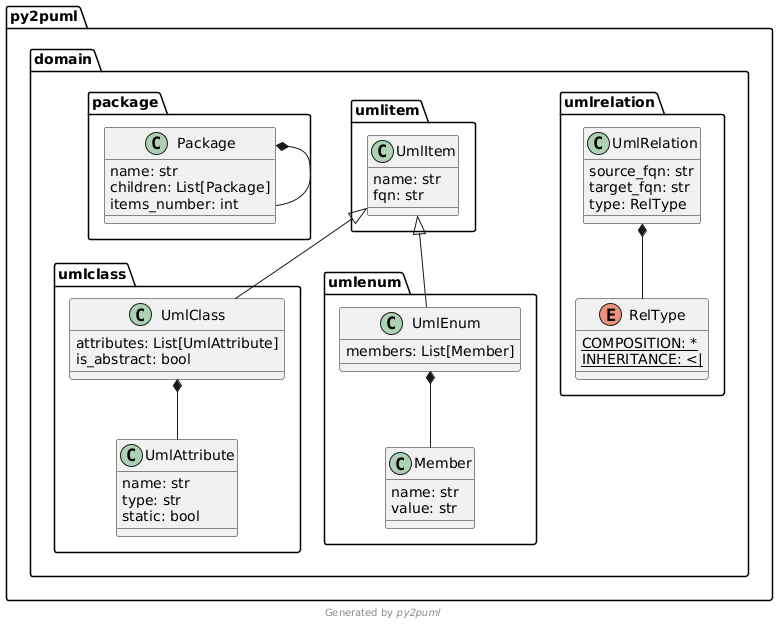 + +For a full overview of the CLI, run: + +```sh +py2puml --help +``` + +The CLI can also be launched as a python module: + +```sh +python -m py2puml py2puml/domain py2puml.domain +``` + +Pipe the result of the CLI with a PlantUML server for instantaneous documentation (rendered by ImageMagick): + +```sh +# runs a local PlantUML server from a docker container: +docker run -d --rm -p 1234:8080 --name plantumlserver plantuml/plantuml-server:jetty + +py2puml py2puml/domain py2puml.domain | curl -X POST --data-binary @- http://localhost:1234/svg/ --output - | display + +# stops the container when you don't need it anymore, restarts it later +docker stop plantumlserver +docker start plantumlserver +``` + +## Python API + +For example, to create the diagram of the classes used by `py2puml`: + +* import the `py2puml` function in your script (see [py2puml/example.py](py2puml/example.py)): + +```python +from py2puml.py2puml import py2puml + +if __name__ == '__main__': + # outputs the PlantUML content in the terminal + print(''.join(py2puml('py2puml/domain', 'py2puml.domain'))) + + # writes the PlantUML content in a file + with open('py2puml/domain.puml', 'w') as puml_file: + puml_file.writelines(py2puml('py2puml/domain', 'py2puml.domain')) +``` + +* running it (`python3 -m py2puml.example`) outputs the previous PlantUML diagram in the terminal and writes it in a file. + + +# Tests + +```sh +# directly with poetry +poetry run pytest -v + +# in a virtual environment +python3 -m pytest -v +``` + +Code coverage (with [missed branch statements](https://pytest-cov.readthedocs.io/en/latest/config.html?highlight=--cov-branch)): + +```sh +poetry run pytest -v --cov=py2puml --cov-branch --cov-report term-missing --cov-fail-under 92 +``` + +# Changelog + +* `0.7.2`: added the current working directory to the import path to make py2puml work in any directory or in native virtual environment (not handled by poetry) +* `0.7.1`: removed obsolete part of documentation: deeply compound types are now well handled (by version `0.7.0`) +* `0.7.0`: improved the generated PlantUML documentation (added the namespace structure of the code base, homogenized type between inspection and parsing), improved relationships management (handle forward references, deduplicate relationships) +* `0.6.1`: handle class names with digits +* `0.6.0`: handle abstract classes +* `0.5.4`: fixed the packaging so that the contribution guide is included in the published package +* `0.5.3`: handle constructors decorated by wrapping decorators (decorators making uses of `functools.wrap`) +* `0.5.2`: specify in pyproject.toml that py2puml requires python 3.8+ (`ast.get_source_segment` was introduced in 3.8) +* `0.5.1`: prevent from parsing inherited constructors +* `0.5.0`: handle instance attributes in class constructors, add code coverage of unit tests +* `0.4.0`: add a simple CLI +* `0.3.1`: inspect sub-folders recursively +* `0.3.0`: handle classes derived from namedtuples (attribute types are `Any`) +* `0.2.0`: handle inheritance relationships and enums +* `0.1.3`: first release, handle all modules of a folder and compositions of domain classes + +# Licence + +Unless stated otherwise all works are licensed under the [MIT license](http://spdx.org/licenses/MIT.html), a copy of which is included [here](LICENSE). + +# Contributions + +* [Luc Sorel-Giffo](https://github.com/lucsorel) +* [Doyou Jung](https://github.com/doyou89) +* [Julien Jerphanion](https://github.com/jjerphan) +* [Luis Fernando Villanueva Pérez](https://github.com/jonykalavera) + +Pull-requests are welcome and will be processed on a best-effort basis. +Follow the [contributing guide](CONTRIBUTING.md). + +# Current limitations + +* regarding **inspection** + + * type hinting is optional when writing Python code and discarded when it is executed, as mentionned in the [typing official documentation](https://docs.python.org/3/library/typing.html). The quality of the diagram output by `py2puml` depends on the reliability with which the type annotations were written + + > The Python runtime does not enforce function and variable type annotations. They can be used by third party tools such as type checkers, IDEs, linters, etc. + +* regarding the detection of instance attributes with **AST parsing**: + * only constructors are visited, attributes assigned in other functions won't be documented + * attribute types are inferred from type annotations: + * of the attribute itself + * of the variable assigned to the attribute: a signature parameter or a locale variable + * to avoid side-effects, no code is executed nor interpreted + +# Alternatives + +If `py2puml` does not meet your needs (suggestions and pull-requests are **welcome**), you can have a look at these projects which follow other approaches (AST, linting, modeling): + +* [pyreverse](https://pylint.pycqa.org/en/latest/additional_commands/index.html#pyreverse), which includes a PlantUML printer [since version 2.10.0](https://pylint.pycqa.org/en/latest/whatsnew/changelog.html?highlight=plantuml#what-s-new-in-pylint-2-10-0) +* [cb109/pyplantuml](https://github.com/cb109/pyplantuml) +* [deadbok/py-puml-tools](https://github.com/deadbok/py-puml-tools) +* [caballero/genUML](https://github.com/jose-caballero/genUML) + + +%package -n python3-py2puml +Summary: Generate PlantUML class diagrams to document your Python application. +Provides: python-py2puml +BuildRequires: python3-devel +BuildRequires: python3-setuptools +BuildRequires: python3-pip +%description -n python3-py2puml +<div align="center"> + <a href="https://www.python.org/psf-landing/" target="_blank"> + <img width="350px" alt="Python logo" + src="https://www.python.org/static/community_logos/python-logo-generic.svg" /> + </a> + <a href="http://plantuml.com/" target="_blank"> + <img width="116px" height="112px" alt="PlantUML logo" src="http://s.plantuml.com/logoc.png" style="margin-bottom: 40px" vspace="40px" /> + </a> + <h1>Python to PlantUML</h1> +</div> + +Generate PlantUML class diagrams to document your Python application. + +# How it works + +`py2puml` produces a class diagram [PlantUML script](https://plantuml.com/en/class-diagram) representing classes properties (static and instance attributes) and their relations (composition and inheritance relationships). + +`py2puml` internally uses code [inspection](https://docs.python.org/3/library/inspect.html) (also called *reflexion* in other programming languages) and [abstract tree parsing](https://docs.python.org/3/library/ast.html) to retrieve relevant information. +Some parsing features are available only since Python 3.8 (like [ast.get_source_segment](https://docs.python.org/3/library/ast.html#ast.get_source_segment)). + +## Features + +From a given path corresponding to a folder containing Python code, `py2puml` processes each Python module and generates a [PlantUML script](https://plantuml.com/en/class-diagram) from the definitions of various data structures using: + +* **[inspection](https://docs.python.org/3/library/inspect.html)** and [type annotations](https://docs.python.org/3/library/typing.html) to detect: + * static class attributes and [dataclass](https://docs.python.org/3/library/dataclasses.html) fields + * fields of [namedtuples](https://docs.python.org/3/library/collections.html#collections.namedtuple) + * members of [enumerations](https://docs.python.org/3/library/enum.html) + * composition and inheritance relationships (between your domain classes only, for documentation sake). +The detection of composition relationships relies on type annotations only, assigned values or expressions are never evaluated to prevent unwanted side-effects + +* parsing **[abstract syntax trees](https://docs.python.org/3/library/ast.html#ast.NodeVisitor)** to detect the instance attributes defined in `__init__` constructors + +`py2puml` outputs diagrams in PlantUML syntax, which can be: +* versioned along your code with a unit-test ensuring its consistency (see the [test_py2puml.py's test_py2puml_model_on_py2uml_domain](tests/py2puml/test_py2puml.py) example) +* generated and hosted along other code documentation (better option: generated documentation should not be versioned with the codebase) + +To generate image files, use the PlantUML runtime, a docker image of the runtime (see [think/plantuml](https://hub.docker.com/r/think/plantuml)) or of a server (see the CLI documentation below) + +If you like tools related with PlantUML, you may also be interested in this [lucsorel/plantuml-file-loader](https://github.com/lucsorel/plantuml-file-loader) project: +a webpack loader which converts PlantUML files into images during the webpack processing (useful to [include PlantUML diagrams in your slides](https://github.com/lucsorel/markdown-image-loader/blob/master/README.md#web-based-slideshows) with RevealJS or RemarkJS). + +# Install + +Install from [PyPI](https://pypi.org/project/py2puml/): + +* with `pip`: + +```sh +pip install py2puml +``` + +* with [poetry](https://python-poetry.org/docs/): + +```sh +poetry add py2puml +``` + +* with [pipenv](https://pipenv.readthedocs.io/en/latest/): + +```sh +pipenv install py2puml +``` + +# Usage + +## CLI + +Once `py2puml` is installed at the system level, an eponymous command is available in your environment shell. + +For example, to create the diagram of the classes used by `py2puml`, run: + +```sh +py2puml py2puml/domain py2puml.domain +``` + +This outputs the following PlantUML content: + +```plantuml +@startuml py2puml.domain +namespace py2puml.domain { + namespace package {} + namespace umlclass {} + namespace umlitem {} + namespace umlenum {} + namespace umlrelation {} +} +class py2puml.domain.package.Package { + name: str + children: List[Package] + items_number: int +} +class py2puml.domain.umlclass.UmlAttribute { + name: str + type: str + static: bool +} +class py2puml.domain.umlclass.UmlClass { + attributes: List[UmlAttribute] + is_abstract: bool +} +class py2puml.domain.umlitem.UmlItem { + name: str + fqn: str +} +class py2puml.domain.umlenum.Member { + name: str + value: str +} +class py2puml.domain.umlenum.UmlEnum { + members: List[Member] +} +enum py2puml.domain.umlrelation.RelType { + COMPOSITION: * {static} + INHERITANCE: <| {static} +} +class py2puml.domain.umlrelation.UmlRelation { + source_fqn: str + target_fqn: str + type: RelType +} +py2puml.domain.package.Package *-- py2puml.domain.package.Package +py2puml.domain.umlclass.UmlClass *-- py2puml.domain.umlclass.UmlAttribute +py2puml.domain.umlitem.UmlItem <|-- py2puml.domain.umlclass.UmlClass +py2puml.domain.umlenum.UmlEnum *-- py2puml.domain.umlenum.Member +py2puml.domain.umlitem.UmlItem <|-- py2puml.domain.umlenum.UmlEnum +py2puml.domain.umlrelation.UmlRelation *-- py2puml.domain.umlrelation.RelType +footer Generated by //py2puml// +@enduml +``` + +Using PlantUML, this content is rendered as this diagram: + + + +For a full overview of the CLI, run: + +```sh +py2puml --help +``` + +The CLI can also be launched as a python module: + +```sh +python -m py2puml py2puml/domain py2puml.domain +``` + +Pipe the result of the CLI with a PlantUML server for instantaneous documentation (rendered by ImageMagick): + +```sh +# runs a local PlantUML server from a docker container: +docker run -d --rm -p 1234:8080 --name plantumlserver plantuml/plantuml-server:jetty + +py2puml py2puml/domain py2puml.domain | curl -X POST --data-binary @- http://localhost:1234/svg/ --output - | display + +# stops the container when you don't need it anymore, restarts it later +docker stop plantumlserver +docker start plantumlserver +``` + +## Python API + +For example, to create the diagram of the classes used by `py2puml`: + +* import the `py2puml` function in your script (see [py2puml/example.py](py2puml/example.py)): + +```python +from py2puml.py2puml import py2puml + +if __name__ == '__main__': + # outputs the PlantUML content in the terminal + print(''.join(py2puml('py2puml/domain', 'py2puml.domain'))) + + # writes the PlantUML content in a file + with open('py2puml/domain.puml', 'w') as puml_file: + puml_file.writelines(py2puml('py2puml/domain', 'py2puml.domain')) +``` + +* running it (`python3 -m py2puml.example`) outputs the previous PlantUML diagram in the terminal and writes it in a file. + + +# Tests + +```sh +# directly with poetry +poetry run pytest -v + +# in a virtual environment +python3 -m pytest -v +``` + +Code coverage (with [missed branch statements](https://pytest-cov.readthedocs.io/en/latest/config.html?highlight=--cov-branch)): + +```sh +poetry run pytest -v --cov=py2puml --cov-branch --cov-report term-missing --cov-fail-under 92 +``` + +# Changelog + +* `0.7.2`: added the current working directory to the import path to make py2puml work in any directory or in native virtual environment (not handled by poetry) +* `0.7.1`: removed obsolete part of documentation: deeply compound types are now well handled (by version `0.7.0`) +* `0.7.0`: improved the generated PlantUML documentation (added the namespace structure of the code base, homogenized type between inspection and parsing), improved relationships management (handle forward references, deduplicate relationships) +* `0.6.1`: handle class names with digits +* `0.6.0`: handle abstract classes +* `0.5.4`: fixed the packaging so that the contribution guide is included in the published package +* `0.5.3`: handle constructors decorated by wrapping decorators (decorators making uses of `functools.wrap`) +* `0.5.2`: specify in pyproject.toml that py2puml requires python 3.8+ (`ast.get_source_segment` was introduced in 3.8) +* `0.5.1`: prevent from parsing inherited constructors +* `0.5.0`: handle instance attributes in class constructors, add code coverage of unit tests +* `0.4.0`: add a simple CLI +* `0.3.1`: inspect sub-folders recursively +* `0.3.0`: handle classes derived from namedtuples (attribute types are `Any`) +* `0.2.0`: handle inheritance relationships and enums +* `0.1.3`: first release, handle all modules of a folder and compositions of domain classes + +# Licence + +Unless stated otherwise all works are licensed under the [MIT license](http://spdx.org/licenses/MIT.html), a copy of which is included [here](LICENSE). + +# Contributions + +* [Luc Sorel-Giffo](https://github.com/lucsorel) +* [Doyou Jung](https://github.com/doyou89) +* [Julien Jerphanion](https://github.com/jjerphan) +* [Luis Fernando Villanueva Pérez](https://github.com/jonykalavera) + +Pull-requests are welcome and will be processed on a best-effort basis. +Follow the [contributing guide](CONTRIBUTING.md). + +# Current limitations + +* regarding **inspection** + + * type hinting is optional when writing Python code and discarded when it is executed, as mentionned in the [typing official documentation](https://docs.python.org/3/library/typing.html). The quality of the diagram output by `py2puml` depends on the reliability with which the type annotations were written + + > The Python runtime does not enforce function and variable type annotations. They can be used by third party tools such as type checkers, IDEs, linters, etc. + +* regarding the detection of instance attributes with **AST parsing**: + * only constructors are visited, attributes assigned in other functions won't be documented + * attribute types are inferred from type annotations: + * of the attribute itself + * of the variable assigned to the attribute: a signature parameter or a locale variable + * to avoid side-effects, no code is executed nor interpreted + +# Alternatives + +If `py2puml` does not meet your needs (suggestions and pull-requests are **welcome**), you can have a look at these projects which follow other approaches (AST, linting, modeling): + +* [pyreverse](https://pylint.pycqa.org/en/latest/additional_commands/index.html#pyreverse), which includes a PlantUML printer [since version 2.10.0](https://pylint.pycqa.org/en/latest/whatsnew/changelog.html?highlight=plantuml#what-s-new-in-pylint-2-10-0) +* [cb109/pyplantuml](https://github.com/cb109/pyplantuml) +* [deadbok/py-puml-tools](https://github.com/deadbok/py-puml-tools) +* [caballero/genUML](https://github.com/jose-caballero/genUML) + + +%package help +Summary: Development documents and examples for py2puml +Provides: python3-py2puml-doc +%description help +<div align="center"> + <a href="https://www.python.org/psf-landing/" target="_blank"> + <img width="350px" alt="Python logo" + src="https://www.python.org/static/community_logos/python-logo-generic.svg" /> + </a> + <a href="http://plantuml.com/" target="_blank"> + <img width="116px" height="112px" alt="PlantUML logo" src="http://s.plantuml.com/logoc.png" style="margin-bottom: 40px" vspace="40px" /> + </a> + <h1>Python to PlantUML</h1> +</div> + +Generate PlantUML class diagrams to document your Python application. + +# How it works + +`py2puml` produces a class diagram [PlantUML script](https://plantuml.com/en/class-diagram) representing classes properties (static and instance attributes) and their relations (composition and inheritance relationships). + +`py2puml` internally uses code [inspection](https://docs.python.org/3/library/inspect.html) (also called *reflexion* in other programming languages) and [abstract tree parsing](https://docs.python.org/3/library/ast.html) to retrieve relevant information. +Some parsing features are available only since Python 3.8 (like [ast.get_source_segment](https://docs.python.org/3/library/ast.html#ast.get_source_segment)). + +## Features + +From a given path corresponding to a folder containing Python code, `py2puml` processes each Python module and generates a [PlantUML script](https://plantuml.com/en/class-diagram) from the definitions of various data structures using: + +* **[inspection](https://docs.python.org/3/library/inspect.html)** and [type annotations](https://docs.python.org/3/library/typing.html) to detect: + * static class attributes and [dataclass](https://docs.python.org/3/library/dataclasses.html) fields + * fields of [namedtuples](https://docs.python.org/3/library/collections.html#collections.namedtuple) + * members of [enumerations](https://docs.python.org/3/library/enum.html) + * composition and inheritance relationships (between your domain classes only, for documentation sake). +The detection of composition relationships relies on type annotations only, assigned values or expressions are never evaluated to prevent unwanted side-effects + +* parsing **[abstract syntax trees](https://docs.python.org/3/library/ast.html#ast.NodeVisitor)** to detect the instance attributes defined in `__init__` constructors + +`py2puml` outputs diagrams in PlantUML syntax, which can be: +* versioned along your code with a unit-test ensuring its consistency (see the [test_py2puml.py's test_py2puml_model_on_py2uml_domain](tests/py2puml/test_py2puml.py) example) +* generated and hosted along other code documentation (better option: generated documentation should not be versioned with the codebase) + +To generate image files, use the PlantUML runtime, a docker image of the runtime (see [think/plantuml](https://hub.docker.com/r/think/plantuml)) or of a server (see the CLI documentation below) + +If you like tools related with PlantUML, you may also be interested in this [lucsorel/plantuml-file-loader](https://github.com/lucsorel/plantuml-file-loader) project: +a webpack loader which converts PlantUML files into images during the webpack processing (useful to [include PlantUML diagrams in your slides](https://github.com/lucsorel/markdown-image-loader/blob/master/README.md#web-based-slideshows) with RevealJS or RemarkJS). + +# Install + +Install from [PyPI](https://pypi.org/project/py2puml/): + +* with `pip`: + +```sh +pip install py2puml +``` + +* with [poetry](https://python-poetry.org/docs/): + +```sh +poetry add py2puml +``` + +* with [pipenv](https://pipenv.readthedocs.io/en/latest/): + +```sh +pipenv install py2puml +``` + +# Usage + +## CLI + +Once `py2puml` is installed at the system level, an eponymous command is available in your environment shell. + +For example, to create the diagram of the classes used by `py2puml`, run: + +```sh +py2puml py2puml/domain py2puml.domain +``` + +This outputs the following PlantUML content: + +```plantuml +@startuml py2puml.domain +namespace py2puml.domain { + namespace package {} + namespace umlclass {} + namespace umlitem {} + namespace umlenum {} + namespace umlrelation {} +} +class py2puml.domain.package.Package { + name: str + children: List[Package] + items_number: int +} +class py2puml.domain.umlclass.UmlAttribute { + name: str + type: str + static: bool +} +class py2puml.domain.umlclass.UmlClass { + attributes: List[UmlAttribute] + is_abstract: bool +} +class py2puml.domain.umlitem.UmlItem { + name: str + fqn: str +} +class py2puml.domain.umlenum.Member { + name: str + value: str +} +class py2puml.domain.umlenum.UmlEnum { + members: List[Member] +} +enum py2puml.domain.umlrelation.RelType { + COMPOSITION: * {static} + INHERITANCE: <| {static} +} +class py2puml.domain.umlrelation.UmlRelation { + source_fqn: str + target_fqn: str + type: RelType +} +py2puml.domain.package.Package *-- py2puml.domain.package.Package +py2puml.domain.umlclass.UmlClass *-- py2puml.domain.umlclass.UmlAttribute +py2puml.domain.umlitem.UmlItem <|-- py2puml.domain.umlclass.UmlClass +py2puml.domain.umlenum.UmlEnum *-- py2puml.domain.umlenum.Member +py2puml.domain.umlitem.UmlItem <|-- py2puml.domain.umlenum.UmlEnum +py2puml.domain.umlrelation.UmlRelation *-- py2puml.domain.umlrelation.RelType +footer Generated by //py2puml// +@enduml +``` + +Using PlantUML, this content is rendered as this diagram: + + + +For a full overview of the CLI, run: + +```sh +py2puml --help +``` + +The CLI can also be launched as a python module: + +```sh +python -m py2puml py2puml/domain py2puml.domain +``` + +Pipe the result of the CLI with a PlantUML server for instantaneous documentation (rendered by ImageMagick): + +```sh +# runs a local PlantUML server from a docker container: +docker run -d --rm -p 1234:8080 --name plantumlserver plantuml/plantuml-server:jetty + +py2puml py2puml/domain py2puml.domain | curl -X POST --data-binary @- http://localhost:1234/svg/ --output - | display + +# stops the container when you don't need it anymore, restarts it later +docker stop plantumlserver +docker start plantumlserver +``` + +## Python API + +For example, to create the diagram of the classes used by `py2puml`: + +* import the `py2puml` function in your script (see [py2puml/example.py](py2puml/example.py)): + +```python +from py2puml.py2puml import py2puml + +if __name__ == '__main__': + # outputs the PlantUML content in the terminal + print(''.join(py2puml('py2puml/domain', 'py2puml.domain'))) + + # writes the PlantUML content in a file + with open('py2puml/domain.puml', 'w') as puml_file: + puml_file.writelines(py2puml('py2puml/domain', 'py2puml.domain')) +``` + +* running it (`python3 -m py2puml.example`) outputs the previous PlantUML diagram in the terminal and writes it in a file. + + +# Tests + +```sh +# directly with poetry +poetry run pytest -v + +# in a virtual environment +python3 -m pytest -v +``` + +Code coverage (with [missed branch statements](https://pytest-cov.readthedocs.io/en/latest/config.html?highlight=--cov-branch)): + +```sh +poetry run pytest -v --cov=py2puml --cov-branch --cov-report term-missing --cov-fail-under 92 +``` + +# Changelog + +* `0.7.2`: added the current working directory to the import path to make py2puml work in any directory or in native virtual environment (not handled by poetry) +* `0.7.1`: removed obsolete part of documentation: deeply compound types are now well handled (by version `0.7.0`) +* `0.7.0`: improved the generated PlantUML documentation (added the namespace structure of the code base, homogenized type between inspection and parsing), improved relationships management (handle forward references, deduplicate relationships) +* `0.6.1`: handle class names with digits +* `0.6.0`: handle abstract classes +* `0.5.4`: fixed the packaging so that the contribution guide is included in the published package +* `0.5.3`: handle constructors decorated by wrapping decorators (decorators making uses of `functools.wrap`) +* `0.5.2`: specify in pyproject.toml that py2puml requires python 3.8+ (`ast.get_source_segment` was introduced in 3.8) +* `0.5.1`: prevent from parsing inherited constructors +* `0.5.0`: handle instance attributes in class constructors, add code coverage of unit tests +* `0.4.0`: add a simple CLI +* `0.3.1`: inspect sub-folders recursively +* `0.3.0`: handle classes derived from namedtuples (attribute types are `Any`) +* `0.2.0`: handle inheritance relationships and enums +* `0.1.3`: first release, handle all modules of a folder and compositions of domain classes + +# Licence + +Unless stated otherwise all works are licensed under the [MIT license](http://spdx.org/licenses/MIT.html), a copy of which is included [here](LICENSE). + +# Contributions + +* [Luc Sorel-Giffo](https://github.com/lucsorel) +* [Doyou Jung](https://github.com/doyou89) +* [Julien Jerphanion](https://github.com/jjerphan) +* [Luis Fernando Villanueva Pérez](https://github.com/jonykalavera) + +Pull-requests are welcome and will be processed on a best-effort basis. +Follow the [contributing guide](CONTRIBUTING.md). + +# Current limitations + +* regarding **inspection** + + * type hinting is optional when writing Python code and discarded when it is executed, as mentionned in the [typing official documentation](https://docs.python.org/3/library/typing.html). The quality of the diagram output by `py2puml` depends on the reliability with which the type annotations were written + + > The Python runtime does not enforce function and variable type annotations. They can be used by third party tools such as type checkers, IDEs, linters, etc. + +* regarding the detection of instance attributes with **AST parsing**: + * only constructors are visited, attributes assigned in other functions won't be documented + * attribute types are inferred from type annotations: + * of the attribute itself + * of the variable assigned to the attribute: a signature parameter or a locale variable + * to avoid side-effects, no code is executed nor interpreted + +# Alternatives + +If `py2puml` does not meet your needs (suggestions and pull-requests are **welcome**), you can have a look at these projects which follow other approaches (AST, linting, modeling): + +* [pyreverse](https://pylint.pycqa.org/en/latest/additional_commands/index.html#pyreverse), which includes a PlantUML printer [since version 2.10.0](https://pylint.pycqa.org/en/latest/whatsnew/changelog.html?highlight=plantuml#what-s-new-in-pylint-2-10-0) +* [cb109/pyplantuml](https://github.com/cb109/pyplantuml) +* [deadbok/py-puml-tools](https://github.com/deadbok/py-puml-tools) +* [caballero/genUML](https://github.com/jose-caballero/genUML) + + +%prep +%autosetup -n py2puml-0.7.2 + +%build +%py3_build + +%install +%py3_install +install -d -m755 %{buildroot}/%{_pkgdocdir} +if [ -d doc ]; then cp -arf doc %{buildroot}/%{_pkgdocdir}; fi +if [ -d docs ]; then cp -arf docs %{buildroot}/%{_pkgdocdir}; fi +if [ -d example ]; then cp -arf example %{buildroot}/%{_pkgdocdir}; fi +if [ -d examples ]; then cp -arf examples %{buildroot}/%{_pkgdocdir}; fi +pushd %{buildroot} +if [ -d usr/lib ]; then + find usr/lib -type f -printf "/%h/%f\n" >> filelist.lst +fi +if [ -d usr/lib64 ]; then + find usr/lib64 -type f -printf "/%h/%f\n" >> filelist.lst +fi +if [ -d usr/bin ]; then + find usr/bin -type f -printf "/%h/%f\n" >> filelist.lst +fi +if [ -d usr/sbin ]; then + find usr/sbin -type f -printf "/%h/%f\n" >> filelist.lst +fi +touch doclist.lst +if [ -d usr/share/man ]; then + find usr/share/man -type f -printf "/%h/%f.gz\n" >> doclist.lst +fi +popd +mv %{buildroot}/filelist.lst . +mv %{buildroot}/doclist.lst . + +%files -n python3-py2puml -f filelist.lst +%dir %{python3_sitelib}/* + +%files help -f doclist.lst +%{_docdir}/* + +%changelog +* Mon May 29 2023 Python_Bot <Python_Bot@openeuler.org> - 0.7.2-1 +- Package Spec generated @@ -0,0 +1 @@ +c998e8a5e592f36c2bea517cb02dbc8a py2puml-0.7.2.tar.gz |