
diff options
| author | CoprDistGit <infra@openeuler.org> | 2023-04-10 19:47:44 +0000 |
|---|---|---|
| committer | CoprDistGit <infra@openeuler.org> | 2023-04-10 19:47:44 +0000 |
| commit | eed3d818e645bbb0e9e28b378631114477417708 (patch) | |
| tree | 188a872b11ca4cf4cf7263fcbdb0bde205fee2a3 | |
| parent | 03ac32f7e0cb32c3f8b1840fd09fca39b6fd794b (diff) | |
automatic import of python-pyglm
| -rw-r--r-- | .gitignore | 1 | ||||
| -rw-r--r-- | python-pyglm.spec | 668 | ||||
| -rw-r--r-- | sources | 1 |
3 files changed, 670 insertions, 0 deletions
@@ -0,0 +1 @@ +/PyGLM-2.7.0.tar.gz diff --git a/python-pyglm.spec b/python-pyglm.spec new file mode 100644 index 0000000..0e4d141 --- /dev/null +++ b/python-pyglm.spec @@ -0,0 +1,668 @@ +%global _empty_manifest_terminate_build 0 +Name: python-PyGLM +Version: 2.7.0 +Release: 1 +Summary: OpenGL Mathematics library for Python +License: zlib/libpng license +URL: https://github.com/Zuzu-Typ/PyGLM +Source0: https://mirrors.nju.edu.cn/pypi/web/packages/4e/4c/ca1a71217c4ac5b0f9ef56681ebe9eae14b5bb0d3ac8bb58f392bad445a5/PyGLM-2.7.0.tar.gz + + +%description +[//]: # (generated using SlashBack 0.2.0) + +# PyGLM +## OpenGL Mathematics \(GLM\) library for Python +**GLSL \+ Optional features \+ Python = PyGLM** +**A mathematics library for graphics programming\.** + +**PyGLM** is a Python extension written in **C\+\+**\. +By using [GLM by G\-Truc](https://glm.g-truc.net) under the hood, it manages to bring **glm's features** to Python\. +Some features are unsupported \(such as most unstable extensions\)\. +If you encounter any issues or want to request a feature, please create an issue on the [issue tracker](https://github.com/Zuzu-Typ/PyGLM/issues)\. + +**For a complete reference of the types and functions, please take a look at the [wiki](https://github.com/Zuzu-Typ/PyGLM/wiki)**\. + +## Tiny Documentation +### Why PyGLM? +Besides the obvious \- being mostly compatible with **GLM** \- PyGLM offers a variety of features for **vector** and **matrix manipulation**\. +It has a lot of possible use cases, including **3D\-Graphics** \(OpenGL, DirectX, \.\.\.\), **Physics** and more\. + +At the same time, it has **great performance**, usually being **a lot faster than numpy\!** \(see [end of page](#speed-comparison-to-numpy)\) +\(*depending on the individual function*\) +### Installation +**PyGLM** supports **Windows**, **Linux**, **MacOS** and other operating systems with either x86 \(**32\-bit**\) or x64 \(**64\-bit**\) architecture, +running **Python 3**\.5 or higher\. \(Prior versions of Python \- such as Python 2 \- were supported up to PyGLM version 0\.4\.8b1\) + +It can be installed from the [PyPI](https://pypi.python.org/pypi/PyGLM) using [pip](https://pip.pypa.io/en/stable/): +``` batch +pip install PyGLM +# please make sure to install "PyGLM" and not "glm", which is a different module + ``` +And finally imported and used: +``` python +import glm + ``` +### Using PyGLM +PyGLM's syntax is very similar to the original GLM's syntax\. +There is no need to import anything but **glm**, as it already contains the entire package\. + +For more information, take a look at the [wiki](https://github.com/Zuzu-Typ/PyGLM/wiki)\. +#### License requirements +Please make sure to **include the license for GLM** in your project when you use PyGLM\! +\(this is especially relevant for **binary distributions**, e\.g\. \*\.exe\) + +You can do so by copying the ``` COPYING ``` file \(or it's contents\) to your project\. +#### Differences to glm +Instead of using double colons \(**::**\) for namespaces, periods \(**\.**\) are used, so +``` glm::vec2 ``` becomes ``` glm.vec2 ```\. + +PyGLM supports the [buffer protocol](https://docs.python.org/3/c-api/buffer.html), meaning its compitible to other objects that support the buffer protocol, +such as ``` bytes ``` or ``` numpy.array ``` +\(for example you can convert a glm matrix to a numpy array and vice versa\)\. +PyGLM is also capable of interpreting iterables \(such as tuples\) as vectors, so e\.g\. the following equasion is possible: +``` python +result = glm.vec2(1) * (2, 3) + ``` +*Note: This feature might not or only partially be available in PyGLM versions prior to 2\.0\.0* + +PyGLM doesn't support precision qualifiers\. All types use the default precision \(``` packed_highp ```\)\. + +If a glm function normally accepts ``` float ``` and ``` double ``` arguments, the higher precision \(``` double ```\) is used\. + +There is no way to set preprocessor definitions \(macros\)\. +If \- for example \- you need to use the left handed coordinate system, you have to use **\*LH**, so +``` glm.perspective ``` becomes ``` glm.perspectiveLH ```\. + +All types are initialized by default to avoid memory access violations\. +\(i\.e\. the macro ``` GLM_FORCE_CTOR_INIT ``` is defined\) + +In case you need the size of a PyGLM datatype, you can use +``` python +glm.sizeof(<type>) + ``` + +The function ``` glm.identity ``` requires a matrix type as it's argument\. + +The function ``` glm.frexp(x, exp) ``` returns a tuple ``` (m, e) ```, if the input arguments are numerical\. +This function may issue a ``` UserWarning ```\. You can silence this warning using ``` glm.silence(1) ```\. + +The function ``` glm.value_ptr(x) ``` returns a ctypes pointer of the respective type\. +I\.e\. if the datatype of ``` x ``` is ``` float ```, then a ``` c_float ``` pointer will be returned\. +Likewise the reverse\-functions \(such as ``` make_vec2(ptr) ```\) will take a ctypes pointer as their argument +and return \(in this case\) a 2 component vector of the pointers underlying type\. + +``` glm.silence(ID) ``` can be used to silence specific warnings\. +Supplying an id of 0 will silence all warnings\. + + +### FAQ +#### How to pass the matrices generated by PyGLM to OpenGL functions? +You will find an overview on the \[[Passing data to external libs](wiki/Passing-data-to-external-libs.md)\] page\. + +#### Types and functions are not available after installing from the PyPI using ``` pip install glm ``` +Most likely you've installed [glm](https://pypi.org/project/glm/), a JSON parser and not [PyGLM](https://pypi.org/project/PyGLM/) \(or a very early version of PyGLM\)\. +The correct install command is: +``` +pip install PyGLM + ``` + +#### Why is *<experimental extension name here>* not supported? +I prefer not to add too many experimental extensions to PyGLM, especially as they might change or be removed in the future and it is simply too much effort for me to keep up with all that\. +If you **need a specific experimental extension**, feel free to **submit a feature request** on the [issue tracker](https://github.com/Zuzu-Typ/PyGLM/issues)\. +I try adding them on a one\-by\-one basis\. + +#### Why are Python versions prior to 3\.5 no longer supported? +Starting with version [0\.5\.0b1](https://github.com/Zuzu-Typ/PyGLM/releases/tag/0.5.0b1) I decided to use C\+\+ to build PyGLM, using [glm](https://glm.g-truc.net/) under the hood \- which requires C\+\+ 11 or upwards\. +Only Python versions 3\.5\+ support C\+\+ 11, thus I was forced to stop supporting older versions\. +The last version to support Python 2 and <3\.5 is [0\.4\.8b1](https://github.com/Zuzu-Typ/PyGLM/releases/tag/0.4.8b1)\. + +### Short example +``` Python +>>> import glm +>>> v = glm.vec3() +>>> v.x = 7 +>>> print(v.xxy) +vec3( 7, 7, 0 ) + +>>> m = glm.mat4() +>>> print(m) +[ 1 | 0 | 0 | 0 ] +[ 0 | 1 | 0 | 0 ] +[ 0 | 0 | 1 | 0 ] +[ 0 | 0 | 0 | 1 ] + +>>> v = glm.vec4(1, 2, 3, 4) +>>> print(v + (8, 7, 6, 5)) +vec4( 9, 9, 9, 9 ) + ``` + +### PyGLM in action +Wanna see what PyGLM can do? +Take a look at the [examples](https://github.com/Zuzu-Typ/LearnOpenGL-Python) from the popular LearnOpenGL tutorials by Joey De Vries running in Python using PyGLM\. +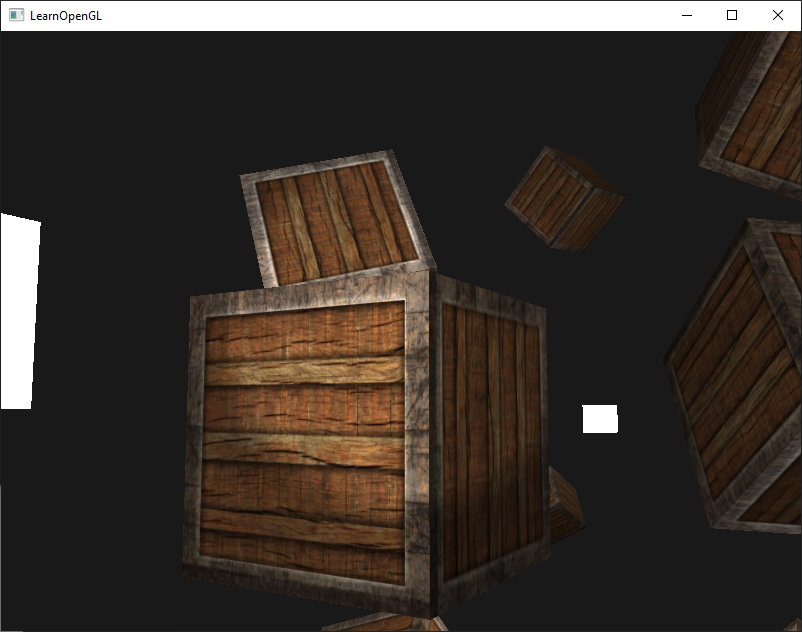 + +### Speed comparison to numpy +The following is the output generated by [test/PyGLM vs Numpy\.py](https://github.com/Zuzu-Typ/PyGLM/blob/master/test/PyGLM%20vs%20NumPy.py) +``` +Evaluating performance of PyGLM compared to NumPy. + +Running on platform 'win32'. + +Python version: +3.10.0 (tags/v3.10.0:b494f59, Oct 4 2021, 19:00:18) [MSC v.1929 64 bit (AMD64)] + +Comparing the following module versions: +PyGLM (DEFAULT) version 2.5.2 + vs +NumPy version 1.21.3 +________________________________________________________________________________ + +The following table shows information about a task to be achieved and the time +it took when using the given module. Lower time is better. +Each task is repeated ten times per module, only showing the best (i.e. lowest) +value. + + ++----------------------------------------+------------+------------+-----------+ +| Description | PyGLM time | NumPy time | ratio | ++----------------------------------------+------------+------------+-----------+ +| 3 component vector creation | | | | +| (100,000 times) | 8ms | 21ms | 2.69x | ++----------------------------------------+------------+------------+-----------+ +| 3 component vector creation with | | | | +| custom components | | | | +| (50,000 times) | 8ms | 34ms | 4.32x | ++----------------------------------------+------------+------------+-----------+ +| dot product | | | | +| (50,000 times) | 4ms | 49ms | 10.93x | ++----------------------------------------+------------+------------+-----------+ +| cross product | | | | +| (25,000 times) | 2ms | 548ms | 234.34x | ++----------------------------------------+------------+------------+-----------+ +| L2-Norm of 3 component vector | | | | +| (100,000 times) | 7ms | 310ms | 44.49x | ++----------------------------------------+------------+------------+-----------+ +| 4x4 matrix creation | | | | +| (50,000 times) | 5ms | 11ms | 2.32x | ++----------------------------------------+------------+------------+-----------+ +| 4x4 identity matrix creation | | | | +| (100,000 times) | 7ms | 176ms | 24.05x | ++----------------------------------------+------------+------------+-----------+ +| 4x4 matrix transposition | | | | +| (50,000 times) | 5ms | 32ms | 6.19x | ++----------------------------------------+------------+------------+-----------+ +| 4x4 multiplicative inverse | | | | +| (50,000 times) | 4ms | 1925ms | 470.77x | ++----------------------------------------+------------+------------+-----------+ +| 3 component vector addition | | | | +| (100,000 times) | 5ms | 38ms | 7.17x | ++----------------------------------------+------------+------------+-----------+ +| 4x4 matrix multiplication | | | | +| (100,000 times) | 7ms | 39ms | 5.36x | ++----------------------------------------+------------+------------+-----------+ +| 4x4 matrix x vector multiplication | | | | +| (100,000 times) | 6ms | 116ms | 20.01x | ++----------------------------------------+------------+------------+-----------+ +| TOTAL | 0.07s | 3.30s | 47.78x | ++----------------------------------------+------------+------------+-----------+ + ``` + + +%package -n python3-PyGLM +Summary: OpenGL Mathematics library for Python +Provides: python-PyGLM +BuildRequires: python3-devel +BuildRequires: python3-setuptools +BuildRequires: python3-pip +BuildRequires: python3-cffi +BuildRequires: gcc +BuildRequires: gdb +%description -n python3-PyGLM +[//]: # (generated using SlashBack 0.2.0) + +# PyGLM +## OpenGL Mathematics \(GLM\) library for Python +**GLSL \+ Optional features \+ Python = PyGLM** +**A mathematics library for graphics programming\.** + +**PyGLM** is a Python extension written in **C\+\+**\. +By using [GLM by G\-Truc](https://glm.g-truc.net) under the hood, it manages to bring **glm's features** to Python\. +Some features are unsupported \(such as most unstable extensions\)\. +If you encounter any issues or want to request a feature, please create an issue on the [issue tracker](https://github.com/Zuzu-Typ/PyGLM/issues)\. + +**For a complete reference of the types and functions, please take a look at the [wiki](https://github.com/Zuzu-Typ/PyGLM/wiki)**\. + +## Tiny Documentation +### Why PyGLM? +Besides the obvious \- being mostly compatible with **GLM** \- PyGLM offers a variety of features for **vector** and **matrix manipulation**\. +It has a lot of possible use cases, including **3D\-Graphics** \(OpenGL, DirectX, \.\.\.\), **Physics** and more\. + +At the same time, it has **great performance**, usually being **a lot faster than numpy\!** \(see [end of page](#speed-comparison-to-numpy)\) +\(*depending on the individual function*\) +### Installation +**PyGLM** supports **Windows**, **Linux**, **MacOS** and other operating systems with either x86 \(**32\-bit**\) or x64 \(**64\-bit**\) architecture, +running **Python 3**\.5 or higher\. \(Prior versions of Python \- such as Python 2 \- were supported up to PyGLM version 0\.4\.8b1\) + +It can be installed from the [PyPI](https://pypi.python.org/pypi/PyGLM) using [pip](https://pip.pypa.io/en/stable/): +``` batch +pip install PyGLM +# please make sure to install "PyGLM" and not "glm", which is a different module + ``` +And finally imported and used: +``` python +import glm + ``` +### Using PyGLM +PyGLM's syntax is very similar to the original GLM's syntax\. +There is no need to import anything but **glm**, as it already contains the entire package\. + +For more information, take a look at the [wiki](https://github.com/Zuzu-Typ/PyGLM/wiki)\. +#### License requirements +Please make sure to **include the license for GLM** in your project when you use PyGLM\! +\(this is especially relevant for **binary distributions**, e\.g\. \*\.exe\) + +You can do so by copying the ``` COPYING ``` file \(or it's contents\) to your project\. +#### Differences to glm +Instead of using double colons \(**::**\) for namespaces, periods \(**\.**\) are used, so +``` glm::vec2 ``` becomes ``` glm.vec2 ```\. + +PyGLM supports the [buffer protocol](https://docs.python.org/3/c-api/buffer.html), meaning its compitible to other objects that support the buffer protocol, +such as ``` bytes ``` or ``` numpy.array ``` +\(for example you can convert a glm matrix to a numpy array and vice versa\)\. +PyGLM is also capable of interpreting iterables \(such as tuples\) as vectors, so e\.g\. the following equasion is possible: +``` python +result = glm.vec2(1) * (2, 3) + ``` +*Note: This feature might not or only partially be available in PyGLM versions prior to 2\.0\.0* + +PyGLM doesn't support precision qualifiers\. All types use the default precision \(``` packed_highp ```\)\. + +If a glm function normally accepts ``` float ``` and ``` double ``` arguments, the higher precision \(``` double ```\) is used\. + +There is no way to set preprocessor definitions \(macros\)\. +If \- for example \- you need to use the left handed coordinate system, you have to use **\*LH**, so +``` glm.perspective ``` becomes ``` glm.perspectiveLH ```\. + +All types are initialized by default to avoid memory access violations\. +\(i\.e\. the macro ``` GLM_FORCE_CTOR_INIT ``` is defined\) + +In case you need the size of a PyGLM datatype, you can use +``` python +glm.sizeof(<type>) + ``` + +The function ``` glm.identity ``` requires a matrix type as it's argument\. + +The function ``` glm.frexp(x, exp) ``` returns a tuple ``` (m, e) ```, if the input arguments are numerical\. +This function may issue a ``` UserWarning ```\. You can silence this warning using ``` glm.silence(1) ```\. + +The function ``` glm.value_ptr(x) ``` returns a ctypes pointer of the respective type\. +I\.e\. if the datatype of ``` x ``` is ``` float ```, then a ``` c_float ``` pointer will be returned\. +Likewise the reverse\-functions \(such as ``` make_vec2(ptr) ```\) will take a ctypes pointer as their argument +and return \(in this case\) a 2 component vector of the pointers underlying type\. + +``` glm.silence(ID) ``` can be used to silence specific warnings\. +Supplying an id of 0 will silence all warnings\. + + +### FAQ +#### How to pass the matrices generated by PyGLM to OpenGL functions? +You will find an overview on the \[[Passing data to external libs](wiki/Passing-data-to-external-libs.md)\] page\. + +#### Types and functions are not available after installing from the PyPI using ``` pip install glm ``` +Most likely you've installed [glm](https://pypi.org/project/glm/), a JSON parser and not [PyGLM](https://pypi.org/project/PyGLM/) \(or a very early version of PyGLM\)\. +The correct install command is: +``` +pip install PyGLM + ``` + +#### Why is *<experimental extension name here>* not supported? +I prefer not to add too many experimental extensions to PyGLM, especially as they might change or be removed in the future and it is simply too much effort for me to keep up with all that\. +If you **need a specific experimental extension**, feel free to **submit a feature request** on the [issue tracker](https://github.com/Zuzu-Typ/PyGLM/issues)\. +I try adding them on a one\-by\-one basis\. + +#### Why are Python versions prior to 3\.5 no longer supported? +Starting with version [0\.5\.0b1](https://github.com/Zuzu-Typ/PyGLM/releases/tag/0.5.0b1) I decided to use C\+\+ to build PyGLM, using [glm](https://glm.g-truc.net/) under the hood \- which requires C\+\+ 11 or upwards\. +Only Python versions 3\.5\+ support C\+\+ 11, thus I was forced to stop supporting older versions\. +The last version to support Python 2 and <3\.5 is [0\.4\.8b1](https://github.com/Zuzu-Typ/PyGLM/releases/tag/0.4.8b1)\. + +### Short example +``` Python +>>> import glm +>>> v = glm.vec3() +>>> v.x = 7 +>>> print(v.xxy) +vec3( 7, 7, 0 ) + +>>> m = glm.mat4() +>>> print(m) +[ 1 | 0 | 0 | 0 ] +[ 0 | 1 | 0 | 0 ] +[ 0 | 0 | 1 | 0 ] +[ 0 | 0 | 0 | 1 ] + +>>> v = glm.vec4(1, 2, 3, 4) +>>> print(v + (8, 7, 6, 5)) +vec4( 9, 9, 9, 9 ) + ``` + +### PyGLM in action +Wanna see what PyGLM can do? +Take a look at the [examples](https://github.com/Zuzu-Typ/LearnOpenGL-Python) from the popular LearnOpenGL tutorials by Joey De Vries running in Python using PyGLM\. + + +### Speed comparison to numpy +The following is the output generated by [test/PyGLM vs Numpy\.py](https://github.com/Zuzu-Typ/PyGLM/blob/master/test/PyGLM%20vs%20NumPy.py) +``` +Evaluating performance of PyGLM compared to NumPy. + +Running on platform 'win32'. + +Python version: +3.10.0 (tags/v3.10.0:b494f59, Oct 4 2021, 19:00:18) [MSC v.1929 64 bit (AMD64)] + +Comparing the following module versions: +PyGLM (DEFAULT) version 2.5.2 + vs +NumPy version 1.21.3 +________________________________________________________________________________ + +The following table shows information about a task to be achieved and the time +it took when using the given module. Lower time is better. +Each task is repeated ten times per module, only showing the best (i.e. lowest) +value. + + ++----------------------------------------+------------+------------+-----------+ +| Description | PyGLM time | NumPy time | ratio | ++----------------------------------------+------------+------------+-----------+ +| 3 component vector creation | | | | +| (100,000 times) | 8ms | 21ms | 2.69x | ++----------------------------------------+------------+------------+-----------+ +| 3 component vector creation with | | | | +| custom components | | | | +| (50,000 times) | 8ms | 34ms | 4.32x | ++----------------------------------------+------------+------------+-----------+ +| dot product | | | | +| (50,000 times) | 4ms | 49ms | 10.93x | ++----------------------------------------+------------+------------+-----------+ +| cross product | | | | +| (25,000 times) | 2ms | 548ms | 234.34x | ++----------------------------------------+------------+------------+-----------+ +| L2-Norm of 3 component vector | | | | +| (100,000 times) | 7ms | 310ms | 44.49x | ++----------------------------------------+------------+------------+-----------+ +| 4x4 matrix creation | | | | +| (50,000 times) | 5ms | 11ms | 2.32x | ++----------------------------------------+------------+------------+-----------+ +| 4x4 identity matrix creation | | | | +| (100,000 times) | 7ms | 176ms | 24.05x | ++----------------------------------------+------------+------------+-----------+ +| 4x4 matrix transposition | | | | +| (50,000 times) | 5ms | 32ms | 6.19x | ++----------------------------------------+------------+------------+-----------+ +| 4x4 multiplicative inverse | | | | +| (50,000 times) | 4ms | 1925ms | 470.77x | ++----------------------------------------+------------+------------+-----------+ +| 3 component vector addition | | | | +| (100,000 times) | 5ms | 38ms | 7.17x | ++----------------------------------------+------------+------------+-----------+ +| 4x4 matrix multiplication | | | | +| (100,000 times) | 7ms | 39ms | 5.36x | ++----------------------------------------+------------+------------+-----------+ +| 4x4 matrix x vector multiplication | | | | +| (100,000 times) | 6ms | 116ms | 20.01x | ++----------------------------------------+------------+------------+-----------+ +| TOTAL | 0.07s | 3.30s | 47.78x | ++----------------------------------------+------------+------------+-----------+ + ``` + + +%package help +Summary: Development documents and examples for PyGLM +Provides: python3-PyGLM-doc +%description help +[//]: # (generated using SlashBack 0.2.0) + +# PyGLM +## OpenGL Mathematics \(GLM\) library for Python +**GLSL \+ Optional features \+ Python = PyGLM** +**A mathematics library for graphics programming\.** + +**PyGLM** is a Python extension written in **C\+\+**\. +By using [GLM by G\-Truc](https://glm.g-truc.net) under the hood, it manages to bring **glm's features** to Python\. +Some features are unsupported \(such as most unstable extensions\)\. +If you encounter any issues or want to request a feature, please create an issue on the [issue tracker](https://github.com/Zuzu-Typ/PyGLM/issues)\. + +**For a complete reference of the types and functions, please take a look at the [wiki](https://github.com/Zuzu-Typ/PyGLM/wiki)**\. + +## Tiny Documentation +### Why PyGLM? +Besides the obvious \- being mostly compatible with **GLM** \- PyGLM offers a variety of features for **vector** and **matrix manipulation**\. +It has a lot of possible use cases, including **3D\-Graphics** \(OpenGL, DirectX, \.\.\.\), **Physics** and more\. + +At the same time, it has **great performance**, usually being **a lot faster than numpy\!** \(see [end of page](#speed-comparison-to-numpy)\) +\(*depending on the individual function*\) +### Installation +**PyGLM** supports **Windows**, **Linux**, **MacOS** and other operating systems with either x86 \(**32\-bit**\) or x64 \(**64\-bit**\) architecture, +running **Python 3**\.5 or higher\. \(Prior versions of Python \- such as Python 2 \- were supported up to PyGLM version 0\.4\.8b1\) + +It can be installed from the [PyPI](https://pypi.python.org/pypi/PyGLM) using [pip](https://pip.pypa.io/en/stable/): +``` batch +pip install PyGLM +# please make sure to install "PyGLM" and not "glm", which is a different module + ``` +And finally imported and used: +``` python +import glm + ``` +### Using PyGLM +PyGLM's syntax is very similar to the original GLM's syntax\. +There is no need to import anything but **glm**, as it already contains the entire package\. + +For more information, take a look at the [wiki](https://github.com/Zuzu-Typ/PyGLM/wiki)\. +#### License requirements +Please make sure to **include the license for GLM** in your project when you use PyGLM\! +\(this is especially relevant for **binary distributions**, e\.g\. \*\.exe\) + +You can do so by copying the ``` COPYING ``` file \(or it's contents\) to your project\. +#### Differences to glm +Instead of using double colons \(**::**\) for namespaces, periods \(**\.**\) are used, so +``` glm::vec2 ``` becomes ``` glm.vec2 ```\. + +PyGLM supports the [buffer protocol](https://docs.python.org/3/c-api/buffer.html), meaning its compitible to other objects that support the buffer protocol, +such as ``` bytes ``` or ``` numpy.array ``` +\(for example you can convert a glm matrix to a numpy array and vice versa\)\. +PyGLM is also capable of interpreting iterables \(such as tuples\) as vectors, so e\.g\. the following equasion is possible: +``` python +result = glm.vec2(1) * (2, 3) + ``` +*Note: This feature might not or only partially be available in PyGLM versions prior to 2\.0\.0* + +PyGLM doesn't support precision qualifiers\. All types use the default precision \(``` packed_highp ```\)\. + +If a glm function normally accepts ``` float ``` and ``` double ``` arguments, the higher precision \(``` double ```\) is used\. + +There is no way to set preprocessor definitions \(macros\)\. +If \- for example \- you need to use the left handed coordinate system, you have to use **\*LH**, so +``` glm.perspective ``` becomes ``` glm.perspectiveLH ```\. + +All types are initialized by default to avoid memory access violations\. +\(i\.e\. the macro ``` GLM_FORCE_CTOR_INIT ``` is defined\) + +In case you need the size of a PyGLM datatype, you can use +``` python +glm.sizeof(<type>) + ``` + +The function ``` glm.identity ``` requires a matrix type as it's argument\. + +The function ``` glm.frexp(x, exp) ``` returns a tuple ``` (m, e) ```, if the input arguments are numerical\. +This function may issue a ``` UserWarning ```\. You can silence this warning using ``` glm.silence(1) ```\. + +The function ``` glm.value_ptr(x) ``` returns a ctypes pointer of the respective type\. +I\.e\. if the datatype of ``` x ``` is ``` float ```, then a ``` c_float ``` pointer will be returned\. +Likewise the reverse\-functions \(such as ``` make_vec2(ptr) ```\) will take a ctypes pointer as their argument +and return \(in this case\) a 2 component vector of the pointers underlying type\. + +``` glm.silence(ID) ``` can be used to silence specific warnings\. +Supplying an id of 0 will silence all warnings\. + + +### FAQ +#### How to pass the matrices generated by PyGLM to OpenGL functions? +You will find an overview on the \[[Passing data to external libs](wiki/Passing-data-to-external-libs.md)\] page\. + +#### Types and functions are not available after installing from the PyPI using ``` pip install glm ``` +Most likely you've installed [glm](https://pypi.org/project/glm/), a JSON parser and not [PyGLM](https://pypi.org/project/PyGLM/) \(or a very early version of PyGLM\)\. +The correct install command is: +``` +pip install PyGLM + ``` + +#### Why is *<experimental extension name here>* not supported? +I prefer not to add too many experimental extensions to PyGLM, especially as they might change or be removed in the future and it is simply too much effort for me to keep up with all that\. +If you **need a specific experimental extension**, feel free to **submit a feature request** on the [issue tracker](https://github.com/Zuzu-Typ/PyGLM/issues)\. +I try adding them on a one\-by\-one basis\. + +#### Why are Python versions prior to 3\.5 no longer supported? +Starting with version [0\.5\.0b1](https://github.com/Zuzu-Typ/PyGLM/releases/tag/0.5.0b1) I decided to use C\+\+ to build PyGLM, using [glm](https://glm.g-truc.net/) under the hood \- which requires C\+\+ 11 or upwards\. +Only Python versions 3\.5\+ support C\+\+ 11, thus I was forced to stop supporting older versions\. +The last version to support Python 2 and <3\.5 is [0\.4\.8b1](https://github.com/Zuzu-Typ/PyGLM/releases/tag/0.4.8b1)\. + +### Short example +``` Python +>>> import glm +>>> v = glm.vec3() +>>> v.x = 7 +>>> print(v.xxy) +vec3( 7, 7, 0 ) + +>>> m = glm.mat4() +>>> print(m) +[ 1 | 0 | 0 | 0 ] +[ 0 | 1 | 0 | 0 ] +[ 0 | 0 | 1 | 0 ] +[ 0 | 0 | 0 | 1 ] + +>>> v = glm.vec4(1, 2, 3, 4) +>>> print(v + (8, 7, 6, 5)) +vec4( 9, 9, 9, 9 ) + ``` + +### PyGLM in action +Wanna see what PyGLM can do? +Take a look at the [examples](https://github.com/Zuzu-Typ/LearnOpenGL-Python) from the popular LearnOpenGL tutorials by Joey De Vries running in Python using PyGLM\. + + +### Speed comparison to numpy +The following is the output generated by [test/PyGLM vs Numpy\.py](https://github.com/Zuzu-Typ/PyGLM/blob/master/test/PyGLM%20vs%20NumPy.py) +``` +Evaluating performance of PyGLM compared to NumPy. + +Running on platform 'win32'. + +Python version: +3.10.0 (tags/v3.10.0:b494f59, Oct 4 2021, 19:00:18) [MSC v.1929 64 bit (AMD64)] + +Comparing the following module versions: +PyGLM (DEFAULT) version 2.5.2 + vs +NumPy version 1.21.3 +________________________________________________________________________________ + +The following table shows information about a task to be achieved and the time +it took when using the given module. Lower time is better. +Each task is repeated ten times per module, only showing the best (i.e. lowest) +value. + + ++----------------------------------------+------------+------------+-----------+ +| Description | PyGLM time | NumPy time | ratio | ++----------------------------------------+------------+------------+-----------+ +| 3 component vector creation | | | | +| (100,000 times) | 8ms | 21ms | 2.69x | ++----------------------------------------+------------+------------+-----------+ +| 3 component vector creation with | | | | +| custom components | | | | +| (50,000 times) | 8ms | 34ms | 4.32x | ++----------------------------------------+------------+------------+-----------+ +| dot product | | | | +| (50,000 times) | 4ms | 49ms | 10.93x | ++----------------------------------------+------------+------------+-----------+ +| cross product | | | | +| (25,000 times) | 2ms | 548ms | 234.34x | ++----------------------------------------+------------+------------+-----------+ +| L2-Norm of 3 component vector | | | | +| (100,000 times) | 7ms | 310ms | 44.49x | ++----------------------------------------+------------+------------+-----------+ +| 4x4 matrix creation | | | | +| (50,000 times) | 5ms | 11ms | 2.32x | ++----------------------------------------+------------+------------+-----------+ +| 4x4 identity matrix creation | | | | +| (100,000 times) | 7ms | 176ms | 24.05x | ++----------------------------------------+------------+------------+-----------+ +| 4x4 matrix transposition | | | | +| (50,000 times) | 5ms | 32ms | 6.19x | ++----------------------------------------+------------+------------+-----------+ +| 4x4 multiplicative inverse | | | | +| (50,000 times) | 4ms | 1925ms | 470.77x | ++----------------------------------------+------------+------------+-----------+ +| 3 component vector addition | | | | +| (100,000 times) | 5ms | 38ms | 7.17x | ++----------------------------------------+------------+------------+-----------+ +| 4x4 matrix multiplication | | | | +| (100,000 times) | 7ms | 39ms | 5.36x | ++----------------------------------------+------------+------------+-----------+ +| 4x4 matrix x vector multiplication | | | | +| (100,000 times) | 6ms | 116ms | 20.01x | ++----------------------------------------+------------+------------+-----------+ +| TOTAL | 0.07s | 3.30s | 47.78x | ++----------------------------------------+------------+------------+-----------+ + ``` + + +%prep +%autosetup -n PyGLM-2.7.0 + +%build +%py3_build + +%install +%py3_install +install -d -m755 %{buildroot}/%{_pkgdocdir} +if [ -d doc ]; then cp -arf doc %{buildroot}/%{_pkgdocdir}; fi +if [ -d docs ]; then cp -arf docs %{buildroot}/%{_pkgdocdir}; fi +if [ -d example ]; then cp -arf example %{buildroot}/%{_pkgdocdir}; fi +if [ -d examples ]; then cp -arf examples %{buildroot}/%{_pkgdocdir}; fi +pushd %{buildroot} +if [ -d usr/lib ]; then + find usr/lib -type f -printf "/%h/%f\n" >> filelist.lst +fi +if [ -d usr/lib64 ]; then + find usr/lib64 -type f -printf "/%h/%f\n" >> filelist.lst +fi +if [ -d usr/bin ]; then + find usr/bin -type f -printf "/%h/%f\n" >> filelist.lst +fi +if [ -d usr/sbin ]; then + find usr/sbin -type f -printf "/%h/%f\n" >> filelist.lst +fi +touch doclist.lst +if [ -d usr/share/man ]; then + find usr/share/man -type f -printf "/%h/%f.gz\n" >> doclist.lst +fi +popd +mv %{buildroot}/filelist.lst . +mv %{buildroot}/doclist.lst . + +%files -n python3-PyGLM -f filelist.lst +%dir %{python3_sitearch}/* + +%files help -f doclist.lst +%{_docdir}/* + +%changelog +* Mon Apr 10 2023 Python_Bot <Python_Bot@openeuler.org> - 2.7.0-1 +- Package Spec generated @@ -0,0 +1 @@ +88f6a66f82ddf37e04890db0d3e75131 PyGLM-2.7.0.tar.gz |