1
2
3
4
5
6
7
8
9
10
11
12
13
14
15
16
17
18
19
20
21
22
23
24
25
26
27
28
29
30
31
32
33
34
35
36
37
38
39
40
41
42
43
44
45
46
47
48
49
50
51
52
53
54
55
56
57
58
59
60
61
62
63
64
65
66
67
68
69
70
71
72
73
74
75
76
77
78
79
80
81
82
83
84
85
86
87
88
89
90
91
92
93
94
95
96
97
98
99
100
101
102
103
104
105
106
107
108
109
110
111
112
113
114
115
116
117
118
119
120
121
122
123
124
125
126
127
128
129
130
131
132
133
134
135
136
137
138
139
140
141
142
143
144
145
146
147
148
149
150
151
152
153
154
155
156
157
158
159
160
161
162
163
164
165
166
167
168
169
170
171
172
173
174
175
176
177
178
179
180
181
182
183
184
185
186
187
188
189
190
191
192
193
194
195
196
197
198
199
200
201
202
203
204
205
206
207
208
209
210
211
212
213
214
215
216
217
218
219
220
221
222
223
224
225
226
227
228
229
230
231
232
233
234
235
236
237
238
239
240
241
242
243
244
245
246
247
248
249
250
251
252
253
254
255
256
257
258
259
260
261
262
263
264
265
266
267
268
269
270
271
272
273
274
275
276
277
278
279
280
281
282
283
284
285
286
287
288
289
290
291
292
293
294
295
296
297
298
299
300
301
302
303
304
305
306
307
308
309
310
311
312
313
314
315
316
317
318
319
320
321
322
323
324
325
326
327
328
329
330
331
332
333
334
335
336
337
338
339
340
341
342
343
344
345
346
347
348
349
350
351
352
353
354
355
356
357
358
359
360
361
362
363
364
365
366
367
368
369
370
371
372
373
374
375
376
377
378
379
380
381
382
383
384
385
386
387
388
389
390
391
392
393
394
395
396
397
398
399
400
401
402
403
404
405
406
407
408
409
410
411
412
413
414
415
416
417
418
419
420
421
422
423
424
425
426
427
428
429
430
431
432
433
434
435
436
437
438
439
440
441
442
443
444
445
446
447
448
449
450
451
452
453
454
455
456
457
458
459
460
461
462
463
464
465
466
467
468
469
470
471
472
473
474
475
476
477
478
479
480
481
482
483
484
485
486
487
488
489
490
491
492
493
494
495
496
497
498
499
500
501
502
503
504
505
506
507
508
509
510
511
512
513
514
515
516
517
518
519
520
521
522
523
524
525
526
527
528
529
530
531
532
533
534
535
536
537
538
539
540
541
542
543
544
545
546
547
548
549
550
551
552
553
554
555
|
%global _empty_manifest_terminate_build 0
Name: python-pythonping
Version: 1.1.4
Release: 1
Summary: A simple way to ping in Python
License: MIT
URL: https://github.com/alessandromaggio/pythonping
Source0: https://mirrors.nju.edu.cn/pypi/web/packages/b8/e5/6c12081f6be60648e6432dca495c3c048a096c9e719283270158256af69c/pythonping-1.1.4.tar.gz
BuildArch: noarch
%description
# pythonping
PythonPing is simple way to ping in Python. With it, you can send ICMP Probes to remote devices like
you would do from the terminal. PythonPing is modular, so that you can run it in a script as a
standalone function, or integrate its components in a fully-fledged application.
## Basic Usage
The simplest usage of PythonPing is in a script. You can use the `ping` function to ping a target.
If you want to see the output immediately, emulating what happens on the terminal, use the
`verbose` flag as below.
```python
from pythonping import ping
ping('127.0.0.1', verbose=True)
```
This will yeld the following result.
```
Reply from 127.0.0.1, 9 bytes in 0.17ms
Reply from 127.0.0.1, 9 bytes in 0.14ms
Reply from 127.0.0.1, 9 bytes in 0.12ms
Reply from 127.0.0.1, 9 bytes in 0.12ms
```
Regardless of the verbose mode, the `ping` function will always return a `ResponseList` object.
This is a special iterable object, containing a list of `Response` items. In each response, you can
find the packet received and some meta information, like the time it took to receive the response
and any error message.
You can also tune your ping by using some of its additional parameters:
* `size` is an integer that allows you to specify the size of the ICMP payload you desire
* `timeout` is the number of seconds you wish to wait for a response, before assuming the target
is unreachable
* `payload` allows you to use a specific payload (bytes)
* `count` specify allows you to define how many ICMP packets to send
* `interval` the time to wait between pings, in seconds
* `sweep_start` and `sweep_end` allows you to perform a ping sweep, starting from payload size
defined in `sweep_start` and growing up to size defined in `sweep_end`. Here, we repeat the payload
you provided to match the desired size, or we generate a random one if no payload was provided.
Note that if you defined `size`, these two fields will be ignored
* `df` is a flag that, if set to True, will enable the *Don't Fragment* flag in the IP header
* `verbose` enables the verbose mode, printing output to a stream (see `out`)
* `out` is the target stream of verbose mode. If you enable the verbose mode and do not provide
`out`, verbose output will be send to the `sys.stdout` stream. You may want to use a file here.
* `match` is a flag that, if set to True, will enable payload matching between a ping request
and reply (default behaviour follows that of Windows which counts a successful reply by a
matched packet identifier only; Linux behaviour counts a non equivalent payload with a matched
packet identifier in reply as fail, such as when pinging 8.8.8.8 with 1000 bytes and the reply
is truncated to only the first 74 of request payload with a matching packet identifier)
## FAQ
### Do I need privileged mode or root?
Yes, you need to be root to use pythonping.
### Why do I need to be root to use pythonping?
All operating systems allow programs to create TCP or UDP sockets without requiring particular
permissions. However, ping runs in ICMP (which is neither TCP or UDP). This means we have to create
raw IP packets, and sniff the traffic on the network card.
**Operating systems are designed to require root for such operations**. This is because having
unrestricted access to the NIC can expose the user to risks if the application running has bad
intentions. This is not the case with pythonping of course, but nonetheless we need this capability
to create custom IP packets. Unfortunately, there is simply no other way to create ICMP packets.
## Advanced Usage
If you wish to extend PythonPing, or integrate it in your application, we recommend to use the
classes that are part of Python Ping instead of the `ping` function. `executor.Communicator`
handles the communication with the target device, it takes care of sending ICMP requests and
processing responses (note that for it to be thread safe you must then handle making a unique
seed ID for each thread instance, see ping.__init\__ for an example of this). It ultimately
produces the `executor.ResponseList` object. The `Communicator` needs to know a target and
which payloads to send to the remote device. For that, we have several classes in the
`payload_provider` module. You may want to create your own provider by extending
`payload_provider.PayloadProvider`. If you are interested in that, you should check the
documentation of both `executor` and `payload_provider` module.
## Code Structure
### Top Level Directory Layout
Our project directory structure contains all src files in the pythonping folder, test cases in another folder, and helping documentation in on the top level directory.
```
.
├── pythonping # Source files
├── test # Automated Testcases for the package
├── CODE_OF_CONDUCT # An md file containing code of conduct
├── CONTRIBUTING # Contributing Guidlins
├── LICENSE # MIT License
├── README.md # An md file
└── setup.py # Instalation
```
A UML Diagram of the code structure is below:
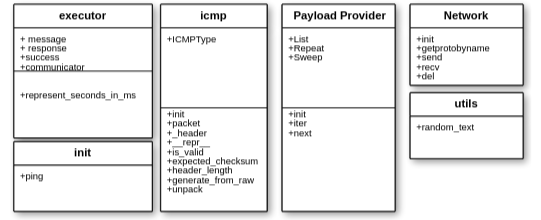
As per the uml diagram above five distinct classes outside of init exist in this package: Executor, Icmp, Payload Provider, and Utils. Each of them rely on attributes which have been listed as sub-classes for brevities sake. An overview of each class is as follows.
### Utils
Simply generates random text. See function random_text.
### Network
Opens a socket to send and recive data. See functions send, recv, and del.
### Payload Provider
Generates ICMP Payloads with no Headers. It's functionaly a interface. It has three
functions init, iter, and next, which are all implmented by subclasses List, Repeat, and Sweep which store payloads in diffrent lists.
### ICMP
Generates the ICMP heaser through subclass ICMPType, and various helper functions.
### Executor
Has various subclasses including Message, Response, Success, and Communicator used for sending icmp packets and collecting data.
### Init
Uses network, executor, payload_provider and utils.random_text to construct and send ICMP packets to ping a network.
## Tests
A test package exists under the folder test, and contains a serise of unit tests. Before commiting changes make sure to run the test bench and make sure all corrisponding cases pass. For new functionality new test cases must be added and documented.
To run testcases we can simply use the ```unitest discover``` utility by running the following command:
```
python -m unittest discover <test_directory>
```
To run the test cases in a specific file FILE we must run the following command:
```
python -m unittest discover -s <test_directory> -p FILE
```
Another option is to run the following from the top level directory:
```
pytest test
```
To test for coverage simply run:
```
coverage run -m pytest test
```
## Contributing
Before contributing read through the contribution guidlines found the CONTRIBUTING file.
### Code Style
A few key points when contributing to this repo are as follows:
1. Use tabs over spaces.
2. Format doc strings as such:
```
DESCRIPTION
:param X: DESCRIPTION
:type X: Type
:param Y: DESCRIPTION
:type Y: Type
```
Please add doc strings to all functions added.
3. Do not add spaces between docstring and first function line.
4. Do not go over 200 characters per line.
5. When closing multiline items under brackets('()', '[]', ... etc) put the closing bracket on it's own line.
%package -n python3-pythonping
Summary: A simple way to ping in Python
Provides: python-pythonping
BuildRequires: python3-devel
BuildRequires: python3-setuptools
BuildRequires: python3-pip
%description -n python3-pythonping
# pythonping
PythonPing is simple way to ping in Python. With it, you can send ICMP Probes to remote devices like
you would do from the terminal. PythonPing is modular, so that you can run it in a script as a
standalone function, or integrate its components in a fully-fledged application.
## Basic Usage
The simplest usage of PythonPing is in a script. You can use the `ping` function to ping a target.
If you want to see the output immediately, emulating what happens on the terminal, use the
`verbose` flag as below.
```python
from pythonping import ping
ping('127.0.0.1', verbose=True)
```
This will yeld the following result.
```
Reply from 127.0.0.1, 9 bytes in 0.17ms
Reply from 127.0.0.1, 9 bytes in 0.14ms
Reply from 127.0.0.1, 9 bytes in 0.12ms
Reply from 127.0.0.1, 9 bytes in 0.12ms
```
Regardless of the verbose mode, the `ping` function will always return a `ResponseList` object.
This is a special iterable object, containing a list of `Response` items. In each response, you can
find the packet received and some meta information, like the time it took to receive the response
and any error message.
You can also tune your ping by using some of its additional parameters:
* `size` is an integer that allows you to specify the size of the ICMP payload you desire
* `timeout` is the number of seconds you wish to wait for a response, before assuming the target
is unreachable
* `payload` allows you to use a specific payload (bytes)
* `count` specify allows you to define how many ICMP packets to send
* `interval` the time to wait between pings, in seconds
* `sweep_start` and `sweep_end` allows you to perform a ping sweep, starting from payload size
defined in `sweep_start` and growing up to size defined in `sweep_end`. Here, we repeat the payload
you provided to match the desired size, or we generate a random one if no payload was provided.
Note that if you defined `size`, these two fields will be ignored
* `df` is a flag that, if set to True, will enable the *Don't Fragment* flag in the IP header
* `verbose` enables the verbose mode, printing output to a stream (see `out`)
* `out` is the target stream of verbose mode. If you enable the verbose mode and do not provide
`out`, verbose output will be send to the `sys.stdout` stream. You may want to use a file here.
* `match` is a flag that, if set to True, will enable payload matching between a ping request
and reply (default behaviour follows that of Windows which counts a successful reply by a
matched packet identifier only; Linux behaviour counts a non equivalent payload with a matched
packet identifier in reply as fail, such as when pinging 8.8.8.8 with 1000 bytes and the reply
is truncated to only the first 74 of request payload with a matching packet identifier)
## FAQ
### Do I need privileged mode or root?
Yes, you need to be root to use pythonping.
### Why do I need to be root to use pythonping?
All operating systems allow programs to create TCP or UDP sockets without requiring particular
permissions. However, ping runs in ICMP (which is neither TCP or UDP). This means we have to create
raw IP packets, and sniff the traffic on the network card.
**Operating systems are designed to require root for such operations**. This is because having
unrestricted access to the NIC can expose the user to risks if the application running has bad
intentions. This is not the case with pythonping of course, but nonetheless we need this capability
to create custom IP packets. Unfortunately, there is simply no other way to create ICMP packets.
## Advanced Usage
If you wish to extend PythonPing, or integrate it in your application, we recommend to use the
classes that are part of Python Ping instead of the `ping` function. `executor.Communicator`
handles the communication with the target device, it takes care of sending ICMP requests and
processing responses (note that for it to be thread safe you must then handle making a unique
seed ID for each thread instance, see ping.__init\__ for an example of this). It ultimately
produces the `executor.ResponseList` object. The `Communicator` needs to know a target and
which payloads to send to the remote device. For that, we have several classes in the
`payload_provider` module. You may want to create your own provider by extending
`payload_provider.PayloadProvider`. If you are interested in that, you should check the
documentation of both `executor` and `payload_provider` module.
## Code Structure
### Top Level Directory Layout
Our project directory structure contains all src files in the pythonping folder, test cases in another folder, and helping documentation in on the top level directory.
```
.
├── pythonping # Source files
├── test # Automated Testcases for the package
├── CODE_OF_CONDUCT # An md file containing code of conduct
├── CONTRIBUTING # Contributing Guidlins
├── LICENSE # MIT License
├── README.md # An md file
└── setup.py # Instalation
```
A UML Diagram of the code structure is below:

As per the uml diagram above five distinct classes outside of init exist in this package: Executor, Icmp, Payload Provider, and Utils. Each of them rely on attributes which have been listed as sub-classes for brevities sake. An overview of each class is as follows.
### Utils
Simply generates random text. See function random_text.
### Network
Opens a socket to send and recive data. See functions send, recv, and del.
### Payload Provider
Generates ICMP Payloads with no Headers. It's functionaly a interface. It has three
functions init, iter, and next, which are all implmented by subclasses List, Repeat, and Sweep which store payloads in diffrent lists.
### ICMP
Generates the ICMP heaser through subclass ICMPType, and various helper functions.
### Executor
Has various subclasses including Message, Response, Success, and Communicator used for sending icmp packets and collecting data.
### Init
Uses network, executor, payload_provider and utils.random_text to construct and send ICMP packets to ping a network.
## Tests
A test package exists under the folder test, and contains a serise of unit tests. Before commiting changes make sure to run the test bench and make sure all corrisponding cases pass. For new functionality new test cases must be added and documented.
To run testcases we can simply use the ```unitest discover``` utility by running the following command:
```
python -m unittest discover <test_directory>
```
To run the test cases in a specific file FILE we must run the following command:
```
python -m unittest discover -s <test_directory> -p FILE
```
Another option is to run the following from the top level directory:
```
pytest test
```
To test for coverage simply run:
```
coverage run -m pytest test
```
## Contributing
Before contributing read through the contribution guidlines found the CONTRIBUTING file.
### Code Style
A few key points when contributing to this repo are as follows:
1. Use tabs over spaces.
2. Format doc strings as such:
```
DESCRIPTION
:param X: DESCRIPTION
:type X: Type
:param Y: DESCRIPTION
:type Y: Type
```
Please add doc strings to all functions added.
3. Do not add spaces between docstring and first function line.
4. Do not go over 200 characters per line.
5. When closing multiline items under brackets('()', '[]', ... etc) put the closing bracket on it's own line.
%package help
Summary: Development documents and examples for pythonping
Provides: python3-pythonping-doc
%description help
# pythonping
PythonPing is simple way to ping in Python. With it, you can send ICMP Probes to remote devices like
you would do from the terminal. PythonPing is modular, so that you can run it in a script as a
standalone function, or integrate its components in a fully-fledged application.
## Basic Usage
The simplest usage of PythonPing is in a script. You can use the `ping` function to ping a target.
If you want to see the output immediately, emulating what happens on the terminal, use the
`verbose` flag as below.
```python
from pythonping import ping
ping('127.0.0.1', verbose=True)
```
This will yeld the following result.
```
Reply from 127.0.0.1, 9 bytes in 0.17ms
Reply from 127.0.0.1, 9 bytes in 0.14ms
Reply from 127.0.0.1, 9 bytes in 0.12ms
Reply from 127.0.0.1, 9 bytes in 0.12ms
```
Regardless of the verbose mode, the `ping` function will always return a `ResponseList` object.
This is a special iterable object, containing a list of `Response` items. In each response, you can
find the packet received and some meta information, like the time it took to receive the response
and any error message.
You can also tune your ping by using some of its additional parameters:
* `size` is an integer that allows you to specify the size of the ICMP payload you desire
* `timeout` is the number of seconds you wish to wait for a response, before assuming the target
is unreachable
* `payload` allows you to use a specific payload (bytes)
* `count` specify allows you to define how many ICMP packets to send
* `interval` the time to wait between pings, in seconds
* `sweep_start` and `sweep_end` allows you to perform a ping sweep, starting from payload size
defined in `sweep_start` and growing up to size defined in `sweep_end`. Here, we repeat the payload
you provided to match the desired size, or we generate a random one if no payload was provided.
Note that if you defined `size`, these two fields will be ignored
* `df` is a flag that, if set to True, will enable the *Don't Fragment* flag in the IP header
* `verbose` enables the verbose mode, printing output to a stream (see `out`)
* `out` is the target stream of verbose mode. If you enable the verbose mode and do not provide
`out`, verbose output will be send to the `sys.stdout` stream. You may want to use a file here.
* `match` is a flag that, if set to True, will enable payload matching between a ping request
and reply (default behaviour follows that of Windows which counts a successful reply by a
matched packet identifier only; Linux behaviour counts a non equivalent payload with a matched
packet identifier in reply as fail, such as when pinging 8.8.8.8 with 1000 bytes and the reply
is truncated to only the first 74 of request payload with a matching packet identifier)
## FAQ
### Do I need privileged mode or root?
Yes, you need to be root to use pythonping.
### Why do I need to be root to use pythonping?
All operating systems allow programs to create TCP or UDP sockets without requiring particular
permissions. However, ping runs in ICMP (which is neither TCP or UDP). This means we have to create
raw IP packets, and sniff the traffic on the network card.
**Operating systems are designed to require root for such operations**. This is because having
unrestricted access to the NIC can expose the user to risks if the application running has bad
intentions. This is not the case with pythonping of course, but nonetheless we need this capability
to create custom IP packets. Unfortunately, there is simply no other way to create ICMP packets.
## Advanced Usage
If you wish to extend PythonPing, or integrate it in your application, we recommend to use the
classes that are part of Python Ping instead of the `ping` function. `executor.Communicator`
handles the communication with the target device, it takes care of sending ICMP requests and
processing responses (note that for it to be thread safe you must then handle making a unique
seed ID for each thread instance, see ping.__init\__ for an example of this). It ultimately
produces the `executor.ResponseList` object. The `Communicator` needs to know a target and
which payloads to send to the remote device. For that, we have several classes in the
`payload_provider` module. You may want to create your own provider by extending
`payload_provider.PayloadProvider`. If you are interested in that, you should check the
documentation of both `executor` and `payload_provider` module.
## Code Structure
### Top Level Directory Layout
Our project directory structure contains all src files in the pythonping folder, test cases in another folder, and helping documentation in on the top level directory.
```
.
├── pythonping # Source files
├── test # Automated Testcases for the package
├── CODE_OF_CONDUCT # An md file containing code of conduct
├── CONTRIBUTING # Contributing Guidlins
├── LICENSE # MIT License
├── README.md # An md file
└── setup.py # Instalation
```
A UML Diagram of the code structure is below:

As per the uml diagram above five distinct classes outside of init exist in this package: Executor, Icmp, Payload Provider, and Utils. Each of them rely on attributes which have been listed as sub-classes for brevities sake. An overview of each class is as follows.
### Utils
Simply generates random text. See function random_text.
### Network
Opens a socket to send and recive data. See functions send, recv, and del.
### Payload Provider
Generates ICMP Payloads with no Headers. It's functionaly a interface. It has three
functions init, iter, and next, which are all implmented by subclasses List, Repeat, and Sweep which store payloads in diffrent lists.
### ICMP
Generates the ICMP heaser through subclass ICMPType, and various helper functions.
### Executor
Has various subclasses including Message, Response, Success, and Communicator used for sending icmp packets and collecting data.
### Init
Uses network, executor, payload_provider and utils.random_text to construct and send ICMP packets to ping a network.
## Tests
A test package exists under the folder test, and contains a serise of unit tests. Before commiting changes make sure to run the test bench and make sure all corrisponding cases pass. For new functionality new test cases must be added and documented.
To run testcases we can simply use the ```unitest discover``` utility by running the following command:
```
python -m unittest discover <test_directory>
```
To run the test cases in a specific file FILE we must run the following command:
```
python -m unittest discover -s <test_directory> -p FILE
```
Another option is to run the following from the top level directory:
```
pytest test
```
To test for coverage simply run:
```
coverage run -m pytest test
```
## Contributing
Before contributing read through the contribution guidlines found the CONTRIBUTING file.
### Code Style
A few key points when contributing to this repo are as follows:
1. Use tabs over spaces.
2. Format doc strings as such:
```
DESCRIPTION
:param X: DESCRIPTION
:type X: Type
:param Y: DESCRIPTION
:type Y: Type
```
Please add doc strings to all functions added.
3. Do not add spaces between docstring and first function line.
4. Do not go over 200 characters per line.
5. When closing multiline items under brackets('()', '[]', ... etc) put the closing bracket on it's own line.
%prep
%autosetup -n pythonping-1.1.4
%build
%py3_build
%install
%py3_install
install -d -m755 %{buildroot}/%{_pkgdocdir}
if [ -d doc ]; then cp -arf doc %{buildroot}/%{_pkgdocdir}; fi
if [ -d docs ]; then cp -arf docs %{buildroot}/%{_pkgdocdir}; fi
if [ -d example ]; then cp -arf example %{buildroot}/%{_pkgdocdir}; fi
if [ -d examples ]; then cp -arf examples %{buildroot}/%{_pkgdocdir}; fi
pushd %{buildroot}
if [ -d usr/lib ]; then
find usr/lib -type f -printf "/%h/%f\n" >> filelist.lst
fi
if [ -d usr/lib64 ]; then
find usr/lib64 -type f -printf "/%h/%f\n" >> filelist.lst
fi
if [ -d usr/bin ]; then
find usr/bin -type f -printf "/%h/%f\n" >> filelist.lst
fi
if [ -d usr/sbin ]; then
find usr/sbin -type f -printf "/%h/%f\n" >> filelist.lst
fi
touch doclist.lst
if [ -d usr/share/man ]; then
find usr/share/man -type f -printf "/%h/%f.gz\n" >> doclist.lst
fi
popd
mv %{buildroot}/filelist.lst .
mv %{buildroot}/doclist.lst .
%files -n python3-pythonping -f filelist.lst
%dir %{python3_sitelib}/*
%files help -f doclist.lst
%{_docdir}/*
%changelog
* Mon Apr 10 2023 Python_Bot <Python_Bot@openeuler.org> - 1.1.4-1
- Package Spec generated
|
