
diff options
| author | CoprDistGit <infra@openeuler.org> | 2023-05-17 02:56:26 +0000 |
|---|---|---|
| committer | CoprDistGit <infra@openeuler.org> | 2023-05-17 02:56:26 +0000 |
| commit | 50ac11febf960f1ccaeb55132dee8b9494877c80 (patch) | |
| tree | 5dff5cbb5ca72d04864b27eca47bdd460379db2c | |
| parent | cb17c343725f48f67c6adc5045d69694da078b8e (diff) | |
automatic import of python-stockwell
| -rw-r--r-- | .gitignore | 1 | ||||
| -rw-r--r-- | python-stockwell.spec | 552 | ||||
| -rw-r--r-- | sources | 1 |
3 files changed, 554 insertions, 0 deletions
@@ -0,0 +1 @@ +/stockwell-1.0.7.tar.gz diff --git a/python-stockwell.spec b/python-stockwell.spec new file mode 100644 index 0000000..e0f13e6 --- /dev/null +++ b/python-stockwell.spec @@ -0,0 +1,552 @@ +%global _empty_manifest_terminate_build 0 +Name: python-stockwell +Version: 1.0.7 +Release: 1 +Summary: Time-frequency analysis through Stockwell transform +License: CeCILL Free Software License Agreement, Version 2.1 +URL: https://github.com/claudiodsf/stockwell +Source0: https://mirrors.nju.edu.cn/pypi/web/packages/f0/42/23ffa0b654a374aff902ac3ca11bfc083f59ca3c8fbf04c236868068a70d/stockwell-1.0.7.tar.gz + +Requires: python3-numpy + +%description +# Stockwell + +Python package for time-frequency analysis through Stockwell transform. + +Based on original code from [NIMH MEG Core Facility]. + +[![cf-badge]][cf-link] +[![PyPI-badge]][PyPI-link] +[![license-badge]][license-link] + + +## Installation + +### Using Anaconda + +If you use [Anaconda], the latest release of Stockwell is available via +[conda-forge][cf-link]. + +To install, simply run: + + conda install -c conda-forge stockwell + + +### Using pip and PyPI + +The latest release of Stockwell is available on the +[Python Package Index][PyPI-link]. + +You can install it easily through `pip`: + + pip install stockwell + + +### Installation from source + +If no precompiled package is available for you architecture on PyPI, or if you +want to work on the source code, you will need to compile this package from +source. + +To obtain the source code, download the latest release from the +[releases page][releases-link], or clone the GitHub project. + +#### C compiler + +Part of Stockwell is written in C, so you will need a C compiler. + +On Linux (Debian or Ubuntu), install the `build-essential` package: + + sudo apt install build-essential + +On macOS, install the XCode Command Line Tools: + + xcode-select --install + +On Windows, install the [Microsoft C++ Build Tools]. + +#### FFTW + +To compile Stockwell, you will need to have [FFTW] +installed. + +If you use [Anaconda] (Linux, macOS, Windows): + + conda install fftw + +If you use Homebrew (macOS) + + brew install fftw + +If you use `apt` (Debian or Ubuntu) + + sudo apt install libfftw3-dev + +#### Install the Python package from source + +Finally, install this Python package using pip: + + pip install . + +Or, alternatively, in "editable" mode: + + pip install -e . + + +## Usage + +Example usage: + +```python +import numpy as np +from scipy.signal import chirp +import matplotlib.pyplot as plt +from stockwell import st + +t = np.linspace(0, 10, 5001) +w = chirp(t, f0=12.5, f1=2.5, t1=10, method='linear') + +fmin = 0 # Hz +fmax = 25 # Hz +df = 1./(t[-1]-t[0]) # sampling step in frequency domain (Hz) +fmin_samples = int(fmin/df) +fmax_samples = int(fmax/df) +stock = st.st(w, fmin_samples, fmax_samples) +extent = (t[0], t[-1], fmin, fmax) + +fig, ax = plt.subplots(2, 1, sharex=True) +ax[0].plot(t, w) +ax[0].set(ylabel='amplitude') +ax[1].imshow(np.abs(stock), origin='lower', extent=extent) +ax[1].axis('tight') +ax[1].set(xlabel='time (s)', ylabel='frequency (Hz)') +plt.show() +``` +You should get the following output: + +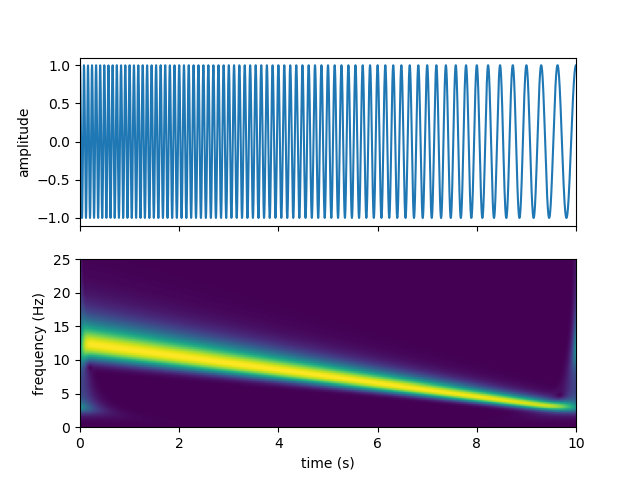 + +You can also compute the inverse Stockwell transform, ex: + +```python +inv_stock = st.ist(stock, fmin_samples, fmax_samples) +fig, ax = plt.subplots(2, 1, sharex=True) +ax[0].plot(t, w, label='original signal') +ax[0].plot(t, inv_stock, label='inverse Stockwell') +ax[0].set(ylabel='amplitude') +ax[0].legend(loc='upper right') +ax[1].plot(t, w - inv_stock) +ax[1].set_xlim(0, 10) +ax[1].set(xlabel='time (s)', ylabel='amplitude difference') +plt.show() +``` +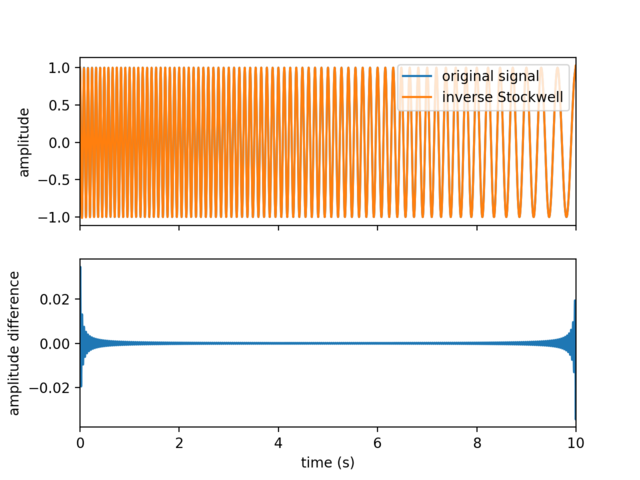 + + +## References + +Stockwell, R.G., Mansinha, L. & Lowe, R.P., 1996. Localization of the complex +spectrum: the S transform, IEEE Trans. Signal Process., 44(4), 998–1001, +doi:[10.1109/78.492555](https://doi.org/10.1109/78.492555) + +[S transform on Wikipedia]. + + + +[NIMH MEG Core Facility]: https://kurage.nimh.nih.gov/meglab/Meg/Stockwell + +[cf-badge]: http://img.shields.io/conda/vn/conda-forge/stockwell.svg +[cf-link]: https://anaconda.org/conda-forge/stockwell +[PyPI-badge]: http://img.shields.io/pypi/v/stockwell.svg +[PyPI-link]: https://pypi.python.org/pypi/stockwell +[license-badge]: https://img.shields.io/badge/license-CeCILL--2.1-green +[license-link]: http://www.cecill.info/licences.en.html +[releases-link]: https://github.com/claudiodsf/stockwell/releases + +[Anaconda]: https://www.anaconda.com/products/individual +[Microsoft C++ Build Tools]: +https://visualstudio.microsoft.com/visual-cpp-build-tools +[FFTW]: http://www.fftw.org +[S transform on Wikipedia]: https://en.wikipedia.org/wiki/S_transform + + +%package -n python3-stockwell +Summary: Time-frequency analysis through Stockwell transform +Provides: python-stockwell +BuildRequires: python3-devel +BuildRequires: python3-setuptools +BuildRequires: python3-pip +BuildRequires: python3-cffi +BuildRequires: gcc +BuildRequires: gdb +%description -n python3-stockwell +# Stockwell + +Python package for time-frequency analysis through Stockwell transform. + +Based on original code from [NIMH MEG Core Facility]. + +[![cf-badge]][cf-link] +[![PyPI-badge]][PyPI-link] +[![license-badge]][license-link] + + +## Installation + +### Using Anaconda + +If you use [Anaconda], the latest release of Stockwell is available via +[conda-forge][cf-link]. + +To install, simply run: + + conda install -c conda-forge stockwell + + +### Using pip and PyPI + +The latest release of Stockwell is available on the +[Python Package Index][PyPI-link]. + +You can install it easily through `pip`: + + pip install stockwell + + +### Installation from source + +If no precompiled package is available for you architecture on PyPI, or if you +want to work on the source code, you will need to compile this package from +source. + +To obtain the source code, download the latest release from the +[releases page][releases-link], or clone the GitHub project. + +#### C compiler + +Part of Stockwell is written in C, so you will need a C compiler. + +On Linux (Debian or Ubuntu), install the `build-essential` package: + + sudo apt install build-essential + +On macOS, install the XCode Command Line Tools: + + xcode-select --install + +On Windows, install the [Microsoft C++ Build Tools]. + +#### FFTW + +To compile Stockwell, you will need to have [FFTW] +installed. + +If you use [Anaconda] (Linux, macOS, Windows): + + conda install fftw + +If you use Homebrew (macOS) + + brew install fftw + +If you use `apt` (Debian or Ubuntu) + + sudo apt install libfftw3-dev + +#### Install the Python package from source + +Finally, install this Python package using pip: + + pip install . + +Or, alternatively, in "editable" mode: + + pip install -e . + + +## Usage + +Example usage: + +```python +import numpy as np +from scipy.signal import chirp +import matplotlib.pyplot as plt +from stockwell import st + +t = np.linspace(0, 10, 5001) +w = chirp(t, f0=12.5, f1=2.5, t1=10, method='linear') + +fmin = 0 # Hz +fmax = 25 # Hz +df = 1./(t[-1]-t[0]) # sampling step in frequency domain (Hz) +fmin_samples = int(fmin/df) +fmax_samples = int(fmax/df) +stock = st.st(w, fmin_samples, fmax_samples) +extent = (t[0], t[-1], fmin, fmax) + +fig, ax = plt.subplots(2, 1, sharex=True) +ax[0].plot(t, w) +ax[0].set(ylabel='amplitude') +ax[1].imshow(np.abs(stock), origin='lower', extent=extent) +ax[1].axis('tight') +ax[1].set(xlabel='time (s)', ylabel='frequency (Hz)') +plt.show() +``` +You should get the following output: + + + +You can also compute the inverse Stockwell transform, ex: + +```python +inv_stock = st.ist(stock, fmin_samples, fmax_samples) +fig, ax = plt.subplots(2, 1, sharex=True) +ax[0].plot(t, w, label='original signal') +ax[0].plot(t, inv_stock, label='inverse Stockwell') +ax[0].set(ylabel='amplitude') +ax[0].legend(loc='upper right') +ax[1].plot(t, w - inv_stock) +ax[1].set_xlim(0, 10) +ax[1].set(xlabel='time (s)', ylabel='amplitude difference') +plt.show() +``` + + + +## References + +Stockwell, R.G., Mansinha, L. & Lowe, R.P., 1996. Localization of the complex +spectrum: the S transform, IEEE Trans. Signal Process., 44(4), 998–1001, +doi:[10.1109/78.492555](https://doi.org/10.1109/78.492555) + +[S transform on Wikipedia]. + + + +[NIMH MEG Core Facility]: https://kurage.nimh.nih.gov/meglab/Meg/Stockwell + +[cf-badge]: http://img.shields.io/conda/vn/conda-forge/stockwell.svg +[cf-link]: https://anaconda.org/conda-forge/stockwell +[PyPI-badge]: http://img.shields.io/pypi/v/stockwell.svg +[PyPI-link]: https://pypi.python.org/pypi/stockwell +[license-badge]: https://img.shields.io/badge/license-CeCILL--2.1-green +[license-link]: http://www.cecill.info/licences.en.html +[releases-link]: https://github.com/claudiodsf/stockwell/releases + +[Anaconda]: https://www.anaconda.com/products/individual +[Microsoft C++ Build Tools]: +https://visualstudio.microsoft.com/visual-cpp-build-tools +[FFTW]: http://www.fftw.org +[S transform on Wikipedia]: https://en.wikipedia.org/wiki/S_transform + + +%package help +Summary: Development documents and examples for stockwell +Provides: python3-stockwell-doc +%description help +# Stockwell + +Python package for time-frequency analysis through Stockwell transform. + +Based on original code from [NIMH MEG Core Facility]. + +[![cf-badge]][cf-link] +[![PyPI-badge]][PyPI-link] +[![license-badge]][license-link] + + +## Installation + +### Using Anaconda + +If you use [Anaconda], the latest release of Stockwell is available via +[conda-forge][cf-link]. + +To install, simply run: + + conda install -c conda-forge stockwell + + +### Using pip and PyPI + +The latest release of Stockwell is available on the +[Python Package Index][PyPI-link]. + +You can install it easily through `pip`: + + pip install stockwell + + +### Installation from source + +If no precompiled package is available for you architecture on PyPI, or if you +want to work on the source code, you will need to compile this package from +source. + +To obtain the source code, download the latest release from the +[releases page][releases-link], or clone the GitHub project. + +#### C compiler + +Part of Stockwell is written in C, so you will need a C compiler. + +On Linux (Debian or Ubuntu), install the `build-essential` package: + + sudo apt install build-essential + +On macOS, install the XCode Command Line Tools: + + xcode-select --install + +On Windows, install the [Microsoft C++ Build Tools]. + +#### FFTW + +To compile Stockwell, you will need to have [FFTW] +installed. + +If you use [Anaconda] (Linux, macOS, Windows): + + conda install fftw + +If you use Homebrew (macOS) + + brew install fftw + +If you use `apt` (Debian or Ubuntu) + + sudo apt install libfftw3-dev + +#### Install the Python package from source + +Finally, install this Python package using pip: + + pip install . + +Or, alternatively, in "editable" mode: + + pip install -e . + + +## Usage + +Example usage: + +```python +import numpy as np +from scipy.signal import chirp +import matplotlib.pyplot as plt +from stockwell import st + +t = np.linspace(0, 10, 5001) +w = chirp(t, f0=12.5, f1=2.5, t1=10, method='linear') + +fmin = 0 # Hz +fmax = 25 # Hz +df = 1./(t[-1]-t[0]) # sampling step in frequency domain (Hz) +fmin_samples = int(fmin/df) +fmax_samples = int(fmax/df) +stock = st.st(w, fmin_samples, fmax_samples) +extent = (t[0], t[-1], fmin, fmax) + +fig, ax = plt.subplots(2, 1, sharex=True) +ax[0].plot(t, w) +ax[0].set(ylabel='amplitude') +ax[1].imshow(np.abs(stock), origin='lower', extent=extent) +ax[1].axis('tight') +ax[1].set(xlabel='time (s)', ylabel='frequency (Hz)') +plt.show() +``` +You should get the following output: + + + +You can also compute the inverse Stockwell transform, ex: + +```python +inv_stock = st.ist(stock, fmin_samples, fmax_samples) +fig, ax = plt.subplots(2, 1, sharex=True) +ax[0].plot(t, w, label='original signal') +ax[0].plot(t, inv_stock, label='inverse Stockwell') +ax[0].set(ylabel='amplitude') +ax[0].legend(loc='upper right') +ax[1].plot(t, w - inv_stock) +ax[1].set_xlim(0, 10) +ax[1].set(xlabel='time (s)', ylabel='amplitude difference') +plt.show() +``` + + + +## References + +Stockwell, R.G., Mansinha, L. & Lowe, R.P., 1996. Localization of the complex +spectrum: the S transform, IEEE Trans. Signal Process., 44(4), 998–1001, +doi:[10.1109/78.492555](https://doi.org/10.1109/78.492555) + +[S transform on Wikipedia]. + + + +[NIMH MEG Core Facility]: https://kurage.nimh.nih.gov/meglab/Meg/Stockwell + +[cf-badge]: http://img.shields.io/conda/vn/conda-forge/stockwell.svg +[cf-link]: https://anaconda.org/conda-forge/stockwell +[PyPI-badge]: http://img.shields.io/pypi/v/stockwell.svg +[PyPI-link]: https://pypi.python.org/pypi/stockwell +[license-badge]: https://img.shields.io/badge/license-CeCILL--2.1-green +[license-link]: http://www.cecill.info/licences.en.html +[releases-link]: https://github.com/claudiodsf/stockwell/releases + +[Anaconda]: https://www.anaconda.com/products/individual +[Microsoft C++ Build Tools]: +https://visualstudio.microsoft.com/visual-cpp-build-tools +[FFTW]: http://www.fftw.org +[S transform on Wikipedia]: https://en.wikipedia.org/wiki/S_transform + + +%prep +%autosetup -n stockwell-1.0.7 + +%build +%py3_build + +%install +%py3_install +install -d -m755 %{buildroot}/%{_pkgdocdir} +if [ -d doc ]; then cp -arf doc %{buildroot}/%{_pkgdocdir}; fi +if [ -d docs ]; then cp -arf docs %{buildroot}/%{_pkgdocdir}; fi +if [ -d example ]; then cp -arf example %{buildroot}/%{_pkgdocdir}; fi +if [ -d examples ]; then cp -arf examples %{buildroot}/%{_pkgdocdir}; fi +pushd %{buildroot} +if [ -d usr/lib ]; then + find usr/lib -type f -printf "/%h/%f\n" >> filelist.lst +fi +if [ -d usr/lib64 ]; then + find usr/lib64 -type f -printf "/%h/%f\n" >> filelist.lst +fi +if [ -d usr/bin ]; then + find usr/bin -type f -printf "/%h/%f\n" >> filelist.lst +fi +if [ -d usr/sbin ]; then + find usr/sbin -type f -printf "/%h/%f\n" >> filelist.lst +fi +touch doclist.lst +if [ -d usr/share/man ]; then + find usr/share/man -type f -printf "/%h/%f.gz\n" >> doclist.lst +fi +popd +mv %{buildroot}/filelist.lst . +mv %{buildroot}/doclist.lst . + +%files -n python3-stockwell -f filelist.lst +%dir %{python3_sitearch}/* + +%files help -f doclist.lst +%{_docdir}/* + +%changelog +* Wed May 17 2023 Python_Bot <Python_Bot@openeuler.org> - 1.0.7-1 +- Package Spec generated @@ -0,0 +1 @@ +4624ecfa5ac8a147ef28071507b3692b stockwell-1.0.7.tar.gz |