
diff options
Diffstat (limited to 'python-tableschema.spec')
| -rw-r--r-- | python-tableschema.spec | 4682 |
1 files changed, 4682 insertions, 0 deletions
diff --git a/python-tableschema.spec b/python-tableschema.spec new file mode 100644 index 0000000..2450cd9 --- /dev/null +++ b/python-tableschema.spec @@ -0,0 +1,4682 @@ +%global _empty_manifest_terminate_build 0 +Name: python-tableschema +Version: 1.20.2 +Release: 1 +Summary: A utility library for working with Table Schema in Python +License: MIT +URL: https://github.com/frictionlessdata/tableschema-py +Source0: https://mirrors.nju.edu.cn/pypi/web/packages/86/94/bea498476f3e4b65e7b46e200af68749f0a762d8bccd048898e0267b3859/tableschema-1.20.2.tar.gz +BuildArch: noarch + +Requires: python3-six +Requires: python3-click +Requires: python3-requests +Requires: python3-cached-property +Requires: python3-dateutil +Requires: python3-jsonschema +Requires: python3-unicodecsv +Requires: python3-isodate +Requires: python3-rfc3986 +Requires: python3-tabulator +Requires: python3-mock +Requires: python3-pylama +Requires: python3-pytest +Requires: python3-pytest-cov + +%description +# tableschema-py + +[](https://travis-ci.org/frictionlessdata/tableschema-py) +[](https://coveralls.io/r/frictionlessdata/tableschema-py?branch=master) +[](https://pypi.python.org/pypi/tableschema) +[](https://github.com/frictionlessdata/tableschema-py) +[](https://gitter.im/frictionlessdata/chat) + +A Python implementation of the [Table Schema](http://specs.frictionlessdata.io/table-schema/) standard. + +> **[Important Notice]** We have released [Frictionless Framework](https://github.com/frictionlessdata/frictionless-py). This framework provides improved `tableschema` functionality extended to be a complete data solution. The change in not breaking for the existing software so no actions are required. Please read the [Migration Guide](https://framework.frictionlessdata.io/docs/development/migration) from `tableschema` to Frictionless Framework. +> - we continue to bug-fix `tableschema@1.x` in this [repository](https://github.com/frictionlessdata/tableschema-py) as well as it's available on [PyPi](https://pypi.org/project/tableschema/) as it was before +> - please note that `frictionless@3.x` version's API, we're working on at the moment, is not stable +> - we will release `frictionless@4.x` by the end of 2020 to be the first SemVer/stable version + +## Features + +- `Table` to work with data tables described by Table Schema +- `Schema` representing Table Schema +- `Field` representing Table Schema field +- `validate` to validate Table Schema +- `infer` to infer Table Schema from data +- built-in command-line interface to validate and infer schemas +- storage/plugins system to connect tables to different storage backends like SQL Database + +## Contents + +<!--TOC--> + + - [Getting Started](#getting-started) + - [Installation](#installation) + - [Documentation](#documentation) + - [Introduction](#introduction) + - [Working with Table](#working-with-table) + - [Working with Schema](#working-with-schema) + - [Working with Field](#working-with-field) + - [API Reference](#api-reference) + - [`cli`](#cli) + - [`Table`](#table) + - [`Schema`](#schema) + - [`Field`](#field) + - [`Storage`](#storage) + - [`validate`](#validate) + - [`infer`](#infer) + - [`FailedCast`](#failedcast) + - [`DataPackageException`](#datapackageexception) + - [`TableSchemaException`](#tableschemaexception) + - [`LoadError`](#loaderror) + - [`ValidationError`](#validationerror) + - [`CastError`](#casterror) + - [`IntegrityError`](#integrityerror) + - [`UniqueKeyError`](#uniquekeyerror) + - [`RelationError`](#relationerror) + - [`UnresolvedFKError`](#unresolvedfkerror) + - [`StorageError`](#storageerror) + - [Experimental](#experimental) + - [Contributing](#contributing) + - [Changelog](#changelog) + +<!--TOC--> + +## Getting Started + +### Installation + +The package uses semantic versioning. It means that major versions could include breaking changes. It's highly recommended to specify `tableschema` version range in your `setup/requirements` file e.g. `tableschema>=1.0,<2.0`. + +```bash +$ pip install tableschema +``` + +## Documentation + +### Introduction + +Let's start with a simple example: + +```python +from tableschema import Table + +# Create table +table = Table('path.csv', schema='schema.json') + +# Print schema descriptor +print(table.schema.descriptor) + +# Print cast rows in a dict form +for keyed_row in table.iter(keyed=True): + print(keyed_row) +``` + +### Working with Table + +A table is a core concept in a tabular data world. It represents data with metadata (Table Schema). Let's see how we can use it in practice. + +Consider we have some local csv file. It could be inline data or from a remote link - all supported by the `Table` class (except local files for in-brower usage of course). But say it's `data.csv` for now: + +```csv +city,location +london,"51.50,-0.11" +paris,"48.85,2.30" +rome,N/A +``` + +Let's create and read a table instance. We use the static `Table.load` method and the `table.read` method with the `keyed` option to get an array of keyed rows: + +```python +table = Table('data.csv') +table.headers # ['city', 'location'] +table.read(keyed=True) +# [ +# {city: 'london', location: '51.50,-0.11'}, +# {city: 'paris', location: '48.85,2.30'}, +# {city: 'rome', location: 'N/A'}, +# ] +``` + +As we can see, our locations are just strings. But they should be geopoints. Also, Rome's location is not available, but it's just a string `N/A` instead of `None`. First we have to infer Table Schema: + +```python +table.infer() +table.schema.descriptor +# { fields: +# [ { name: 'city', type: 'string', format: 'default' }, +# { name: 'location', type: 'geopoint', format: 'default' } ], +# missingValues: [ '' ] } +table.read(keyed=True) +# Fails with a data validation error +``` + +Let's fix the "not available" location. There is a `missingValues` property in Table Schema specification. As a first try we set `missingValues` to `N/A` in `table.schema.descriptor`. The schema descriptor can be changed in-place, but all changes should also be committed using `table.schema.commit()`: + +```python +table.schema.descriptor['missingValues'] = 'N/A' +table.schema.commit() +table.schema.valid # false +table.schema.errors +# [<ValidationError: "'N/A' is not of type 'array'">] +``` + +As a good citizens we've decided to check our schema descriptor's validity. And it's not valid! We should use an array for the `missingValues` property. Also, don't forget to include "empty string" as a valid missing value: + +```python +table.schema.descriptor['missingValues'] = ['', 'N/A'] +table.schema.commit() +table.schema.valid # true +``` + +All good. It looks like we're ready to read our data again: + +```python +table.read(keyed=True) +# [ +# {city: 'london', location: [51.50,-0.11]}, +# {city: 'paris', location: [48.85,2.30]}, +# {city: 'rome', location: null}, +# ] +``` + +Now we see that: +- locations are arrays with numeric latitude and longitude +- Rome's location is a native Python `None` + +And because there are no errors after reading, we can be sure that our data is valid against our schema. Let's save it: + +```python +table.schema.save('schema.json') +table.save('data.csv') +``` + +Our `data.csv` looks the same because it has been stringified back to `csv` format. But now we have `schema.json`: + +```json +{ + "fields": [ + { + "name": "city", + "type": "string", + "format": "default" + }, + { + "name": "location", + "type": "geopoint", + "format": "default" + } + ], + "missingValues": [ + "", + "N/A" + ] +} + +``` + +If we decide to improve it even more we could update the schema file and then open it again. But now providing a schema path: + +```python +table = Table('data.csv', schema='schema.json') +# Continue the work +``` + +As already mentioned a given schema can be used to *validate* data (see the [Schema](#schema) section for schema specification details). In default mode invalid data rows immediately trigger an [exception](#exceptions) in the `table.iter()`/`table.write()` methods. + +Suppose this schema-invalid local file `invalid_data.csv`: +```csv +key,value +zero,0 +one,not_an_integer +two,2 +``` + +We're going to validate the data against the following schema: +```python +table = Table( + 'invalid_data.csv', + schema={'fields': [{'name': 'key'}, {'name': 'value', 'type': 'integer'}]}) +``` + +Iterating over the data triggers an exception due to the failed cast of `'not_an_integer'` to `int`: +```python +for row in table.iter(): + print(row) + +# Traceback (most recent call last): +# ... +# tableschema.exceptions.CastError: There are 1 cast errors (see exception.errors) for row "3" +``` + +Hint: The row number count starts with 1 and also includes header lines. + +(Note: You can optionally switch off `iter()`/`read()` value casting using the cast parameter, see reference below.) + +By providing a custom exception handler (a callable) to those methods you can treat occurring exceptions at your own discretion, i.e. to "fail late" and e.g. gather a validation report on the whole data: + +```python +errors = [] +def exc_handler(exc, row_number=None, row_data=None, error_data=None): + errors.append((exc, row_number, row_data, error_data)) + +for row in table.iter(exc_handler=exc_handler): + print(row) + +# ['zero', 0] +# ['one', FailedCast('not_an_integer')] +# ['two', 2] + +print(errors) + +# [(CastError('There are 1 cast errors (see exception.errors) for row "3"',), +# 3, +# OrderedDict([('key', 'one'), ('value', 'not_an_integer')]), +# OrderedDict([('value', 'not_an_integer')]))] +``` + +Note that + +- Data rows are yielded even though the data is schema-invalid; this is due to our custom expression handler choosing not to raise exceptions (but rather collect them in the errors list). +- Data field values that can't get casted properly (if `iter()`/`read()` cast parameter is set to True, which is the default) are wrapped into a `FailedCast` "value holder". This allows for distinguishing uncasted values from successfully casted values on the data consumer side. `FailedCast` instances can only get yielded when custom exception handling is in place. +- The custom exception handler callable must support a function signature as specified in the `iter()`/`read()` sections of the `Table` class API reference. + +### Working with Schema + +A model of a schema with helpful methods for working with the schema and supported data. Schema instances can be initialized with a schema source as a url to a JSON file or a JSON object. The schema is initially validated (see [validate](#validate) below). By default validation errors will be stored in `schema.errors` but in a strict mode it will be instantly raised. + +Let's create a blank schema. It's not valid because `descriptor.fields` property is required by the [Table Schema](http://specs.frictionlessdata.io/table-schema/) specification: + +```python +schema = Schema() +schema.valid # false +schema.errors +# [<ValidationError: "'fields' is a required property">] +``` + +To avoid creating a schema descriptor by hand we will use a `schema.infer` method to infer the descriptor from given data: + +```python +schema.infer([ + ['id', 'age', 'name'], + ['1','39','Paul'], + ['2','23','Jimmy'], + ['3','36','Jane'], + ['4','28','Judy'], +]) +schema.valid # true +schema.descriptor +#{ fields: +# [ { name: 'id', type: 'integer', format: 'default' }, +# { name: 'age', type: 'integer', format: 'default' }, +# { name: 'name', type: 'string', format: 'default' } ], +# missingValues: [ '' ] } +``` + +Now we have an inferred schema and it's valid. We can cast data rows against our schema. We provide a string input which will be cast correspondingly: + +```python +schema.cast_row(['5', '66', 'Sam']) +# [ 5, 66, 'Sam' ] +``` + +But if we try provide some missing value to the `age` field, the cast will fail because the only valid "missing" value is an empty string. Let's update our schema: + +```python +schema.cast_row(['6', 'N/A', 'Walt']) +# Cast error +schema.descriptor['missingValues'] = ['', 'N/A'] +schema.commit() +schema.cast_row(['6', 'N/A', 'Walt']) +# [ 6, None, 'Walt' ] +``` + +We can save the schema to a local file, and resume work on it at any time by loading it from that file: + +```python +schema.save('schema.json') +schema = Schema('schema.json') +``` + +### Working with Field + +```python +from tableschema import Field + +# Init field +field = Field({'name': 'name', 'type': 'number'}) + +# Cast a value +field.cast_value('12345') # -> 12345 +``` + +Data values can be cast to native Python objects with a Field instance. Type instances can be initialized with [field descriptors](https://specs.frictionlessdata.io/table-schema/). This allows formats and constraints to be defined. + +Casting a value will check the value is of the expected type, is in the correct format, and complies with any constraints imposed by a schema. E.g. a date value (in ISO 8601 format) can be cast with a DateType instance. Values that can't be cast will raise an `InvalidCastError` exception. + +Casting a value that doesn't meet the constraints will raise a `ConstraintError` exception. + +## API Reference + +### `cli` +```python +cli() +``` +Command-line interface + +``` +Usage: tableschema [OPTIONS] COMMAND [ARGS]... + +Options: + --help Show this message and exit. + +Commands: + infer Infer a schema from data. + info Return info on this version of Table Schema + validate Validate that a supposed schema is in fact a Table Schema. +``` + + +### `Table` +```python +Table(self, + source, + schema=None, + strict=False, + post_cast=[], + storage=None, + **options) +``` +Table representation + +__Arguments__ +- __source (str/list[])__: data source one of: + - local file (path) + - remote file (url) + - array of arrays representing the rows +- __schema (any)__: data schema in all forms supported by `Schema` class +- __strict (bool)__: strictness option to pass to `Schema` constructor +- __post_cast (function[])__: list of post cast processors +- __storage (None)__: storage name like `sql` or `bigquery` +- __options (dict)__: `tabulator` or storage's options + +__Raises__ +- `TableSchemaException`: raises on any error + + + +#### `table.hash` +Table's SHA256 hash if it's available. + +If it's already read using e.g. `table.read`, otherwise returns `None`. +In the middle of an iteration it returns hash of already read contents + +__Returns__ + +`str/None`: SHA256 hash + + + +#### `table.headers` +Table's headers is available + +__Returns__ + +`str[]`: headers + + + +#### `table.schema` +Returns schema class instance if available + +__Returns__ + +`Schema`: schema + + + +#### `table.size` +Table's size in BYTES if it's available + +If it's already read using e.g. `table.read`, otherwise returns `None`. +In the middle of an iteration it returns size of already read contents + +__Returns__ + +`int/None`: size in BYTES + + + +#### `table.iter` +```python +table.iter(keyed=False, + extended=False, + cast=True, + integrity=False, + relations=False, + foreign_keys_values=False, + exc_handler=None) +``` +Iterates through the table data and emits rows cast based on table schema. + +__Arguments__ + + + keyed (bool): + yield keyed rows in a form of `{header1: value1, header2: value2}` + (default is false; the form of rows is `[value1, value2]`) + + extended (bool): + yield extended rows in a for of `[rowNumber, [header1, header2], [value1, value2]]` + (default is false; the form of rows is `[value1, value2]`) + + cast (bool): + disable data casting if false + (default is true) + + integrity (dict): + dictionary in a form of `{'size': <bytes>, 'hash': '<sha256>'}` + to check integrity of the table when it's read completely. + Both keys are optional. + + relations (dict): + dictionary of foreign key references in a form + of `{resource1: [{field1: value1, field2: value2}, ...], ...}`. + If provided, foreign key fields will checked and resolved + to one of their references (/!\ one-to-many fk are not completely resolved). + + foreign_keys_values (dict): + three-level dictionary of foreign key references optimized + to speed up validation process in a form of + `{resource1: {(fk_field1, fk_field2): {(value1, value2): {one_keyedrow}, ... }}}`. + If not provided but relations is true, it will be created + before the validation process by *index_foreign_keys_values* method + + exc_handler (func): + optional custom exception handler callable. + Can be used to defer raising errors (i.e. "fail late"), e.g. + for data validation purposes. Must support the signature below + +__Custom exception handler__ + + +```python +def exc_handler(exc, row_number=None, row_data=None, error_data=None): + '''Custom exception handler (example) + + # Arguments: + exc(Exception): + Deferred exception instance + row_number(int): + Data row number that triggers exception exc + row_data(OrderedDict): + Invalid data row source data + error_data(OrderedDict): + Data row source data field subset responsible for the error, if + applicable (e.g. invalid primary or foreign key fields). May be + identical to row_data. + ''' + # ... +``` + +__Raises__ +- `TableSchemaException`: base class of any error +- `CastError`: data cast error +- `IntegrityError`: integrity checking error +- `UniqueKeyError`: unique key constraint violation +- `UnresolvedFKError`: unresolved foreign key reference error + +__Returns__ + +`Iterator[list]`: yields rows + + + +#### `table.read` +```python +table.read(keyed=False, + extended=False, + cast=True, + limit=None, + integrity=False, + relations=False, + foreign_keys_values=False, + exc_handler=None) +``` +Read the whole table and return as array of rows + +> It has the same API as `table.iter` except for + +__Arguments__ +- __limit (int)__: limit count of rows to read and return + +__Returns__ + +`list[]`: returns rows + + + +#### `table.infer` +```python +table.infer(limit=100, + confidence=0.75, + missing_values=[''], + guesser_cls=None, + resolver_cls=None) +``` +Infer a schema for the table. + +It will infer and set Table Schema to `table.schema` based on table data. + +__Arguments__ +- __limit (int)__: limit rows sample size +- __confidence (float)__: how many casting errors are allowed (as a ratio, between 0 and 1) +- __missing_values (str[])__: list of missing values (by default `['']`) +- __guesser_cls (class)__: you can implement inferring strategies by + providing type-guessing and type-resolving classes [experimental] +- __resolver_cls (class)__: you can implement inferring strategies by + providing type-guessing and type-resolving classes [experimental] + +__Returns__ + +`dict`: Table Schema descriptor + + + +#### `table.save` +```python +table.save(target, storage=None, **options) +``` +Save data source to file locally in CSV format with `,` (comma) delimiter + +> To save schema use `table.schema.save()` + +__Arguments__ +- __target (str)__: saving target (e.g. file path) +- __storage (None/str)__: storage name like `sql` or `bigquery` +- __options (dict)__: `tabulator` or storage options + +__Raises__ +- `TableSchemaException`: raises an error if there is saving problem + +__Returns__ + +`True/Storage`: returns true or storage instance + + + +#### `table.index_foreign_keys_values` +```python +table.index_foreign_keys_values(relations) +``` +Creates a three-level dictionary of foreign key references + +We create them optimized to speed up validation process in a form of +`{resource1: {(fk_field1, fk_field2): {(value1, value2): {one_keyedrow}, ... }}}`. + +For each foreign key of the schema it will iterate through the corresponding +`relations['resource']` to create an index (i.e. a dict) of existing values +for the foreign fields and store on keyed row for each value combination. + +The optimization relies on the indexation of possible values for one foreign key +in a hashmap to later speed up resolution. + +This method is public to allow creating the index once to apply it +on multiple tables charing the same schema +(typically [grouped resources in datapackage](https://github.com/frictionlessdata/datapackage-py#group)) + +__Notes__ + +- the second key of the output is a tuple of the foreign fields, + a proxy identifier of the foreign key +- the same relation resource can be indexed multiple times + as a schema can contain more than one Foreign Keys + pointing to the same resource + +__Arguments__ +- __relations (dict)__: + dict of foreign key references in a form of + `{resource1: [{field1: value1, field2: value2}, ...], ...}`. + It must contain all resources pointed in the foreign keys schema definition. + +__Returns__ + +`dict`: + returns a three-level dictionary of foreign key references + optimized to speed up validation process in a form of + `{resource1: {(fk_field1, fk_field2): {(value1, value2): {one_keyedrow}, ... }}})` + + +### `Schema` +```python +Schema(self, descriptor={}, strict=False) +``` +Schema representation + +__Arguments__ +- __descriptor (str/dict)__: schema descriptor one of: + - local path + - remote url + - dictionary +- __strict (bool)__: flag to specify validation behaviour: + - if false, errors will not be raised but instead collected in `schema.errors` + - if true, validation errors are raised immediately + +__Raises__ +- `TableSchemaException`: raise any error that occurs during the process + + + +#### `schema.descriptor` +Schema's descriptor + +__Returns__ + +`dict`: descriptor + + + +#### `schema.errors` +Validation errors + +Always empty in strict mode. + +__Returns__ + +`Exception[]`: validation errors + + + +#### `schema.field_names` +Schema's field names + +__Returns__ + +`str[]`: an array of field names + + + +#### `schema.fields` +Schema's fields + +__Returns__ + +`Field[]`: an array of field instances + + + +#### `schema.foreign_keys` +Schema's foreign keys + +__Returns__ + +`dict[]`: foreign keys + + + +#### `schema.headers` +Schema's field names + +__Returns__ + +`str[]`: an array of field names + + + +#### `schema.missing_values` +Schema's missing values + +__Returns__ + +`str[]`: missing values + + + +#### `schema.primary_key` +Schema's primary keys + +__Returns__ + +`str[]`: primary keys + + + +#### `schema.valid` +Validation status + +Always true in strict mode. + +__Returns__ + +`bool`: validation status + + + +#### `schema.get_field` +```python +schema.get_field(name) +``` +Get schema's field by name. + +> Use `table.update_field` if you want to modify the field descriptor + +__Arguments__ +- __name (str)__: schema field name + +__Returns__ + +`Field/None`: `Field` instance or `None` if not found + + + +#### `schema.get_field` +```python +schema.get_field(name) +``` +Get schema's field by name. + +> Use `table.update_field` if you want to modify the field descriptor + +__Arguments__ +- __name (str)__: schema field name + +__Returns__ + +`Field/None`: `Field` instance or `None` if not found + + + +#### `schema.add_field` +```python +schema.add_field(descriptor) +``` +Add new field to schema. + +The schema descriptor will be validated with newly added field descriptor. + +__Arguments__ +- __descriptor (dict)__: field descriptor + +__Raises__ +- `TableSchemaException`: raises any error that occurs during the process + +__Returns__ + +`Field/None`: added `Field` instance or `None` if not added + + + +#### `schema.update_field` +```python +schema.update_field(name, update) +``` +Update existing descriptor field by name + +__Arguments__ +- __name (str)__: schema field name +- __update (dict)__: update to apply to field's descriptor + +__Returns__ + +`bool`: true on success and false if no field is found to be modified + + + +#### `schema.remove_field` +```python +schema.remove_field(name) +``` +Remove field resource by name. + +The schema descriptor will be validated after field descriptor removal. + +__Arguments__ +- __name (str)__: schema field name + +__Raises__ +- `TableSchemaException`: raises any error that occurs during the process + +__Returns__ + +`Field/None`: removed `Field` instances or `None` if not found + + + +#### `schema.cast_row` +```python +schema.cast_row(row, fail_fast=False, row_number=None, exc_handler=None) +``` +Cast row based on field types and formats. + +__Arguments__ +- __row (any[]__: data row as an array of values + +__Returns__ + +`any[]`: returns cast data row + + + +#### `schema.infer` +```python +schema.infer(rows, + headers=1, + confidence=0.75, + guesser_cls=None, + resolver_cls=None) +``` +Infer and set `schema.descriptor` based on data sample. + +__Arguments__ +- __rows (list[])__: array of arrays representing rows. +- __headers (int/str[])__: data sample headers (one of): + - row number containing headers (`rows` should contain headers rows) + - array of headers (`rows` should NOT contain headers rows) +- __confidence (float)__: how many casting errors are allowed (as a ratio, between 0 and 1) +- __guesser_cls (class)__: you can implement inferring strategies by + providing type-guessing and type-resolving classes [experimental] +- __resolver_cls (class)__: you can implement inferring strategies by + providing type-guessing and type-resolving classes [experimental] + +__Returns__ + +`dict`: Table Schema descriptor + + + +#### `schema.commit` +```python +schema.commit(strict=None) +``` +Update schema instance if there are in-place changes in the descriptor. + +__Example__ + + +```python +from tableschema import Schema +descriptor = {'fields': [{'name': 'my_field', 'title': 'My Field', 'type': 'string'}]} +schema = Schema(descriptor) +print(schema.get_field('my_field').descriptor['type']) # string + +# Update descriptor by field position +schema.descriptor['fields'][0]['type'] = 'number' +# Update descriptor by field name +schema.update_field('my_field', {'title': 'My Pretty Field'}) # True + +# Change are not committed +print(schema.get_field('my_field').descriptor['type']) # string +print(schema.get_field('my_field').descriptor['title']) # My Field + +# Commit change +schema.commit() +print(schema.get_field('my_field').descriptor['type']) # number +print(schema.get_field('my_field').descriptor['title']) # My Pretty Field + +``` + +__Arguments__ +- __strict (bool)__: alter `strict` mode for further work + +__Raises__ +- `TableSchemaException`: raises any error that occurs during the process + +__Returns__ + +`bool`: true on success and false if not modified + + + +#### `schema.save` +```python +schema.save(target, ensure_ascii=True) +``` +Save schema descriptor to target destination. + +__Arguments__ +- __target (str)__: path where to save a descriptor + +__Raises__ +- `TableSchemaException`: raises any error that occurs during the process + +__Returns__ + +`bool`: true on success + + + +### `Field` +```python +Field(self, descriptor, missing_values=[''], schema=None) +``` +Field representaion + +__Arguments__ +- __descriptor (dict)__: schema field descriptor +- __missingValues (str[])__: an array with string representing missing values + +__Raises__ +- `TableSchemaException`: raises any error that occurs during the process + + + +#### `field.constraints` +Field constraints + +__Returns__ + +`dict`: dict of field constraints + + + +#### `field.descriptor` +Fields's descriptor + +__Returns__ + +`dict`: descriptor + + + +#### `field.format` +Field format + +__Returns__ + +`str`: field format + + + +#### `field.missing_values` +Field's missing values + +__Returns__ + +`str[]`: missing values + + + +#### `field.name` +Field name + +__Returns__ + +`str`: field name + + + +#### `field.required` +Whether field is required + +__Returns__ + +`bool`: true if required + + + +#### `field.schema` +Returns a schema instance if the field belongs to some schema + +__Returns__ + +`Schema`: field's schema + + + +#### `field.type` +Field type + +__Returns__ + +`str`: field type + + + +#### `field.cast_value` +```python +field.cast_value(value, constraints=True) +``` +Cast given value according to the field type and format. + +__Arguments__ +- __value (any)__: value to cast against field +- __constraints (boll/str[])__: gets constraints configuration + - it could be set to true to disable constraint checks + - it could be an Array of constraints to check e.g. ['minimum', 'maximum'] + +__Raises__ +- `TableSchemaException`: raises any error that occurs during the process + +__Returns__ + +`any`: returns cast value + + + +#### `field.test_value` +```python +field.test_value(value, constraints=True) +``` +Test whether value is compliant to the field. + +__Arguments__ +- __value (any)__: value to cast against field +- __constraints (bool/str[])__: constraints configuration + +__Returns__ + +`bool`: returns if value is compliant to the field + + +### `Storage` +```python +Storage(self, **options) +``` +Storage factory/interface + +__For users__ + + +> Use `Storage.connect` to instantiate a storage + +For instantiation of concrete storage instances, +`tableschema.Storage` provides a unified factory method `connect` +(which uses the plugin system under the hood): + +```python +# pip install tableschema_sql +from tableschema import Storage + +storage = Storage.connect('sql', **options) +storage.create('bucket', descriptor) +storage.write('bucket', rows) +storage.read('bucket') +``` + +__For integrators__ + + +The library includes interface declaration to implement tabular `Storage`. +This interface allow to use different data storage systems like SQL +with `tableschema.Table` class (load/save) as well as on the data package level: + +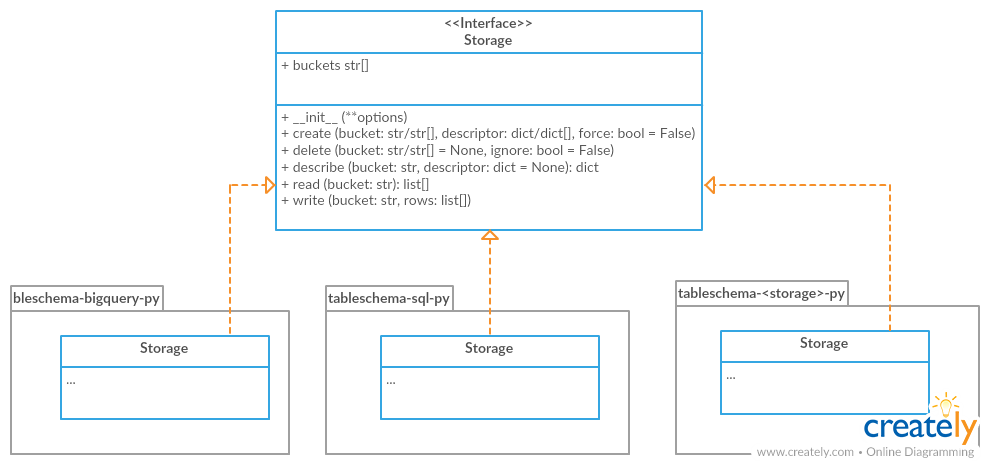 + +An implementor must follow `tableschema.Storage` interface +to write his own storage backend. Concrete storage backends +could include additional functionality specific to conrete storage system. +See `plugins` below to know how to integrate custom storage plugin into your workflow. + + + +#### `storage.buckets` +Return list of storage bucket names. + +A `bucket` is a special term which has almost the same meaning as `table`. +You should consider `bucket` as a `table` stored in the `storage`. + +__Raises__ +- `exceptions.StorageError`: raises on any error + +__Returns__ + +`str[]`: return list of bucket names + + + +#### `storage.connect` +```python +storage.connect(name, **options) +``` +Create tabular `storage` based on storage name. + +> This method is statis: `Storage.connect()` + +__Arguments__ +- __name (str)__: storage name like `sql` +- __options (dict)__: concrete storage options + +__Raises__ +- `StorageError`: raises on any error + +__Returns__ + +`Storage`: returns `Storage` instance + + + +#### `storage.create` +```python +storage.create(bucket, descriptor, force=False) +``` +Create one/multiple buckets. + +__Arguments__ +- __bucket (str/list)__: bucket name or list of bucket names +- __descriptor (dict/dict[])__: schema descriptor or list of descriptors +- __force (bool)__: whether to delete and re-create already existing buckets + +__Raises__ +- `exceptions.StorageError`: raises on any error + + + +#### `storage.delete` +```python +storage.delete(bucket=None, ignore=False) +``` +Delete one/multiple/all buckets. + +__Arguments__ +- __bucket (str/list/None)__: bucket name or list of bucket names to delete. + If `None`, all buckets will be deleted +- __descriptor (dict/dict[])__: schema descriptor or list of descriptors +- __ignore (bool)__: don't raise an error on non-existent bucket deletion + +__Raises__ +- `exceptions.StorageError`: raises on any error + + + +#### `storage.describe` +```python +storage.describe(bucket, descriptor=None) +``` +Get/set bucket's Table Schema descriptor + +__Arguments__ +- __bucket (str)__: bucket name +- __descriptor (dict/None)__: schema descriptor to set + +__Raises__ +- `exceptions.StorageError`: raises on any error + +__Returns__ + +`dict`: returns Table Schema descriptor + + + +#### `storage.iter` +```python +storage.iter(bucket) +``` +Return an iterator of typed values based on the schema of this bucket. + +__Arguments__ +- __bucket (str)__: bucket name + +__Raises__ +- `exceptions.StorageError`: raises on any error + +__Returns__ + +`list[]`: yields data rows + + + +#### `storage.read` +```python +storage.read(bucket) +``` +Read typed values based on the schema of this bucket. + +__Arguments__ +- __bucket (str)__: bucket name +__Raises__ +- `exceptions.StorageError`: raises on any error +__Returns__ + +`list[]`: returns data rows + + + +#### `storage.write` +```python +storage.write(bucket, rows) +``` +This method writes data rows into `storage`. + +It should store values of unsupported types as strings internally (like csv does). + +__Arguments__ +- __bucket (str)__: bucket name +- __rows (list[])__: data rows to write + +__Raises__ +- `exceptions.StorageError`: raises on any error + + +### `validate` +```python +validate(descriptor) +``` +Validate descriptor + +__Arguments__ +- __dict__: descriptor + +__Raises__ +- `ValidationError`: on validation errors + +__Returns__ + +`bool`: True + + +### `infer` +```python +infer(source, + headers=1, + limit=100, + confidence=0.75, + missing_values=[''], + guesser_cls=None, + resolver_cls=None, + **options) +``` +Infer source schema. + +__Arguments__ +- __source (any)__: source as path, url or inline data +- __headers (int/str[])__: headers rows number or headers list +- __confidence (float)__: how many casting errors are allowed (as a ratio, between 0 and 1) +- __missing_values (str[])__: list of missing values (by default `['']`) +- __guesser_cls (class)__: you can implement inferring strategies by + providing type-guessing and type-resolving classes [experimental] +- __resolver_cls (class)__: you can implement inferring strategies by + providing type-guessing and type-resolving classes [experimental] + +__Raises__ +- `TableSchemaException`: raises any error that occurs during the process + +__Returns__ + +`dict`: returns schema descriptor + + +### `FailedCast` +```python +FailedCast(self, value) +``` +Wrap an original data field value that failed to be properly casted. + +FailedCast allows for further processing/yielding values but still be able +to distinguish uncasted values on the consuming side. + +Delegates attribute access and the basic rich comparison methods to the +underlying object. Supports default user-defined classes hashability i.e. +is hashable based on object identity (not based on the wrapped value). + +__Arguments__ +- __value (any)__: value + + +### `DataPackageException` +```python +DataPackageException(self, message, errors=[]) +``` +Base class for all DataPackage/TableSchema exceptions. + +If there are multiple errors, they can be read from the exception object: + +```python +try: + # lib action +except DataPackageException as exception: + if exception.multiple: + for error in exception.errors: + # handle error +``` + + + +#### `datapackageexception.errors` +List of nested errors + +__Returns__ + +`DataPackageException[]`: list of nested errors + + + +#### `datapackageexception.multiple` +Whether it's a nested exception + +__Returns__ + +`bool`: whether it's a nested exception + + + +### `TableSchemaException` +```python +TableSchemaException(self, message, errors=[]) +``` +Base class for all TableSchema exceptions. + + +### `LoadError` +```python +LoadError(self, message, errors=[]) +``` +All loading errors. + + +### `ValidationError` +```python +ValidationError(self, message, errors=[]) +``` +All validation errors. + + +### `CastError` +```python +CastError(self, message, errors=[]) +``` +All value cast errors. + + +### `IntegrityError` +```python +IntegrityError(self, message, errors=[]) +``` +All integrity errors. + + +### `UniqueKeyError` +```python +UniqueKeyError(self, message, errors=[]) +``` +Unique key constraint violation (CastError subclass) + + +### `RelationError` +```python +RelationError(self, message, errors=[]) +``` +All relations errors. + + +### `UnresolvedFKError` +```python +UnresolvedFKError(self, message, errors=[]) +``` +Unresolved foreign key reference error (RelationError subclass). + + +### `StorageError` +```python +StorageError(self, message, errors=[]) +``` +All storage errors. + +## Experimental + +> This API is experimental and can be changed/removed in the future + +There is an experimental environment variable `TABLESCHEMA_PRESERVE_MISSING_VALUES` which, if it is set, affects how data casting works. + +By default, missing values are resolved to `None` values. When this flag is set, missing values are passed through as it is. For example: + +> missing_values.py + +```python +from tableschema import Field + +field = Field({'type': 'number'}, missing_values=['-']) +print(field.cast_value('3')) +print(field.cast_value('-')) +``` + +Running this script in different modes: + +```bash +$ python missing_values.py +3 +None +$ TABLESCHEMA_PRESERVE_MISSING_VALUES=1 python missing_values.py +3 +- +``` + +The flags affects all the library's APIs and software built on top of `tableschema`. For example, Data Package Pipelines: + +```bash +$ TABLESCHEMA_PRESERVE_MISSING_VALUES=1 dpp run ./my_pipeline +``` + +## Contributing + +> The project follows the [Open Knowledge International coding standards](https://github.com/okfn/coding-standards). + +Recommended way to get started is to create and activate a project virtual environment. +To install package and development dependencies into active environment: + +```bash +$ make install +``` + +To run tests with linting and coverage: + +```bash +$ make test +``` + +## Changelog + +Here described only breaking and the most important changes. The full changelog and documentation for all released versions can be found in the nicely formatted [commit history](https://github.com/frictionlessdata/tableschema-py/commits/master). + +#### v1.20 + +- Added --json flag to the CLI (#287) + +#### v1.19 + +- Deduplicate field names if guessing in infer + +#### v1.18 + +- Publish `field.ERROR/cast_function/check_functions` + +#### v1.17 + +- Added `schema.missing_values` and `field.missing_values` + +#### v1.16 + +- Fixed the way we parse `geopoint`: + - as a string it can be in 3 forms ("default", "array", "object") BUT + - as native object it can only be a list/tuple + +#### v1.15 + +- Added an experimental `TABLESCHEMA_PRESERVE_MISSING_VALUES` environment variable flag + +#### v1.14 + +- Allow providing custom guesser and resolver to `table.infer` and `infer` + +#### v1.13 + +- Added `missing_values` argument to the `infer` function (#269) + +#### v1.12 + +- Support optional custom exception handling for table.iter/read (#259) + +#### v1.11 + +- Added `preserve_missing_values` parameter to `field.cast_value` + +#### v1.10 + +- Added an ability to check table's integrity while reading + +#### v1.9 + +- Implemented the `table.size` and `table.hash` properties + +#### v1.8 + +- Added `table.index_foreign_keys_values` and improved foreign key checks performance + +#### v1.7 + +- Added `field.schema` property + +#### v1.6 + +- In `strict` mode raise an exception if there are problems in field construction + +#### v1.5 + +- Allow providing custom guesser and resolver to schema infer + +#### v1.4 + +- Added `schema.update_field` method + +#### v1.3 + +- Support datetime with no time for date casting + +#### v1.2 + +- Support floats like 1.0 for integer casting + +#### v1.1 + +- Added the `confidence` parameter to `infer` + +#### v1.0 + +- The library has been rebased on the Frictionless Data specs v1 - https://frictionlessdata.io/specs/table-schema/ + + + +%package -n python3-tableschema +Summary: A utility library for working with Table Schema in Python +Provides: python-tableschema +BuildRequires: python3-devel +BuildRequires: python3-setuptools +BuildRequires: python3-pip +%description -n python3-tableschema +# tableschema-py + +[](https://travis-ci.org/frictionlessdata/tableschema-py) +[](https://coveralls.io/r/frictionlessdata/tableschema-py?branch=master) +[](https://pypi.python.org/pypi/tableschema) +[](https://github.com/frictionlessdata/tableschema-py) +[](https://gitter.im/frictionlessdata/chat) + +A Python implementation of the [Table Schema](http://specs.frictionlessdata.io/table-schema/) standard. + +> **[Important Notice]** We have released [Frictionless Framework](https://github.com/frictionlessdata/frictionless-py). This framework provides improved `tableschema` functionality extended to be a complete data solution. The change in not breaking for the existing software so no actions are required. Please read the [Migration Guide](https://framework.frictionlessdata.io/docs/development/migration) from `tableschema` to Frictionless Framework. +> - we continue to bug-fix `tableschema@1.x` in this [repository](https://github.com/frictionlessdata/tableschema-py) as well as it's available on [PyPi](https://pypi.org/project/tableschema/) as it was before +> - please note that `frictionless@3.x` version's API, we're working on at the moment, is not stable +> - we will release `frictionless@4.x` by the end of 2020 to be the first SemVer/stable version + +## Features + +- `Table` to work with data tables described by Table Schema +- `Schema` representing Table Schema +- `Field` representing Table Schema field +- `validate` to validate Table Schema +- `infer` to infer Table Schema from data +- built-in command-line interface to validate and infer schemas +- storage/plugins system to connect tables to different storage backends like SQL Database + +## Contents + +<!--TOC--> + + - [Getting Started](#getting-started) + - [Installation](#installation) + - [Documentation](#documentation) + - [Introduction](#introduction) + - [Working with Table](#working-with-table) + - [Working with Schema](#working-with-schema) + - [Working with Field](#working-with-field) + - [API Reference](#api-reference) + - [`cli`](#cli) + - [`Table`](#table) + - [`Schema`](#schema) + - [`Field`](#field) + - [`Storage`](#storage) + - [`validate`](#validate) + - [`infer`](#infer) + - [`FailedCast`](#failedcast) + - [`DataPackageException`](#datapackageexception) + - [`TableSchemaException`](#tableschemaexception) + - [`LoadError`](#loaderror) + - [`ValidationError`](#validationerror) + - [`CastError`](#casterror) + - [`IntegrityError`](#integrityerror) + - [`UniqueKeyError`](#uniquekeyerror) + - [`RelationError`](#relationerror) + - [`UnresolvedFKError`](#unresolvedfkerror) + - [`StorageError`](#storageerror) + - [Experimental](#experimental) + - [Contributing](#contributing) + - [Changelog](#changelog) + +<!--TOC--> + +## Getting Started + +### Installation + +The package uses semantic versioning. It means that major versions could include breaking changes. It's highly recommended to specify `tableschema` version range in your `setup/requirements` file e.g. `tableschema>=1.0,<2.0`. + +```bash +$ pip install tableschema +``` + +## Documentation + +### Introduction + +Let's start with a simple example: + +```python +from tableschema import Table + +# Create table +table = Table('path.csv', schema='schema.json') + +# Print schema descriptor +print(table.schema.descriptor) + +# Print cast rows in a dict form +for keyed_row in table.iter(keyed=True): + print(keyed_row) +``` + +### Working with Table + +A table is a core concept in a tabular data world. It represents data with metadata (Table Schema). Let's see how we can use it in practice. + +Consider we have some local csv file. It could be inline data or from a remote link - all supported by the `Table` class (except local files for in-brower usage of course). But say it's `data.csv` for now: + +```csv +city,location +london,"51.50,-0.11" +paris,"48.85,2.30" +rome,N/A +``` + +Let's create and read a table instance. We use the static `Table.load` method and the `table.read` method with the `keyed` option to get an array of keyed rows: + +```python +table = Table('data.csv') +table.headers # ['city', 'location'] +table.read(keyed=True) +# [ +# {city: 'london', location: '51.50,-0.11'}, +# {city: 'paris', location: '48.85,2.30'}, +# {city: 'rome', location: 'N/A'}, +# ] +``` + +As we can see, our locations are just strings. But they should be geopoints. Also, Rome's location is not available, but it's just a string `N/A` instead of `None`. First we have to infer Table Schema: + +```python +table.infer() +table.schema.descriptor +# { fields: +# [ { name: 'city', type: 'string', format: 'default' }, +# { name: 'location', type: 'geopoint', format: 'default' } ], +# missingValues: [ '' ] } +table.read(keyed=True) +# Fails with a data validation error +``` + +Let's fix the "not available" location. There is a `missingValues` property in Table Schema specification. As a first try we set `missingValues` to `N/A` in `table.schema.descriptor`. The schema descriptor can be changed in-place, but all changes should also be committed using `table.schema.commit()`: + +```python +table.schema.descriptor['missingValues'] = 'N/A' +table.schema.commit() +table.schema.valid # false +table.schema.errors +# [<ValidationError: "'N/A' is not of type 'array'">] +``` + +As a good citizens we've decided to check our schema descriptor's validity. And it's not valid! We should use an array for the `missingValues` property. Also, don't forget to include "empty string" as a valid missing value: + +```python +table.schema.descriptor['missingValues'] = ['', 'N/A'] +table.schema.commit() +table.schema.valid # true +``` + +All good. It looks like we're ready to read our data again: + +```python +table.read(keyed=True) +# [ +# {city: 'london', location: [51.50,-0.11]}, +# {city: 'paris', location: [48.85,2.30]}, +# {city: 'rome', location: null}, +# ] +``` + +Now we see that: +- locations are arrays with numeric latitude and longitude +- Rome's location is a native Python `None` + +And because there are no errors after reading, we can be sure that our data is valid against our schema. Let's save it: + +```python +table.schema.save('schema.json') +table.save('data.csv') +``` + +Our `data.csv` looks the same because it has been stringified back to `csv` format. But now we have `schema.json`: + +```json +{ + "fields": [ + { + "name": "city", + "type": "string", + "format": "default" + }, + { + "name": "location", + "type": "geopoint", + "format": "default" + } + ], + "missingValues": [ + "", + "N/A" + ] +} + +``` + +If we decide to improve it even more we could update the schema file and then open it again. But now providing a schema path: + +```python +table = Table('data.csv', schema='schema.json') +# Continue the work +``` + +As already mentioned a given schema can be used to *validate* data (see the [Schema](#schema) section for schema specification details). In default mode invalid data rows immediately trigger an [exception](#exceptions) in the `table.iter()`/`table.write()` methods. + +Suppose this schema-invalid local file `invalid_data.csv`: +```csv +key,value +zero,0 +one,not_an_integer +two,2 +``` + +We're going to validate the data against the following schema: +```python +table = Table( + 'invalid_data.csv', + schema={'fields': [{'name': 'key'}, {'name': 'value', 'type': 'integer'}]}) +``` + +Iterating over the data triggers an exception due to the failed cast of `'not_an_integer'` to `int`: +```python +for row in table.iter(): + print(row) + +# Traceback (most recent call last): +# ... +# tableschema.exceptions.CastError: There are 1 cast errors (see exception.errors) for row "3" +``` + +Hint: The row number count starts with 1 and also includes header lines. + +(Note: You can optionally switch off `iter()`/`read()` value casting using the cast parameter, see reference below.) + +By providing a custom exception handler (a callable) to those methods you can treat occurring exceptions at your own discretion, i.e. to "fail late" and e.g. gather a validation report on the whole data: + +```python +errors = [] +def exc_handler(exc, row_number=None, row_data=None, error_data=None): + errors.append((exc, row_number, row_data, error_data)) + +for row in table.iter(exc_handler=exc_handler): + print(row) + +# ['zero', 0] +# ['one', FailedCast('not_an_integer')] +# ['two', 2] + +print(errors) + +# [(CastError('There are 1 cast errors (see exception.errors) for row "3"',), +# 3, +# OrderedDict([('key', 'one'), ('value', 'not_an_integer')]), +# OrderedDict([('value', 'not_an_integer')]))] +``` + +Note that + +- Data rows are yielded even though the data is schema-invalid; this is due to our custom expression handler choosing not to raise exceptions (but rather collect them in the errors list). +- Data field values that can't get casted properly (if `iter()`/`read()` cast parameter is set to True, which is the default) are wrapped into a `FailedCast` "value holder". This allows for distinguishing uncasted values from successfully casted values on the data consumer side. `FailedCast` instances can only get yielded when custom exception handling is in place. +- The custom exception handler callable must support a function signature as specified in the `iter()`/`read()` sections of the `Table` class API reference. + +### Working with Schema + +A model of a schema with helpful methods for working with the schema and supported data. Schema instances can be initialized with a schema source as a url to a JSON file or a JSON object. The schema is initially validated (see [validate](#validate) below). By default validation errors will be stored in `schema.errors` but in a strict mode it will be instantly raised. + +Let's create a blank schema. It's not valid because `descriptor.fields` property is required by the [Table Schema](http://specs.frictionlessdata.io/table-schema/) specification: + +```python +schema = Schema() +schema.valid # false +schema.errors +# [<ValidationError: "'fields' is a required property">] +``` + +To avoid creating a schema descriptor by hand we will use a `schema.infer` method to infer the descriptor from given data: + +```python +schema.infer([ + ['id', 'age', 'name'], + ['1','39','Paul'], + ['2','23','Jimmy'], + ['3','36','Jane'], + ['4','28','Judy'], +]) +schema.valid # true +schema.descriptor +#{ fields: +# [ { name: 'id', type: 'integer', format: 'default' }, +# { name: 'age', type: 'integer', format: 'default' }, +# { name: 'name', type: 'string', format: 'default' } ], +# missingValues: [ '' ] } +``` + +Now we have an inferred schema and it's valid. We can cast data rows against our schema. We provide a string input which will be cast correspondingly: + +```python +schema.cast_row(['5', '66', 'Sam']) +# [ 5, 66, 'Sam' ] +``` + +But if we try provide some missing value to the `age` field, the cast will fail because the only valid "missing" value is an empty string. Let's update our schema: + +```python +schema.cast_row(['6', 'N/A', 'Walt']) +# Cast error +schema.descriptor['missingValues'] = ['', 'N/A'] +schema.commit() +schema.cast_row(['6', 'N/A', 'Walt']) +# [ 6, None, 'Walt' ] +``` + +We can save the schema to a local file, and resume work on it at any time by loading it from that file: + +```python +schema.save('schema.json') +schema = Schema('schema.json') +``` + +### Working with Field + +```python +from tableschema import Field + +# Init field +field = Field({'name': 'name', 'type': 'number'}) + +# Cast a value +field.cast_value('12345') # -> 12345 +``` + +Data values can be cast to native Python objects with a Field instance. Type instances can be initialized with [field descriptors](https://specs.frictionlessdata.io/table-schema/). This allows formats and constraints to be defined. + +Casting a value will check the value is of the expected type, is in the correct format, and complies with any constraints imposed by a schema. E.g. a date value (in ISO 8601 format) can be cast with a DateType instance. Values that can't be cast will raise an `InvalidCastError` exception. + +Casting a value that doesn't meet the constraints will raise a `ConstraintError` exception. + +## API Reference + +### `cli` +```python +cli() +``` +Command-line interface + +``` +Usage: tableschema [OPTIONS] COMMAND [ARGS]... + +Options: + --help Show this message and exit. + +Commands: + infer Infer a schema from data. + info Return info on this version of Table Schema + validate Validate that a supposed schema is in fact a Table Schema. +``` + + +### `Table` +```python +Table(self, + source, + schema=None, + strict=False, + post_cast=[], + storage=None, + **options) +``` +Table representation + +__Arguments__ +- __source (str/list[])__: data source one of: + - local file (path) + - remote file (url) + - array of arrays representing the rows +- __schema (any)__: data schema in all forms supported by `Schema` class +- __strict (bool)__: strictness option to pass to `Schema` constructor +- __post_cast (function[])__: list of post cast processors +- __storage (None)__: storage name like `sql` or `bigquery` +- __options (dict)__: `tabulator` or storage's options + +__Raises__ +- `TableSchemaException`: raises on any error + + + +#### `table.hash` +Table's SHA256 hash if it's available. + +If it's already read using e.g. `table.read`, otherwise returns `None`. +In the middle of an iteration it returns hash of already read contents + +__Returns__ + +`str/None`: SHA256 hash + + + +#### `table.headers` +Table's headers is available + +__Returns__ + +`str[]`: headers + + + +#### `table.schema` +Returns schema class instance if available + +__Returns__ + +`Schema`: schema + + + +#### `table.size` +Table's size in BYTES if it's available + +If it's already read using e.g. `table.read`, otherwise returns `None`. +In the middle of an iteration it returns size of already read contents + +__Returns__ + +`int/None`: size in BYTES + + + +#### `table.iter` +```python +table.iter(keyed=False, + extended=False, + cast=True, + integrity=False, + relations=False, + foreign_keys_values=False, + exc_handler=None) +``` +Iterates through the table data and emits rows cast based on table schema. + +__Arguments__ + + + keyed (bool): + yield keyed rows in a form of `{header1: value1, header2: value2}` + (default is false; the form of rows is `[value1, value2]`) + + extended (bool): + yield extended rows in a for of `[rowNumber, [header1, header2], [value1, value2]]` + (default is false; the form of rows is `[value1, value2]`) + + cast (bool): + disable data casting if false + (default is true) + + integrity (dict): + dictionary in a form of `{'size': <bytes>, 'hash': '<sha256>'}` + to check integrity of the table when it's read completely. + Both keys are optional. + + relations (dict): + dictionary of foreign key references in a form + of `{resource1: [{field1: value1, field2: value2}, ...], ...}`. + If provided, foreign key fields will checked and resolved + to one of their references (/!\ one-to-many fk are not completely resolved). + + foreign_keys_values (dict): + three-level dictionary of foreign key references optimized + to speed up validation process in a form of + `{resource1: {(fk_field1, fk_field2): {(value1, value2): {one_keyedrow}, ... }}}`. + If not provided but relations is true, it will be created + before the validation process by *index_foreign_keys_values* method + + exc_handler (func): + optional custom exception handler callable. + Can be used to defer raising errors (i.e. "fail late"), e.g. + for data validation purposes. Must support the signature below + +__Custom exception handler__ + + +```python +def exc_handler(exc, row_number=None, row_data=None, error_data=None): + '''Custom exception handler (example) + + # Arguments: + exc(Exception): + Deferred exception instance + row_number(int): + Data row number that triggers exception exc + row_data(OrderedDict): + Invalid data row source data + error_data(OrderedDict): + Data row source data field subset responsible for the error, if + applicable (e.g. invalid primary or foreign key fields). May be + identical to row_data. + ''' + # ... +``` + +__Raises__ +- `TableSchemaException`: base class of any error +- `CastError`: data cast error +- `IntegrityError`: integrity checking error +- `UniqueKeyError`: unique key constraint violation +- `UnresolvedFKError`: unresolved foreign key reference error + +__Returns__ + +`Iterator[list]`: yields rows + + + +#### `table.read` +```python +table.read(keyed=False, + extended=False, + cast=True, + limit=None, + integrity=False, + relations=False, + foreign_keys_values=False, + exc_handler=None) +``` +Read the whole table and return as array of rows + +> It has the same API as `table.iter` except for + +__Arguments__ +- __limit (int)__: limit count of rows to read and return + +__Returns__ + +`list[]`: returns rows + + + +#### `table.infer` +```python +table.infer(limit=100, + confidence=0.75, + missing_values=[''], + guesser_cls=None, + resolver_cls=None) +``` +Infer a schema for the table. + +It will infer and set Table Schema to `table.schema` based on table data. + +__Arguments__ +- __limit (int)__: limit rows sample size +- __confidence (float)__: how many casting errors are allowed (as a ratio, between 0 and 1) +- __missing_values (str[])__: list of missing values (by default `['']`) +- __guesser_cls (class)__: you can implement inferring strategies by + providing type-guessing and type-resolving classes [experimental] +- __resolver_cls (class)__: you can implement inferring strategies by + providing type-guessing and type-resolving classes [experimental] + +__Returns__ + +`dict`: Table Schema descriptor + + + +#### `table.save` +```python +table.save(target, storage=None, **options) +``` +Save data source to file locally in CSV format with `,` (comma) delimiter + +> To save schema use `table.schema.save()` + +__Arguments__ +- __target (str)__: saving target (e.g. file path) +- __storage (None/str)__: storage name like `sql` or `bigquery` +- __options (dict)__: `tabulator` or storage options + +__Raises__ +- `TableSchemaException`: raises an error if there is saving problem + +__Returns__ + +`True/Storage`: returns true or storage instance + + + +#### `table.index_foreign_keys_values` +```python +table.index_foreign_keys_values(relations) +``` +Creates a three-level dictionary of foreign key references + +We create them optimized to speed up validation process in a form of +`{resource1: {(fk_field1, fk_field2): {(value1, value2): {one_keyedrow}, ... }}}`. + +For each foreign key of the schema it will iterate through the corresponding +`relations['resource']` to create an index (i.e. a dict) of existing values +for the foreign fields and store on keyed row for each value combination. + +The optimization relies on the indexation of possible values for one foreign key +in a hashmap to later speed up resolution. + +This method is public to allow creating the index once to apply it +on multiple tables charing the same schema +(typically [grouped resources in datapackage](https://github.com/frictionlessdata/datapackage-py#group)) + +__Notes__ + +- the second key of the output is a tuple of the foreign fields, + a proxy identifier of the foreign key +- the same relation resource can be indexed multiple times + as a schema can contain more than one Foreign Keys + pointing to the same resource + +__Arguments__ +- __relations (dict)__: + dict of foreign key references in a form of + `{resource1: [{field1: value1, field2: value2}, ...], ...}`. + It must contain all resources pointed in the foreign keys schema definition. + +__Returns__ + +`dict`: + returns a three-level dictionary of foreign key references + optimized to speed up validation process in a form of + `{resource1: {(fk_field1, fk_field2): {(value1, value2): {one_keyedrow}, ... }}})` + + +### `Schema` +```python +Schema(self, descriptor={}, strict=False) +``` +Schema representation + +__Arguments__ +- __descriptor (str/dict)__: schema descriptor one of: + - local path + - remote url + - dictionary +- __strict (bool)__: flag to specify validation behaviour: + - if false, errors will not be raised but instead collected in `schema.errors` + - if true, validation errors are raised immediately + +__Raises__ +- `TableSchemaException`: raise any error that occurs during the process + + + +#### `schema.descriptor` +Schema's descriptor + +__Returns__ + +`dict`: descriptor + + + +#### `schema.errors` +Validation errors + +Always empty in strict mode. + +__Returns__ + +`Exception[]`: validation errors + + + +#### `schema.field_names` +Schema's field names + +__Returns__ + +`str[]`: an array of field names + + + +#### `schema.fields` +Schema's fields + +__Returns__ + +`Field[]`: an array of field instances + + + +#### `schema.foreign_keys` +Schema's foreign keys + +__Returns__ + +`dict[]`: foreign keys + + + +#### `schema.headers` +Schema's field names + +__Returns__ + +`str[]`: an array of field names + + + +#### `schema.missing_values` +Schema's missing values + +__Returns__ + +`str[]`: missing values + + + +#### `schema.primary_key` +Schema's primary keys + +__Returns__ + +`str[]`: primary keys + + + +#### `schema.valid` +Validation status + +Always true in strict mode. + +__Returns__ + +`bool`: validation status + + + +#### `schema.get_field` +```python +schema.get_field(name) +``` +Get schema's field by name. + +> Use `table.update_field` if you want to modify the field descriptor + +__Arguments__ +- __name (str)__: schema field name + +__Returns__ + +`Field/None`: `Field` instance or `None` if not found + + + +#### `schema.get_field` +```python +schema.get_field(name) +``` +Get schema's field by name. + +> Use `table.update_field` if you want to modify the field descriptor + +__Arguments__ +- __name (str)__: schema field name + +__Returns__ + +`Field/None`: `Field` instance or `None` if not found + + + +#### `schema.add_field` +```python +schema.add_field(descriptor) +``` +Add new field to schema. + +The schema descriptor will be validated with newly added field descriptor. + +__Arguments__ +- __descriptor (dict)__: field descriptor + +__Raises__ +- `TableSchemaException`: raises any error that occurs during the process + +__Returns__ + +`Field/None`: added `Field` instance or `None` if not added + + + +#### `schema.update_field` +```python +schema.update_field(name, update) +``` +Update existing descriptor field by name + +__Arguments__ +- __name (str)__: schema field name +- __update (dict)__: update to apply to field's descriptor + +__Returns__ + +`bool`: true on success and false if no field is found to be modified + + + +#### `schema.remove_field` +```python +schema.remove_field(name) +``` +Remove field resource by name. + +The schema descriptor will be validated after field descriptor removal. + +__Arguments__ +- __name (str)__: schema field name + +__Raises__ +- `TableSchemaException`: raises any error that occurs during the process + +__Returns__ + +`Field/None`: removed `Field` instances or `None` if not found + + + +#### `schema.cast_row` +```python +schema.cast_row(row, fail_fast=False, row_number=None, exc_handler=None) +``` +Cast row based on field types and formats. + +__Arguments__ +- __row (any[]__: data row as an array of values + +__Returns__ + +`any[]`: returns cast data row + + + +#### `schema.infer` +```python +schema.infer(rows, + headers=1, + confidence=0.75, + guesser_cls=None, + resolver_cls=None) +``` +Infer and set `schema.descriptor` based on data sample. + +__Arguments__ +- __rows (list[])__: array of arrays representing rows. +- __headers (int/str[])__: data sample headers (one of): + - row number containing headers (`rows` should contain headers rows) + - array of headers (`rows` should NOT contain headers rows) +- __confidence (float)__: how many casting errors are allowed (as a ratio, between 0 and 1) +- __guesser_cls (class)__: you can implement inferring strategies by + providing type-guessing and type-resolving classes [experimental] +- __resolver_cls (class)__: you can implement inferring strategies by + providing type-guessing and type-resolving classes [experimental] + +__Returns__ + +`dict`: Table Schema descriptor + + + +#### `schema.commit` +```python +schema.commit(strict=None) +``` +Update schema instance if there are in-place changes in the descriptor. + +__Example__ + + +```python +from tableschema import Schema +descriptor = {'fields': [{'name': 'my_field', 'title': 'My Field', 'type': 'string'}]} +schema = Schema(descriptor) +print(schema.get_field('my_field').descriptor['type']) # string + +# Update descriptor by field position +schema.descriptor['fields'][0]['type'] = 'number' +# Update descriptor by field name +schema.update_field('my_field', {'title': 'My Pretty Field'}) # True + +# Change are not committed +print(schema.get_field('my_field').descriptor['type']) # string +print(schema.get_field('my_field').descriptor['title']) # My Field + +# Commit change +schema.commit() +print(schema.get_field('my_field').descriptor['type']) # number +print(schema.get_field('my_field').descriptor['title']) # My Pretty Field + +``` + +__Arguments__ +- __strict (bool)__: alter `strict` mode for further work + +__Raises__ +- `TableSchemaException`: raises any error that occurs during the process + +__Returns__ + +`bool`: true on success and false if not modified + + + +#### `schema.save` +```python +schema.save(target, ensure_ascii=True) +``` +Save schema descriptor to target destination. + +__Arguments__ +- __target (str)__: path where to save a descriptor + +__Raises__ +- `TableSchemaException`: raises any error that occurs during the process + +__Returns__ + +`bool`: true on success + + + +### `Field` +```python +Field(self, descriptor, missing_values=[''], schema=None) +``` +Field representaion + +__Arguments__ +- __descriptor (dict)__: schema field descriptor +- __missingValues (str[])__: an array with string representing missing values + +__Raises__ +- `TableSchemaException`: raises any error that occurs during the process + + + +#### `field.constraints` +Field constraints + +__Returns__ + +`dict`: dict of field constraints + + + +#### `field.descriptor` +Fields's descriptor + +__Returns__ + +`dict`: descriptor + + + +#### `field.format` +Field format + +__Returns__ + +`str`: field format + + + +#### `field.missing_values` +Field's missing values + +__Returns__ + +`str[]`: missing values + + + +#### `field.name` +Field name + +__Returns__ + +`str`: field name + + + +#### `field.required` +Whether field is required + +__Returns__ + +`bool`: true if required + + + +#### `field.schema` +Returns a schema instance if the field belongs to some schema + +__Returns__ + +`Schema`: field's schema + + + +#### `field.type` +Field type + +__Returns__ + +`str`: field type + + + +#### `field.cast_value` +```python +field.cast_value(value, constraints=True) +``` +Cast given value according to the field type and format. + +__Arguments__ +- __value (any)__: value to cast against field +- __constraints (boll/str[])__: gets constraints configuration + - it could be set to true to disable constraint checks + - it could be an Array of constraints to check e.g. ['minimum', 'maximum'] + +__Raises__ +- `TableSchemaException`: raises any error that occurs during the process + +__Returns__ + +`any`: returns cast value + + + +#### `field.test_value` +```python +field.test_value(value, constraints=True) +``` +Test whether value is compliant to the field. + +__Arguments__ +- __value (any)__: value to cast against field +- __constraints (bool/str[])__: constraints configuration + +__Returns__ + +`bool`: returns if value is compliant to the field + + +### `Storage` +```python +Storage(self, **options) +``` +Storage factory/interface + +__For users__ + + +> Use `Storage.connect` to instantiate a storage + +For instantiation of concrete storage instances, +`tableschema.Storage` provides a unified factory method `connect` +(which uses the plugin system under the hood): + +```python +# pip install tableschema_sql +from tableschema import Storage + +storage = Storage.connect('sql', **options) +storage.create('bucket', descriptor) +storage.write('bucket', rows) +storage.read('bucket') +``` + +__For integrators__ + + +The library includes interface declaration to implement tabular `Storage`. +This interface allow to use different data storage systems like SQL +with `tableschema.Table` class (load/save) as well as on the data package level: + + + +An implementor must follow `tableschema.Storage` interface +to write his own storage backend. Concrete storage backends +could include additional functionality specific to conrete storage system. +See `plugins` below to know how to integrate custom storage plugin into your workflow. + + + +#### `storage.buckets` +Return list of storage bucket names. + +A `bucket` is a special term which has almost the same meaning as `table`. +You should consider `bucket` as a `table` stored in the `storage`. + +__Raises__ +- `exceptions.StorageError`: raises on any error + +__Returns__ + +`str[]`: return list of bucket names + + + +#### `storage.connect` +```python +storage.connect(name, **options) +``` +Create tabular `storage` based on storage name. + +> This method is statis: `Storage.connect()` + +__Arguments__ +- __name (str)__: storage name like `sql` +- __options (dict)__: concrete storage options + +__Raises__ +- `StorageError`: raises on any error + +__Returns__ + +`Storage`: returns `Storage` instance + + + +#### `storage.create` +```python +storage.create(bucket, descriptor, force=False) +``` +Create one/multiple buckets. + +__Arguments__ +- __bucket (str/list)__: bucket name or list of bucket names +- __descriptor (dict/dict[])__: schema descriptor or list of descriptors +- __force (bool)__: whether to delete and re-create already existing buckets + +__Raises__ +- `exceptions.StorageError`: raises on any error + + + +#### `storage.delete` +```python +storage.delete(bucket=None, ignore=False) +``` +Delete one/multiple/all buckets. + +__Arguments__ +- __bucket (str/list/None)__: bucket name or list of bucket names to delete. + If `None`, all buckets will be deleted +- __descriptor (dict/dict[])__: schema descriptor or list of descriptors +- __ignore (bool)__: don't raise an error on non-existent bucket deletion + +__Raises__ +- `exceptions.StorageError`: raises on any error + + + +#### `storage.describe` +```python +storage.describe(bucket, descriptor=None) +``` +Get/set bucket's Table Schema descriptor + +__Arguments__ +- __bucket (str)__: bucket name +- __descriptor (dict/None)__: schema descriptor to set + +__Raises__ +- `exceptions.StorageError`: raises on any error + +__Returns__ + +`dict`: returns Table Schema descriptor + + + +#### `storage.iter` +```python +storage.iter(bucket) +``` +Return an iterator of typed values based on the schema of this bucket. + +__Arguments__ +- __bucket (str)__: bucket name + +__Raises__ +- `exceptions.StorageError`: raises on any error + +__Returns__ + +`list[]`: yields data rows + + + +#### `storage.read` +```python +storage.read(bucket) +``` +Read typed values based on the schema of this bucket. + +__Arguments__ +- __bucket (str)__: bucket name +__Raises__ +- `exceptions.StorageError`: raises on any error +__Returns__ + +`list[]`: returns data rows + + + +#### `storage.write` +```python +storage.write(bucket, rows) +``` +This method writes data rows into `storage`. + +It should store values of unsupported types as strings internally (like csv does). + +__Arguments__ +- __bucket (str)__: bucket name +- __rows (list[])__: data rows to write + +__Raises__ +- `exceptions.StorageError`: raises on any error + + +### `validate` +```python +validate(descriptor) +``` +Validate descriptor + +__Arguments__ +- __dict__: descriptor + +__Raises__ +- `ValidationError`: on validation errors + +__Returns__ + +`bool`: True + + +### `infer` +```python +infer(source, + headers=1, + limit=100, + confidence=0.75, + missing_values=[''], + guesser_cls=None, + resolver_cls=None, + **options) +``` +Infer source schema. + +__Arguments__ +- __source (any)__: source as path, url or inline data +- __headers (int/str[])__: headers rows number or headers list +- __confidence (float)__: how many casting errors are allowed (as a ratio, between 0 and 1) +- __missing_values (str[])__: list of missing values (by default `['']`) +- __guesser_cls (class)__: you can implement inferring strategies by + providing type-guessing and type-resolving classes [experimental] +- __resolver_cls (class)__: you can implement inferring strategies by + providing type-guessing and type-resolving classes [experimental] + +__Raises__ +- `TableSchemaException`: raises any error that occurs during the process + +__Returns__ + +`dict`: returns schema descriptor + + +### `FailedCast` +```python +FailedCast(self, value) +``` +Wrap an original data field value that failed to be properly casted. + +FailedCast allows for further processing/yielding values but still be able +to distinguish uncasted values on the consuming side. + +Delegates attribute access and the basic rich comparison methods to the +underlying object. Supports default user-defined classes hashability i.e. +is hashable based on object identity (not based on the wrapped value). + +__Arguments__ +- __value (any)__: value + + +### `DataPackageException` +```python +DataPackageException(self, message, errors=[]) +``` +Base class for all DataPackage/TableSchema exceptions. + +If there are multiple errors, they can be read from the exception object: + +```python +try: + # lib action +except DataPackageException as exception: + if exception.multiple: + for error in exception.errors: + # handle error +``` + + + +#### `datapackageexception.errors` +List of nested errors + +__Returns__ + +`DataPackageException[]`: list of nested errors + + + +#### `datapackageexception.multiple` +Whether it's a nested exception + +__Returns__ + +`bool`: whether it's a nested exception + + + +### `TableSchemaException` +```python +TableSchemaException(self, message, errors=[]) +``` +Base class for all TableSchema exceptions. + + +### `LoadError` +```python +LoadError(self, message, errors=[]) +``` +All loading errors. + + +### `ValidationError` +```python +ValidationError(self, message, errors=[]) +``` +All validation errors. + + +### `CastError` +```python +CastError(self, message, errors=[]) +``` +All value cast errors. + + +### `IntegrityError` +```python +IntegrityError(self, message, errors=[]) +``` +All integrity errors. + + +### `UniqueKeyError` +```python +UniqueKeyError(self, message, errors=[]) +``` +Unique key constraint violation (CastError subclass) + + +### `RelationError` +```python +RelationError(self, message, errors=[]) +``` +All relations errors. + + +### `UnresolvedFKError` +```python +UnresolvedFKError(self, message, errors=[]) +``` +Unresolved foreign key reference error (RelationError subclass). + + +### `StorageError` +```python +StorageError(self, message, errors=[]) +``` +All storage errors. + +## Experimental + +> This API is experimental and can be changed/removed in the future + +There is an experimental environment variable `TABLESCHEMA_PRESERVE_MISSING_VALUES` which, if it is set, affects how data casting works. + +By default, missing values are resolved to `None` values. When this flag is set, missing values are passed through as it is. For example: + +> missing_values.py + +```python +from tableschema import Field + +field = Field({'type': 'number'}, missing_values=['-']) +print(field.cast_value('3')) +print(field.cast_value('-')) +``` + +Running this script in different modes: + +```bash +$ python missing_values.py +3 +None +$ TABLESCHEMA_PRESERVE_MISSING_VALUES=1 python missing_values.py +3 +- +``` + +The flags affects all the library's APIs and software built on top of `tableschema`. For example, Data Package Pipelines: + +```bash +$ TABLESCHEMA_PRESERVE_MISSING_VALUES=1 dpp run ./my_pipeline +``` + +## Contributing + +> The project follows the [Open Knowledge International coding standards](https://github.com/okfn/coding-standards). + +Recommended way to get started is to create and activate a project virtual environment. +To install package and development dependencies into active environment: + +```bash +$ make install +``` + +To run tests with linting and coverage: + +```bash +$ make test +``` + +## Changelog + +Here described only breaking and the most important changes. The full changelog and documentation for all released versions can be found in the nicely formatted [commit history](https://github.com/frictionlessdata/tableschema-py/commits/master). + +#### v1.20 + +- Added --json flag to the CLI (#287) + +#### v1.19 + +- Deduplicate field names if guessing in infer + +#### v1.18 + +- Publish `field.ERROR/cast_function/check_functions` + +#### v1.17 + +- Added `schema.missing_values` and `field.missing_values` + +#### v1.16 + +- Fixed the way we parse `geopoint`: + - as a string it can be in 3 forms ("default", "array", "object") BUT + - as native object it can only be a list/tuple + +#### v1.15 + +- Added an experimental `TABLESCHEMA_PRESERVE_MISSING_VALUES` environment variable flag + +#### v1.14 + +- Allow providing custom guesser and resolver to `table.infer` and `infer` + +#### v1.13 + +- Added `missing_values` argument to the `infer` function (#269) + +#### v1.12 + +- Support optional custom exception handling for table.iter/read (#259) + +#### v1.11 + +- Added `preserve_missing_values` parameter to `field.cast_value` + +#### v1.10 + +- Added an ability to check table's integrity while reading + +#### v1.9 + +- Implemented the `table.size` and `table.hash` properties + +#### v1.8 + +- Added `table.index_foreign_keys_values` and improved foreign key checks performance + +#### v1.7 + +- Added `field.schema` property + +#### v1.6 + +- In `strict` mode raise an exception if there are problems in field construction + +#### v1.5 + +- Allow providing custom guesser and resolver to schema infer + +#### v1.4 + +- Added `schema.update_field` method + +#### v1.3 + +- Support datetime with no time for date casting + +#### v1.2 + +- Support floats like 1.0 for integer casting + +#### v1.1 + +- Added the `confidence` parameter to `infer` + +#### v1.0 + +- The library has been rebased on the Frictionless Data specs v1 - https://frictionlessdata.io/specs/table-schema/ + + + +%package help +Summary: Development documents and examples for tableschema +Provides: python3-tableschema-doc +%description help +# tableschema-py + +[](https://travis-ci.org/frictionlessdata/tableschema-py) +[](https://coveralls.io/r/frictionlessdata/tableschema-py?branch=master) +[](https://pypi.python.org/pypi/tableschema) +[](https://github.com/frictionlessdata/tableschema-py) +[](https://gitter.im/frictionlessdata/chat) + +A Python implementation of the [Table Schema](http://specs.frictionlessdata.io/table-schema/) standard. + +> **[Important Notice]** We have released [Frictionless Framework](https://github.com/frictionlessdata/frictionless-py). This framework provides improved `tableschema` functionality extended to be a complete data solution. The change in not breaking for the existing software so no actions are required. Please read the [Migration Guide](https://framework.frictionlessdata.io/docs/development/migration) from `tableschema` to Frictionless Framework. +> - we continue to bug-fix `tableschema@1.x` in this [repository](https://github.com/frictionlessdata/tableschema-py) as well as it's available on [PyPi](https://pypi.org/project/tableschema/) as it was before +> - please note that `frictionless@3.x` version's API, we're working on at the moment, is not stable +> - we will release `frictionless@4.x` by the end of 2020 to be the first SemVer/stable version + +## Features + +- `Table` to work with data tables described by Table Schema +- `Schema` representing Table Schema +- `Field` representing Table Schema field +- `validate` to validate Table Schema +- `infer` to infer Table Schema from data +- built-in command-line interface to validate and infer schemas +- storage/plugins system to connect tables to different storage backends like SQL Database + +## Contents + +<!--TOC--> + + - [Getting Started](#getting-started) + - [Installation](#installation) + - [Documentation](#documentation) + - [Introduction](#introduction) + - [Working with Table](#working-with-table) + - [Working with Schema](#working-with-schema) + - [Working with Field](#working-with-field) + - [API Reference](#api-reference) + - [`cli`](#cli) + - [`Table`](#table) + - [`Schema`](#schema) + - [`Field`](#field) + - [`Storage`](#storage) + - [`validate`](#validate) + - [`infer`](#infer) + - [`FailedCast`](#failedcast) + - [`DataPackageException`](#datapackageexception) + - [`TableSchemaException`](#tableschemaexception) + - [`LoadError`](#loaderror) + - [`ValidationError`](#validationerror) + - [`CastError`](#casterror) + - [`IntegrityError`](#integrityerror) + - [`UniqueKeyError`](#uniquekeyerror) + - [`RelationError`](#relationerror) + - [`UnresolvedFKError`](#unresolvedfkerror) + - [`StorageError`](#storageerror) + - [Experimental](#experimental) + - [Contributing](#contributing) + - [Changelog](#changelog) + +<!--TOC--> + +## Getting Started + +### Installation + +The package uses semantic versioning. It means that major versions could include breaking changes. It's highly recommended to specify `tableschema` version range in your `setup/requirements` file e.g. `tableschema>=1.0,<2.0`. + +```bash +$ pip install tableschema +``` + +## Documentation + +### Introduction + +Let's start with a simple example: + +```python +from tableschema import Table + +# Create table +table = Table('path.csv', schema='schema.json') + +# Print schema descriptor +print(table.schema.descriptor) + +# Print cast rows in a dict form +for keyed_row in table.iter(keyed=True): + print(keyed_row) +``` + +### Working with Table + +A table is a core concept in a tabular data world. It represents data with metadata (Table Schema). Let's see how we can use it in practice. + +Consider we have some local csv file. It could be inline data or from a remote link - all supported by the `Table` class (except local files for in-brower usage of course). But say it's `data.csv` for now: + +```csv +city,location +london,"51.50,-0.11" +paris,"48.85,2.30" +rome,N/A +``` + +Let's create and read a table instance. We use the static `Table.load` method and the `table.read` method with the `keyed` option to get an array of keyed rows: + +```python +table = Table('data.csv') +table.headers # ['city', 'location'] +table.read(keyed=True) +# [ +# {city: 'london', location: '51.50,-0.11'}, +# {city: 'paris', location: '48.85,2.30'}, +# {city: 'rome', location: 'N/A'}, +# ] +``` + +As we can see, our locations are just strings. But they should be geopoints. Also, Rome's location is not available, but it's just a string `N/A` instead of `None`. First we have to infer Table Schema: + +```python +table.infer() +table.schema.descriptor +# { fields: +# [ { name: 'city', type: 'string', format: 'default' }, +# { name: 'location', type: 'geopoint', format: 'default' } ], +# missingValues: [ '' ] } +table.read(keyed=True) +# Fails with a data validation error +``` + +Let's fix the "not available" location. There is a `missingValues` property in Table Schema specification. As a first try we set `missingValues` to `N/A` in `table.schema.descriptor`. The schema descriptor can be changed in-place, but all changes should also be committed using `table.schema.commit()`: + +```python +table.schema.descriptor['missingValues'] = 'N/A' +table.schema.commit() +table.schema.valid # false +table.schema.errors +# [<ValidationError: "'N/A' is not of type 'array'">] +``` + +As a good citizens we've decided to check our schema descriptor's validity. And it's not valid! We should use an array for the `missingValues` property. Also, don't forget to include "empty string" as a valid missing value: + +```python +table.schema.descriptor['missingValues'] = ['', 'N/A'] +table.schema.commit() +table.schema.valid # true +``` + +All good. It looks like we're ready to read our data again: + +```python +table.read(keyed=True) +# [ +# {city: 'london', location: [51.50,-0.11]}, +# {city: 'paris', location: [48.85,2.30]}, +# {city: 'rome', location: null}, +# ] +``` + +Now we see that: +- locations are arrays with numeric latitude and longitude +- Rome's location is a native Python `None` + +And because there are no errors after reading, we can be sure that our data is valid against our schema. Let's save it: + +```python +table.schema.save('schema.json') +table.save('data.csv') +``` + +Our `data.csv` looks the same because it has been stringified back to `csv` format. But now we have `schema.json`: + +```json +{ + "fields": [ + { + "name": "city", + "type": "string", + "format": "default" + }, + { + "name": "location", + "type": "geopoint", + "format": "default" + } + ], + "missingValues": [ + "", + "N/A" + ] +} + +``` + +If we decide to improve it even more we could update the schema file and then open it again. But now providing a schema path: + +```python +table = Table('data.csv', schema='schema.json') +# Continue the work +``` + +As already mentioned a given schema can be used to *validate* data (see the [Schema](#schema) section for schema specification details). In default mode invalid data rows immediately trigger an [exception](#exceptions) in the `table.iter()`/`table.write()` methods. + +Suppose this schema-invalid local file `invalid_data.csv`: +```csv +key,value +zero,0 +one,not_an_integer +two,2 +``` + +We're going to validate the data against the following schema: +```python +table = Table( + 'invalid_data.csv', + schema={'fields': [{'name': 'key'}, {'name': 'value', 'type': 'integer'}]}) +``` + +Iterating over the data triggers an exception due to the failed cast of `'not_an_integer'` to `int`: +```python +for row in table.iter(): + print(row) + +# Traceback (most recent call last): +# ... +# tableschema.exceptions.CastError: There are 1 cast errors (see exception.errors) for row "3" +``` + +Hint: The row number count starts with 1 and also includes header lines. + +(Note: You can optionally switch off `iter()`/`read()` value casting using the cast parameter, see reference below.) + +By providing a custom exception handler (a callable) to those methods you can treat occurring exceptions at your own discretion, i.e. to "fail late" and e.g. gather a validation report on the whole data: + +```python +errors = [] +def exc_handler(exc, row_number=None, row_data=None, error_data=None): + errors.append((exc, row_number, row_data, error_data)) + +for row in table.iter(exc_handler=exc_handler): + print(row) + +# ['zero', 0] +# ['one', FailedCast('not_an_integer')] +# ['two', 2] + +print(errors) + +# [(CastError('There are 1 cast errors (see exception.errors) for row "3"',), +# 3, +# OrderedDict([('key', 'one'), ('value', 'not_an_integer')]), +# OrderedDict([('value', 'not_an_integer')]))] +``` + +Note that + +- Data rows are yielded even though the data is schema-invalid; this is due to our custom expression handler choosing not to raise exceptions (but rather collect them in the errors list). +- Data field values that can't get casted properly (if `iter()`/`read()` cast parameter is set to True, which is the default) are wrapped into a `FailedCast` "value holder". This allows for distinguishing uncasted values from successfully casted values on the data consumer side. `FailedCast` instances can only get yielded when custom exception handling is in place. +- The custom exception handler callable must support a function signature as specified in the `iter()`/`read()` sections of the `Table` class API reference. + +### Working with Schema + +A model of a schema with helpful methods for working with the schema and supported data. Schema instances can be initialized with a schema source as a url to a JSON file or a JSON object. The schema is initially validated (see [validate](#validate) below). By default validation errors will be stored in `schema.errors` but in a strict mode it will be instantly raised. + +Let's create a blank schema. It's not valid because `descriptor.fields` property is required by the [Table Schema](http://specs.frictionlessdata.io/table-schema/) specification: + +```python +schema = Schema() +schema.valid # false +schema.errors +# [<ValidationError: "'fields' is a required property">] +``` + +To avoid creating a schema descriptor by hand we will use a `schema.infer` method to infer the descriptor from given data: + +```python +schema.infer([ + ['id', 'age', 'name'], + ['1','39','Paul'], + ['2','23','Jimmy'], + ['3','36','Jane'], + ['4','28','Judy'], +]) +schema.valid # true +schema.descriptor +#{ fields: +# [ { name: 'id', type: 'integer', format: 'default' }, +# { name: 'age', type: 'integer', format: 'default' }, +# { name: 'name', type: 'string', format: 'default' } ], +# missingValues: [ '' ] } +``` + +Now we have an inferred schema and it's valid. We can cast data rows against our schema. We provide a string input which will be cast correspondingly: + +```python +schema.cast_row(['5', '66', 'Sam']) +# [ 5, 66, 'Sam' ] +``` + +But if we try provide some missing value to the `age` field, the cast will fail because the only valid "missing" value is an empty string. Let's update our schema: + +```python +schema.cast_row(['6', 'N/A', 'Walt']) +# Cast error +schema.descriptor['missingValues'] = ['', 'N/A'] +schema.commit() +schema.cast_row(['6', 'N/A', 'Walt']) +# [ 6, None, 'Walt' ] +``` + +We can save the schema to a local file, and resume work on it at any time by loading it from that file: + +```python +schema.save('schema.json') +schema = Schema('schema.json') +``` + +### Working with Field + +```python +from tableschema import Field + +# Init field +field = Field({'name': 'name', 'type': 'number'}) + +# Cast a value +field.cast_value('12345') # -> 12345 +``` + +Data values can be cast to native Python objects with a Field instance. Type instances can be initialized with [field descriptors](https://specs.frictionlessdata.io/table-schema/). This allows formats and constraints to be defined. + +Casting a value will check the value is of the expected type, is in the correct format, and complies with any constraints imposed by a schema. E.g. a date value (in ISO 8601 format) can be cast with a DateType instance. Values that can't be cast will raise an `InvalidCastError` exception. + +Casting a value that doesn't meet the constraints will raise a `ConstraintError` exception. + +## API Reference + +### `cli` +```python +cli() +``` +Command-line interface + +``` +Usage: tableschema [OPTIONS] COMMAND [ARGS]... + +Options: + --help Show this message and exit. + +Commands: + infer Infer a schema from data. + info Return info on this version of Table Schema + validate Validate that a supposed schema is in fact a Table Schema. +``` + + +### `Table` +```python +Table(self, + source, + schema=None, + strict=False, + post_cast=[], + storage=None, + **options) +``` +Table representation + +__Arguments__ +- __source (str/list[])__: data source one of: + - local file (path) + - remote file (url) + - array of arrays representing the rows +- __schema (any)__: data schema in all forms supported by `Schema` class +- __strict (bool)__: strictness option to pass to `Schema` constructor +- __post_cast (function[])__: list of post cast processors +- __storage (None)__: storage name like `sql` or `bigquery` +- __options (dict)__: `tabulator` or storage's options + +__Raises__ +- `TableSchemaException`: raises on any error + + + +#### `table.hash` +Table's SHA256 hash if it's available. + +If it's already read using e.g. `table.read`, otherwise returns `None`. +In the middle of an iteration it returns hash of already read contents + +__Returns__ + +`str/None`: SHA256 hash + + + +#### `table.headers` +Table's headers is available + +__Returns__ + +`str[]`: headers + + + +#### `table.schema` +Returns schema class instance if available + +__Returns__ + +`Schema`: schema + + + +#### `table.size` +Table's size in BYTES if it's available + +If it's already read using e.g. `table.read`, otherwise returns `None`. +In the middle of an iteration it returns size of already read contents + +__Returns__ + +`int/None`: size in BYTES + + + +#### `table.iter` +```python +table.iter(keyed=False, + extended=False, + cast=True, + integrity=False, + relations=False, + foreign_keys_values=False, + exc_handler=None) +``` +Iterates through the table data and emits rows cast based on table schema. + +__Arguments__ + + + keyed (bool): + yield keyed rows in a form of `{header1: value1, header2: value2}` + (default is false; the form of rows is `[value1, value2]`) + + extended (bool): + yield extended rows in a for of `[rowNumber, [header1, header2], [value1, value2]]` + (default is false; the form of rows is `[value1, value2]`) + + cast (bool): + disable data casting if false + (default is true) + + integrity (dict): + dictionary in a form of `{'size': <bytes>, 'hash': '<sha256>'}` + to check integrity of the table when it's read completely. + Both keys are optional. + + relations (dict): + dictionary of foreign key references in a form + of `{resource1: [{field1: value1, field2: value2}, ...], ...}`. + If provided, foreign key fields will checked and resolved + to one of their references (/!\ one-to-many fk are not completely resolved). + + foreign_keys_values (dict): + three-level dictionary of foreign key references optimized + to speed up validation process in a form of + `{resource1: {(fk_field1, fk_field2): {(value1, value2): {one_keyedrow}, ... }}}`. + If not provided but relations is true, it will be created + before the validation process by *index_foreign_keys_values* method + + exc_handler (func): + optional custom exception handler callable. + Can be used to defer raising errors (i.e. "fail late"), e.g. + for data validation purposes. Must support the signature below + +__Custom exception handler__ + + +```python +def exc_handler(exc, row_number=None, row_data=None, error_data=None): + '''Custom exception handler (example) + + # Arguments: + exc(Exception): + Deferred exception instance + row_number(int): + Data row number that triggers exception exc + row_data(OrderedDict): + Invalid data row source data + error_data(OrderedDict): + Data row source data field subset responsible for the error, if + applicable (e.g. invalid primary or foreign key fields). May be + identical to row_data. + ''' + # ... +``` + +__Raises__ +- `TableSchemaException`: base class of any error +- `CastError`: data cast error +- `IntegrityError`: integrity checking error +- `UniqueKeyError`: unique key constraint violation +- `UnresolvedFKError`: unresolved foreign key reference error + +__Returns__ + +`Iterator[list]`: yields rows + + + +#### `table.read` +```python +table.read(keyed=False, + extended=False, + cast=True, + limit=None, + integrity=False, + relations=False, + foreign_keys_values=False, + exc_handler=None) +``` +Read the whole table and return as array of rows + +> It has the same API as `table.iter` except for + +__Arguments__ +- __limit (int)__: limit count of rows to read and return + +__Returns__ + +`list[]`: returns rows + + + +#### `table.infer` +```python +table.infer(limit=100, + confidence=0.75, + missing_values=[''], + guesser_cls=None, + resolver_cls=None) +``` +Infer a schema for the table. + +It will infer and set Table Schema to `table.schema` based on table data. + +__Arguments__ +- __limit (int)__: limit rows sample size +- __confidence (float)__: how many casting errors are allowed (as a ratio, between 0 and 1) +- __missing_values (str[])__: list of missing values (by default `['']`) +- __guesser_cls (class)__: you can implement inferring strategies by + providing type-guessing and type-resolving classes [experimental] +- __resolver_cls (class)__: you can implement inferring strategies by + providing type-guessing and type-resolving classes [experimental] + +__Returns__ + +`dict`: Table Schema descriptor + + + +#### `table.save` +```python +table.save(target, storage=None, **options) +``` +Save data source to file locally in CSV format with `,` (comma) delimiter + +> To save schema use `table.schema.save()` + +__Arguments__ +- __target (str)__: saving target (e.g. file path) +- __storage (None/str)__: storage name like `sql` or `bigquery` +- __options (dict)__: `tabulator` or storage options + +__Raises__ +- `TableSchemaException`: raises an error if there is saving problem + +__Returns__ + +`True/Storage`: returns true or storage instance + + + +#### `table.index_foreign_keys_values` +```python +table.index_foreign_keys_values(relations) +``` +Creates a three-level dictionary of foreign key references + +We create them optimized to speed up validation process in a form of +`{resource1: {(fk_field1, fk_field2): {(value1, value2): {one_keyedrow}, ... }}}`. + +For each foreign key of the schema it will iterate through the corresponding +`relations['resource']` to create an index (i.e. a dict) of existing values +for the foreign fields and store on keyed row for each value combination. + +The optimization relies on the indexation of possible values for one foreign key +in a hashmap to later speed up resolution. + +This method is public to allow creating the index once to apply it +on multiple tables charing the same schema +(typically [grouped resources in datapackage](https://github.com/frictionlessdata/datapackage-py#group)) + +__Notes__ + +- the second key of the output is a tuple of the foreign fields, + a proxy identifier of the foreign key +- the same relation resource can be indexed multiple times + as a schema can contain more than one Foreign Keys + pointing to the same resource + +__Arguments__ +- __relations (dict)__: + dict of foreign key references in a form of + `{resource1: [{field1: value1, field2: value2}, ...], ...}`. + It must contain all resources pointed in the foreign keys schema definition. + +__Returns__ + +`dict`: + returns a three-level dictionary of foreign key references + optimized to speed up validation process in a form of + `{resource1: {(fk_field1, fk_field2): {(value1, value2): {one_keyedrow}, ... }}})` + + +### `Schema` +```python +Schema(self, descriptor={}, strict=False) +``` +Schema representation + +__Arguments__ +- __descriptor (str/dict)__: schema descriptor one of: + - local path + - remote url + - dictionary +- __strict (bool)__: flag to specify validation behaviour: + - if false, errors will not be raised but instead collected in `schema.errors` + - if true, validation errors are raised immediately + +__Raises__ +- `TableSchemaException`: raise any error that occurs during the process + + + +#### `schema.descriptor` +Schema's descriptor + +__Returns__ + +`dict`: descriptor + + + +#### `schema.errors` +Validation errors + +Always empty in strict mode. + +__Returns__ + +`Exception[]`: validation errors + + + +#### `schema.field_names` +Schema's field names + +__Returns__ + +`str[]`: an array of field names + + + +#### `schema.fields` +Schema's fields + +__Returns__ + +`Field[]`: an array of field instances + + + +#### `schema.foreign_keys` +Schema's foreign keys + +__Returns__ + +`dict[]`: foreign keys + + + +#### `schema.headers` +Schema's field names + +__Returns__ + +`str[]`: an array of field names + + + +#### `schema.missing_values` +Schema's missing values + +__Returns__ + +`str[]`: missing values + + + +#### `schema.primary_key` +Schema's primary keys + +__Returns__ + +`str[]`: primary keys + + + +#### `schema.valid` +Validation status + +Always true in strict mode. + +__Returns__ + +`bool`: validation status + + + +#### `schema.get_field` +```python +schema.get_field(name) +``` +Get schema's field by name. + +> Use `table.update_field` if you want to modify the field descriptor + +__Arguments__ +- __name (str)__: schema field name + +__Returns__ + +`Field/None`: `Field` instance or `None` if not found + + + +#### `schema.get_field` +```python +schema.get_field(name) +``` +Get schema's field by name. + +> Use `table.update_field` if you want to modify the field descriptor + +__Arguments__ +- __name (str)__: schema field name + +__Returns__ + +`Field/None`: `Field` instance or `None` if not found + + + +#### `schema.add_field` +```python +schema.add_field(descriptor) +``` +Add new field to schema. + +The schema descriptor will be validated with newly added field descriptor. + +__Arguments__ +- __descriptor (dict)__: field descriptor + +__Raises__ +- `TableSchemaException`: raises any error that occurs during the process + +__Returns__ + +`Field/None`: added `Field` instance or `None` if not added + + + +#### `schema.update_field` +```python +schema.update_field(name, update) +``` +Update existing descriptor field by name + +__Arguments__ +- __name (str)__: schema field name +- __update (dict)__: update to apply to field's descriptor + +__Returns__ + +`bool`: true on success and false if no field is found to be modified + + + +#### `schema.remove_field` +```python +schema.remove_field(name) +``` +Remove field resource by name. + +The schema descriptor will be validated after field descriptor removal. + +__Arguments__ +- __name (str)__: schema field name + +__Raises__ +- `TableSchemaException`: raises any error that occurs during the process + +__Returns__ + +`Field/None`: removed `Field` instances or `None` if not found + + + +#### `schema.cast_row` +```python +schema.cast_row(row, fail_fast=False, row_number=None, exc_handler=None) +``` +Cast row based on field types and formats. + +__Arguments__ +- __row (any[]__: data row as an array of values + +__Returns__ + +`any[]`: returns cast data row + + + +#### `schema.infer` +```python +schema.infer(rows, + headers=1, + confidence=0.75, + guesser_cls=None, + resolver_cls=None) +``` +Infer and set `schema.descriptor` based on data sample. + +__Arguments__ +- __rows (list[])__: array of arrays representing rows. +- __headers (int/str[])__: data sample headers (one of): + - row number containing headers (`rows` should contain headers rows) + - array of headers (`rows` should NOT contain headers rows) +- __confidence (float)__: how many casting errors are allowed (as a ratio, between 0 and 1) +- __guesser_cls (class)__: you can implement inferring strategies by + providing type-guessing and type-resolving classes [experimental] +- __resolver_cls (class)__: you can implement inferring strategies by + providing type-guessing and type-resolving classes [experimental] + +__Returns__ + +`dict`: Table Schema descriptor + + + +#### `schema.commit` +```python +schema.commit(strict=None) +``` +Update schema instance if there are in-place changes in the descriptor. + +__Example__ + + +```python +from tableschema import Schema +descriptor = {'fields': [{'name': 'my_field', 'title': 'My Field', 'type': 'string'}]} +schema = Schema(descriptor) +print(schema.get_field('my_field').descriptor['type']) # string + +# Update descriptor by field position +schema.descriptor['fields'][0]['type'] = 'number' +# Update descriptor by field name +schema.update_field('my_field', {'title': 'My Pretty Field'}) # True + +# Change are not committed +print(schema.get_field('my_field').descriptor['type']) # string +print(schema.get_field('my_field').descriptor['title']) # My Field + +# Commit change +schema.commit() +print(schema.get_field('my_field').descriptor['type']) # number +print(schema.get_field('my_field').descriptor['title']) # My Pretty Field + +``` + +__Arguments__ +- __strict (bool)__: alter `strict` mode for further work + +__Raises__ +- `TableSchemaException`: raises any error that occurs during the process + +__Returns__ + +`bool`: true on success and false if not modified + + + +#### `schema.save` +```python +schema.save(target, ensure_ascii=True) +``` +Save schema descriptor to target destination. + +__Arguments__ +- __target (str)__: path where to save a descriptor + +__Raises__ +- `TableSchemaException`: raises any error that occurs during the process + +__Returns__ + +`bool`: true on success + + + +### `Field` +```python +Field(self, descriptor, missing_values=[''], schema=None) +``` +Field representaion + +__Arguments__ +- __descriptor (dict)__: schema field descriptor +- __missingValues (str[])__: an array with string representing missing values + +__Raises__ +- `TableSchemaException`: raises any error that occurs during the process + + + +#### `field.constraints` +Field constraints + +__Returns__ + +`dict`: dict of field constraints + + + +#### `field.descriptor` +Fields's descriptor + +__Returns__ + +`dict`: descriptor + + + +#### `field.format` +Field format + +__Returns__ + +`str`: field format + + + +#### `field.missing_values` +Field's missing values + +__Returns__ + +`str[]`: missing values + + + +#### `field.name` +Field name + +__Returns__ + +`str`: field name + + + +#### `field.required` +Whether field is required + +__Returns__ + +`bool`: true if required + + + +#### `field.schema` +Returns a schema instance if the field belongs to some schema + +__Returns__ + +`Schema`: field's schema + + + +#### `field.type` +Field type + +__Returns__ + +`str`: field type + + + +#### `field.cast_value` +```python +field.cast_value(value, constraints=True) +``` +Cast given value according to the field type and format. + +__Arguments__ +- __value (any)__: value to cast against field +- __constraints (boll/str[])__: gets constraints configuration + - it could be set to true to disable constraint checks + - it could be an Array of constraints to check e.g. ['minimum', 'maximum'] + +__Raises__ +- `TableSchemaException`: raises any error that occurs during the process + +__Returns__ + +`any`: returns cast value + + + +#### `field.test_value` +```python +field.test_value(value, constraints=True) +``` +Test whether value is compliant to the field. + +__Arguments__ +- __value (any)__: value to cast against field +- __constraints (bool/str[])__: constraints configuration + +__Returns__ + +`bool`: returns if value is compliant to the field + + +### `Storage` +```python +Storage(self, **options) +``` +Storage factory/interface + +__For users__ + + +> Use `Storage.connect` to instantiate a storage + +For instantiation of concrete storage instances, +`tableschema.Storage` provides a unified factory method `connect` +(which uses the plugin system under the hood): + +```python +# pip install tableschema_sql +from tableschema import Storage + +storage = Storage.connect('sql', **options) +storage.create('bucket', descriptor) +storage.write('bucket', rows) +storage.read('bucket') +``` + +__For integrators__ + + +The library includes interface declaration to implement tabular `Storage`. +This interface allow to use different data storage systems like SQL +with `tableschema.Table` class (load/save) as well as on the data package level: + + + +An implementor must follow `tableschema.Storage` interface +to write his own storage backend. Concrete storage backends +could include additional functionality specific to conrete storage system. +See `plugins` below to know how to integrate custom storage plugin into your workflow. + + + +#### `storage.buckets` +Return list of storage bucket names. + +A `bucket` is a special term which has almost the same meaning as `table`. +You should consider `bucket` as a `table` stored in the `storage`. + +__Raises__ +- `exceptions.StorageError`: raises on any error + +__Returns__ + +`str[]`: return list of bucket names + + + +#### `storage.connect` +```python +storage.connect(name, **options) +``` +Create tabular `storage` based on storage name. + +> This method is statis: `Storage.connect()` + +__Arguments__ +- __name (str)__: storage name like `sql` +- __options (dict)__: concrete storage options + +__Raises__ +- `StorageError`: raises on any error + +__Returns__ + +`Storage`: returns `Storage` instance + + + +#### `storage.create` +```python +storage.create(bucket, descriptor, force=False) +``` +Create one/multiple buckets. + +__Arguments__ +- __bucket (str/list)__: bucket name or list of bucket names +- __descriptor (dict/dict[])__: schema descriptor or list of descriptors +- __force (bool)__: whether to delete and re-create already existing buckets + +__Raises__ +- `exceptions.StorageError`: raises on any error + + + +#### `storage.delete` +```python +storage.delete(bucket=None, ignore=False) +``` +Delete one/multiple/all buckets. + +__Arguments__ +- __bucket (str/list/None)__: bucket name or list of bucket names to delete. + If `None`, all buckets will be deleted +- __descriptor (dict/dict[])__: schema descriptor or list of descriptors +- __ignore (bool)__: don't raise an error on non-existent bucket deletion + +__Raises__ +- `exceptions.StorageError`: raises on any error + + + +#### `storage.describe` +```python +storage.describe(bucket, descriptor=None) +``` +Get/set bucket's Table Schema descriptor + +__Arguments__ +- __bucket (str)__: bucket name +- __descriptor (dict/None)__: schema descriptor to set + +__Raises__ +- `exceptions.StorageError`: raises on any error + +__Returns__ + +`dict`: returns Table Schema descriptor + + + +#### `storage.iter` +```python +storage.iter(bucket) +``` +Return an iterator of typed values based on the schema of this bucket. + +__Arguments__ +- __bucket (str)__: bucket name + +__Raises__ +- `exceptions.StorageError`: raises on any error + +__Returns__ + +`list[]`: yields data rows + + + +#### `storage.read` +```python +storage.read(bucket) +``` +Read typed values based on the schema of this bucket. + +__Arguments__ +- __bucket (str)__: bucket name +__Raises__ +- `exceptions.StorageError`: raises on any error +__Returns__ + +`list[]`: returns data rows + + + +#### `storage.write` +```python +storage.write(bucket, rows) +``` +This method writes data rows into `storage`. + +It should store values of unsupported types as strings internally (like csv does). + +__Arguments__ +- __bucket (str)__: bucket name +- __rows (list[])__: data rows to write + +__Raises__ +- `exceptions.StorageError`: raises on any error + + +### `validate` +```python +validate(descriptor) +``` +Validate descriptor + +__Arguments__ +- __dict__: descriptor + +__Raises__ +- `ValidationError`: on validation errors + +__Returns__ + +`bool`: True + + +### `infer` +```python +infer(source, + headers=1, + limit=100, + confidence=0.75, + missing_values=[''], + guesser_cls=None, + resolver_cls=None, + **options) +``` +Infer source schema. + +__Arguments__ +- __source (any)__: source as path, url or inline data +- __headers (int/str[])__: headers rows number or headers list +- __confidence (float)__: how many casting errors are allowed (as a ratio, between 0 and 1) +- __missing_values (str[])__: list of missing values (by default `['']`) +- __guesser_cls (class)__: you can implement inferring strategies by + providing type-guessing and type-resolving classes [experimental] +- __resolver_cls (class)__: you can implement inferring strategies by + providing type-guessing and type-resolving classes [experimental] + +__Raises__ +- `TableSchemaException`: raises any error that occurs during the process + +__Returns__ + +`dict`: returns schema descriptor + + +### `FailedCast` +```python +FailedCast(self, value) +``` +Wrap an original data field value that failed to be properly casted. + +FailedCast allows for further processing/yielding values but still be able +to distinguish uncasted values on the consuming side. + +Delegates attribute access and the basic rich comparison methods to the +underlying object. Supports default user-defined classes hashability i.e. +is hashable based on object identity (not based on the wrapped value). + +__Arguments__ +- __value (any)__: value + + +### `DataPackageException` +```python +DataPackageException(self, message, errors=[]) +``` +Base class for all DataPackage/TableSchema exceptions. + +If there are multiple errors, they can be read from the exception object: + +```python +try: + # lib action +except DataPackageException as exception: + if exception.multiple: + for error in exception.errors: + # handle error +``` + + + +#### `datapackageexception.errors` +List of nested errors + +__Returns__ + +`DataPackageException[]`: list of nested errors + + + +#### `datapackageexception.multiple` +Whether it's a nested exception + +__Returns__ + +`bool`: whether it's a nested exception + + + +### `TableSchemaException` +```python +TableSchemaException(self, message, errors=[]) +``` +Base class for all TableSchema exceptions. + + +### `LoadError` +```python +LoadError(self, message, errors=[]) +``` +All loading errors. + + +### `ValidationError` +```python +ValidationError(self, message, errors=[]) +``` +All validation errors. + + +### `CastError` +```python +CastError(self, message, errors=[]) +``` +All value cast errors. + + +### `IntegrityError` +```python +IntegrityError(self, message, errors=[]) +``` +All integrity errors. + + +### `UniqueKeyError` +```python +UniqueKeyError(self, message, errors=[]) +``` +Unique key constraint violation (CastError subclass) + + +### `RelationError` +```python +RelationError(self, message, errors=[]) +``` +All relations errors. + + +### `UnresolvedFKError` +```python +UnresolvedFKError(self, message, errors=[]) +``` +Unresolved foreign key reference error (RelationError subclass). + + +### `StorageError` +```python +StorageError(self, message, errors=[]) +``` +All storage errors. + +## Experimental + +> This API is experimental and can be changed/removed in the future + +There is an experimental environment variable `TABLESCHEMA_PRESERVE_MISSING_VALUES` which, if it is set, affects how data casting works. + +By default, missing values are resolved to `None` values. When this flag is set, missing values are passed through as it is. For example: + +> missing_values.py + +```python +from tableschema import Field + +field = Field({'type': 'number'}, missing_values=['-']) +print(field.cast_value('3')) +print(field.cast_value('-')) +``` + +Running this script in different modes: + +```bash +$ python missing_values.py +3 +None +$ TABLESCHEMA_PRESERVE_MISSING_VALUES=1 python missing_values.py +3 +- +``` + +The flags affects all the library's APIs and software built on top of `tableschema`. For example, Data Package Pipelines: + +```bash +$ TABLESCHEMA_PRESERVE_MISSING_VALUES=1 dpp run ./my_pipeline +``` + +## Contributing + +> The project follows the [Open Knowledge International coding standards](https://github.com/okfn/coding-standards). + +Recommended way to get started is to create and activate a project virtual environment. +To install package and development dependencies into active environment: + +```bash +$ make install +``` + +To run tests with linting and coverage: + +```bash +$ make test +``` + +## Changelog + +Here described only breaking and the most important changes. The full changelog and documentation for all released versions can be found in the nicely formatted [commit history](https://github.com/frictionlessdata/tableschema-py/commits/master). + +#### v1.20 + +- Added --json flag to the CLI (#287) + +#### v1.19 + +- Deduplicate field names if guessing in infer + +#### v1.18 + +- Publish `field.ERROR/cast_function/check_functions` + +#### v1.17 + +- Added `schema.missing_values` and `field.missing_values` + +#### v1.16 + +- Fixed the way we parse `geopoint`: + - as a string it can be in 3 forms ("default", "array", "object") BUT + - as native object it can only be a list/tuple + +#### v1.15 + +- Added an experimental `TABLESCHEMA_PRESERVE_MISSING_VALUES` environment variable flag + +#### v1.14 + +- Allow providing custom guesser and resolver to `table.infer` and `infer` + +#### v1.13 + +- Added `missing_values` argument to the `infer` function (#269) + +#### v1.12 + +- Support optional custom exception handling for table.iter/read (#259) + +#### v1.11 + +- Added `preserve_missing_values` parameter to `field.cast_value` + +#### v1.10 + +- Added an ability to check table's integrity while reading + +#### v1.9 + +- Implemented the `table.size` and `table.hash` properties + +#### v1.8 + +- Added `table.index_foreign_keys_values` and improved foreign key checks performance + +#### v1.7 + +- Added `field.schema` property + +#### v1.6 + +- In `strict` mode raise an exception if there are problems in field construction + +#### v1.5 + +- Allow providing custom guesser and resolver to schema infer + +#### v1.4 + +- Added `schema.update_field` method + +#### v1.3 + +- Support datetime with no time for date casting + +#### v1.2 + +- Support floats like 1.0 for integer casting + +#### v1.1 + +- Added the `confidence` parameter to `infer` + +#### v1.0 + +- The library has been rebased on the Frictionless Data specs v1 - https://frictionlessdata.io/specs/table-schema/ + + + +%prep +%autosetup -n tableschema-1.20.2 + +%build +%py3_build + +%install +%py3_install +install -d -m755 %{buildroot}/%{_pkgdocdir} +if [ -d doc ]; then cp -arf doc %{buildroot}/%{_pkgdocdir}; fi +if [ -d docs ]; then cp -arf docs %{buildroot}/%{_pkgdocdir}; fi +if [ -d example ]; then cp -arf example %{buildroot}/%{_pkgdocdir}; fi +if [ -d examples ]; then cp -arf examples %{buildroot}/%{_pkgdocdir}; fi +pushd %{buildroot} +if [ -d usr/lib ]; then + find usr/lib -type f -printf "/%h/%f\n" >> filelist.lst +fi +if [ -d usr/lib64 ]; then + find usr/lib64 -type f -printf "/%h/%f\n" >> filelist.lst +fi +if [ -d usr/bin ]; then + find usr/bin -type f -printf "/%h/%f\n" >> filelist.lst +fi +if [ -d usr/sbin ]; then + find usr/sbin -type f -printf "/%h/%f\n" >> filelist.lst +fi +touch doclist.lst +if [ -d usr/share/man ]; then + find usr/share/man -type f -printf "/%h/%f.gz\n" >> doclist.lst +fi +popd +mv %{buildroot}/filelist.lst . +mv %{buildroot}/doclist.lst . + +%files -n python3-tableschema -f filelist.lst +%dir %{python3_sitelib}/* + +%files help -f doclist.lst +%{_docdir}/* + +%changelog +* Mon Apr 10 2023 Python_Bot <Python_Bot@openeuler.org> - 1.20.2-1 +- Package Spec generated |