1
2
3
4
5
6
7
8
9
10
11
12
13
14
15
16
17
18
19
20
21
22
23
24
25
26
27
28
29
30
31
32
33
34
35
36
37
38
39
40
41
42
43
44
45
46
47
48
49
50
51
52
53
54
55
56
57
58
59
60
61
62
63
64
65
66
67
68
69
70
71
72
73
74
75
76
77
78
79
80
81
82
83
84
85
86
87
88
89
90
91
92
93
94
95
96
97
98
99
100
101
102
103
104
105
106
107
108
109
110
111
112
113
114
115
116
117
118
119
120
121
122
123
124
125
126
127
128
129
130
131
132
133
134
135
136
137
138
139
140
141
142
143
144
145
146
147
148
149
150
151
152
153
154
155
156
157
158
159
160
161
162
163
164
165
166
167
168
169
170
171
172
173
174
175
176
177
178
179
180
181
182
183
184
185
186
187
188
189
190
191
192
193
194
195
196
197
198
199
200
201
202
203
204
205
206
207
208
209
210
211
212
213
214
215
216
217
218
219
220
221
222
223
224
225
226
227
228
229
230
231
232
233
234
235
236
237
238
239
240
241
242
243
244
245
246
247
248
249
250
251
252
253
254
255
256
257
258
259
260
261
262
263
264
265
266
267
268
269
270
271
272
273
274
275
276
277
278
279
280
281
282
283
284
285
286
287
288
289
290
291
292
293
294
295
296
297
298
299
300
301
302
303
304
305
306
307
308
309
310
311
312
313
314
315
316
317
318
319
320
321
322
323
324
325
326
327
328
329
330
331
332
333
334
335
336
337
338
339
340
341
342
343
344
345
346
347
348
349
350
351
352
353
354
355
356
357
358
359
360
361
362
363
364
365
366
367
368
369
370
371
372
373
374
375
376
377
378
379
380
381
382
383
384
385
386
387
388
389
390
391
392
393
394
395
396
397
398
399
400
401
402
403
404
405
406
407
408
409
410
411
412
413
414
415
416
417
418
419
420
421
422
423
424
425
426
427
428
429
430
431
432
433
434
435
436
437
438
439
440
441
442
443
444
445
446
447
448
449
450
451
452
453
454
455
456
457
458
459
460
461
462
463
464
465
466
467
468
469
470
471
472
473
474
475
476
477
478
479
480
481
482
483
484
485
486
487
488
489
490
491
492
493
494
495
496
497
498
499
500
501
502
503
504
505
506
507
508
509
510
511
512
513
514
515
516
517
518
519
520
521
522
523
524
525
526
527
528
529
530
531
532
533
534
535
536
537
538
539
540
541
542
543
544
545
546
547
548
549
550
551
552
553
554
555
556
557
558
559
560
561
562
563
564
565
566
567
568
569
570
571
572
573
574
575
576
577
578
579
580
581
582
583
584
585
586
587
588
589
590
591
592
593
594
595
596
597
598
599
600
601
602
603
604
605
606
607
608
609
|
%global _empty_manifest_terminate_build 0
Name: python-tensorflow-similarity
Version: 0.16.10
Release: 1
Summary: Metric Learning for Humans
License: Apache License 2.0
URL: https://github.com/tensorflow/similarity
Source0: https://mirrors.nju.edu.cn/pypi/web/packages/16/5c/58403c36b55e635f207c3f65208b57f1c106b1b59b2667921956f8ca0dbc/tensorflow_similarity-0.16.10.tar.gz
BuildArch: noarch
Requires: python3-distinctipy
Requires: python3-nmslib
Requires: python3-matplotlib
Requires: python3-numpy
Requires: python3-pandas
Requires: python3-Pillow
Requires: python3-tabulate
Requires: python3-tensorflow-datasets
Requires: python3-tqdm
Requires: python3-bokeh
Requires: python3-umap-learn
Requires: python3-flake8
Requires: python3-black
Requires: python3-pre-commit
Requires: python3-isort
Requires: python3-mkdocs
Requires: python3-mkdocs-autorefs
Requires: python3-mkdocs-material
Requires: python3-mkdocstrings
Requires: python3-mypy
Requires: python3-pytest
Requires: python3-pytype
Requires: python3-setuptools
Requires: python3-types-termcolor
Requires: python3-twine
Requires: python3-types-tabulate
Requires: python3-wheel
Requires: python3-tensorflow
Requires: python3-tensorflow-cpu
Requires: python3-tensorflow-gpu
%description
# TensorFlow Similarity: Metric Learning for Humans
TensorFlow Similarity is a [TensorFlow](https://tensorflow.org) library for [similarity learning](https://en.wikipedia.org/wiki/Similarity_learning) which includes techniques such as self-supervised learning, metric learning, similarity learning, and contrastive learning. TensorFlow Similarity is still in beta and we may push breaking changes.
## Introduction
Tensorflow Similarity offers state-of-the-art algorithms for metric learning along with all the necessary components to research, train, evaluate, and serve similarity and contrastive based models. These components include models, losses, metrics, samplers, visualizers, and indexing subsystems to make this quick and easy.
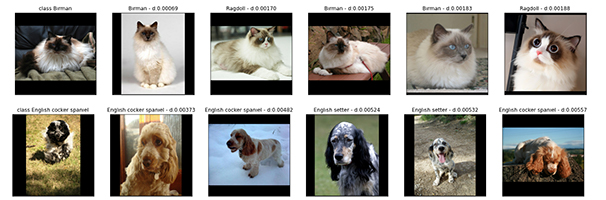
With Tensorflow Similarity you can train two main types of models:
1. **Self-supervised models**: Used to learn general data representations on unlabeled data to boost the accuracy of downstream tasks where you have few labels. For example, you can pre-train a model on a large number of unlabled images using one of the supported contrastive methods supported by TensorFlow Similarity, and then fine-tune it on a small labeled dataset to achieve higher accuracy. To get started training your own self-supervised model see this [notebook](examples/unsupervised_hello_world.ipynb).
2. **Similarity models**: Output embeddings that allow you to find and cluster similar examples such as images representing the same object within a large corpus of examples. For instance, as visible above, you can train a similarity model to find and cluster similar looking, unseen cat and dog images from the [Oxford IIIT Pet Dataset](https://www.tensorflow.org/datasets/catalog/oxford_iiit_pet) while only training on a few of the dataset classes. To get started training your own similarity model see this [notebook](examples/supervised/visualization.ipynb).
## What's new
- [May 2022]: 0.16 major optimization release
* Cross-batch memory (XBM) loss added thank to @chjort
* Many self-supervised related improvement thanks to @dewball345
* Major layers and callback refactoring to make them faster and more flexible. E.g `EvalCallback()` now support splited validation.
For full changes see [the changelog](./releases.md)
- [Jan 2022]: 0.15 self-supervised release
* Added support for self-supervised contrastive learning. Including SimCLR, SimSiam, and Barlow Twins. Checkout the in-depth [hello world notebook](examples/unsupervised_hello_world.ipynb) to get started.
* Soft Nearest Neighbor Loss added thanks to [Abhishar Sinha](https://github.com/abhisharsinha)
* Added GenerlizedMeanPooling2D support that improves similarity matching accuracy over GlobalMeanPooling2D.
* Numerous speed optimizations and general bug fixes.
For previous changes and more details - see [the changelog](./releases.md)
## Getting Started
### Installation
Use pip to install the library.
**NOTE**: The Tensorflow extra_require key can be omitted if you already have tensorflow>=2.4 installed.
```shell
pip install --upgrade-strategy=only-if-needed tensorflow_similarity[tensorflow]
```
### Documentation
The detailed and narrated [notebooks](examples/) are a good way to get started with TensorFlow Similarity. There is likely to be one that is similar to your data or your problem (if not, let us know). You can start working with the examples immediately in Google Colab by clicking the Google Colab icon.
For more information about specific functions, you can [check the API documentation](api/)
For contributing to the project please check out the [contribution guidelines](CONTRIBUTING.md)
### Minimal Example: MNIST similarity
<details>
<summary> Click to expand and see how to train a supervised similarity model on mnist using TF.Similarity</summary>
Here is a bare bones example demonstrating how to train a TensorFlow Similarity model on the MNIST data. This example illustrates some of the main components provided by TensorFlow Similarity and how they fit together. Please refer to the [hello_world notebook](examples/supervised_hello_world.ipynb) for a more detailed introduction.
### Preparing data
TensorFlow Similarity provides [data samplers](api/TFSimilarity/samplers/), for various dataset types, that balance the batches to ensure smoother training.
In this example, we are using the multi-shot sampler that integrates directly from the TensorFlow dataset catalog.
```python
from tensorflow_similarity.samplers import TFDatasetMultiShotMemorySampler
# Data sampler that generates balanced batches from MNIST dataset
sampler = TFDatasetMultiShotMemorySampler(dataset_name='mnist', classes_per_batch=10)
```
### Building a Similarity model
Building a TensorFlow Similarity model is similar to building a standard Keras model, except the output layer is usually a [`MetricEmbedding()`](api/TFSimilarity/layers/) layer that enforces L2 normalization and the model is instantiated as a specialized subclass [`SimilarityModel()`](api/TFSimilarity/models/SimilarityModel.md) that supports additional functionality.
```python
from tensorflow.keras import layers
from tensorflow_similarity.layers import MetricEmbedding
from tensorflow_similarity.models import SimilarityModel
# Build a Similarity model using standard Keras layers
inputs = layers.Input(shape=(28, 28, 1))
x = layers.experimental.preprocessing.Rescaling(1/255)(inputs)
x = layers.Conv2D(64, 3, activation='relu')(x)
x = layers.Flatten()(x)
x = layers.Dense(64, activation='relu')(x)
outputs = MetricEmbedding(64)(x)
# Build a specialized Similarity model
model = SimilarityModel(inputs, outputs)
```
### Training model via contrastive learning
To output a metric embedding, that are searchable via approximate nearest neighbor search, the model needs to be trained using a similarity loss. Here we are using the `MultiSimilarityLoss()`, which is one of the most efficient loss functions.
```python
from tensorflow_similarity.losses import MultiSimilarityLoss
# Train Similarity model using contrastive loss
model.compile('adam', loss=MultiSimilarityLoss())
model.fit(sampler, epochs=5)
```
### Building images index and querying it
Once the model is trained, reference examples must be indexed via the model index API to be searchable. After indexing, you can use the model lookup API to search the index for the K most similar items.
```python
from tensorflow_similarity.visualization import viz_neigbors_imgs
# Index 100 embedded MNIST examples to make them searchable
sx, sy = sampler.get_slice(0,100)
model.index(x=sx, y=sy, data=sx)
# Find the top 5 most similar indexed MNIST examples for a given example
qx, qy = sampler.get_slice(3713, 1)
nns = model.single_lookup(qx[0])
# Visualize the query example and its top 5 neighbors
viz_neigbors_imgs(qx[0], qy[0], nns)
```
</details>
## Supported Algorithms
### Self-Supervised Models
- SimCLR
- SimSiam
- Barlow Twins
### Supervised Losses
- Triplet Loss
- PN Loss
- Multi Sim Loss
- Circle Loss
- Soft Nearest Neighbor Loss
### Metrics
Tensorflow Similarity offers many of the most common metrics used for [classification](api/TFSimilarity/classification_metrics/) and [retrieval](api/TFSimilarity/retrieval_metrics/) evaluation. Including:
| Name | Type | Description |
| ---- | ---- | ----------- |
| Precision | Classification | |
| Recall | Classification | |
| F1 Score | Classification | |
| Recall@K | Retrieval | |
| Binary NDCG | Retrieval | |
## Citing
Please cite this reference if you use any part of TensorFlow similarity in your research:
```bibtex
@article{EBSIM21,
title={TensorFlow Similarity: A Usable, High-Performance Metric Learning Library},
author={Elie Bursztein, James Long, Shun Lin, Owen Vallis, Francois Chollet},
journal={Fixme},
year={2021}
}
```
## Disclaimer
This is not an official Google product.
%package -n python3-tensorflow-similarity
Summary: Metric Learning for Humans
Provides: python-tensorflow-similarity
BuildRequires: python3-devel
BuildRequires: python3-setuptools
BuildRequires: python3-pip
%description -n python3-tensorflow-similarity
# TensorFlow Similarity: Metric Learning for Humans
TensorFlow Similarity is a [TensorFlow](https://tensorflow.org) library for [similarity learning](https://en.wikipedia.org/wiki/Similarity_learning) which includes techniques such as self-supervised learning, metric learning, similarity learning, and contrastive learning. TensorFlow Similarity is still in beta and we may push breaking changes.
## Introduction
Tensorflow Similarity offers state-of-the-art algorithms for metric learning along with all the necessary components to research, train, evaluate, and serve similarity and contrastive based models. These components include models, losses, metrics, samplers, visualizers, and indexing subsystems to make this quick and easy.

With Tensorflow Similarity you can train two main types of models:
1. **Self-supervised models**: Used to learn general data representations on unlabeled data to boost the accuracy of downstream tasks where you have few labels. For example, you can pre-train a model on a large number of unlabled images using one of the supported contrastive methods supported by TensorFlow Similarity, and then fine-tune it on a small labeled dataset to achieve higher accuracy. To get started training your own self-supervised model see this [notebook](examples/unsupervised_hello_world.ipynb).
2. **Similarity models**: Output embeddings that allow you to find and cluster similar examples such as images representing the same object within a large corpus of examples. For instance, as visible above, you can train a similarity model to find and cluster similar looking, unseen cat and dog images from the [Oxford IIIT Pet Dataset](https://www.tensorflow.org/datasets/catalog/oxford_iiit_pet) while only training on a few of the dataset classes. To get started training your own similarity model see this [notebook](examples/supervised/visualization.ipynb).
## What's new
- [May 2022]: 0.16 major optimization release
* Cross-batch memory (XBM) loss added thank to @chjort
* Many self-supervised related improvement thanks to @dewball345
* Major layers and callback refactoring to make them faster and more flexible. E.g `EvalCallback()` now support splited validation.
For full changes see [the changelog](./releases.md)
- [Jan 2022]: 0.15 self-supervised release
* Added support for self-supervised contrastive learning. Including SimCLR, SimSiam, and Barlow Twins. Checkout the in-depth [hello world notebook](examples/unsupervised_hello_world.ipynb) to get started.
* Soft Nearest Neighbor Loss added thanks to [Abhishar Sinha](https://github.com/abhisharsinha)
* Added GenerlizedMeanPooling2D support that improves similarity matching accuracy over GlobalMeanPooling2D.
* Numerous speed optimizations and general bug fixes.
For previous changes and more details - see [the changelog](./releases.md)
## Getting Started
### Installation
Use pip to install the library.
**NOTE**: The Tensorflow extra_require key can be omitted if you already have tensorflow>=2.4 installed.
```shell
pip install --upgrade-strategy=only-if-needed tensorflow_similarity[tensorflow]
```
### Documentation
The detailed and narrated [notebooks](examples/) are a good way to get started with TensorFlow Similarity. There is likely to be one that is similar to your data or your problem (if not, let us know). You can start working with the examples immediately in Google Colab by clicking the Google Colab icon.
For more information about specific functions, you can [check the API documentation](api/)
For contributing to the project please check out the [contribution guidelines](CONTRIBUTING.md)
### Minimal Example: MNIST similarity
<details>
<summary> Click to expand and see how to train a supervised similarity model on mnist using TF.Similarity</summary>
Here is a bare bones example demonstrating how to train a TensorFlow Similarity model on the MNIST data. This example illustrates some of the main components provided by TensorFlow Similarity and how they fit together. Please refer to the [hello_world notebook](examples/supervised_hello_world.ipynb) for a more detailed introduction.
### Preparing data
TensorFlow Similarity provides [data samplers](api/TFSimilarity/samplers/), for various dataset types, that balance the batches to ensure smoother training.
In this example, we are using the multi-shot sampler that integrates directly from the TensorFlow dataset catalog.
```python
from tensorflow_similarity.samplers import TFDatasetMultiShotMemorySampler
# Data sampler that generates balanced batches from MNIST dataset
sampler = TFDatasetMultiShotMemorySampler(dataset_name='mnist', classes_per_batch=10)
```
### Building a Similarity model
Building a TensorFlow Similarity model is similar to building a standard Keras model, except the output layer is usually a [`MetricEmbedding()`](api/TFSimilarity/layers/) layer that enforces L2 normalization and the model is instantiated as a specialized subclass [`SimilarityModel()`](api/TFSimilarity/models/SimilarityModel.md) that supports additional functionality.
```python
from tensorflow.keras import layers
from tensorflow_similarity.layers import MetricEmbedding
from tensorflow_similarity.models import SimilarityModel
# Build a Similarity model using standard Keras layers
inputs = layers.Input(shape=(28, 28, 1))
x = layers.experimental.preprocessing.Rescaling(1/255)(inputs)
x = layers.Conv2D(64, 3, activation='relu')(x)
x = layers.Flatten()(x)
x = layers.Dense(64, activation='relu')(x)
outputs = MetricEmbedding(64)(x)
# Build a specialized Similarity model
model = SimilarityModel(inputs, outputs)
```
### Training model via contrastive learning
To output a metric embedding, that are searchable via approximate nearest neighbor search, the model needs to be trained using a similarity loss. Here we are using the `MultiSimilarityLoss()`, which is one of the most efficient loss functions.
```python
from tensorflow_similarity.losses import MultiSimilarityLoss
# Train Similarity model using contrastive loss
model.compile('adam', loss=MultiSimilarityLoss())
model.fit(sampler, epochs=5)
```
### Building images index and querying it
Once the model is trained, reference examples must be indexed via the model index API to be searchable. After indexing, you can use the model lookup API to search the index for the K most similar items.
```python
from tensorflow_similarity.visualization import viz_neigbors_imgs
# Index 100 embedded MNIST examples to make them searchable
sx, sy = sampler.get_slice(0,100)
model.index(x=sx, y=sy, data=sx)
# Find the top 5 most similar indexed MNIST examples for a given example
qx, qy = sampler.get_slice(3713, 1)
nns = model.single_lookup(qx[0])
# Visualize the query example and its top 5 neighbors
viz_neigbors_imgs(qx[0], qy[0], nns)
```
</details>
## Supported Algorithms
### Self-Supervised Models
- SimCLR
- SimSiam
- Barlow Twins
### Supervised Losses
- Triplet Loss
- PN Loss
- Multi Sim Loss
- Circle Loss
- Soft Nearest Neighbor Loss
### Metrics
Tensorflow Similarity offers many of the most common metrics used for [classification](api/TFSimilarity/classification_metrics/) and [retrieval](api/TFSimilarity/retrieval_metrics/) evaluation. Including:
| Name | Type | Description |
| ---- | ---- | ----------- |
| Precision | Classification | |
| Recall | Classification | |
| F1 Score | Classification | |
| Recall@K | Retrieval | |
| Binary NDCG | Retrieval | |
## Citing
Please cite this reference if you use any part of TensorFlow similarity in your research:
```bibtex
@article{EBSIM21,
title={TensorFlow Similarity: A Usable, High-Performance Metric Learning Library},
author={Elie Bursztein, James Long, Shun Lin, Owen Vallis, Francois Chollet},
journal={Fixme},
year={2021}
}
```
## Disclaimer
This is not an official Google product.
%package help
Summary: Development documents and examples for tensorflow-similarity
Provides: python3-tensorflow-similarity-doc
%description help
# TensorFlow Similarity: Metric Learning for Humans
TensorFlow Similarity is a [TensorFlow](https://tensorflow.org) library for [similarity learning](https://en.wikipedia.org/wiki/Similarity_learning) which includes techniques such as self-supervised learning, metric learning, similarity learning, and contrastive learning. TensorFlow Similarity is still in beta and we may push breaking changes.
## Introduction
Tensorflow Similarity offers state-of-the-art algorithms for metric learning along with all the necessary components to research, train, evaluate, and serve similarity and contrastive based models. These components include models, losses, metrics, samplers, visualizers, and indexing subsystems to make this quick and easy.

With Tensorflow Similarity you can train two main types of models:
1. **Self-supervised models**: Used to learn general data representations on unlabeled data to boost the accuracy of downstream tasks where you have few labels. For example, you can pre-train a model on a large number of unlabled images using one of the supported contrastive methods supported by TensorFlow Similarity, and then fine-tune it on a small labeled dataset to achieve higher accuracy. To get started training your own self-supervised model see this [notebook](examples/unsupervised_hello_world.ipynb).
2. **Similarity models**: Output embeddings that allow you to find and cluster similar examples such as images representing the same object within a large corpus of examples. For instance, as visible above, you can train a similarity model to find and cluster similar looking, unseen cat and dog images from the [Oxford IIIT Pet Dataset](https://www.tensorflow.org/datasets/catalog/oxford_iiit_pet) while only training on a few of the dataset classes. To get started training your own similarity model see this [notebook](examples/supervised/visualization.ipynb).
## What's new
- [May 2022]: 0.16 major optimization release
* Cross-batch memory (XBM) loss added thank to @chjort
* Many self-supervised related improvement thanks to @dewball345
* Major layers and callback refactoring to make them faster and more flexible. E.g `EvalCallback()` now support splited validation.
For full changes see [the changelog](./releases.md)
- [Jan 2022]: 0.15 self-supervised release
* Added support for self-supervised contrastive learning. Including SimCLR, SimSiam, and Barlow Twins. Checkout the in-depth [hello world notebook](examples/unsupervised_hello_world.ipynb) to get started.
* Soft Nearest Neighbor Loss added thanks to [Abhishar Sinha](https://github.com/abhisharsinha)
* Added GenerlizedMeanPooling2D support that improves similarity matching accuracy over GlobalMeanPooling2D.
* Numerous speed optimizations and general bug fixes.
For previous changes and more details - see [the changelog](./releases.md)
## Getting Started
### Installation
Use pip to install the library.
**NOTE**: The Tensorflow extra_require key can be omitted if you already have tensorflow>=2.4 installed.
```shell
pip install --upgrade-strategy=only-if-needed tensorflow_similarity[tensorflow]
```
### Documentation
The detailed and narrated [notebooks](examples/) are a good way to get started with TensorFlow Similarity. There is likely to be one that is similar to your data or your problem (if not, let us know). You can start working with the examples immediately in Google Colab by clicking the Google Colab icon.
For more information about specific functions, you can [check the API documentation](api/)
For contributing to the project please check out the [contribution guidelines](CONTRIBUTING.md)
### Minimal Example: MNIST similarity
<details>
<summary> Click to expand and see how to train a supervised similarity model on mnist using TF.Similarity</summary>
Here is a bare bones example demonstrating how to train a TensorFlow Similarity model on the MNIST data. This example illustrates some of the main components provided by TensorFlow Similarity and how they fit together. Please refer to the [hello_world notebook](examples/supervised_hello_world.ipynb) for a more detailed introduction.
### Preparing data
TensorFlow Similarity provides [data samplers](api/TFSimilarity/samplers/), for various dataset types, that balance the batches to ensure smoother training.
In this example, we are using the multi-shot sampler that integrates directly from the TensorFlow dataset catalog.
```python
from tensorflow_similarity.samplers import TFDatasetMultiShotMemorySampler
# Data sampler that generates balanced batches from MNIST dataset
sampler = TFDatasetMultiShotMemorySampler(dataset_name='mnist', classes_per_batch=10)
```
### Building a Similarity model
Building a TensorFlow Similarity model is similar to building a standard Keras model, except the output layer is usually a [`MetricEmbedding()`](api/TFSimilarity/layers/) layer that enforces L2 normalization and the model is instantiated as a specialized subclass [`SimilarityModel()`](api/TFSimilarity/models/SimilarityModel.md) that supports additional functionality.
```python
from tensorflow.keras import layers
from tensorflow_similarity.layers import MetricEmbedding
from tensorflow_similarity.models import SimilarityModel
# Build a Similarity model using standard Keras layers
inputs = layers.Input(shape=(28, 28, 1))
x = layers.experimental.preprocessing.Rescaling(1/255)(inputs)
x = layers.Conv2D(64, 3, activation='relu')(x)
x = layers.Flatten()(x)
x = layers.Dense(64, activation='relu')(x)
outputs = MetricEmbedding(64)(x)
# Build a specialized Similarity model
model = SimilarityModel(inputs, outputs)
```
### Training model via contrastive learning
To output a metric embedding, that are searchable via approximate nearest neighbor search, the model needs to be trained using a similarity loss. Here we are using the `MultiSimilarityLoss()`, which is one of the most efficient loss functions.
```python
from tensorflow_similarity.losses import MultiSimilarityLoss
# Train Similarity model using contrastive loss
model.compile('adam', loss=MultiSimilarityLoss())
model.fit(sampler, epochs=5)
```
### Building images index and querying it
Once the model is trained, reference examples must be indexed via the model index API to be searchable. After indexing, you can use the model lookup API to search the index for the K most similar items.
```python
from tensorflow_similarity.visualization import viz_neigbors_imgs
# Index 100 embedded MNIST examples to make them searchable
sx, sy = sampler.get_slice(0,100)
model.index(x=sx, y=sy, data=sx)
# Find the top 5 most similar indexed MNIST examples for a given example
qx, qy = sampler.get_slice(3713, 1)
nns = model.single_lookup(qx[0])
# Visualize the query example and its top 5 neighbors
viz_neigbors_imgs(qx[0], qy[0], nns)
```
</details>
## Supported Algorithms
### Self-Supervised Models
- SimCLR
- SimSiam
- Barlow Twins
### Supervised Losses
- Triplet Loss
- PN Loss
- Multi Sim Loss
- Circle Loss
- Soft Nearest Neighbor Loss
### Metrics
Tensorflow Similarity offers many of the most common metrics used for [classification](api/TFSimilarity/classification_metrics/) and [retrieval](api/TFSimilarity/retrieval_metrics/) evaluation. Including:
| Name | Type | Description |
| ---- | ---- | ----------- |
| Precision | Classification | |
| Recall | Classification | |
| F1 Score | Classification | |
| Recall@K | Retrieval | |
| Binary NDCG | Retrieval | |
## Citing
Please cite this reference if you use any part of TensorFlow similarity in your research:
```bibtex
@article{EBSIM21,
title={TensorFlow Similarity: A Usable, High-Performance Metric Learning Library},
author={Elie Bursztein, James Long, Shun Lin, Owen Vallis, Francois Chollet},
journal={Fixme},
year={2021}
}
```
## Disclaimer
This is not an official Google product.
%prep
%autosetup -n tensorflow-similarity-0.16.10
%build
%py3_build
%install
%py3_install
install -d -m755 %{buildroot}/%{_pkgdocdir}
if [ -d doc ]; then cp -arf doc %{buildroot}/%{_pkgdocdir}; fi
if [ -d docs ]; then cp -arf docs %{buildroot}/%{_pkgdocdir}; fi
if [ -d example ]; then cp -arf example %{buildroot}/%{_pkgdocdir}; fi
if [ -d examples ]; then cp -arf examples %{buildroot}/%{_pkgdocdir}; fi
pushd %{buildroot}
if [ -d usr/lib ]; then
find usr/lib -type f -printf "/%h/%f\n" >> filelist.lst
fi
if [ -d usr/lib64 ]; then
find usr/lib64 -type f -printf "/%h/%f\n" >> filelist.lst
fi
if [ -d usr/bin ]; then
find usr/bin -type f -printf "/%h/%f\n" >> filelist.lst
fi
if [ -d usr/sbin ]; then
find usr/sbin -type f -printf "/%h/%f\n" >> filelist.lst
fi
touch doclist.lst
if [ -d usr/share/man ]; then
find usr/share/man -type f -printf "/%h/%f.gz\n" >> doclist.lst
fi
popd
mv %{buildroot}/filelist.lst .
mv %{buildroot}/doclist.lst .
%files -n python3-tensorflow-similarity -f filelist.lst
%dir %{python3_sitelib}/*
%files help -f doclist.lst
%{_docdir}/*
%changelog
* Fri May 05 2023 Python_Bot <Python_Bot@openeuler.org> - 0.16.10-1
- Package Spec generated
|
