
diff options
| -rw-r--r-- | .gitignore | 1 | ||||
| -rw-r--r-- | python-unidic2ud.spec | 852 | ||||
| -rw-r--r-- | sources | 1 |
3 files changed, 854 insertions, 0 deletions
@@ -0,0 +1 @@ +/unidic2ud-2.9.9.tar.gz diff --git a/python-unidic2ud.spec b/python-unidic2ud.spec new file mode 100644 index 0000000..000680f --- /dev/null +++ b/python-unidic2ud.spec @@ -0,0 +1,852 @@ +%global _empty_manifest_terminate_build 0 +Name: python-unidic2ud +Version: 2.9.9 +Release: 1 +Summary: Tokenizer POS-tagger Lemmatizer and Dependency-parser for modern and contemporary Japanese +License: MIT +URL: https://github.com/KoichiYasuoka/UniDic2UD +Source0: https://mirrors.nju.edu.cn/pypi/web/packages/38/31/c632c61020e41c516022a0d60a588d5260578477733f5167a5e48f83afdd/unidic2ud-2.9.9.tar.gz +BuildArch: noarch + + +%description +[](https://pypi.org/project/unidic2ud/) + +# UniDic2UD + +Tokenizer, POS-tagger, lemmatizer, and dependency-parser for modern and contemporary Japanese, working on [Universal Dependencies](https://universaldependencies.org/format.html). + +## Basic usage + +```py +>>> import unidic2ud +>>> nlp=unidic2ud.load("kindai") +>>> s=nlp("其國を治めんと欲する者は先づ其家を齊ふ") +>>> print(s) +# text = 其國を治めんと欲する者は先づ其家を齊ふ +1 其 其の DET 連体詞 _ 2 det _ SpaceAfter=No|Translit=ソノ +2 國 国 NOUN 名詞-普通名詞-一般 _ 4 obj _ SpaceAfter=No|Translit=クニ +3 を を ADP 助詞-格助詞 _ 2 case _ SpaceAfter=No|Translit=ヲ +4 治め 収める VERB 動詞-一般 _ 7 advcl _ SpaceAfter=No|Translit=オサメ +5 ん む AUX 助動詞 _ 4 aux _ SpaceAfter=No|Translit=ン +6 と と ADP 助詞-格助詞 _ 4 case _ SpaceAfter=No|Translit=ト +7 欲する 欲する VERB 動詞-一般 _ 8 acl _ SpaceAfter=No|Translit=ホッスル +8 者 者 NOUN 名詞-普通名詞-一般 _ 14 nsubj _ SpaceAfter=No|Translit=モノ +9 は は ADP 助詞-係助詞 _ 8 case _ SpaceAfter=No|Translit=ハ +10 先づ 先ず ADV 副詞 _ 14 advmod _ SpaceAfter=No|Translit=マヅ +11 其 其の DET 連体詞 _ 12 det _ SpaceAfter=No|Translit=ソノ +12 家 家 NOUN 名詞-普通名詞-一般 _ 14 obj _ SpaceAfter=No|Translit=ウチ +13 を を ADP 助詞-格助詞 _ 12 case _ SpaceAfter=No|Translit=ヲ +14 齊ふ 整える VERB 動詞-一般 _ 0 root _ SpaceAfter=No|Translit=トトノフ + +>>> t=s[7] +>>> print(t.id,t.form,t.lemma,t.upos,t.xpos,t.feats,t.head.id,t.deprel,t.deps,t.misc) +7 欲する 欲する VERB 動詞-一般 _ 8 acl _ SpaceAfter=No|Translit=ホッスル + +>>> print(s.to_tree()) + 其 <══╗ det(決定詞) + 國 ═╗═╝<╗ obj(目的語) + を <╝ ║ case(格表示) + 治め ═╗═╗═╝<╗ advcl(連用修飾節) + ん <╝ ║ ║ aux(動詞補助成分) + と <══╝ ║ case(格表示) +欲する ═══════╝<╗ acl(連体修飾節) + 者 ═╗═══════╝<╗ nsubj(主語) + は <╝ ║ case(格表示) + 先づ <══════╗ ║ advmod(連用修飾語) + 其 <══╗ ║ ║ det(決定詞) + 家 ═╗═╝<╗ ║ ║ obj(目的語) + を <╝ ║ ║ ║ case(格表示) + 齊ふ ═════╝═╝═══╝ root(親) + +>>> f=open("trial.svg","w") +>>> f.write(s.to_svg()) +>>> f.close() +``` + + +`unidic2ud.load(UniDic,UDPipe)` loads a natural language processor pipeline, which uses `UniDic` for tokenizer POS-tagger and lemmatizer, then uses `UDPipe` for dependency-parser. The default `UDPipe` is `UDPipe="japanese-modern"`. Available `UniDic` options are: + +* `UniDic="gendai"`: Use [現代書き言葉UniDic](https://clrd.ninjal.ac.jp/unidic/download_all.html#unidic_bccwj). +* `UniDic="spoken"`: Use [現代話し言葉UniDic](https://clrd.ninjal.ac.jp/unidic/download_all.html#unidic_csj). +* `UniDic="novel"`: Use [近現代口語小説UniDic](https://clrd.ninjal.ac.jp/unidic/download_all.html#unidic_novel). +* `UniDic="qkana"`: Use [旧仮名口語UniDic](https://clrd.ninjal.ac.jp/unidic/download_all.html#unidic_qkana). +* `UniDic="kindai"`: Use [近代文語UniDic](https://clrd.ninjal.ac.jp/unidic/download_all.html#unidic_kindai). +* `UniDic="kinsei"`: Use [近世江戸口語UniDic](https://clrd.ninjal.ac.jp/unidic/download_all.html#unidic_kinsei-edo). +* `UniDic="kyogen"`: Use [中世口語UniDic](https://clrd.ninjal.ac.jp/unidic/download_all.html#unidic_chusei-kougo). +* `UniDic="wakan"`: Use [中世文語UniDic](https://clrd.ninjal.ac.jp/unidic/download_all.html#unidic_chusei-bungo). +* `UniDic="wabun"`: Use [中古和文UniDic](https://clrd.ninjal.ac.jp/unidic/download_all.html#unidic_wabun). +* `UniDic="manyo"`: Use [上代語UniDic](https://clrd.ninjal.ac.jp/unidic/download_all.html#unidic_jodai). +* `UniDic=None`: Use `UDPipe` for tokenizer, POS-tagger, lemmatizer, and dependency-parser. + +`unidic2ud.UniDic2UDEntry.to_tree()` has an option `to_tree(BoxDrawingWidth=2)` for old terminals, whose Box Drawing characters are "fullwidth". + +You can simply use `unidic2ud` on the command line: +```sh +echo 其國を治めんと欲する者は先づ其家を齊ふ | unidic2ud -U kindai +``` + +## CaboCha emulator usage + +```py +>>> import unidic2ud.cabocha as CaboCha +>>> c=CaboCha.Parser("kindai") +>>> s=c.parse("其國を治めんと欲する者は先づ其家を齊ふ") +>>> print(s.toString(CaboCha.FORMAT_TREE_LATTICE)) + 其-D + 國を-D +治めんと-D + 欲する-D + 者は-------D + 先づ-----D + 其-D | + 家を-D + 齊ふ +EOS +* 0 1D 0/0 0.000000 +其 連体詞,*,*,*,*,*,其の,ソノ,*,DET O 1<-det-2 +* 1 2D 0/1 0.000000 +國 名詞,普通名詞,一般,*,*,*,国,クニ,*,NOUN O 2<-obj-4 +を 助詞,格助詞,*,*,*,*,を,ヲ,*,ADP O 3<-case-2 +* 2 3D 0/1 0.000000 +治め 動詞,一般,*,*,*,*,収める,オサメ,*,VERB O 4<-advcl-7 +ん 助動詞,*,*,*,*,*,む,ン,*,AUX O 5<-aux-4 +と 助詞,格助詞,*,*,*,*,と,ト,*,ADP O 6<-case-4 +* 3 4D 0/0 0.000000 +欲する 動詞,一般,*,*,*,*,欲する,ホッスル,*,VERB O 7<-acl-8 +* 4 8D 0/1 0.000000 +者 名詞,普通名詞,一般,*,*,*,者,モノ,*,NOUN O 8<-nsubj-14 +は 助詞,係助詞,*,*,*,*,は,ハ,*,ADP O 9<-case-8 +* 5 8D 0/0 0.000000 +先づ 副詞,*,*,*,*,*,先ず,マヅ,*,ADV O 10<-advmod-14 +* 6 7D 0/0 0.000000 +其 連体詞,*,*,*,*,*,其の,ソノ,*,DET O 11<-det-12 +* 7 8D 0/1 0.000000 +家 名詞,普通名詞,一般,*,*,*,家,ウチ,*,NOUN O 12<-obj-14 +を 助詞,格助詞,*,*,*,*,を,ヲ,*,ADP O 13<-case-12 +* 8 -1D 0/0 0.000000 +齊ふ 動詞,一般,*,*,*,*,整える,トトノフ,*,VERB O 14<-root +EOS +>>> for c in [s.chunk(i) for i in range(s.chunk_size())]: +... if c.link>=0: +... print(c,"->",s.chunk(c.link)) +... +其 -> 國を +國を -> 治めんと +治めんと -> 欲する +欲する -> 者は +者は -> 齊ふ +先づ -> 齊ふ +其 -> 家を +家を -> 齊ふ +``` +`CaboCha.Parser(UniDic)` is an alias for `unidic2ud.load(UniDic,UDPipe="japanese-modern")`, and its default is `UniDic=None`. `CaboCha.Tree.toString(format)` has five available formats: +* `CaboCha.FORMAT_TREE`: tree (numbered as 0) +* `CaboCha.FORMAT_LATTICE`: lattice (numbered as 1) +* `CaboCha.FORMAT_TREE_LATTICE`: tree + lattice (numbered as 2) +* `CaboCha.FORMAT_XML`: XML (numbered as 3) +* `CaboCha.FORMAT_CONLL`: Universal Dependencies CoNLL-U (numbered as 4) + +You can simply use `udcabocha` on the command line: +```sh +echo 其國を治めんと欲する者は先づ其家を齊ふ | udcabocha -U kindai -f 2 +``` +`-U UniDic` specifies `UniDic`. `-f format` specifies the output format in 0 to 4 above (default is `-f 0`) and in 5 to 8 below: +* `-f 5`: `to_tree()` +* `-f 6`: `to_tree(BoxDrawingWidth=2)` +* `-f 7`: `to_svg()` +* `-f 8`: [raw DOT](https://graphviz.readthedocs.io/en/stable/manual.html#using-raw-dot) graph through [Immediate Catena Analysis](https://koichiyasuoka.github.io/deplacy/#deplacydot) + +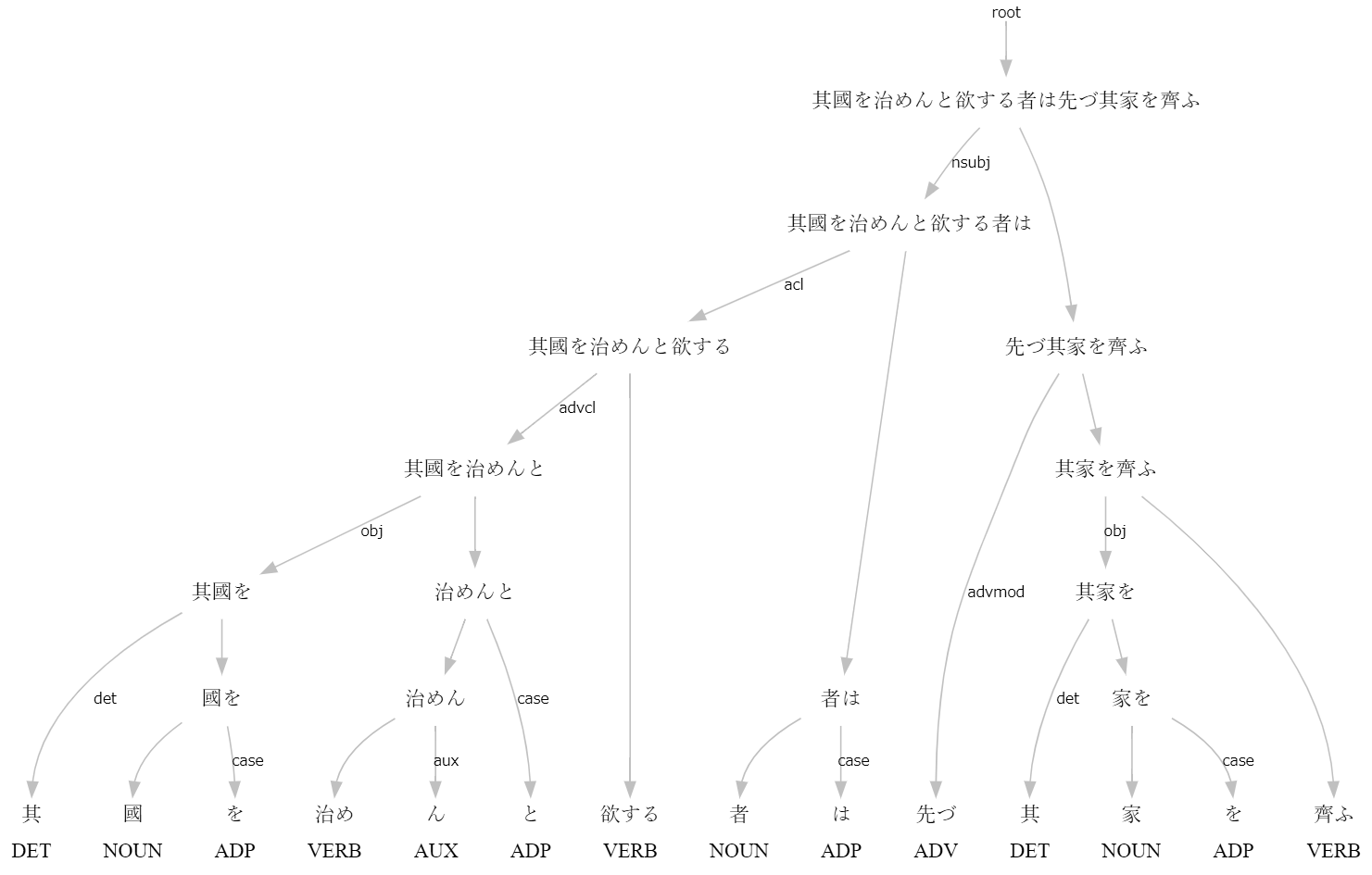 + +Try [notebook](https://colab.research.google.com/github/KoichiYasuoka/UniDic2UD/blob/master/udcabocha.ipynb) for Google Colaboratory. + +## Usage via spaCy + +If you have already installed [spaCy](https://pypi.org/project/spacy/) 2.1.0 or later, you can use `UniDic` via spaCy Language pipeline. + +```py +>>> import unidic2ud.spacy +>>> nlp=unidic2ud.spacy.load("kindai") +>>> d=nlp("其國を治めんと欲する者は先づ其家を齊ふ") +>>> print(unidic2ud.spacy.to_conllu(d)) +# text = 其國を治めんと欲する者は先づ其家を齊ふ +1 其 其の DET 連体詞 _ 2 det _ SpaceAfter=No|Translit=ソノ +2 國 国 NOUN 名詞-普通名詞-一般 _ 4 obj _ SpaceAfter=No|Translit=クニ +3 を を ADP 助詞-格助詞 _ 2 case _ SpaceAfter=No|Translit=ヲ +4 治め 収める VERB 動詞-一般 _ 7 advcl _ SpaceAfter=No|Translit=オサメ +5 ん む AUX 助動詞 _ 4 aux _ SpaceAfter=No|Translit=ン +6 と と ADP 助詞-格助詞 _ 4 case _ SpaceAfter=No|Translit=ト +7 欲する 欲する VERB 動詞-一般 _ 8 acl _ SpaceAfter=No|Translit=ホッスル +8 者 者 NOUN 名詞-普通名詞-一般 _ 14 nsubj _ SpaceAfter=No|Translit=モノ +9 は は ADP 助詞-係助詞 _ 8 case _ SpaceAfter=No|Translit=ハ +10 先づ 先ず ADV 副詞 _ 14 advmod _ SpaceAfter=No|Translit=マヅ +11 其 其の DET 連体詞 _ 12 det _ SpaceAfter=No|Translit=ソノ +12 家 家 NOUN 名詞-普通名詞-一般 _ 14 obj _ SpaceAfter=No|Translit=ウチ +13 を を ADP 助詞-格助詞 _ 12 case _ SpaceAfter=No|Translit=ヲ +14 齊ふ 整える VERB 動詞-一般 _ 0 root _ SpaceAfter=No|Translit=トトノフ + +>>> t=d[6] +>>> print(t.i+1,t.orth_,t.lemma_,t.pos_,t.tag_,t.head.i+1,t.dep_,t.whitespace_,t.norm_) +7 欲する 欲する VERB 動詞-一般 8 acl ホッスル + +>>> from deplacy.deprelja import deprelja +>>> for b in unidic2ud.spacy.bunsetu_spans(d): +... for t in b.lefts: +... print(unidic2ud.spacy.bunsetu_span(t),"->",b,"("+deprelja[t.dep_]+")") +... +其 -> 國を (決定詞) +國を -> 治めんと (目的語) +治めんと -> 欲する (連用修飾節) +欲する -> 者は (連体修飾節) +其 -> 家を (決定詞) +者は -> 齊ふ (主語) +先づ -> 齊ふ (連用修飾語) +家を -> 齊ふ (目的語) +``` + +`unidic2ud.spacy.load(UniDic,parser)` loads a spaCy pipeline, which uses `UniDic` for tokenizer POS-tagger and lemmatizer (as shown above), then uses `parser` for dependency-parser. The default `parser` is `parser="japanese-modern"` and available options are: + +* `parser="ja_core_news_sm"`: Use [spaCy Japanese model](https://spacy.io/models/ja) (small). +* `parser="ja_core_news_md"`: Use spaCy Japanese model (middle). +* `parser="ja_core_news_lg"`: Use spaCy Japanese model (large). +* `parser="ja_ginza"`: Use [GiNZA](https://github.com/megagonlabs/ginza). +* `parser="japanese-gsd"`: Use [UDPipe Japanese model](http://hdl.handle.net/11234/1-3131). +* `parser="stanza_ja"`: Use [Stanza Japanese model](https://stanfordnlp.github.io/stanza/available_models.html). + +## Installation for Linux + +Tar-ball is available for Linux, and is installed by default when you use `pip`: +```sh +pip install unidic2ud +``` + +By default installation, `UniDic` is invoked through Web APIs. If you want to invoke them locally and faster, you can download `UniDic` which you use just as follows: +```sh +python -m unidic2ud download kindai +python -m unidic2ud dictlist +``` +Licenses of dictionaries and models are: GPL/LGPL/BSD for `gendai` and `spoken`; CC BY-NC-SA 4.0 for others. + +## Installation for Cygwin + +Make sure to get `gcc-g++` `python37-pip` `python37-devel` packages, and then: +```sh +pip3.7 install unidic2ud +``` +Use `python3.7` command in [Cygwin](https://www.cygwin.com/install.html) instead of `python`. + +## Installation for Jupyter Notebook (Google Colaboratory) + +```py +!pip install unidic2ud +``` +## Benchmarks + +Results of [舞姬/雪國/荒野より-Benchmarks](https://colab.research.google.com/github/KoichiYasuoka/UniDic2UD/blob/master/benchmark/benchmark.ipynb) + +|[舞姬](https://github.com/KoichiYasuoka/UniDic2UD/blob/master/benchmark/maihime-benchmark.tar.gz)|LAS|MLAS|BLEX| +|---------------|-----|-----|-----| +|UniDic="kindai"|81.13|70.37|77.78| +|UniDic="qkana" |79.25|70.37|77.78| +|UniDic="kinsei"|72.22|60.71|64.29| + +|[雪國](https://github.com/KoichiYasuoka/UniDic2UD/blob/master/benchmark/yukiguni-benchmark.tar.gz)|LAS|MLAS|BLEX| +|---------------|-----|-----|-----| +|UniDic="qkana" |89.29|85.71|81.63| +|UniDic="kinsei"|89.29|85.71|77.55| +|UniDic="kindai"|84.96|81.63|77.55| + +|[荒野より](https://github.com/KoichiYasuoka/UniDic2UD/blob/master/benchmark/koyayori-benchmark.tar.gz)|LAS|MLAS|BLEX| +|---------------|-----|-----|-----| +|UniDic="kindai"|76.44|61.54|53.85| +|UniDic="qkana" |75.39|61.54|53.85| +|UniDic="kinsei"|71.88|58.97|51.28| + +## Author + +Koichi Yasuoka (安岡孝一) + +## References + +* 安岡孝一: [形態素解析部の付け替えによる近代日本語(旧字旧仮名)の係り受け解析](http://hdl.handle.net/2433/254677), 情報処理学会研究報告, Vol.2020-CH-124「人文科学とコンピュータ」, No.3 (2020年9月5日), pp.1-8. +* 安岡孝一: [漢日英Universal Dependencies平行コーパスとその差異](http://hdl.handle.net/2433/245218), 人文科学とコンピュータシンポジウム「じんもんこん2019」論文集 (2019年12月), pp.43-50. + +%package -n python3-unidic2ud +Summary: Tokenizer POS-tagger Lemmatizer and Dependency-parser for modern and contemporary Japanese +Provides: python-unidic2ud +BuildRequires: python3-devel +BuildRequires: python3-setuptools +BuildRequires: python3-pip +%description -n python3-unidic2ud +[](https://pypi.org/project/unidic2ud/) + +# UniDic2UD + +Tokenizer, POS-tagger, lemmatizer, and dependency-parser for modern and contemporary Japanese, working on [Universal Dependencies](https://universaldependencies.org/format.html). + +## Basic usage + +```py +>>> import unidic2ud +>>> nlp=unidic2ud.load("kindai") +>>> s=nlp("其國を治めんと欲する者は先づ其家を齊ふ") +>>> print(s) +# text = 其國を治めんと欲する者は先づ其家を齊ふ +1 其 其の DET 連体詞 _ 2 det _ SpaceAfter=No|Translit=ソノ +2 國 国 NOUN 名詞-普通名詞-一般 _ 4 obj _ SpaceAfter=No|Translit=クニ +3 を を ADP 助詞-格助詞 _ 2 case _ SpaceAfter=No|Translit=ヲ +4 治め 収める VERB 動詞-一般 _ 7 advcl _ SpaceAfter=No|Translit=オサメ +5 ん む AUX 助動詞 _ 4 aux _ SpaceAfter=No|Translit=ン +6 と と ADP 助詞-格助詞 _ 4 case _ SpaceAfter=No|Translit=ト +7 欲する 欲する VERB 動詞-一般 _ 8 acl _ SpaceAfter=No|Translit=ホッスル +8 者 者 NOUN 名詞-普通名詞-一般 _ 14 nsubj _ SpaceAfter=No|Translit=モノ +9 は は ADP 助詞-係助詞 _ 8 case _ SpaceAfter=No|Translit=ハ +10 先づ 先ず ADV 副詞 _ 14 advmod _ SpaceAfter=No|Translit=マヅ +11 其 其の DET 連体詞 _ 12 det _ SpaceAfter=No|Translit=ソノ +12 家 家 NOUN 名詞-普通名詞-一般 _ 14 obj _ SpaceAfter=No|Translit=ウチ +13 を を ADP 助詞-格助詞 _ 12 case _ SpaceAfter=No|Translit=ヲ +14 齊ふ 整える VERB 動詞-一般 _ 0 root _ SpaceAfter=No|Translit=トトノフ + +>>> t=s[7] +>>> print(t.id,t.form,t.lemma,t.upos,t.xpos,t.feats,t.head.id,t.deprel,t.deps,t.misc) +7 欲する 欲する VERB 動詞-一般 _ 8 acl _ SpaceAfter=No|Translit=ホッスル + +>>> print(s.to_tree()) + 其 <══╗ det(決定詞) + 國 ═╗═╝<╗ obj(目的語) + を <╝ ║ case(格表示) + 治め ═╗═╗═╝<╗ advcl(連用修飾節) + ん <╝ ║ ║ aux(動詞補助成分) + と <══╝ ║ case(格表示) +欲する ═══════╝<╗ acl(連体修飾節) + 者 ═╗═══════╝<╗ nsubj(主語) + は <╝ ║ case(格表示) + 先づ <══════╗ ║ advmod(連用修飾語) + 其 <══╗ ║ ║ det(決定詞) + 家 ═╗═╝<╗ ║ ║ obj(目的語) + を <╝ ║ ║ ║ case(格表示) + 齊ふ ═════╝═╝═══╝ root(親) + +>>> f=open("trial.svg","w") +>>> f.write(s.to_svg()) +>>> f.close() +``` + + +`unidic2ud.load(UniDic,UDPipe)` loads a natural language processor pipeline, which uses `UniDic` for tokenizer POS-tagger and lemmatizer, then uses `UDPipe` for dependency-parser. The default `UDPipe` is `UDPipe="japanese-modern"`. Available `UniDic` options are: + +* `UniDic="gendai"`: Use [現代書き言葉UniDic](https://clrd.ninjal.ac.jp/unidic/download_all.html#unidic_bccwj). +* `UniDic="spoken"`: Use [現代話し言葉UniDic](https://clrd.ninjal.ac.jp/unidic/download_all.html#unidic_csj). +* `UniDic="novel"`: Use [近現代口語小説UniDic](https://clrd.ninjal.ac.jp/unidic/download_all.html#unidic_novel). +* `UniDic="qkana"`: Use [旧仮名口語UniDic](https://clrd.ninjal.ac.jp/unidic/download_all.html#unidic_qkana). +* `UniDic="kindai"`: Use [近代文語UniDic](https://clrd.ninjal.ac.jp/unidic/download_all.html#unidic_kindai). +* `UniDic="kinsei"`: Use [近世江戸口語UniDic](https://clrd.ninjal.ac.jp/unidic/download_all.html#unidic_kinsei-edo). +* `UniDic="kyogen"`: Use [中世口語UniDic](https://clrd.ninjal.ac.jp/unidic/download_all.html#unidic_chusei-kougo). +* `UniDic="wakan"`: Use [中世文語UniDic](https://clrd.ninjal.ac.jp/unidic/download_all.html#unidic_chusei-bungo). +* `UniDic="wabun"`: Use [中古和文UniDic](https://clrd.ninjal.ac.jp/unidic/download_all.html#unidic_wabun). +* `UniDic="manyo"`: Use [上代語UniDic](https://clrd.ninjal.ac.jp/unidic/download_all.html#unidic_jodai). +* `UniDic=None`: Use `UDPipe` for tokenizer, POS-tagger, lemmatizer, and dependency-parser. + +`unidic2ud.UniDic2UDEntry.to_tree()` has an option `to_tree(BoxDrawingWidth=2)` for old terminals, whose Box Drawing characters are "fullwidth". + +You can simply use `unidic2ud` on the command line: +```sh +echo 其國を治めんと欲する者は先づ其家を齊ふ | unidic2ud -U kindai +``` + +## CaboCha emulator usage + +```py +>>> import unidic2ud.cabocha as CaboCha +>>> c=CaboCha.Parser("kindai") +>>> s=c.parse("其國を治めんと欲する者は先づ其家を齊ふ") +>>> print(s.toString(CaboCha.FORMAT_TREE_LATTICE)) + 其-D + 國を-D +治めんと-D + 欲する-D + 者は-------D + 先づ-----D + 其-D | + 家を-D + 齊ふ +EOS +* 0 1D 0/0 0.000000 +其 連体詞,*,*,*,*,*,其の,ソノ,*,DET O 1<-det-2 +* 1 2D 0/1 0.000000 +國 名詞,普通名詞,一般,*,*,*,国,クニ,*,NOUN O 2<-obj-4 +を 助詞,格助詞,*,*,*,*,を,ヲ,*,ADP O 3<-case-2 +* 2 3D 0/1 0.000000 +治め 動詞,一般,*,*,*,*,収める,オサメ,*,VERB O 4<-advcl-7 +ん 助動詞,*,*,*,*,*,む,ン,*,AUX O 5<-aux-4 +と 助詞,格助詞,*,*,*,*,と,ト,*,ADP O 6<-case-4 +* 3 4D 0/0 0.000000 +欲する 動詞,一般,*,*,*,*,欲する,ホッスル,*,VERB O 7<-acl-8 +* 4 8D 0/1 0.000000 +者 名詞,普通名詞,一般,*,*,*,者,モノ,*,NOUN O 8<-nsubj-14 +は 助詞,係助詞,*,*,*,*,は,ハ,*,ADP O 9<-case-8 +* 5 8D 0/0 0.000000 +先づ 副詞,*,*,*,*,*,先ず,マヅ,*,ADV O 10<-advmod-14 +* 6 7D 0/0 0.000000 +其 連体詞,*,*,*,*,*,其の,ソノ,*,DET O 11<-det-12 +* 7 8D 0/1 0.000000 +家 名詞,普通名詞,一般,*,*,*,家,ウチ,*,NOUN O 12<-obj-14 +を 助詞,格助詞,*,*,*,*,を,ヲ,*,ADP O 13<-case-12 +* 8 -1D 0/0 0.000000 +齊ふ 動詞,一般,*,*,*,*,整える,トトノフ,*,VERB O 14<-root +EOS +>>> for c in [s.chunk(i) for i in range(s.chunk_size())]: +... if c.link>=0: +... print(c,"->",s.chunk(c.link)) +... +其 -> 國を +國を -> 治めんと +治めんと -> 欲する +欲する -> 者は +者は -> 齊ふ +先づ -> 齊ふ +其 -> 家を +家を -> 齊ふ +``` +`CaboCha.Parser(UniDic)` is an alias for `unidic2ud.load(UniDic,UDPipe="japanese-modern")`, and its default is `UniDic=None`. `CaboCha.Tree.toString(format)` has five available formats: +* `CaboCha.FORMAT_TREE`: tree (numbered as 0) +* `CaboCha.FORMAT_LATTICE`: lattice (numbered as 1) +* `CaboCha.FORMAT_TREE_LATTICE`: tree + lattice (numbered as 2) +* `CaboCha.FORMAT_XML`: XML (numbered as 3) +* `CaboCha.FORMAT_CONLL`: Universal Dependencies CoNLL-U (numbered as 4) + +You can simply use `udcabocha` on the command line: +```sh +echo 其國を治めんと欲する者は先づ其家を齊ふ | udcabocha -U kindai -f 2 +``` +`-U UniDic` specifies `UniDic`. `-f format` specifies the output format in 0 to 4 above (default is `-f 0`) and in 5 to 8 below: +* `-f 5`: `to_tree()` +* `-f 6`: `to_tree(BoxDrawingWidth=2)` +* `-f 7`: `to_svg()` +* `-f 8`: [raw DOT](https://graphviz.readthedocs.io/en/stable/manual.html#using-raw-dot) graph through [Immediate Catena Analysis](https://koichiyasuoka.github.io/deplacy/#deplacydot) + + + +Try [notebook](https://colab.research.google.com/github/KoichiYasuoka/UniDic2UD/blob/master/udcabocha.ipynb) for Google Colaboratory. + +## Usage via spaCy + +If you have already installed [spaCy](https://pypi.org/project/spacy/) 2.1.0 or later, you can use `UniDic` via spaCy Language pipeline. + +```py +>>> import unidic2ud.spacy +>>> nlp=unidic2ud.spacy.load("kindai") +>>> d=nlp("其國を治めんと欲する者は先づ其家を齊ふ") +>>> print(unidic2ud.spacy.to_conllu(d)) +# text = 其國を治めんと欲する者は先づ其家を齊ふ +1 其 其の DET 連体詞 _ 2 det _ SpaceAfter=No|Translit=ソノ +2 國 国 NOUN 名詞-普通名詞-一般 _ 4 obj _ SpaceAfter=No|Translit=クニ +3 を を ADP 助詞-格助詞 _ 2 case _ SpaceAfter=No|Translit=ヲ +4 治め 収める VERB 動詞-一般 _ 7 advcl _ SpaceAfter=No|Translit=オサメ +5 ん む AUX 助動詞 _ 4 aux _ SpaceAfter=No|Translit=ン +6 と と ADP 助詞-格助詞 _ 4 case _ SpaceAfter=No|Translit=ト +7 欲する 欲する VERB 動詞-一般 _ 8 acl _ SpaceAfter=No|Translit=ホッスル +8 者 者 NOUN 名詞-普通名詞-一般 _ 14 nsubj _ SpaceAfter=No|Translit=モノ +9 は は ADP 助詞-係助詞 _ 8 case _ SpaceAfter=No|Translit=ハ +10 先づ 先ず ADV 副詞 _ 14 advmod _ SpaceAfter=No|Translit=マヅ +11 其 其の DET 連体詞 _ 12 det _ SpaceAfter=No|Translit=ソノ +12 家 家 NOUN 名詞-普通名詞-一般 _ 14 obj _ SpaceAfter=No|Translit=ウチ +13 を を ADP 助詞-格助詞 _ 12 case _ SpaceAfter=No|Translit=ヲ +14 齊ふ 整える VERB 動詞-一般 _ 0 root _ SpaceAfter=No|Translit=トトノフ + +>>> t=d[6] +>>> print(t.i+1,t.orth_,t.lemma_,t.pos_,t.tag_,t.head.i+1,t.dep_,t.whitespace_,t.norm_) +7 欲する 欲する VERB 動詞-一般 8 acl ホッスル + +>>> from deplacy.deprelja import deprelja +>>> for b in unidic2ud.spacy.bunsetu_spans(d): +... for t in b.lefts: +... print(unidic2ud.spacy.bunsetu_span(t),"->",b,"("+deprelja[t.dep_]+")") +... +其 -> 國を (決定詞) +國を -> 治めんと (目的語) +治めんと -> 欲する (連用修飾節) +欲する -> 者は (連体修飾節) +其 -> 家を (決定詞) +者は -> 齊ふ (主語) +先づ -> 齊ふ (連用修飾語) +家を -> 齊ふ (目的語) +``` + +`unidic2ud.spacy.load(UniDic,parser)` loads a spaCy pipeline, which uses `UniDic` for tokenizer POS-tagger and lemmatizer (as shown above), then uses `parser` for dependency-parser. The default `parser` is `parser="japanese-modern"` and available options are: + +* `parser="ja_core_news_sm"`: Use [spaCy Japanese model](https://spacy.io/models/ja) (small). +* `parser="ja_core_news_md"`: Use spaCy Japanese model (middle). +* `parser="ja_core_news_lg"`: Use spaCy Japanese model (large). +* `parser="ja_ginza"`: Use [GiNZA](https://github.com/megagonlabs/ginza). +* `parser="japanese-gsd"`: Use [UDPipe Japanese model](http://hdl.handle.net/11234/1-3131). +* `parser="stanza_ja"`: Use [Stanza Japanese model](https://stanfordnlp.github.io/stanza/available_models.html). + +## Installation for Linux + +Tar-ball is available for Linux, and is installed by default when you use `pip`: +```sh +pip install unidic2ud +``` + +By default installation, `UniDic` is invoked through Web APIs. If you want to invoke them locally and faster, you can download `UniDic` which you use just as follows: +```sh +python -m unidic2ud download kindai +python -m unidic2ud dictlist +``` +Licenses of dictionaries and models are: GPL/LGPL/BSD for `gendai` and `spoken`; CC BY-NC-SA 4.0 for others. + +## Installation for Cygwin + +Make sure to get `gcc-g++` `python37-pip` `python37-devel` packages, and then: +```sh +pip3.7 install unidic2ud +``` +Use `python3.7` command in [Cygwin](https://www.cygwin.com/install.html) instead of `python`. + +## Installation for Jupyter Notebook (Google Colaboratory) + +```py +!pip install unidic2ud +``` +## Benchmarks + +Results of [舞姬/雪國/荒野より-Benchmarks](https://colab.research.google.com/github/KoichiYasuoka/UniDic2UD/blob/master/benchmark/benchmark.ipynb) + +|[舞姬](https://github.com/KoichiYasuoka/UniDic2UD/blob/master/benchmark/maihime-benchmark.tar.gz)|LAS|MLAS|BLEX| +|---------------|-----|-----|-----| +|UniDic="kindai"|81.13|70.37|77.78| +|UniDic="qkana" |79.25|70.37|77.78| +|UniDic="kinsei"|72.22|60.71|64.29| + +|[雪國](https://github.com/KoichiYasuoka/UniDic2UD/blob/master/benchmark/yukiguni-benchmark.tar.gz)|LAS|MLAS|BLEX| +|---------------|-----|-----|-----| +|UniDic="qkana" |89.29|85.71|81.63| +|UniDic="kinsei"|89.29|85.71|77.55| +|UniDic="kindai"|84.96|81.63|77.55| + +|[荒野より](https://github.com/KoichiYasuoka/UniDic2UD/blob/master/benchmark/koyayori-benchmark.tar.gz)|LAS|MLAS|BLEX| +|---------------|-----|-----|-----| +|UniDic="kindai"|76.44|61.54|53.85| +|UniDic="qkana" |75.39|61.54|53.85| +|UniDic="kinsei"|71.88|58.97|51.28| + +## Author + +Koichi Yasuoka (安岡孝一) + +## References + +* 安岡孝一: [形態素解析部の付け替えによる近代日本語(旧字旧仮名)の係り受け解析](http://hdl.handle.net/2433/254677), 情報処理学会研究報告, Vol.2020-CH-124「人文科学とコンピュータ」, No.3 (2020年9月5日), pp.1-8. +* 安岡孝一: [漢日英Universal Dependencies平行コーパスとその差異](http://hdl.handle.net/2433/245218), 人文科学とコンピュータシンポジウム「じんもんこん2019」論文集 (2019年12月), pp.43-50. + +%package help +Summary: Development documents and examples for unidic2ud +Provides: python3-unidic2ud-doc +%description help +[](https://pypi.org/project/unidic2ud/) + +# UniDic2UD + +Tokenizer, POS-tagger, lemmatizer, and dependency-parser for modern and contemporary Japanese, working on [Universal Dependencies](https://universaldependencies.org/format.html). + +## Basic usage + +```py +>>> import unidic2ud +>>> nlp=unidic2ud.load("kindai") +>>> s=nlp("其國を治めんと欲する者は先づ其家を齊ふ") +>>> print(s) +# text = 其國を治めんと欲する者は先づ其家を齊ふ +1 其 其の DET 連体詞 _ 2 det _ SpaceAfter=No|Translit=ソノ +2 國 国 NOUN 名詞-普通名詞-一般 _ 4 obj _ SpaceAfter=No|Translit=クニ +3 を を ADP 助詞-格助詞 _ 2 case _ SpaceAfter=No|Translit=ヲ +4 治め 収める VERB 動詞-一般 _ 7 advcl _ SpaceAfter=No|Translit=オサメ +5 ん む AUX 助動詞 _ 4 aux _ SpaceAfter=No|Translit=ン +6 と と ADP 助詞-格助詞 _ 4 case _ SpaceAfter=No|Translit=ト +7 欲する 欲する VERB 動詞-一般 _ 8 acl _ SpaceAfter=No|Translit=ホッスル +8 者 者 NOUN 名詞-普通名詞-一般 _ 14 nsubj _ SpaceAfter=No|Translit=モノ +9 は は ADP 助詞-係助詞 _ 8 case _ SpaceAfter=No|Translit=ハ +10 先づ 先ず ADV 副詞 _ 14 advmod _ SpaceAfter=No|Translit=マヅ +11 其 其の DET 連体詞 _ 12 det _ SpaceAfter=No|Translit=ソノ +12 家 家 NOUN 名詞-普通名詞-一般 _ 14 obj _ SpaceAfter=No|Translit=ウチ +13 を を ADP 助詞-格助詞 _ 12 case _ SpaceAfter=No|Translit=ヲ +14 齊ふ 整える VERB 動詞-一般 _ 0 root _ SpaceAfter=No|Translit=トトノフ + +>>> t=s[7] +>>> print(t.id,t.form,t.lemma,t.upos,t.xpos,t.feats,t.head.id,t.deprel,t.deps,t.misc) +7 欲する 欲する VERB 動詞-一般 _ 8 acl _ SpaceAfter=No|Translit=ホッスル + +>>> print(s.to_tree()) + 其 <══╗ det(決定詞) + 國 ═╗═╝<╗ obj(目的語) + を <╝ ║ case(格表示) + 治め ═╗═╗═╝<╗ advcl(連用修飾節) + ん <╝ ║ ║ aux(動詞補助成分) + と <══╝ ║ case(格表示) +欲する ═══════╝<╗ acl(連体修飾節) + 者 ═╗═══════╝<╗ nsubj(主語) + は <╝ ║ case(格表示) + 先づ <══════╗ ║ advmod(連用修飾語) + 其 <══╗ ║ ║ det(決定詞) + 家 ═╗═╝<╗ ║ ║ obj(目的語) + を <╝ ║ ║ ║ case(格表示) + 齊ふ ═════╝═╝═══╝ root(親) + +>>> f=open("trial.svg","w") +>>> f.write(s.to_svg()) +>>> f.close() +``` + + +`unidic2ud.load(UniDic,UDPipe)` loads a natural language processor pipeline, which uses `UniDic` for tokenizer POS-tagger and lemmatizer, then uses `UDPipe` for dependency-parser. The default `UDPipe` is `UDPipe="japanese-modern"`. Available `UniDic` options are: + +* `UniDic="gendai"`: Use [現代書き言葉UniDic](https://clrd.ninjal.ac.jp/unidic/download_all.html#unidic_bccwj). +* `UniDic="spoken"`: Use [現代話し言葉UniDic](https://clrd.ninjal.ac.jp/unidic/download_all.html#unidic_csj). +* `UniDic="novel"`: Use [近現代口語小説UniDic](https://clrd.ninjal.ac.jp/unidic/download_all.html#unidic_novel). +* `UniDic="qkana"`: Use [旧仮名口語UniDic](https://clrd.ninjal.ac.jp/unidic/download_all.html#unidic_qkana). +* `UniDic="kindai"`: Use [近代文語UniDic](https://clrd.ninjal.ac.jp/unidic/download_all.html#unidic_kindai). +* `UniDic="kinsei"`: Use [近世江戸口語UniDic](https://clrd.ninjal.ac.jp/unidic/download_all.html#unidic_kinsei-edo). +* `UniDic="kyogen"`: Use [中世口語UniDic](https://clrd.ninjal.ac.jp/unidic/download_all.html#unidic_chusei-kougo). +* `UniDic="wakan"`: Use [中世文語UniDic](https://clrd.ninjal.ac.jp/unidic/download_all.html#unidic_chusei-bungo). +* `UniDic="wabun"`: Use [中古和文UniDic](https://clrd.ninjal.ac.jp/unidic/download_all.html#unidic_wabun). +* `UniDic="manyo"`: Use [上代語UniDic](https://clrd.ninjal.ac.jp/unidic/download_all.html#unidic_jodai). +* `UniDic=None`: Use `UDPipe` for tokenizer, POS-tagger, lemmatizer, and dependency-parser. + +`unidic2ud.UniDic2UDEntry.to_tree()` has an option `to_tree(BoxDrawingWidth=2)` for old terminals, whose Box Drawing characters are "fullwidth". + +You can simply use `unidic2ud` on the command line: +```sh +echo 其國を治めんと欲する者は先づ其家を齊ふ | unidic2ud -U kindai +``` + +## CaboCha emulator usage + +```py +>>> import unidic2ud.cabocha as CaboCha +>>> c=CaboCha.Parser("kindai") +>>> s=c.parse("其國を治めんと欲する者は先づ其家を齊ふ") +>>> print(s.toString(CaboCha.FORMAT_TREE_LATTICE)) + 其-D + 國を-D +治めんと-D + 欲する-D + 者は-------D + 先づ-----D + 其-D | + 家を-D + 齊ふ +EOS +* 0 1D 0/0 0.000000 +其 連体詞,*,*,*,*,*,其の,ソノ,*,DET O 1<-det-2 +* 1 2D 0/1 0.000000 +國 名詞,普通名詞,一般,*,*,*,国,クニ,*,NOUN O 2<-obj-4 +を 助詞,格助詞,*,*,*,*,を,ヲ,*,ADP O 3<-case-2 +* 2 3D 0/1 0.000000 +治め 動詞,一般,*,*,*,*,収める,オサメ,*,VERB O 4<-advcl-7 +ん 助動詞,*,*,*,*,*,む,ン,*,AUX O 5<-aux-4 +と 助詞,格助詞,*,*,*,*,と,ト,*,ADP O 6<-case-4 +* 3 4D 0/0 0.000000 +欲する 動詞,一般,*,*,*,*,欲する,ホッスル,*,VERB O 7<-acl-8 +* 4 8D 0/1 0.000000 +者 名詞,普通名詞,一般,*,*,*,者,モノ,*,NOUN O 8<-nsubj-14 +は 助詞,係助詞,*,*,*,*,は,ハ,*,ADP O 9<-case-8 +* 5 8D 0/0 0.000000 +先づ 副詞,*,*,*,*,*,先ず,マヅ,*,ADV O 10<-advmod-14 +* 6 7D 0/0 0.000000 +其 連体詞,*,*,*,*,*,其の,ソノ,*,DET O 11<-det-12 +* 7 8D 0/1 0.000000 +家 名詞,普通名詞,一般,*,*,*,家,ウチ,*,NOUN O 12<-obj-14 +を 助詞,格助詞,*,*,*,*,を,ヲ,*,ADP O 13<-case-12 +* 8 -1D 0/0 0.000000 +齊ふ 動詞,一般,*,*,*,*,整える,トトノフ,*,VERB O 14<-root +EOS +>>> for c in [s.chunk(i) for i in range(s.chunk_size())]: +... if c.link>=0: +... print(c,"->",s.chunk(c.link)) +... +其 -> 國を +國を -> 治めんと +治めんと -> 欲する +欲する -> 者は +者は -> 齊ふ +先づ -> 齊ふ +其 -> 家を +家を -> 齊ふ +``` +`CaboCha.Parser(UniDic)` is an alias for `unidic2ud.load(UniDic,UDPipe="japanese-modern")`, and its default is `UniDic=None`. `CaboCha.Tree.toString(format)` has five available formats: +* `CaboCha.FORMAT_TREE`: tree (numbered as 0) +* `CaboCha.FORMAT_LATTICE`: lattice (numbered as 1) +* `CaboCha.FORMAT_TREE_LATTICE`: tree + lattice (numbered as 2) +* `CaboCha.FORMAT_XML`: XML (numbered as 3) +* `CaboCha.FORMAT_CONLL`: Universal Dependencies CoNLL-U (numbered as 4) + +You can simply use `udcabocha` on the command line: +```sh +echo 其國を治めんと欲する者は先づ其家を齊ふ | udcabocha -U kindai -f 2 +``` +`-U UniDic` specifies `UniDic`. `-f format` specifies the output format in 0 to 4 above (default is `-f 0`) and in 5 to 8 below: +* `-f 5`: `to_tree()` +* `-f 6`: `to_tree(BoxDrawingWidth=2)` +* `-f 7`: `to_svg()` +* `-f 8`: [raw DOT](https://graphviz.readthedocs.io/en/stable/manual.html#using-raw-dot) graph through [Immediate Catena Analysis](https://koichiyasuoka.github.io/deplacy/#deplacydot) + + + +Try [notebook](https://colab.research.google.com/github/KoichiYasuoka/UniDic2UD/blob/master/udcabocha.ipynb) for Google Colaboratory. + +## Usage via spaCy + +If you have already installed [spaCy](https://pypi.org/project/spacy/) 2.1.0 or later, you can use `UniDic` via spaCy Language pipeline. + +```py +>>> import unidic2ud.spacy +>>> nlp=unidic2ud.spacy.load("kindai") +>>> d=nlp("其國を治めんと欲する者は先づ其家を齊ふ") +>>> print(unidic2ud.spacy.to_conllu(d)) +# text = 其國を治めんと欲する者は先づ其家を齊ふ +1 其 其の DET 連体詞 _ 2 det _ SpaceAfter=No|Translit=ソノ +2 國 国 NOUN 名詞-普通名詞-一般 _ 4 obj _ SpaceAfter=No|Translit=クニ +3 を を ADP 助詞-格助詞 _ 2 case _ SpaceAfter=No|Translit=ヲ +4 治め 収める VERB 動詞-一般 _ 7 advcl _ SpaceAfter=No|Translit=オサメ +5 ん む AUX 助動詞 _ 4 aux _ SpaceAfter=No|Translit=ン +6 と と ADP 助詞-格助詞 _ 4 case _ SpaceAfter=No|Translit=ト +7 欲する 欲する VERB 動詞-一般 _ 8 acl _ SpaceAfter=No|Translit=ホッスル +8 者 者 NOUN 名詞-普通名詞-一般 _ 14 nsubj _ SpaceAfter=No|Translit=モノ +9 は は ADP 助詞-係助詞 _ 8 case _ SpaceAfter=No|Translit=ハ +10 先づ 先ず ADV 副詞 _ 14 advmod _ SpaceAfter=No|Translit=マヅ +11 其 其の DET 連体詞 _ 12 det _ SpaceAfter=No|Translit=ソノ +12 家 家 NOUN 名詞-普通名詞-一般 _ 14 obj _ SpaceAfter=No|Translit=ウチ +13 を を ADP 助詞-格助詞 _ 12 case _ SpaceAfter=No|Translit=ヲ +14 齊ふ 整える VERB 動詞-一般 _ 0 root _ SpaceAfter=No|Translit=トトノフ + +>>> t=d[6] +>>> print(t.i+1,t.orth_,t.lemma_,t.pos_,t.tag_,t.head.i+1,t.dep_,t.whitespace_,t.norm_) +7 欲する 欲する VERB 動詞-一般 8 acl ホッスル + +>>> from deplacy.deprelja import deprelja +>>> for b in unidic2ud.spacy.bunsetu_spans(d): +... for t in b.lefts: +... print(unidic2ud.spacy.bunsetu_span(t),"->",b,"("+deprelja[t.dep_]+")") +... +其 -> 國を (決定詞) +國を -> 治めんと (目的語) +治めんと -> 欲する (連用修飾節) +欲する -> 者は (連体修飾節) +其 -> 家を (決定詞) +者は -> 齊ふ (主語) +先づ -> 齊ふ (連用修飾語) +家を -> 齊ふ (目的語) +``` + +`unidic2ud.spacy.load(UniDic,parser)` loads a spaCy pipeline, which uses `UniDic` for tokenizer POS-tagger and lemmatizer (as shown above), then uses `parser` for dependency-parser. The default `parser` is `parser="japanese-modern"` and available options are: + +* `parser="ja_core_news_sm"`: Use [spaCy Japanese model](https://spacy.io/models/ja) (small). +* `parser="ja_core_news_md"`: Use spaCy Japanese model (middle). +* `parser="ja_core_news_lg"`: Use spaCy Japanese model (large). +* `parser="ja_ginza"`: Use [GiNZA](https://github.com/megagonlabs/ginza). +* `parser="japanese-gsd"`: Use [UDPipe Japanese model](http://hdl.handle.net/11234/1-3131). +* `parser="stanza_ja"`: Use [Stanza Japanese model](https://stanfordnlp.github.io/stanza/available_models.html). + +## Installation for Linux + +Tar-ball is available for Linux, and is installed by default when you use `pip`: +```sh +pip install unidic2ud +``` + +By default installation, `UniDic` is invoked through Web APIs. If you want to invoke them locally and faster, you can download `UniDic` which you use just as follows: +```sh +python -m unidic2ud download kindai +python -m unidic2ud dictlist +``` +Licenses of dictionaries and models are: GPL/LGPL/BSD for `gendai` and `spoken`; CC BY-NC-SA 4.0 for others. + +## Installation for Cygwin + +Make sure to get `gcc-g++` `python37-pip` `python37-devel` packages, and then: +```sh +pip3.7 install unidic2ud +``` +Use `python3.7` command in [Cygwin](https://www.cygwin.com/install.html) instead of `python`. + +## Installation for Jupyter Notebook (Google Colaboratory) + +```py +!pip install unidic2ud +``` +## Benchmarks + +Results of [舞姬/雪國/荒野より-Benchmarks](https://colab.research.google.com/github/KoichiYasuoka/UniDic2UD/blob/master/benchmark/benchmark.ipynb) + +|[舞姬](https://github.com/KoichiYasuoka/UniDic2UD/blob/master/benchmark/maihime-benchmark.tar.gz)|LAS|MLAS|BLEX| +|---------------|-----|-----|-----| +|UniDic="kindai"|81.13|70.37|77.78| +|UniDic="qkana" |79.25|70.37|77.78| +|UniDic="kinsei"|72.22|60.71|64.29| + +|[雪國](https://github.com/KoichiYasuoka/UniDic2UD/blob/master/benchmark/yukiguni-benchmark.tar.gz)|LAS|MLAS|BLEX| +|---------------|-----|-----|-----| +|UniDic="qkana" |89.29|85.71|81.63| +|UniDic="kinsei"|89.29|85.71|77.55| +|UniDic="kindai"|84.96|81.63|77.55| + +|[荒野より](https://github.com/KoichiYasuoka/UniDic2UD/blob/master/benchmark/koyayori-benchmark.tar.gz)|LAS|MLAS|BLEX| +|---------------|-----|-----|-----| +|UniDic="kindai"|76.44|61.54|53.85| +|UniDic="qkana" |75.39|61.54|53.85| +|UniDic="kinsei"|71.88|58.97|51.28| + +## Author + +Koichi Yasuoka (安岡孝一) + +## References + +* 安岡孝一: [形態素解析部の付け替えによる近代日本語(旧字旧仮名)の係り受け解析](http://hdl.handle.net/2433/254677), 情報処理学会研究報告, Vol.2020-CH-124「人文科学とコンピュータ」, No.3 (2020年9月5日), pp.1-8. +* 安岡孝一: [漢日英Universal Dependencies平行コーパスとその差異](http://hdl.handle.net/2433/245218), 人文科学とコンピュータシンポジウム「じんもんこん2019」論文集 (2019年12月), pp.43-50. + +%prep +%autosetup -n unidic2ud-2.9.9 + +%build +%py3_build + +%install +%py3_install +install -d -m755 %{buildroot}/%{_pkgdocdir} +if [ -d doc ]; then cp -arf doc %{buildroot}/%{_pkgdocdir}; fi +if [ -d docs ]; then cp -arf docs %{buildroot}/%{_pkgdocdir}; fi +if [ -d example ]; then cp -arf example %{buildroot}/%{_pkgdocdir}; fi +if [ -d examples ]; then cp -arf examples %{buildroot}/%{_pkgdocdir}; fi +pushd %{buildroot} +if [ -d usr/lib ]; then + find usr/lib -type f -printf "/%h/%f\n" >> filelist.lst +fi +if [ -d usr/lib64 ]; then + find usr/lib64 -type f -printf "/%h/%f\n" >> filelist.lst +fi +if [ -d usr/bin ]; then + find usr/bin -type f -printf "/%h/%f\n" >> filelist.lst +fi +if [ -d usr/sbin ]; then + find usr/sbin -type f -printf "/%h/%f\n" >> filelist.lst +fi +touch doclist.lst +if [ -d usr/share/man ]; then + find usr/share/man -type f -printf "/%h/%f.gz\n" >> doclist.lst +fi +popd +mv %{buildroot}/filelist.lst . +mv %{buildroot}/doclist.lst . + +%files -n python3-unidic2ud -f filelist.lst +%dir %{python3_sitelib}/* + +%files help -f doclist.lst +%{_docdir}/* + +%changelog +* Wed May 10 2023 Python_Bot <Python_Bot@openeuler.org> - 2.9.9-1 +- Package Spec generated @@ -0,0 +1 @@ +53b90a83db59d8e4a87005c95ec206dd unidic2ud-2.9.9.tar.gz |