1
2
3
4
5
6
7
8
9
10
11
12
13
14
15
16
17
18
19
20
21
22
23
24
25
26
27
28
29
30
31
32
33
34
35
36
37
38
39
40
41
42
43
44
45
46
47
48
49
50
51
52
53
54
55
56
57
58
59
60
61
62
63
64
65
66
67
68
69
70
71
72
73
74
75
76
77
78
79
80
81
82
83
84
85
86
87
88
89
90
91
92
93
94
95
96
97
98
99
100
101
102
103
104
105
106
107
108
109
110
111
112
113
114
115
116
117
118
119
120
121
122
123
124
125
126
127
128
129
130
131
132
133
134
135
136
137
138
139
140
141
142
143
144
145
146
147
148
149
150
151
152
153
154
155
156
157
158
159
160
161
162
163
164
165
166
167
168
169
170
171
172
173
174
175
176
177
178
179
180
181
182
183
184
185
186
187
188
189
190
191
192
193
194
195
196
197
198
199
200
201
202
203
204
205
206
207
208
209
210
211
212
213
214
215
216
217
218
219
220
221
222
223
224
225
226
227
228
229
230
231
232
233
234
235
236
237
238
239
240
241
242
243
244
245
246
247
248
249
250
251
252
253
254
255
256
257
258
259
260
261
262
263
264
265
266
267
268
269
270
271
272
273
274
275
276
277
278
279
280
281
282
283
284
285
286
287
288
289
290
291
292
293
294
295
296
297
298
299
300
301
302
303
304
305
306
307
308
309
310
311
312
313
314
315
316
317
318
319
320
321
322
323
324
325
326
327
328
329
330
331
332
333
334
335
336
337
338
339
340
341
342
343
344
345
346
347
348
349
350
351
352
353
354
355
356
357
358
359
360
361
362
363
364
365
366
367
368
369
370
371
372
373
374
375
376
377
378
379
380
381
382
383
384
385
386
387
388
389
390
391
392
393
394
395
396
397
398
399
400
401
402
403
404
405
406
407
408
409
410
411
412
413
414
415
416
417
418
419
420
421
422
423
424
425
426
427
428
429
430
431
432
433
434
435
436
437
438
439
440
441
442
443
444
445
446
447
448
449
450
451
452
453
454
|
%global _empty_manifest_terminate_build 0
Name: python-livelossplot
Version: 0.5.5
Release: 1
Summary: Live training loss plot in Jupyter Notebook for Keras, PyTorch and others.
License: MIT
URL: https://github.com/stared/livelossplot
Source0: https://mirrors.nju.edu.cn/pypi/web/packages/13/e9/7a1bdea97b97a321844f38d707fe3e786d598215e6dc06e5a024f8494fe0/livelossplot-0.5.5.tar.gz
BuildArch: noarch
Requires: python3-matplotlib
Requires: python3-bokeh
Requires: python3-ipython
Requires: python3-numpy
%description
# livelossplot
[](https://pypi.org/project/livelossplot/)



[](https://github.com/stared/livelossplot/actions)
[](https://pepy.tech/project/livelossplot)
[](https://twitter.com/pmigdal)
Don't train deep learning models blindfolded! Be impatient and look at each epoch of your training!
([RECENT CHANGES](CHANGELOG.md), [EXAMPLES IN COLAB](https://colab.research.google.com/github/stared/livelossplot), [API LOOKUP](http://p.migdal.pl/livelossplot/), [CODE](https://github.com/stared/livelossplot))
A live training loss plot in [Jupyter Notebook](http://jupyter.org/) for [Keras](https://keras.io/), [PyTorch](http://pytorch.org/) and other frameworks. An open-source Python package by [Piotr Migdał](https://p.migdal.pl/), [Bartłomiej Olechno](https://github.com/Bartolo1024/) and [others](https://github.com/stared/livelossplot/graphs/contributors). **Open for collaboration!** (Some tasks are as simple as writing code docstrings, so - no excuses! :))
```python
from livelossplot import PlotLossesKeras
model.fit(X_train, Y_train,
epochs=10,
validation_data=(X_test, Y_test),
callbacks=[PlotLossesKeras()],
verbose=0)
```
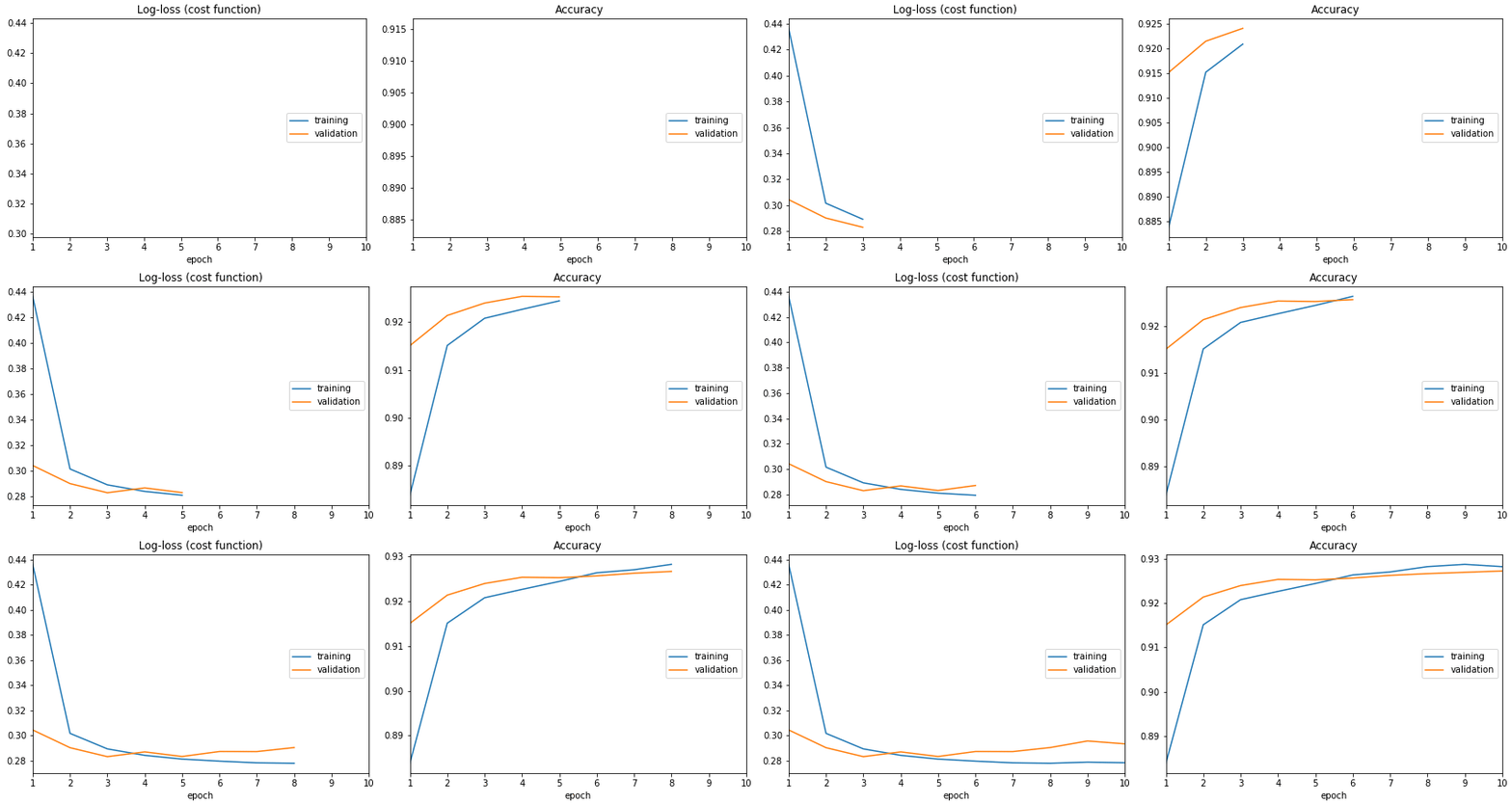
- (The most FA)Q: Why not TensorBoard?
- A: Jupyter Notebook compatibility (for exploration and teaching). The simplicity of use.
## Installation
To install [this version from PyPI](https://pypi.org/project/livelossplot/), type:
```bash
pip install livelossplot
```
To get the newest one from this repo (note that we are in the alpha stage, so there may be frequent updates), type:
```bash
pip install git+git://github.com/stared/livelossplot.git
```
## Examples
Look at notebook files with full working [examples](https://github.com/stared/livelossplot/blob/master/examples/):
- [keras.ipynb](https://github.com/stared/livelossplot/blob/master/examples/keras.ipynb) - a Keras callback
- [minimal.ipynb](https://github.com/stared/livelossplot/blob/master/examples/minimal.ipynb) - a bare API, to use anywhere
- [bokeh.ipynb](https://github.com/stared/livelossplot/blob/master/examples/bokeh.ipynb) - a bare API, plots with Bokeh ([open it in Colab to see the plots](https://colab.research.google.com/github/stared/livelossplot/blob/master/examples/bokeh.ipynb))
- [pytorch.ipynb](https://github.com/stared/livelossplot/blob/master/examples/pytorch.ipynb) - a bare API, as applied to PyTorch
- [2d_prediction_maps.ipynb](https://github.com/stared/livelossplot/blob/master/examples/2d_prediction_maps.ipynb) - example of custom plots - 2d prediction maps (0.4.1+)
- [poutyne.ipynb](https://github.com/stared/livelossplot/blob/master/examples/poutyne.ipynb) - a Poutyne callback ([Poutyne](https://poutyne.org/) is a Keras-like framework for PyTorch)
- [torchbearer.ipynb](https://github.com/stared/livelossplot/blob/master/examples/torchbearer.ipynb) - an example using the built in functionality from torchbearer ([torchbearer](https://github.com/ecs-vlc/torchbearer) is a model fitting library for PyTorch)
- [neptune.py](https://github.com/stared/livelossplot/blob/master/examples/neptune.py) and [neptune.ipynb](https://github.com/stared/livelossplot/blob/master/examples/neptune.ipynb) - a [Neptune.AI](https://neptune.ai/)
- [matplotlib.ipynb](https://github.com/stared/livelossplot/blob/master/examples/matplotlib.ipynb) - a Matplotlib output example
- [various_options.ipynb](https://github.com/stared/livelossplot/blob/master/examples/various_options.ipynb) - an extended API for metrics grouping and custom outputs
You [run examples in Colab](https://colab.research.google.com/github/stared/livelossplot).
## Overview
Text logs are easy, but it's easy to miss the most crucial information: is it learning, doing nothing or overfitting?
Visual feedback allows us to keep track of the training process. Now there is one for Jupyter.
If you want to get serious - use [TensorBoard](https://www.tensorflow.org/programmers_guide/summaries_and_tensorboard), .
But what if you just want to train a small model in Jupyter Notebook? Here is a way to do so, using `livelossplot` as a plug&play component
### from livelossplot import ...
`PlotLosses` for a generic API.
```{python}
plotlosses = PlotLosses()
plotlosses.update({'acc': 0.7, 'val_acc': 0.4, 'loss': 0.9, 'val_loss': 1.1})
plot.send() # draw, update logs, etc
```
There are callbacks for common libraries and frameworks: `PlotLossesKeras`, `PlotLossesKerasTF`, `PlotLossesPoutyne`, `PlotLossesIgnite`.
Feel invited to write, and contribute, your adapter.
If you want to use a bare logger, there is `MainLogger`.
### from livelossplot.outputs import ...
Plots: `MatplotlibPlot`, `BokehPlot`.
Loggers: `ExtremaPrinter` (to standard output), `TensorboardLogger`, `TensorboardTFLogger`, `NeptuneLogger`.
To use them, initialize PlotLosses with some outputs:
```{python}
plotlosses = PlotLosses(outputs=[MatplotlibPlot(), TensorboardLogger()])
```
There are custom `matplotlib` plots in `livelossplot.outputs.matplotlib_subplots` you can pass in `MatplotlibPlot` arguments.
If you like to plot with [Bokeh](https://docs.bokeh.org/en/latest/) instead of [matplotlib](https://matplotlib.org/), use
```{python}
plotlosses = PlotLosses(outputs=[BokehPlot()])
```
## Sponsors
This project supported by [Jacek Migdał](http://jacek.migdal.pl/), [Marek Cichy](https://medium.com/@marekkcichy/), [Casper da Costa-Luis](https://cdcl.ml/), and [Piotr Zientara](https://twitter.com/piotr_zientara). [Join the sponsors - show your ❤️ and support, and appear on the list](https://github.com/sponsors/stared)! It will give me time and energy to work on this project.
This project is also supported by a European program *Program Operacyjny Inteligentny Rozwój* for [GearShift - building the engine of behavior of wheeled motor vehicles and map’s generation based on artificial intelligence algorithms implemented on the Unreal Engine platform](https://mapadotacji.gov.pl/projekty/874596/?lang=en) lead by ECC Games (NCBR grant GameINN).
## Trivia
It started as [this gist](https://gist.github.com/stared/dfb4dfaf6d9a8501cd1cc8b8cb806d2e). Since it went popular, I decided to rewrite it as a package.
Oh, and I am in general interested in data vis, see [Simple diagrams of convoluted neural networks](https://medium.com/inbrowserai/simple-diagrams-of-convoluted-neural-networks-39c097d2925b) (and overview of deep learning architecture diagrams):
> A good diagram is worth a thousand equations — let’s create more of these!
...or [my other data vis projects](https://p.migdal.pl/projects/).
## Todo
If you want more functionality - open an [Issue](https://github.com/stared/livelossplot/issues) or even better - prepare a [Pull Request](https://github.com/stared/livelossplot/pulls).
%package -n python3-livelossplot
Summary: Live training loss plot in Jupyter Notebook for Keras, PyTorch and others.
Provides: python-livelossplot
BuildRequires: python3-devel
BuildRequires: python3-setuptools
BuildRequires: python3-pip
%description -n python3-livelossplot
# livelossplot
[](https://pypi.org/project/livelossplot/)



[](https://github.com/stared/livelossplot/actions)
[](https://pepy.tech/project/livelossplot)
[](https://twitter.com/pmigdal)
Don't train deep learning models blindfolded! Be impatient and look at each epoch of your training!
([RECENT CHANGES](CHANGELOG.md), [EXAMPLES IN COLAB](https://colab.research.google.com/github/stared/livelossplot), [API LOOKUP](http://p.migdal.pl/livelossplot/), [CODE](https://github.com/stared/livelossplot))
A live training loss plot in [Jupyter Notebook](http://jupyter.org/) for [Keras](https://keras.io/), [PyTorch](http://pytorch.org/) and other frameworks. An open-source Python package by [Piotr Migdał](https://p.migdal.pl/), [Bartłomiej Olechno](https://github.com/Bartolo1024/) and [others](https://github.com/stared/livelossplot/graphs/contributors). **Open for collaboration!** (Some tasks are as simple as writing code docstrings, so - no excuses! :))
```python
from livelossplot import PlotLossesKeras
model.fit(X_train, Y_train,
epochs=10,
validation_data=(X_test, Y_test),
callbacks=[PlotLossesKeras()],
verbose=0)
```

- (The most FA)Q: Why not TensorBoard?
- A: Jupyter Notebook compatibility (for exploration and teaching). The simplicity of use.
## Installation
To install [this version from PyPI](https://pypi.org/project/livelossplot/), type:
```bash
pip install livelossplot
```
To get the newest one from this repo (note that we are in the alpha stage, so there may be frequent updates), type:
```bash
pip install git+git://github.com/stared/livelossplot.git
```
## Examples
Look at notebook files with full working [examples](https://github.com/stared/livelossplot/blob/master/examples/):
- [keras.ipynb](https://github.com/stared/livelossplot/blob/master/examples/keras.ipynb) - a Keras callback
- [minimal.ipynb](https://github.com/stared/livelossplot/blob/master/examples/minimal.ipynb) - a bare API, to use anywhere
- [bokeh.ipynb](https://github.com/stared/livelossplot/blob/master/examples/bokeh.ipynb) - a bare API, plots with Bokeh ([open it in Colab to see the plots](https://colab.research.google.com/github/stared/livelossplot/blob/master/examples/bokeh.ipynb))
- [pytorch.ipynb](https://github.com/stared/livelossplot/blob/master/examples/pytorch.ipynb) - a bare API, as applied to PyTorch
- [2d_prediction_maps.ipynb](https://github.com/stared/livelossplot/blob/master/examples/2d_prediction_maps.ipynb) - example of custom plots - 2d prediction maps (0.4.1+)
- [poutyne.ipynb](https://github.com/stared/livelossplot/blob/master/examples/poutyne.ipynb) - a Poutyne callback ([Poutyne](https://poutyne.org/) is a Keras-like framework for PyTorch)
- [torchbearer.ipynb](https://github.com/stared/livelossplot/blob/master/examples/torchbearer.ipynb) - an example using the built in functionality from torchbearer ([torchbearer](https://github.com/ecs-vlc/torchbearer) is a model fitting library for PyTorch)
- [neptune.py](https://github.com/stared/livelossplot/blob/master/examples/neptune.py) and [neptune.ipynb](https://github.com/stared/livelossplot/blob/master/examples/neptune.ipynb) - a [Neptune.AI](https://neptune.ai/)
- [matplotlib.ipynb](https://github.com/stared/livelossplot/blob/master/examples/matplotlib.ipynb) - a Matplotlib output example
- [various_options.ipynb](https://github.com/stared/livelossplot/blob/master/examples/various_options.ipynb) - an extended API for metrics grouping and custom outputs
You [run examples in Colab](https://colab.research.google.com/github/stared/livelossplot).
## Overview
Text logs are easy, but it's easy to miss the most crucial information: is it learning, doing nothing or overfitting?
Visual feedback allows us to keep track of the training process. Now there is one for Jupyter.
If you want to get serious - use [TensorBoard](https://www.tensorflow.org/programmers_guide/summaries_and_tensorboard), .
But what if you just want to train a small model in Jupyter Notebook? Here is a way to do so, using `livelossplot` as a plug&play component
### from livelossplot import ...
`PlotLosses` for a generic API.
```{python}
plotlosses = PlotLosses()
plotlosses.update({'acc': 0.7, 'val_acc': 0.4, 'loss': 0.9, 'val_loss': 1.1})
plot.send() # draw, update logs, etc
```
There are callbacks for common libraries and frameworks: `PlotLossesKeras`, `PlotLossesKerasTF`, `PlotLossesPoutyne`, `PlotLossesIgnite`.
Feel invited to write, and contribute, your adapter.
If you want to use a bare logger, there is `MainLogger`.
### from livelossplot.outputs import ...
Plots: `MatplotlibPlot`, `BokehPlot`.
Loggers: `ExtremaPrinter` (to standard output), `TensorboardLogger`, `TensorboardTFLogger`, `NeptuneLogger`.
To use them, initialize PlotLosses with some outputs:
```{python}
plotlosses = PlotLosses(outputs=[MatplotlibPlot(), TensorboardLogger()])
```
There are custom `matplotlib` plots in `livelossplot.outputs.matplotlib_subplots` you can pass in `MatplotlibPlot` arguments.
If you like to plot with [Bokeh](https://docs.bokeh.org/en/latest/) instead of [matplotlib](https://matplotlib.org/), use
```{python}
plotlosses = PlotLosses(outputs=[BokehPlot()])
```
## Sponsors
This project supported by [Jacek Migdał](http://jacek.migdal.pl/), [Marek Cichy](https://medium.com/@marekkcichy/), [Casper da Costa-Luis](https://cdcl.ml/), and [Piotr Zientara](https://twitter.com/piotr_zientara). [Join the sponsors - show your ❤️ and support, and appear on the list](https://github.com/sponsors/stared)! It will give me time and energy to work on this project.
This project is also supported by a European program *Program Operacyjny Inteligentny Rozwój* for [GearShift - building the engine of behavior of wheeled motor vehicles and map’s generation based on artificial intelligence algorithms implemented on the Unreal Engine platform](https://mapadotacji.gov.pl/projekty/874596/?lang=en) lead by ECC Games (NCBR grant GameINN).
## Trivia
It started as [this gist](https://gist.github.com/stared/dfb4dfaf6d9a8501cd1cc8b8cb806d2e). Since it went popular, I decided to rewrite it as a package.
Oh, and I am in general interested in data vis, see [Simple diagrams of convoluted neural networks](https://medium.com/inbrowserai/simple-diagrams-of-convoluted-neural-networks-39c097d2925b) (and overview of deep learning architecture diagrams):
> A good diagram is worth a thousand equations — let’s create more of these!
...or [my other data vis projects](https://p.migdal.pl/projects/).
## Todo
If you want more functionality - open an [Issue](https://github.com/stared/livelossplot/issues) or even better - prepare a [Pull Request](https://github.com/stared/livelossplot/pulls).
%package help
Summary: Development documents and examples for livelossplot
Provides: python3-livelossplot-doc
%description help
# livelossplot
[](https://pypi.org/project/livelossplot/)



[](https://github.com/stared/livelossplot/actions)
[](https://pepy.tech/project/livelossplot)
[](https://twitter.com/pmigdal)
Don't train deep learning models blindfolded! Be impatient and look at each epoch of your training!
([RECENT CHANGES](CHANGELOG.md), [EXAMPLES IN COLAB](https://colab.research.google.com/github/stared/livelossplot), [API LOOKUP](http://p.migdal.pl/livelossplot/), [CODE](https://github.com/stared/livelossplot))
A live training loss plot in [Jupyter Notebook](http://jupyter.org/) for [Keras](https://keras.io/), [PyTorch](http://pytorch.org/) and other frameworks. An open-source Python package by [Piotr Migdał](https://p.migdal.pl/), [Bartłomiej Olechno](https://github.com/Bartolo1024/) and [others](https://github.com/stared/livelossplot/graphs/contributors). **Open for collaboration!** (Some tasks are as simple as writing code docstrings, so - no excuses! :))
```python
from livelossplot import PlotLossesKeras
model.fit(X_train, Y_train,
epochs=10,
validation_data=(X_test, Y_test),
callbacks=[PlotLossesKeras()],
verbose=0)
```

- (The most FA)Q: Why not TensorBoard?
- A: Jupyter Notebook compatibility (for exploration and teaching). The simplicity of use.
## Installation
To install [this version from PyPI](https://pypi.org/project/livelossplot/), type:
```bash
pip install livelossplot
```
To get the newest one from this repo (note that we are in the alpha stage, so there may be frequent updates), type:
```bash
pip install git+git://github.com/stared/livelossplot.git
```
## Examples
Look at notebook files with full working [examples](https://github.com/stared/livelossplot/blob/master/examples/):
- [keras.ipynb](https://github.com/stared/livelossplot/blob/master/examples/keras.ipynb) - a Keras callback
- [minimal.ipynb](https://github.com/stared/livelossplot/blob/master/examples/minimal.ipynb) - a bare API, to use anywhere
- [bokeh.ipynb](https://github.com/stared/livelossplot/blob/master/examples/bokeh.ipynb) - a bare API, plots with Bokeh ([open it in Colab to see the plots](https://colab.research.google.com/github/stared/livelossplot/blob/master/examples/bokeh.ipynb))
- [pytorch.ipynb](https://github.com/stared/livelossplot/blob/master/examples/pytorch.ipynb) - a bare API, as applied to PyTorch
- [2d_prediction_maps.ipynb](https://github.com/stared/livelossplot/blob/master/examples/2d_prediction_maps.ipynb) - example of custom plots - 2d prediction maps (0.4.1+)
- [poutyne.ipynb](https://github.com/stared/livelossplot/blob/master/examples/poutyne.ipynb) - a Poutyne callback ([Poutyne](https://poutyne.org/) is a Keras-like framework for PyTorch)
- [torchbearer.ipynb](https://github.com/stared/livelossplot/blob/master/examples/torchbearer.ipynb) - an example using the built in functionality from torchbearer ([torchbearer](https://github.com/ecs-vlc/torchbearer) is a model fitting library for PyTorch)
- [neptune.py](https://github.com/stared/livelossplot/blob/master/examples/neptune.py) and [neptune.ipynb](https://github.com/stared/livelossplot/blob/master/examples/neptune.ipynb) - a [Neptune.AI](https://neptune.ai/)
- [matplotlib.ipynb](https://github.com/stared/livelossplot/blob/master/examples/matplotlib.ipynb) - a Matplotlib output example
- [various_options.ipynb](https://github.com/stared/livelossplot/blob/master/examples/various_options.ipynb) - an extended API for metrics grouping and custom outputs
You [run examples in Colab](https://colab.research.google.com/github/stared/livelossplot).
## Overview
Text logs are easy, but it's easy to miss the most crucial information: is it learning, doing nothing or overfitting?
Visual feedback allows us to keep track of the training process. Now there is one for Jupyter.
If you want to get serious - use [TensorBoard](https://www.tensorflow.org/programmers_guide/summaries_and_tensorboard), .
But what if you just want to train a small model in Jupyter Notebook? Here is a way to do so, using `livelossplot` as a plug&play component
### from livelossplot import ...
`PlotLosses` for a generic API.
```{python}
plotlosses = PlotLosses()
plotlosses.update({'acc': 0.7, 'val_acc': 0.4, 'loss': 0.9, 'val_loss': 1.1})
plot.send() # draw, update logs, etc
```
There are callbacks for common libraries and frameworks: `PlotLossesKeras`, `PlotLossesKerasTF`, `PlotLossesPoutyne`, `PlotLossesIgnite`.
Feel invited to write, and contribute, your adapter.
If you want to use a bare logger, there is `MainLogger`.
### from livelossplot.outputs import ...
Plots: `MatplotlibPlot`, `BokehPlot`.
Loggers: `ExtremaPrinter` (to standard output), `TensorboardLogger`, `TensorboardTFLogger`, `NeptuneLogger`.
To use them, initialize PlotLosses with some outputs:
```{python}
plotlosses = PlotLosses(outputs=[MatplotlibPlot(), TensorboardLogger()])
```
There are custom `matplotlib` plots in `livelossplot.outputs.matplotlib_subplots` you can pass in `MatplotlibPlot` arguments.
If you like to plot with [Bokeh](https://docs.bokeh.org/en/latest/) instead of [matplotlib](https://matplotlib.org/), use
```{python}
plotlosses = PlotLosses(outputs=[BokehPlot()])
```
## Sponsors
This project supported by [Jacek Migdał](http://jacek.migdal.pl/), [Marek Cichy](https://medium.com/@marekkcichy/), [Casper da Costa-Luis](https://cdcl.ml/), and [Piotr Zientara](https://twitter.com/piotr_zientara). [Join the sponsors - show your ❤️ and support, and appear on the list](https://github.com/sponsors/stared)! It will give me time and energy to work on this project.
This project is also supported by a European program *Program Operacyjny Inteligentny Rozwój* for [GearShift - building the engine of behavior of wheeled motor vehicles and map’s generation based on artificial intelligence algorithms implemented on the Unreal Engine platform](https://mapadotacji.gov.pl/projekty/874596/?lang=en) lead by ECC Games (NCBR grant GameINN).
## Trivia
It started as [this gist](https://gist.github.com/stared/dfb4dfaf6d9a8501cd1cc8b8cb806d2e). Since it went popular, I decided to rewrite it as a package.
Oh, and I am in general interested in data vis, see [Simple diagrams of convoluted neural networks](https://medium.com/inbrowserai/simple-diagrams-of-convoluted-neural-networks-39c097d2925b) (and overview of deep learning architecture diagrams):
> A good diagram is worth a thousand equations — let’s create more of these!
...or [my other data vis projects](https://p.migdal.pl/projects/).
## Todo
If you want more functionality - open an [Issue](https://github.com/stared/livelossplot/issues) or even better - prepare a [Pull Request](https://github.com/stared/livelossplot/pulls).
%prep
%autosetup -n livelossplot-0.5.5
%build
%py3_build
%install
%py3_install
install -d -m755 %{buildroot}/%{_pkgdocdir}
if [ -d doc ]; then cp -arf doc %{buildroot}/%{_pkgdocdir}; fi
if [ -d docs ]; then cp -arf docs %{buildroot}/%{_pkgdocdir}; fi
if [ -d example ]; then cp -arf example %{buildroot}/%{_pkgdocdir}; fi
if [ -d examples ]; then cp -arf examples %{buildroot}/%{_pkgdocdir}; fi
pushd %{buildroot}
if [ -d usr/lib ]; then
find usr/lib -type f -printf "/%h/%f\n" >> filelist.lst
fi
if [ -d usr/lib64 ]; then
find usr/lib64 -type f -printf "/%h/%f\n" >> filelist.lst
fi
if [ -d usr/bin ]; then
find usr/bin -type f -printf "/%h/%f\n" >> filelist.lst
fi
if [ -d usr/sbin ]; then
find usr/sbin -type f -printf "/%h/%f\n" >> filelist.lst
fi
touch doclist.lst
if [ -d usr/share/man ]; then
find usr/share/man -type f -printf "/%h/%f.gz\n" >> doclist.lst
fi
popd
mv %{buildroot}/filelist.lst .
mv %{buildroot}/doclist.lst .
%files -n python3-livelossplot -f filelist.lst
%dir %{python3_sitelib}/*
%files help -f doclist.lst
%{_docdir}/*
%changelog
* Sun Apr 23 2023 Python_Bot <Python_Bot@openeuler.org> - 0.5.5-1
- Package Spec generated
|
