
diff options
| author | CoprDistGit <infra@openeuler.org> | 2023-05-05 04:16:22 +0000 |
|---|---|---|
| committer | CoprDistGit <infra@openeuler.org> | 2023-05-05 04:16:22 +0000 |
| commit | d607f41845d960c57043106d529a18ba3e8c4365 (patch) | |
| tree | 4e5dea59175dfc88fb9ea2b76ec49bf6d8cb47c8 | |
| parent | 732cbb5508975212132126037011317a6be99a23 (diff) | |
automatic import of python-pymdeopeneuler20.03
| -rw-r--r-- | .gitignore | 1 | ||||
| -rw-r--r-- | python-pymde.spec | 579 | ||||
| -rw-r--r-- | sources | 1 |
3 files changed, 581 insertions, 0 deletions
@@ -0,0 +1 @@ +/pymde-0.1.18.tar.gz diff --git a/python-pymde.spec b/python-pymde.spec new file mode 100644 index 0000000..b6cbabb --- /dev/null +++ b/python-pymde.spec @@ -0,0 +1,579 @@ +%global _empty_manifest_terminate_build 0 +Name: python-pymde +Version: 0.1.18 +Release: 1 +Summary: Minimum-Distortion Embedding +License: Apache License, Version 2.0 +URL: https://github.com/cvxgrp/pymde +Source0: https://mirrors.nju.edu.cn/pypi/web/packages/a0/8e/21406b5c87e93f73b84992441652e340079725dfc8722be710fb46232a6d/pymde-0.1.18.tar.gz + +Requires: python3-matplotlib +Requires: python3-numpy +Requires: python3-pynndescent +Requires: python3-scipy +Requires: python3-torch +Requires: python3-torchvision +Requires: python3-requests + +%description +# PyMDE +  [](https://pypi.org/project/pymde/) [](https://anaconda.org/conda-forge/pymde) + +*The official documentation for PyMDE is available at www.pymde.org.* + +This repository accompanies the monograph [*Minimum-Distortion Embedding*](https://web.stanford.edu/~boyd/papers/min_dist_emb.html). + +PyMDE is a Python library for computing vector embeddings for finite sets of +items, such as images, biological cells, nodes in a network, or any other +abstract object. + +What sets PyMDE apart from other embedding libraries is that it provides a +simple but general framework for embedding, called _Minimum-Distortion +Embedding_ (MDE). With MDE, it is easy to recreate well-known embeddings and to +create new ones, tailored to your particular application. + +PyMDE is competitive +in runtime with more specialized embedding methods. With a GPU, it can be +even faster. + +## Overview +PyMDE can be enjoyed by beginners and experts alike. It can be used to: + +* visualize datasets, small or large; +* generate feature vectors for supervised learning; +* compress high-dimensional vector data; +* draw graphs (in up to orders of magnitude less time than packages like NetworkX); +* create custom embeddings, with custom objective functions and constraints (such as having uncorrelated feature columns); +* and more. + +PyMDE is very young software, under active development. If you run into issues, +or have any feedback, please reach out by [filing a Github +issue](https://github.com/cvxgrp/pymde/issues). + +This README gives a very brief overview of PyMDE. Make sure to read the +official documentation at www.pymde.org, which has in-depth tutorials +and API documentation. + +- [Installation](#installation) +- [Getting started](#getting-started) +- [Example notebooks](#example-notebooks) +- [Citing](#citing) + +## Installation +PyMDE is available on the Python Package Index, and on Conda Forge. + +To install with pip, use + +``` +pip install pymde +``` + +Alternatively, to install with conda, use + +``` +conda install -c pytorch -c conda-forge pymde +``` + +PyMDE has the following requirements: + +* Python >= 3.7 +* numpy >= 1.17.5 +* scipy +* torch >= 1.7.1 +* torchvision >= 0.8.2 +* pynndescent +* requests + +## Getting started +Getting started with PyMDE is easy. For embeddings that work out-of-the box, we provide two main functions: + +```python3 +pymde.preserve_neighbors +``` + +which preserves the local structure of original data, and + +```python3 +pymde.preserve_distances +``` + +which preserves pairwise distances or dissimilarity scores in the original +data. + +**Arguments.** The input to these functions is the original data, represented +either as a data matrix in which each row is a feature vector, or as a +(possibly sparse) graph encoding pairwise distances. The embedding dimension is +specified by the `embedding_dim` keyword argument, which is `2` by default. + +**Return value.** The return value is an `MDE` object. Calling the `embed()` +method on this object returns an embedding, which is a matrix +(`torch.Tensor`) in which each row is an embedding vector. For example, if the +original input is a data matrix of shape `(n_items, n_features)`, then the +embedding matrix has shape `(n_items, embeddimg_dim)`. + +We give examples of using these functions below. + +### Preserving neighbors +The following code produces an embedding of the MNIST dataset (images of +handwritten digits), in a fashion similar to LargeVis, t-SNE, UMAP, and other +neighborhood-based embeddings. The original data is a matrix of shape `(70000, +784)`, with each row representing an image. + +```python3 +import pymde + +mnist = pymde.datasets.MNIST() +embedding = pymde.preserve_neighbors(mnist.data, verbose=True).embed() +pymde.plot(embedding, color_by=mnist.attributes['digits']) +``` + +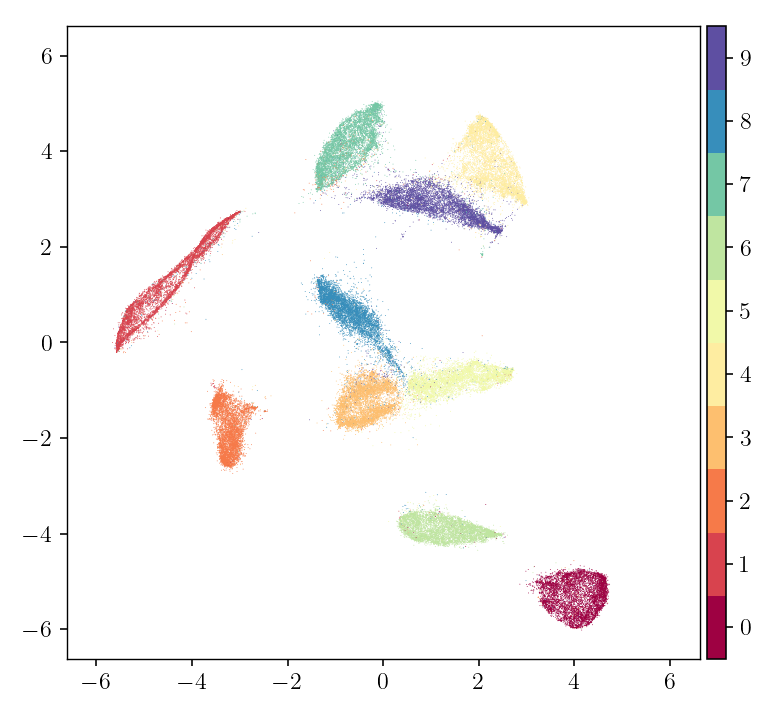 + +Unlike most other embedding methods, PyMDE can compute embeddings that satisfy +constraints. For example: + +```python3 +embedding = pymde.preserve_neighbors(mnist.data, constraint=pymde.Standardized(), verbose=True).embed() +pymde.plot(embedding, color_by=mnist.attributes['digits']) +``` + + + +The standardization constraint enforces the embedding vectors to be centered +and have uncorrelated features. + + +### Preserving distances +The function `pymde.preserve_distances` is useful when you're more interested +in preserving the gross global structure instead of local structure. + +Here's an example that produces an embedding of an academic coauthorship +network, from Google Scholar. The original data is a sparse graph on roughly +40,000 authors, with an edge between authors who have collaborated on at least +one paper. + +```python3 +import pymde + +google_scholar = pymde.datasets.google_scholar() +embedding = pymde.preserve_distances(google_scholar.data, verbose=True).embed() +pymde.plot(embedding, color_by=google_scholar.attributes['coauthors'], color_map='viridis', background_color='black') +``` + + + +More collaborative authors are colored brighter, and are near the center of the +embedding. + + +## Example notebooks +We have several [example notebooks](https://github.com/cvxgrp/pymde/tree/main/examples) that show how to use PyMDE on real (and synthetic) datasets. + +## Citing +To cite our work, please use the following BibTex entry. + +``` +@article{agrawal2021minimum, + author = {Agrawal, Akshay and Ali, Alnur and Boyd, Stephen}, + title = {Minimum-Distortion Embedding}, + journal = {arXiv}, + year = {2021}, +} +``` + +PyMDE was designed and developed by [Akshay Agrawal](https://www.akshayagrawal.com/). + + +%package -n python3-pymde +Summary: Minimum-Distortion Embedding +Provides: python-pymde +BuildRequires: python3-devel +BuildRequires: python3-setuptools +BuildRequires: python3-pip +BuildRequires: python3-cffi +BuildRequires: gcc +BuildRequires: gdb +%description -n python3-pymde +# PyMDE +  [](https://pypi.org/project/pymde/) [](https://anaconda.org/conda-forge/pymde) + +*The official documentation for PyMDE is available at www.pymde.org.* + +This repository accompanies the monograph [*Minimum-Distortion Embedding*](https://web.stanford.edu/~boyd/papers/min_dist_emb.html). + +PyMDE is a Python library for computing vector embeddings for finite sets of +items, such as images, biological cells, nodes in a network, or any other +abstract object. + +What sets PyMDE apart from other embedding libraries is that it provides a +simple but general framework for embedding, called _Minimum-Distortion +Embedding_ (MDE). With MDE, it is easy to recreate well-known embeddings and to +create new ones, tailored to your particular application. + +PyMDE is competitive +in runtime with more specialized embedding methods. With a GPU, it can be +even faster. + +## Overview +PyMDE can be enjoyed by beginners and experts alike. It can be used to: + +* visualize datasets, small or large; +* generate feature vectors for supervised learning; +* compress high-dimensional vector data; +* draw graphs (in up to orders of magnitude less time than packages like NetworkX); +* create custom embeddings, with custom objective functions and constraints (such as having uncorrelated feature columns); +* and more. + +PyMDE is very young software, under active development. If you run into issues, +or have any feedback, please reach out by [filing a Github +issue](https://github.com/cvxgrp/pymde/issues). + +This README gives a very brief overview of PyMDE. Make sure to read the +official documentation at www.pymde.org, which has in-depth tutorials +and API documentation. + +- [Installation](#installation) +- [Getting started](#getting-started) +- [Example notebooks](#example-notebooks) +- [Citing](#citing) + +## Installation +PyMDE is available on the Python Package Index, and on Conda Forge. + +To install with pip, use + +``` +pip install pymde +``` + +Alternatively, to install with conda, use + +``` +conda install -c pytorch -c conda-forge pymde +``` + +PyMDE has the following requirements: + +* Python >= 3.7 +* numpy >= 1.17.5 +* scipy +* torch >= 1.7.1 +* torchvision >= 0.8.2 +* pynndescent +* requests + +## Getting started +Getting started with PyMDE is easy. For embeddings that work out-of-the box, we provide two main functions: + +```python3 +pymde.preserve_neighbors +``` + +which preserves the local structure of original data, and + +```python3 +pymde.preserve_distances +``` + +which preserves pairwise distances or dissimilarity scores in the original +data. + +**Arguments.** The input to these functions is the original data, represented +either as a data matrix in which each row is a feature vector, or as a +(possibly sparse) graph encoding pairwise distances. The embedding dimension is +specified by the `embedding_dim` keyword argument, which is `2` by default. + +**Return value.** The return value is an `MDE` object. Calling the `embed()` +method on this object returns an embedding, which is a matrix +(`torch.Tensor`) in which each row is an embedding vector. For example, if the +original input is a data matrix of shape `(n_items, n_features)`, then the +embedding matrix has shape `(n_items, embeddimg_dim)`. + +We give examples of using these functions below. + +### Preserving neighbors +The following code produces an embedding of the MNIST dataset (images of +handwritten digits), in a fashion similar to LargeVis, t-SNE, UMAP, and other +neighborhood-based embeddings. The original data is a matrix of shape `(70000, +784)`, with each row representing an image. + +```python3 +import pymde + +mnist = pymde.datasets.MNIST() +embedding = pymde.preserve_neighbors(mnist.data, verbose=True).embed() +pymde.plot(embedding, color_by=mnist.attributes['digits']) +``` + + + +Unlike most other embedding methods, PyMDE can compute embeddings that satisfy +constraints. For example: + +```python3 +embedding = pymde.preserve_neighbors(mnist.data, constraint=pymde.Standardized(), verbose=True).embed() +pymde.plot(embedding, color_by=mnist.attributes['digits']) +``` + + + +The standardization constraint enforces the embedding vectors to be centered +and have uncorrelated features. + + +### Preserving distances +The function `pymde.preserve_distances` is useful when you're more interested +in preserving the gross global structure instead of local structure. + +Here's an example that produces an embedding of an academic coauthorship +network, from Google Scholar. The original data is a sparse graph on roughly +40,000 authors, with an edge between authors who have collaborated on at least +one paper. + +```python3 +import pymde + +google_scholar = pymde.datasets.google_scholar() +embedding = pymde.preserve_distances(google_scholar.data, verbose=True).embed() +pymde.plot(embedding, color_by=google_scholar.attributes['coauthors'], color_map='viridis', background_color='black') +``` + + + +More collaborative authors are colored brighter, and are near the center of the +embedding. + + +## Example notebooks +We have several [example notebooks](https://github.com/cvxgrp/pymde/tree/main/examples) that show how to use PyMDE on real (and synthetic) datasets. + +## Citing +To cite our work, please use the following BibTex entry. + +``` +@article{agrawal2021minimum, + author = {Agrawal, Akshay and Ali, Alnur and Boyd, Stephen}, + title = {Minimum-Distortion Embedding}, + journal = {arXiv}, + year = {2021}, +} +``` + +PyMDE was designed and developed by [Akshay Agrawal](https://www.akshayagrawal.com/). + + +%package help +Summary: Development documents and examples for pymde +Provides: python3-pymde-doc +%description help +# PyMDE +  [](https://pypi.org/project/pymde/) [](https://anaconda.org/conda-forge/pymde) + +*The official documentation for PyMDE is available at www.pymde.org.* + +This repository accompanies the monograph [*Minimum-Distortion Embedding*](https://web.stanford.edu/~boyd/papers/min_dist_emb.html). + +PyMDE is a Python library for computing vector embeddings for finite sets of +items, such as images, biological cells, nodes in a network, or any other +abstract object. + +What sets PyMDE apart from other embedding libraries is that it provides a +simple but general framework for embedding, called _Minimum-Distortion +Embedding_ (MDE). With MDE, it is easy to recreate well-known embeddings and to +create new ones, tailored to your particular application. + +PyMDE is competitive +in runtime with more specialized embedding methods. With a GPU, it can be +even faster. + +## Overview +PyMDE can be enjoyed by beginners and experts alike. It can be used to: + +* visualize datasets, small or large; +* generate feature vectors for supervised learning; +* compress high-dimensional vector data; +* draw graphs (in up to orders of magnitude less time than packages like NetworkX); +* create custom embeddings, with custom objective functions and constraints (such as having uncorrelated feature columns); +* and more. + +PyMDE is very young software, under active development. If you run into issues, +or have any feedback, please reach out by [filing a Github +issue](https://github.com/cvxgrp/pymde/issues). + +This README gives a very brief overview of PyMDE. Make sure to read the +official documentation at www.pymde.org, which has in-depth tutorials +and API documentation. + +- [Installation](#installation) +- [Getting started](#getting-started) +- [Example notebooks](#example-notebooks) +- [Citing](#citing) + +## Installation +PyMDE is available on the Python Package Index, and on Conda Forge. + +To install with pip, use + +``` +pip install pymde +``` + +Alternatively, to install with conda, use + +``` +conda install -c pytorch -c conda-forge pymde +``` + +PyMDE has the following requirements: + +* Python >= 3.7 +* numpy >= 1.17.5 +* scipy +* torch >= 1.7.1 +* torchvision >= 0.8.2 +* pynndescent +* requests + +## Getting started +Getting started with PyMDE is easy. For embeddings that work out-of-the box, we provide two main functions: + +```python3 +pymde.preserve_neighbors +``` + +which preserves the local structure of original data, and + +```python3 +pymde.preserve_distances +``` + +which preserves pairwise distances or dissimilarity scores in the original +data. + +**Arguments.** The input to these functions is the original data, represented +either as a data matrix in which each row is a feature vector, or as a +(possibly sparse) graph encoding pairwise distances. The embedding dimension is +specified by the `embedding_dim` keyword argument, which is `2` by default. + +**Return value.** The return value is an `MDE` object. Calling the `embed()` +method on this object returns an embedding, which is a matrix +(`torch.Tensor`) in which each row is an embedding vector. For example, if the +original input is a data matrix of shape `(n_items, n_features)`, then the +embedding matrix has shape `(n_items, embeddimg_dim)`. + +We give examples of using these functions below. + +### Preserving neighbors +The following code produces an embedding of the MNIST dataset (images of +handwritten digits), in a fashion similar to LargeVis, t-SNE, UMAP, and other +neighborhood-based embeddings. The original data is a matrix of shape `(70000, +784)`, with each row representing an image. + +```python3 +import pymde + +mnist = pymde.datasets.MNIST() +embedding = pymde.preserve_neighbors(mnist.data, verbose=True).embed() +pymde.plot(embedding, color_by=mnist.attributes['digits']) +``` + + + +Unlike most other embedding methods, PyMDE can compute embeddings that satisfy +constraints. For example: + +```python3 +embedding = pymde.preserve_neighbors(mnist.data, constraint=pymde.Standardized(), verbose=True).embed() +pymde.plot(embedding, color_by=mnist.attributes['digits']) +``` + + + +The standardization constraint enforces the embedding vectors to be centered +and have uncorrelated features. + + +### Preserving distances +The function `pymde.preserve_distances` is useful when you're more interested +in preserving the gross global structure instead of local structure. + +Here's an example that produces an embedding of an academic coauthorship +network, from Google Scholar. The original data is a sparse graph on roughly +40,000 authors, with an edge between authors who have collaborated on at least +one paper. + +```python3 +import pymde + +google_scholar = pymde.datasets.google_scholar() +embedding = pymde.preserve_distances(google_scholar.data, verbose=True).embed() +pymde.plot(embedding, color_by=google_scholar.attributes['coauthors'], color_map='viridis', background_color='black') +``` + + + +More collaborative authors are colored brighter, and are near the center of the +embedding. + + +## Example notebooks +We have several [example notebooks](https://github.com/cvxgrp/pymde/tree/main/examples) that show how to use PyMDE on real (and synthetic) datasets. + +## Citing +To cite our work, please use the following BibTex entry. + +``` +@article{agrawal2021minimum, + author = {Agrawal, Akshay and Ali, Alnur and Boyd, Stephen}, + title = {Minimum-Distortion Embedding}, + journal = {arXiv}, + year = {2021}, +} +``` + +PyMDE was designed and developed by [Akshay Agrawal](https://www.akshayagrawal.com/). + + +%prep +%autosetup -n pymde-0.1.18 + +%build +%py3_build + +%install +%py3_install +install -d -m755 %{buildroot}/%{_pkgdocdir} +if [ -d doc ]; then cp -arf doc %{buildroot}/%{_pkgdocdir}; fi +if [ -d docs ]; then cp -arf docs %{buildroot}/%{_pkgdocdir}; fi +if [ -d example ]; then cp -arf example %{buildroot}/%{_pkgdocdir}; fi +if [ -d examples ]; then cp -arf examples %{buildroot}/%{_pkgdocdir}; fi +pushd %{buildroot} +if [ -d usr/lib ]; then + find usr/lib -type f -printf "/%h/%f\n" >> filelist.lst +fi +if [ -d usr/lib64 ]; then + find usr/lib64 -type f -printf "/%h/%f\n" >> filelist.lst +fi +if [ -d usr/bin ]; then + find usr/bin -type f -printf "/%h/%f\n" >> filelist.lst +fi +if [ -d usr/sbin ]; then + find usr/sbin -type f -printf "/%h/%f\n" >> filelist.lst +fi +touch doclist.lst +if [ -d usr/share/man ]; then + find usr/share/man -type f -printf "/%h/%f.gz\n" >> doclist.lst +fi +popd +mv %{buildroot}/filelist.lst . +mv %{buildroot}/doclist.lst . + +%files -n python3-pymde -f filelist.lst +%dir %{python3_sitearch}/* + +%files help -f doclist.lst +%{_docdir}/* + +%changelog +* Fri May 05 2023 Python_Bot <Python_Bot@openeuler.org> - 0.1.18-1 +- Package Spec generated @@ -0,0 +1 @@ +5e126e4f7cd5ea5d12ea269df71ce9b5 pymde-0.1.18.tar.gz |