
diff options
| author | CoprDistGit <infra@openeuler.org> | 2023-06-08 16:00:58 +0000 |
|---|---|---|
| committer | CoprDistGit <infra@openeuler.org> | 2023-06-08 16:00:58 +0000 |
| commit | 4939716b9ccec1c654258f3516db67f2f9f0bc76 (patch) | |
| tree | 9f19a3262715d37ca7381f43270fb4143e504e49 /python-pynguin.spec | |
| parent | e08c16915d26f66ec87ec90a367d40ccec0248e4 (diff) | |
automatic import of python-pynguinopeneuler20.03
Diffstat (limited to 'python-pynguin.spec')
| -rw-r--r-- | python-pynguin.spec | 576 |
1 files changed, 576 insertions, 0 deletions
diff --git a/python-pynguin.spec b/python-pynguin.spec new file mode 100644 index 0000000..bf7dba4 --- /dev/null +++ b/python-pynguin.spec @@ -0,0 +1,576 @@ +%global _empty_manifest_terminate_build 0 +Name: python-pynguin +Version: 0.33.0 +Release: 1 +Summary: Pynguin is a tool for automated unit test generation for Python +License: MIT +URL: https://www.pynguin.eu +Source0: https://mirrors.aliyun.com/pypi/web/packages/04/e4/53af2a8be279c9cbc06788da3e449598cf7f6b57682398e7be855a9808c4/pynguin-0.33.0.tar.gz +BuildArch: noarch + +Requires: python3-astroid +Requires: python3-black +Requires: python3-bytecode +Requires: python3-jellyfish +Requires: python3-Jinja2 +Requires: python3-MutPy-Pynguin +Requires: python3-networkx +Requires: python3-rich +Requires: python3-Pygments +Requires: python3-pytest +Requires: python3-simple-parsing +Requires: python3-typing_inspect +Requires: python3-asciitree +Requires: python3-libcst +Requires: python3-requests + +%description +<!-- +SPDX-FileCopyrightText: 2019–2023 Pynguin Contributors + +SPDX-License-Identifier: CC-BY-4.0 +--> + +# Pynguin + +Pynguin (IPA: ˈpɪŋɡuiːn), +the +PYthoN +General +UnIt +test +geNerator, +is a tool that allows developers to generate unit tests automatically. + +Testing software is often considered to be a tedious task. +Thus, automated generation techniques have been proposed and mature tools exist—for +statically typed languages, such as Java. +There is, however, no fully-automated tool available that produces unit tests for +general-purpose programs in a dynamically typed language. +Pynguin is, to the best of our knowledge, the first tool that fills this gap +and allows the automated generation of unit tests for Python programs. + +<details> +<summary>Internal Pipeline Status</summary> + +[](https://gitlab.infosun.fim.uni-passau.de/se2/pynguin/pynguin/-/commits/main) +[](https://gitlab.infosun.fim.uni-passau.de/se2/pynguin/pynguin/-/commits/main) + +</details> + +[](https://opensource.org/licenses/MIT) +[](https://github.com/ambv/black) +[](https://badge.fury.io/py/pynguin) +[](https://github.com/se2p/pynguin) +[](https://pynguin.readthedocs.io/en/latest/?badge=latest) +[](https://doi.org/10.5281/zenodo.3989840) +[](https://api.reuse.software/info/github.com/se2p/pynguin) +[](https://pepy.tech/project/pynguin) + + + + +## Attention + +*Please Note:* + +**Pynguin executes the module under test!** +As a consequence, depending on what code is in that module, +running Pynguin can cause serious harm to your computer, +for example, wipe your entire hard disk! +We recommend running Pynguin in an isolated environment; +use, for example, a Docker container to minimize the risk of damaging +your system. + +**Pynguin is only a research prototype!** +It is not tailored towards production use whatsoever. +However, we would love to see Pynguin in a production-ready stage at some point; +please report your experiences in using Pynguin to us. + + +## Prerequisites + +Before you begin, ensure you have met the following requirements: +- You have installed Python 3.10 (we have not yet tested with Python + 3.11, there might be some problems due to changed internals regarding the byte-code + instrumentation). + + **Attention:** Pynguin now requires Python 3.10! Older versions are no longer + supported! +- You have a recent Linux/macOS/Windows machine. + +Please consider reading the [online documentation](https://pynguin.readthedocs.io) +to start your Pynguin adventure. + +## Installing Pynguin + +Pynguin can be easily installed using the `pip` tool by typing: +```bash +pip install pynguin +``` + +Make sure that your version of `pip` is that of a supported Python version, as any +older version is not supported by Pynguin! + +## Using Pynguin + +Before you continue, please read the [quick start guide](https://pynguin.readthedocs.io/en/latest/user/quickstart.html) + +Pynguin is a command-line application. +Once you installed it to a virtual environment, you can invoke the tool by typing +`pynguin` inside this virtual environment. +Pynguin will then print a list of its command-line parameters. + +A minimal full command line to invoke Pynguin could be the following, +where we assume that a project `foo` is located in `/tmp/foo`, +we want to store Pynguin's generated tests in `/tmp/testgen`, +and we want to generate tests using a whole-suite approach for the module `foo.bar` +(wrapped for better readability): +```bash +pynguin \ + --project-path /tmp/foo \ + --output-path /tmp/testgen \ + --module-name foo.bar +``` +Please find a more detailed example in the [quick start guide](https://pynguin.readthedocs.io/en/latest/user/quickstart.html). + + +## Contributing to Pynguin + +For the development of Pynguin you will need the [`poetry`](https://python-poetry.org) +dependency management and packaging tool. +To start developing, follow these steps: +1. Clone the repository +2. Change to the `pynguin` folder: `cd pynguin` +3. Create a virtual environment and install dependencies using `poetry`: `poetry install` +4. Make your changes +5. Run `make check` to verify that your changes pass all checks + + Please see the [`poetry` documentation](https://python-poetry.org/docs/) for more information on this tool. + +## Contributors + +Pynguin is developed at the +[Chair of Software Engineering II](https://www.fim.uni-passau.de/lehrstuhl-fuer-software-engineering-ii/) +of the [University of Passau](https://www.uni-passau.de). + +Maintainer: [Stephan Lukasczyk](https://github.com/stephanlukasczyk) + +Contributors: +- [Tucker Blue](https://github.com/tuckcodes) +- [Gordon Fraser](https://github.com/gofraser) +- [Abdur-Rahmaan Janhangeer](https://github.com/Abdur-rahmaanJ) +- [Maximilian Königseder](https://github.com/mak1ng) +- [Florian Kroiß](https://github.com/Wooza) +- [Simon Labrenz](https://github.com/labrenz) +- [Roman Levin](https://github.com/romanlevin) +- [Juan Julián Merelo Guervós](https://github.com/JJ) +- [Lukas Steffens](https://github.com/Luki42) +- [Florian Straubinger](https://github.com/f-str) +- [Sara Tavares](https://github.com/stavares843) + + +### Development using PyCharm. + +If you want to use the PyCharm IDE you have to set up a few things: +1. Import `pynguin` into PyCharm. +2. Let PyCharm configure configure a virtual environment using `poetry`. +3. Set the default test runner to `pytest` +4. Set the DocString format to `Google` + + +## License + +This project is licensed under the terms of the [MIT License](LICENSE.rst). +Pynguin was using the GNU Lesser General Public License (LGPL) until version 0.29.0, +its licence was changed with version 0.30.0. + +## Star History + +[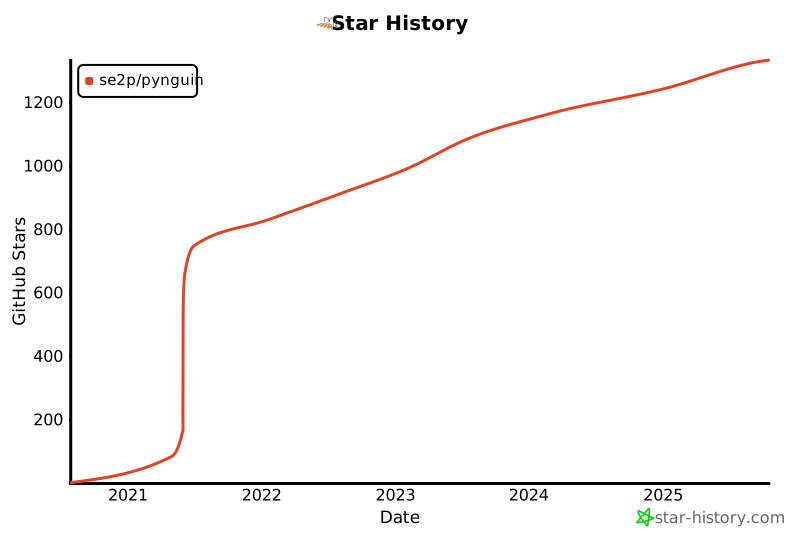](https://star-history.com/#se2p/pynguin) + + +%package -n python3-pynguin +Summary: Pynguin is a tool for automated unit test generation for Python +Provides: python-pynguin +BuildRequires: python3-devel +BuildRequires: python3-setuptools +BuildRequires: python3-pip +%description -n python3-pynguin +<!-- +SPDX-FileCopyrightText: 2019–2023 Pynguin Contributors + +SPDX-License-Identifier: CC-BY-4.0 +--> + +# Pynguin + +Pynguin (IPA: ˈpɪŋɡuiːn), +the +PYthoN +General +UnIt +test +geNerator, +is a tool that allows developers to generate unit tests automatically. + +Testing software is often considered to be a tedious task. +Thus, automated generation techniques have been proposed and mature tools exist—for +statically typed languages, such as Java. +There is, however, no fully-automated tool available that produces unit tests for +general-purpose programs in a dynamically typed language. +Pynguin is, to the best of our knowledge, the first tool that fills this gap +and allows the automated generation of unit tests for Python programs. + +<details> +<summary>Internal Pipeline Status</summary> + +[](https://gitlab.infosun.fim.uni-passau.de/se2/pynguin/pynguin/-/commits/main) +[](https://gitlab.infosun.fim.uni-passau.de/se2/pynguin/pynguin/-/commits/main) + +</details> + +[](https://opensource.org/licenses/MIT) +[](https://github.com/ambv/black) +[](https://badge.fury.io/py/pynguin) +[](https://github.com/se2p/pynguin) +[](https://pynguin.readthedocs.io/en/latest/?badge=latest) +[](https://doi.org/10.5281/zenodo.3989840) +[](https://api.reuse.software/info/github.com/se2p/pynguin) +[](https://pepy.tech/project/pynguin) + + + + +## Attention + +*Please Note:* + +**Pynguin executes the module under test!** +As a consequence, depending on what code is in that module, +running Pynguin can cause serious harm to your computer, +for example, wipe your entire hard disk! +We recommend running Pynguin in an isolated environment; +use, for example, a Docker container to minimize the risk of damaging +your system. + +**Pynguin is only a research prototype!** +It is not tailored towards production use whatsoever. +However, we would love to see Pynguin in a production-ready stage at some point; +please report your experiences in using Pynguin to us. + + +## Prerequisites + +Before you begin, ensure you have met the following requirements: +- You have installed Python 3.10 (we have not yet tested with Python + 3.11, there might be some problems due to changed internals regarding the byte-code + instrumentation). + + **Attention:** Pynguin now requires Python 3.10! Older versions are no longer + supported! +- You have a recent Linux/macOS/Windows machine. + +Please consider reading the [online documentation](https://pynguin.readthedocs.io) +to start your Pynguin adventure. + +## Installing Pynguin + +Pynguin can be easily installed using the `pip` tool by typing: +```bash +pip install pynguin +``` + +Make sure that your version of `pip` is that of a supported Python version, as any +older version is not supported by Pynguin! + +## Using Pynguin + +Before you continue, please read the [quick start guide](https://pynguin.readthedocs.io/en/latest/user/quickstart.html) + +Pynguin is a command-line application. +Once you installed it to a virtual environment, you can invoke the tool by typing +`pynguin` inside this virtual environment. +Pynguin will then print a list of its command-line parameters. + +A minimal full command line to invoke Pynguin could be the following, +where we assume that a project `foo` is located in `/tmp/foo`, +we want to store Pynguin's generated tests in `/tmp/testgen`, +and we want to generate tests using a whole-suite approach for the module `foo.bar` +(wrapped for better readability): +```bash +pynguin \ + --project-path /tmp/foo \ + --output-path /tmp/testgen \ + --module-name foo.bar +``` +Please find a more detailed example in the [quick start guide](https://pynguin.readthedocs.io/en/latest/user/quickstart.html). + + +## Contributing to Pynguin + +For the development of Pynguin you will need the [`poetry`](https://python-poetry.org) +dependency management and packaging tool. +To start developing, follow these steps: +1. Clone the repository +2. Change to the `pynguin` folder: `cd pynguin` +3. Create a virtual environment and install dependencies using `poetry`: `poetry install` +4. Make your changes +5. Run `make check` to verify that your changes pass all checks + + Please see the [`poetry` documentation](https://python-poetry.org/docs/) for more information on this tool. + +## Contributors + +Pynguin is developed at the +[Chair of Software Engineering II](https://www.fim.uni-passau.de/lehrstuhl-fuer-software-engineering-ii/) +of the [University of Passau](https://www.uni-passau.de). + +Maintainer: [Stephan Lukasczyk](https://github.com/stephanlukasczyk) + +Contributors: +- [Tucker Blue](https://github.com/tuckcodes) +- [Gordon Fraser](https://github.com/gofraser) +- [Abdur-Rahmaan Janhangeer](https://github.com/Abdur-rahmaanJ) +- [Maximilian Königseder](https://github.com/mak1ng) +- [Florian Kroiß](https://github.com/Wooza) +- [Simon Labrenz](https://github.com/labrenz) +- [Roman Levin](https://github.com/romanlevin) +- [Juan Julián Merelo Guervós](https://github.com/JJ) +- [Lukas Steffens](https://github.com/Luki42) +- [Florian Straubinger](https://github.com/f-str) +- [Sara Tavares](https://github.com/stavares843) + + +### Development using PyCharm. + +If you want to use the PyCharm IDE you have to set up a few things: +1. Import `pynguin` into PyCharm. +2. Let PyCharm configure configure a virtual environment using `poetry`. +3. Set the default test runner to `pytest` +4. Set the DocString format to `Google` + + +## License + +This project is licensed under the terms of the [MIT License](LICENSE.rst). +Pynguin was using the GNU Lesser General Public License (LGPL) until version 0.29.0, +its licence was changed with version 0.30.0. + +## Star History + +[](https://star-history.com/#se2p/pynguin) + + +%package help +Summary: Development documents and examples for pynguin +Provides: python3-pynguin-doc +%description help +<!-- +SPDX-FileCopyrightText: 2019–2023 Pynguin Contributors + +SPDX-License-Identifier: CC-BY-4.0 +--> + +# Pynguin + +Pynguin (IPA: ˈpɪŋɡuiːn), +the +PYthoN +General +UnIt +test +geNerator, +is a tool that allows developers to generate unit tests automatically. + +Testing software is often considered to be a tedious task. +Thus, automated generation techniques have been proposed and mature tools exist—for +statically typed languages, such as Java. +There is, however, no fully-automated tool available that produces unit tests for +general-purpose programs in a dynamically typed language. +Pynguin is, to the best of our knowledge, the first tool that fills this gap +and allows the automated generation of unit tests for Python programs. + +<details> +<summary>Internal Pipeline Status</summary> + +[](https://gitlab.infosun.fim.uni-passau.de/se2/pynguin/pynguin/-/commits/main) +[](https://gitlab.infosun.fim.uni-passau.de/se2/pynguin/pynguin/-/commits/main) + +</details> + +[](https://opensource.org/licenses/MIT) +[](https://github.com/ambv/black) +[](https://badge.fury.io/py/pynguin) +[](https://github.com/se2p/pynguin) +[](https://pynguin.readthedocs.io/en/latest/?badge=latest) +[](https://doi.org/10.5281/zenodo.3989840) +[](https://api.reuse.software/info/github.com/se2p/pynguin) +[](https://pepy.tech/project/pynguin) + + + + +## Attention + +*Please Note:* + +**Pynguin executes the module under test!** +As a consequence, depending on what code is in that module, +running Pynguin can cause serious harm to your computer, +for example, wipe your entire hard disk! +We recommend running Pynguin in an isolated environment; +use, for example, a Docker container to minimize the risk of damaging +your system. + +**Pynguin is only a research prototype!** +It is not tailored towards production use whatsoever. +However, we would love to see Pynguin in a production-ready stage at some point; +please report your experiences in using Pynguin to us. + + +## Prerequisites + +Before you begin, ensure you have met the following requirements: +- You have installed Python 3.10 (we have not yet tested with Python + 3.11, there might be some problems due to changed internals regarding the byte-code + instrumentation). + + **Attention:** Pynguin now requires Python 3.10! Older versions are no longer + supported! +- You have a recent Linux/macOS/Windows machine. + +Please consider reading the [online documentation](https://pynguin.readthedocs.io) +to start your Pynguin adventure. + +## Installing Pynguin + +Pynguin can be easily installed using the `pip` tool by typing: +```bash +pip install pynguin +``` + +Make sure that your version of `pip` is that of a supported Python version, as any +older version is not supported by Pynguin! + +## Using Pynguin + +Before you continue, please read the [quick start guide](https://pynguin.readthedocs.io/en/latest/user/quickstart.html) + +Pynguin is a command-line application. +Once you installed it to a virtual environment, you can invoke the tool by typing +`pynguin` inside this virtual environment. +Pynguin will then print a list of its command-line parameters. + +A minimal full command line to invoke Pynguin could be the following, +where we assume that a project `foo` is located in `/tmp/foo`, +we want to store Pynguin's generated tests in `/tmp/testgen`, +and we want to generate tests using a whole-suite approach for the module `foo.bar` +(wrapped for better readability): +```bash +pynguin \ + --project-path /tmp/foo \ + --output-path /tmp/testgen \ + --module-name foo.bar +``` +Please find a more detailed example in the [quick start guide](https://pynguin.readthedocs.io/en/latest/user/quickstart.html). + + +## Contributing to Pynguin + +For the development of Pynguin you will need the [`poetry`](https://python-poetry.org) +dependency management and packaging tool. +To start developing, follow these steps: +1. Clone the repository +2. Change to the `pynguin` folder: `cd pynguin` +3. Create a virtual environment and install dependencies using `poetry`: `poetry install` +4. Make your changes +5. Run `make check` to verify that your changes pass all checks + + Please see the [`poetry` documentation](https://python-poetry.org/docs/) for more information on this tool. + +## Contributors + +Pynguin is developed at the +[Chair of Software Engineering II](https://www.fim.uni-passau.de/lehrstuhl-fuer-software-engineering-ii/) +of the [University of Passau](https://www.uni-passau.de). + +Maintainer: [Stephan Lukasczyk](https://github.com/stephanlukasczyk) + +Contributors: +- [Tucker Blue](https://github.com/tuckcodes) +- [Gordon Fraser](https://github.com/gofraser) +- [Abdur-Rahmaan Janhangeer](https://github.com/Abdur-rahmaanJ) +- [Maximilian Königseder](https://github.com/mak1ng) +- [Florian Kroiß](https://github.com/Wooza) +- [Simon Labrenz](https://github.com/labrenz) +- [Roman Levin](https://github.com/romanlevin) +- [Juan Julián Merelo Guervós](https://github.com/JJ) +- [Lukas Steffens](https://github.com/Luki42) +- [Florian Straubinger](https://github.com/f-str) +- [Sara Tavares](https://github.com/stavares843) + + +### Development using PyCharm. + +If you want to use the PyCharm IDE you have to set up a few things: +1. Import `pynguin` into PyCharm. +2. Let PyCharm configure configure a virtual environment using `poetry`. +3. Set the default test runner to `pytest` +4. Set the DocString format to `Google` + + +## License + +This project is licensed under the terms of the [MIT License](LICENSE.rst). +Pynguin was using the GNU Lesser General Public License (LGPL) until version 0.29.0, +its licence was changed with version 0.30.0. + +## Star History + +[](https://star-history.com/#se2p/pynguin) + + +%prep +%autosetup -n pynguin-0.33.0 + +%build +%py3_build + +%install +%py3_install +install -d -m755 %{buildroot}/%{_pkgdocdir} +if [ -d doc ]; then cp -arf doc %{buildroot}/%{_pkgdocdir}; fi +if [ -d docs ]; then cp -arf docs %{buildroot}/%{_pkgdocdir}; fi +if [ -d example ]; then cp -arf example %{buildroot}/%{_pkgdocdir}; fi +if [ -d examples ]; then cp -arf examples %{buildroot}/%{_pkgdocdir}; fi +pushd %{buildroot} +if [ -d usr/lib ]; then + find usr/lib -type f -printf "\"/%h/%f\"\n" >> filelist.lst +fi +if [ -d usr/lib64 ]; then + find usr/lib64 -type f -printf "\"/%h/%f\"\n" >> filelist.lst +fi +if [ -d usr/bin ]; then + find usr/bin -type f -printf "\"/%h/%f\"\n" >> filelist.lst +fi +if [ -d usr/sbin ]; then + find usr/sbin -type f -printf "\"/%h/%f\"\n" >> filelist.lst +fi +touch doclist.lst +if [ -d usr/share/man ]; then + find usr/share/man -type f -printf "\"/%h/%f.gz\"\n" >> doclist.lst +fi +popd +mv %{buildroot}/filelist.lst . +mv %{buildroot}/doclist.lst . + +%files -n python3-pynguin -f filelist.lst +%dir %{python3_sitelib}/* + +%files help -f doclist.lst +%{_docdir}/* + +%changelog +* Thu Jun 08 2023 Python_Bot <Python_Bot@openeuler.org> - 0.33.0-1 +- Package Spec generated |