
diff options
| author | CoprDistGit <infra@openeuler.org> | 2023-05-10 05:27:14 +0000 |
|---|---|---|
| committer | CoprDistGit <infra@openeuler.org> | 2023-05-10 05:27:14 +0000 |
| commit | 7d59083d364b55184961e52abdeaf7916a9fc3be (patch) | |
| tree | 250b93ad3f52ba45b084363343f879aa45e93eeb /python-pysdm.spec | |
| parent | d6e53148b9e110a2060521a51b826a631a75b56e (diff) | |
automatic import of python-pysdmopeneuler20.03
Diffstat (limited to 'python-pysdm.spec')
| -rw-r--r-- | python-pysdm.spec | 2192 |
1 files changed, 2192 insertions, 0 deletions
diff --git a/python-pysdm.spec b/python-pysdm.spec new file mode 100644 index 0000000..dd751e5 --- /dev/null +++ b/python-pysdm.spec @@ -0,0 +1,2192 @@ +%global _empty_manifest_terminate_build 0 +Name: python-PySDM +Version: 2.20 +Release: 1 +Summary: Pythonic particle-based (super-droplet) warm-rain/aqueous-chemistry cloud microphysics package with box, parcel & 1D/2D prescribed-flow examples in Python, Julia and Matlab +License: GPL-3.0 +URL: https://github.com/open-atmos/PySDM +Source0: https://mirrors.nju.edu.cn/pypi/web/packages/ad/a0/dcd7124ece512f8148c4ed0b825725dcdb01537edb76600dd35f3033dd02/PySDM-2.20.tar.gz +BuildArch: noarch + +Requires: python3-ThrustRTC +Requires: python3-CURandRTC +Requires: python3-numba +Requires: python3-numpy +Requires: python3-Pint +Requires: python3-chempy +Requires: python3-scipy +Requires: python3-pyevtk + +%description +# PySDM + +[](https://www.python.org/) +[](https://numba.pydata.org) +[](https://pypi.org/project/ThrustRTC/) +[](https://en.wikipedia.org/wiki/Linux) +[](https://en.wikipedia.org/wiki/macOS) +[](https://en.wikipedia.org/wiki/Windows) +[](https://jupyter.org/) +[](https://github.com/open-atmos/PySDM/graphs/commit-activity) +[](https://www.openhub.net/p/atmos-cloud-sim-uj-PySDM) +[](https://joss.theoj.org/papers/62cad07440b941f73f57d187df1aa6e9) +[](https://zenodo.org/badge/latestdoi/199064632) +[](https://www.fnp.org.pl/en/) +[](https://www.ncn.gov.pl/?language=en) +[](https://asr.science.energy.gov/) + +[](https://www.gnu.org/licenses/gpl-3.0.html) + +[](https://github.com/open-atmos/PySDM/actions) +[](https://ci.appveyor.com/project/slayoo/pysdm/branch/main) +[](https://app.codecov.io/gh/open-atmos/PySDM) +[](https://pypi.org/project/PySDM) +[](https://open-atmos.github.io/PySDM/) + +PySDM is a package for simulating the dynamics of population of particles. +It is intended to serve as a building block for simulation systems modelling + fluid flows involving a dispersed phase, + with PySDM being responsible for representation of the dispersed phase. +Currently, the development is focused on atmospheric cloud physics + applications, in particular on modelling the dynamics of particles immersed in moist air + using the particle-based (a.k.a. super-droplet) approach + to represent aerosol/cloud/rain microphysics. +The package features a Pythonic high-performance implementation of the + Super-Droplet Method (SDM) Monte-Carlo algorithm for representing collisional growth + ([Shima et al. 2009](https://rmets.onlinelibrary.wiley.com/doi/abs/10.1002/qj.441)), hence the name. + +PySDM has two alternative parallel number-crunching backends + available: multi-threaded CPU backend based on [Numba](http://numba.pydata.org/) + and GPU-resident backend built on top of [ThrustRTC](https://pypi.org/project/ThrustRTC/). +The [`Numba`](https://open-atmos.github.io/PySDM/backends/numba/numba.html) backend (aliased ``CPU``) features multi-threaded parallelism for + multi-core CPUs, it uses the just-in-time compilation technique based on the LLVM infrastructure. +The [`ThrustRTC`](https://open-atmos.github.io/PySDM/backends/thrustRTC/thrustRTC.html) backend (aliased ``GPU``) offers GPU-resident operation of PySDM + leveraging the [SIMT](https://en.wikipedia.org/wiki/Single_instruction,_multiple_threads) + parallelisation model. +Using the ``GPU`` backend requires nVidia hardware and [CUDA driver](https://developer.nvidia.com/cuda-downloads). + +For an overview paper on PySDM v1 (and the preferred item to cite if using PySDM), see [Bartman et al. 2022](https://doi.org/10.21105/joss.03219) (J. Open Source Software). +For a list of talks and other materials on PySDM, see the [project wiki](https://github.com/open-atmos/PySDM/wiki). + +A [pdoc-generated](https://pdoc3.github.io/pdoc) documentation of PySDM public API is maintained at: [https://open-atmos.github.io/PySDM](https://open-atmos.github.io/PySDM) + +## Dependencies and Installation + +PySDM dependencies are: [Numpy](https://numpy.org/), [Numba](http://numba.pydata.org/), [SciPy](https://scipy.org/), +[Pint](https://pint.readthedocs.io/), [chempy](https://pypi.org/project/chempy/), +[pyevtk](https://pypi.org/project/pyevtk/), +[ThrustRTC](https://fynv.github.io/ThrustRTC/) and [CURandRTC](https://github.com/fynv/CURandRTC). + +To install PySDM using ``pip``, use: ``pip install PySDM`` +(or ``pip install git+https://github.com/open-atmos/PySDM.git`` to get updates +beyond the latest release). + +Conda users may use ``pip`` as well, see the [Installing non-conda packages](https://docs.conda.io/projects/conda/en/latest/user-guide/tasks/manage-pkgs.html#installing-non-conda-packages) section in the conda docs. Dependencies of PySDM are available at the following conda channels: +- numba: [numba](https://anaconda.org/numba/numba) +- conda-forge: [pyevtk](https://anaconda.org/conda-forge/pyevtk), [pint](https://anaconda.org/conda-forge/pint) and []() +- fyplus: [ThrustRTC](https://anaconda.org/fyplus/thrustrtc), [CURandRTC](https://anaconda.org/fyplus/curandrtc) +- bjodah: [chempy](https://anaconda.org/bjodah/chempy) +- nvidia: [cudatoolkit](https://anaconda.org/nvidia/cudatoolkit) + +For development purposes, we suggest cloning the repository and installing it using ``pip -e``. +Test-time dependencies are listed in the ``test-time-requirements.txt`` file. + +PySDM examples are hosted in a separate repository and constitute +the [``PySDM_examples``](https://github.com/open-atmos/PySDM-examples) package. +The examples have additional dependencies listed in [``PySDM_examples`` package ``setup.py``](https://github.com/open-atmos/PySDM-examples/blob/main/setup.py) file. +Running the examples requires the ``PySDM_examples`` package to be installed. +Since the examples package includes Jupyter notebooks (and their execution requires write access), the suggested install and launch steps are: +``` +git clone https://github.com/open-atmos/PySDM-examples.git +cd PySDM-examples +pip install -e . +jupyter-notebook +``` +Alternatively, one can also install the examples package from pypi.org by +using ``pip install PySDM-examples``. + +## PySDM examples (Jupyter notebooks reproducing results from literature): + +Examples are maintained at the `PySDM-examples` repository, see [PySDM-examples README.md](https://github.com/open-atmos/PySDM-examples/blob/main/README.md) file for details. + +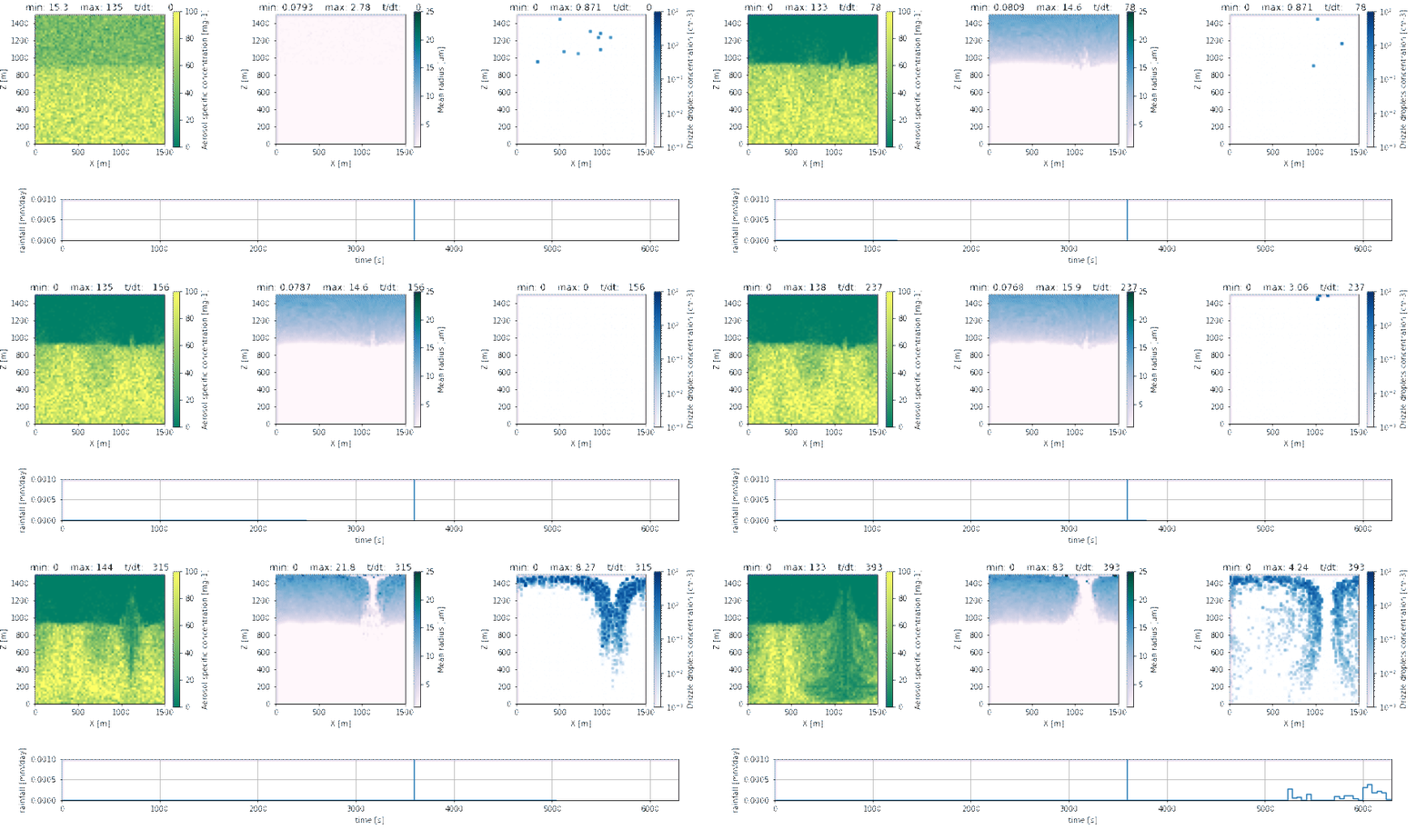 + +## Hello-world coalescence example in Python, Julia and Matlab + +In order to depict the PySDM API with a practical example, the following + listings provide sample code roughly reproducing the + Figure 2 from [Shima et al. 2009 paper](http://doi.org/10.1002/qj.441) + using PySDM from Python, Julia and Matlab. +It is a [`Coalescence`](https://open-atmos.github.io/PySDM/dynamics/coalescence.html)-only set-up in which the initial particle size + spectrum is [`Exponential`](https://open-atmos.github.io/PySDM/initialisation/spectra.html#PySDM.initialisation.spectra.Exponential) and is deterministically sampled to match + the condition of each super-droplet having equal initial multiplicity: +<details> +<summary>Julia (click to expand)</summary> + +```Julia +using Pkg +Pkg.add("PyCall") +Pkg.add("Plots") +Pkg.add("PlotlyJS") + +using PyCall +si = pyimport("PySDM.physics").si +ConstantMultiplicity = pyimport("PySDM.initialisation.sampling.spectral_sampling").ConstantMultiplicity +Exponential = pyimport("PySDM.initialisation.spectra").Exponential + +n_sd = 2^15 +initial_spectrum = Exponential(norm_factor=8.39e12, scale=1.19e5 * si.um^3) +attributes = Dict() +attributes["volume"], attributes["n"] = ConstantMultiplicity(spectrum=initial_spectrum).sample(n_sd) +``` +</details> +<details> +<summary>Matlab (click to expand)</summary> + +```Matlab +si = py.importlib.import_module('PySDM.physics').si; +ConstantMultiplicity = py.importlib.import_module('PySDM.initialisation.sampling.spectral_sampling').ConstantMultiplicity; +Exponential = py.importlib.import_module('PySDM.initialisation.spectra').Exponential; + +n_sd = 2^15; +initial_spectrum = Exponential(pyargs(... + 'norm_factor', 8.39e12, ... + 'scale', 1.19e5 * si.um ^ 3 ... +)); +tmp = ConstantMultiplicity(initial_spectrum).sample(int32(n_sd)); +attributes = py.dict(pyargs('volume', tmp{1}, 'n', tmp{2})); +``` +</details> +<details open> +<summary>Python (click to expand)</summary> + +```Python +from PySDM.physics import si +from PySDM.initialisation.sampling.spectral_sampling import ConstantMultiplicity +from PySDM.initialisation.spectra.exponential import Exponential + +n_sd = 2 ** 15 +initial_spectrum = Exponential(norm_factor=8.39e12, scale=1.19e5 * si.um ** 3) +attributes = {} +attributes['volume'], attributes['n'] = ConstantMultiplicity(initial_spectrum).sample(n_sd) +``` +</details> + +The key element of the PySDM interface is the [``Particulator``](https://open-atmos.github.io/PySDM/particulator.html) + class instances of which are used to manage the system state and control the simulation. +Instantiation of the [``Particulator``](https://open-atmos.github.io/PySDM/particulator.html) class is handled by the [``Builder``](https://open-atmos.github.io/PySDM/builder.html) + as exemplified below: +<details> +<summary>Julia (click to expand)</summary> + +```Julia +Builder = pyimport("PySDM").Builder +Box = pyimport("PySDM.environments").Box +Coalescence = pyimport("PySDM.dynamics").Coalescence +Golovin = pyimport("PySDM.dynamics.collisions.collision_kernels").Golovin +CPU = pyimport("PySDM.backends").CPU +ParticleVolumeVersusRadiusLogarithmSpectrum = pyimport("PySDM.products").ParticleVolumeVersusRadiusLogarithmSpectrum + +radius_bins_edges = 10 .^ range(log10(10*si.um), log10(5e3*si.um), length=32) + +builder = Builder(n_sd=n_sd, backend=CPU()) +builder.set_environment(Box(dt=1 * si.s, dv=1e6 * si.m^3)) +builder.add_dynamic(Coalescence(collision_kernel=Golovin(b=1.5e3 / si.s))) +products = [ParticleVolumeVersusRadiusLogarithmSpectrum(radius_bins_edges=radius_bins_edges, name="dv/dlnr")] +particulator = builder.build(attributes, products) +``` +</details> +<details> +<summary>Matlab (click to expand)</summary> + +```Matlab +Builder = py.importlib.import_module('PySDM').Builder; +Box = py.importlib.import_module('PySDM.environments').Box; +Coalescence = py.importlib.import_module('PySDM.dynamics').Coalescence; +Golovin = py.importlib.import_module('PySDM.dynamics.collisions.collision_kernels').Golovin; +CPU = py.importlib.import_module('PySDM.backends').CPU; +ParticleVolumeVersusRadiusLogarithmSpectrum = py.importlib.import_module('PySDM.products').ParticleVolumeVersusRadiusLogarithmSpectrum; + +radius_bins_edges = logspace(log10(10 * si.um), log10(5e3 * si.um), 32); + +builder = Builder(pyargs('n_sd', int32(n_sd), 'backend', CPU())); +builder.set_environment(Box(pyargs('dt', 1 * si.s, 'dv', 1e6 * si.m ^ 3))); +builder.add_dynamic(Coalescence(pyargs('collision_kernel', Golovin(1.5e3 / si.s)))); +products = py.list({ ParticleVolumeVersusRadiusLogarithmSpectrum(pyargs( ... + 'radius_bins_edges', py.numpy.array(radius_bins_edges), ... + 'name', 'dv/dlnr' ... +)) }); +particulator = builder.build(attributes, products); +``` +</details> +<details open> +<summary>Python (click to expand)</summary> + +```Python +import numpy as np +from PySDM import Builder +from PySDM.environments import Box +from PySDM.dynamics import Coalescence +from PySDM.dynamics.collisions.collision_kernels import Golovin +from PySDM.backends import CPU +from PySDM.products import ParticleVolumeVersusRadiusLogarithmSpectrum + +radius_bins_edges = np.logspace(np.log10(10 * si.um), np.log10(5e3 * si.um), num=32) + +builder = Builder(n_sd=n_sd, backend=CPU()) +builder.set_environment(Box(dt=1 * si.s, dv=1e6 * si.m ** 3)) +builder.add_dynamic(Coalescence(collision_kernel=Golovin(b=1.5e3 / si.s))) +products = [ParticleVolumeVersusRadiusLogarithmSpectrum(radius_bins_edges=radius_bins_edges, name='dv/dlnr')] +particulator = builder.build(attributes, products) +``` +</details> + +The ``backend`` argument may be set to ``CPU`` or ``GPU`` + what translates to choosing the multi-threaded backend or the + GPU-resident computation mode, respectively. +The employed [`Box`](https://open-atmos.github.io/PySDM/environments/box.html) environment corresponds to a zero-dimensional framework + (particle positions are not considered). +The vectors of particle multiplicities ``n`` and particle volumes ``v`` are + used to initialise super-droplet attributes. +The [`Coalescence`](https://open-atmos.github.io/PySDM/dynamics/coalescence.html) + Monte-Carlo algorithm (Super Droplet Method) is registered as the only + dynamic in the system. +Finally, the [`build()`](https://open-atmos.github.io/PySDM/builder.html#PySDM.builder.Builder.build) method is used to obtain an instance + of [`Particulator`](https://open-atmos.github.io/PySDM/particulator.html#PySDM.particulator.Particulator) which can then be used to control time-stepping and + access simulation state. + +The [`run(nt)`](https://open-atmos.github.io/PySDM/particulator.html#PySDM.particuparticulatorr.Particulator.run) method advances the simulation by ``nt`` timesteps. +In the listing below, its usage is interleaved with plotting logic + which displays a histogram of particle mass distribution + at selected timesteps: +<details> +<summary>Julia (click to expand)</summary> + +```Julia +rho_w = pyimport("PySDM.physics.constants_defaults").rho_w +using Plots; plotlyjs() + +for step = 0:1200:3600 + particulator.run(step - particulator.n_steps) + plot!( + radius_bins_edges[1:end-1] / si.um, + particulator.products["dv/dlnr"].get()[:] * rho_w / si.g, + linetype=:steppost, + xaxis=:log, + xlabel="particle radius [µm]", + ylabel="dm/dlnr [g/m^3/(unit dr/r)]", + label="t = $step s" + ) +end +savefig("plot.svg") +``` +</details> +<details> +<summary>Matlab (click to expand)</summary> + +```Matlab +rho_w = py.importlib.import_module('PySDM.physics.constants_defaults').rho_w; + +for step = 0:1200:3600 + particulator.run(int32(step - particulator.n_steps)); + x = radius_bins_edges / si.um; + y = particulator.products{"dv/dlnr"}.get() * rho_w / si.g; + stairs(... + x(1:end-1), ... + double(py.array.array('d',py.numpy.nditer(y))), ... + 'DisplayName', sprintf("t = %d s", step) ... + ); + hold on +end +hold off +set(gca,'XScale','log'); +xlabel('particle radius [µm]') +ylabel("dm/dlnr [g/m^3/(unit dr/r)]") +legend() +``` +</details> +<details open> +<summary>Python (click to expand)</summary> + +```Python +from PySDM.physics.constants_defaults import rho_w +from matplotlib import pyplot + +for step in [0, 1200, 2400, 3600]: + particulator.run(step - particulator.n_steps) + pyplot.step(x=radius_bins_edges[:-1] / si.um, + y=particulator.products['dv/dlnr'].get()[0] * rho_w / si.g, + where='post', label=f"t = {step}s") + +pyplot.xscale('log') +pyplot.xlabel('particle radius [µm]') +pyplot.ylabel("dm/dlnr [g/m$^3$/(unit dr/r)]") +pyplot.legend() +pyplot.savefig('readme.png') +``` +</details> + +The resultant plot (generated with the Python code) looks as follows: + + + +## Hello-world condensation example in Python, Julia and Matlab + +In the following example, a condensation-only setup is used with the adiabatic +[`Parcel`](https://open-atmos.github.io/PySDM/environments/parcel.html) environment. +An initial [`Lognormal`](https://open-atmos.github.io/PySDM/initialisation/spectra.html#PySDM.initialisation.spectra.Lognormal) +spectrum of dry aerosol particles is first initialised to equilibrium wet size for the given +initial humidity. +Subsequent particle growth due to [`Condensation`](https://open-atmos.github.io/PySDM/dynamics/condensation.html) of water vapour (coupled with the release of latent heat) +causes a subset of particles to activate into cloud droplets. +Results of the simulation are plotted against vertical +[`ParcelDisplacement`](https://open-atmos.github.io/PySDM/products/housekeeping/parcel_displacement.html) +and depict the evolution of +[`PeakSupersaturation`](https://open-atmos.github.io/PySDM/products/condensation/peak_supersaturation.html), +[`EffectiveRadius`](https://open-atmos.github.io/PySDM/products/size_spectral/effective_radius.html), +[`ParticleConcentration`](https://open-atmos.github.io/PySDM/products/size_spectral/particle_concentration.html#PySDM.products.particles_concentration.ParticleConcentration) +and the +[`WaterMixingRatio `](https://open-atmos.github.io/PySDM/products/size_spectral/water_mixing_ratio.html). + +<details> +<summary>Julia (click to expand)</summary> + +```Julia +using PyCall +using Plots; plotlyjs() +si = pyimport("PySDM.physics").si +spectral_sampling = pyimport("PySDM.initialisation.sampling").spectral_sampling +discretise_multiplicities = pyimport("PySDM.initialisation").discretise_multiplicities +Lognormal = pyimport("PySDM.initialisation.spectra").Lognormal +equilibrate_wet_radii = pyimport("PySDM.initialisation").equilibrate_wet_radii +CPU = pyimport("PySDM.backends").CPU +AmbientThermodynamics = pyimport("PySDM.dynamics").AmbientThermodynamics +Condensation = pyimport("PySDM.dynamics").Condensation +Parcel = pyimport("PySDM.environments").Parcel +Builder = pyimport("PySDM").Builder +Formulae = pyimport("PySDM").Formulae +products = pyimport("PySDM.products") + +env = Parcel( + dt=.25 * si.s, + mass_of_dry_air=1e3 * si.kg, + p0=1122 * si.hPa, + q0=20 * si.g / si.kg, + T0=300 * si.K, + w= 2.5 * si.m / si.s +) +spectrum = Lognormal(norm_factor=1e4/si.mg, m_mode=50*si.nm, s_geom=1.4) +kappa = .5 * si.dimensionless +cloud_range = (.5 * si.um, 25 * si.um) +output_interval = 4 +output_points = 40 +n_sd = 256 + +formulae = Formulae() +builder = Builder(backend=CPU(formulae), n_sd=n_sd) +builder.set_environment(env) +builder.add_dynamic(AmbientThermodynamics()) +builder.add_dynamic(Condensation()) + +r_dry, specific_concentration = spectral_sampling.Logarithmic(spectrum).sample(n_sd) +v_dry = formulae.trivia.volume(radius=r_dry) +r_wet = equilibrate_wet_radii(r_dry=r_dry, environment=env, kappa_times_dry_volume=kappa * v_dry) + +attributes = Dict() +attributes["n"] = discretise_multiplicities(specific_concentration * env.mass_of_dry_air) +attributes["dry volume"] = v_dry +attributes["kappa times dry volume"] = kappa * v_dry +attributes["volume"] = formulae.trivia.volume(radius=r_wet) + +particulator = builder.build(attributes, products=[ + products.PeakSupersaturation(name="S_max", unit="%"), + products.EffectiveRadius(name="r_eff", unit="um", radius_range=cloud_range), + products.ParticleConcentration(name="n_c_cm3", unit="cm^-3", radius_range=cloud_range), + products.WaterMixingRatio(name="ql", unit="g/kg", radius_range=cloud_range), + products.ParcelDisplacement(name="z") +]) + +cell_id=1 +output = Dict() +for (_, product) in particulator.products + output[product.name] = Array{Float32}(undef, output_points+1) + output[product.name][1] = product.get()[cell_id] +end + +for step = 2:output_points+1 + particulator.run(steps=output_interval) + for (_, product) in particulator.products + output[product.name][step] = product.get()[cell_id] + end +end + +plots = [] +ylbl = particulator.products["z"].unit +for (_, product) in particulator.products + if product.name != "z" + append!(plots, [plot(output[product.name], output["z"], ylabel=ylbl, xlabel=product.unit, title=product.name)]) + end + global ylbl = "" +end +plot(plots..., layout=(1, length(output)-1)) +savefig("parcel.svg") +``` +</details> +<details> +<summary>Matlab (click to expand)</summary> + +```Matlab +si = py.importlib.import_module('PySDM.physics').si; +spectral_sampling = py.importlib.import_module('PySDM.initialisation.sampling').spectral_sampling; +discretise_multiplicities = py.importlib.import_module('PySDM.initialisation').discretise_multiplicities; +Lognormal = py.importlib.import_module('PySDM.initialisation.spectra').Lognormal; +equilibrate_wet_radii = py.importlib.import_module('PySDM.initialisation').equilibrate_wet_radii; +CPU = py.importlib.import_module('PySDM.backends').CPU; +AmbientThermodynamics = py.importlib.import_module('PySDM.dynamics').AmbientThermodynamics; +Condensation = py.importlib.import_module('PySDM.dynamics').Condensation; +Parcel = py.importlib.import_module('PySDM.environments').Parcel; +Builder = py.importlib.import_module('PySDM').Builder; +Formulae = py.importlib.import_module('PySDM').Formulae; +products = py.importlib.import_module('PySDM.products'); + +env = Parcel(pyargs( ... + 'dt', .25 * si.s, ... + 'mass_of_dry_air', 1e3 * si.kg, ... + 'p0', 1122 * si.hPa, ... + 'q0', 20 * si.g / si.kg, ... + 'T0', 300 * si.K, ... + 'w', 2.5 * si.m / si.s ... +)); +spectrum = Lognormal(pyargs('norm_factor', 1e4/si.mg, 'm_mode', 50 * si.nm, 's_geom', 1.4)); +kappa = .5; +cloud_range = py.tuple({.5 * si.um, 25 * si.um}); +output_interval = 4; +output_points = 40; +n_sd = 256; + +formulae = Formulae(); +builder = Builder(pyargs('backend', CPU(formulae), 'n_sd', int32(n_sd))); +builder.set_environment(env); +builder.add_dynamic(AmbientThermodynamics()); +builder.add_dynamic(Condensation()); + +tmp = spectral_sampling.Logarithmic(spectrum).sample(int32(n_sd)); +r_dry = tmp{1}; +v_dry = formulae.trivia.volume(pyargs('radius', r_dry)); +specific_concentration = tmp{2}; +r_wet = equilibrate_wet_radii(pyargs(... + 'r_dry', r_dry, ... + 'environment', env, ... + 'kappa_times_dry_volume', kappa * v_dry... +)); + +attributes = py.dict(pyargs( ... + 'n', discretise_multiplicities(specific_concentration * env.mass_of_dry_air), ... + 'dry volume', v_dry, ... + 'kappa times dry volume', kappa * v_dry, ... + 'volume', formulae.trivia.volume(pyargs('radius', r_wet)) ... +)); + +particulator = builder.build(attributes, py.list({ ... + products.PeakSupersaturation(pyargs('name', 'S_max', 'unit', '%')), ... + products.EffectiveRadius(pyargs('name', 'r_eff', 'unit', 'um', 'radius_range', cloud_range)), ... + products.ParticleConcentration(pyargs('name', 'n_c_cm3', 'unit', 'cm^-3', 'radius_range', cloud_range)), ... + products.WaterMixingRatio(pyargs('name', 'ql', 'unit', 'g/kg', 'radius_range', cloud_range)) ... + products.ParcelDisplacement(pyargs('name', 'z')) ... +})); + +cell_id = int32(0); +output_size = [output_points+1, length(py.list(particulator.products.keys()))]; +output_types = repelem({'double'}, output_size(2)); +output_names = [cellfun(@string, cell(py.list(particulator.products.keys())))]; +output = table(... + 'Size', output_size, ... + 'VariableTypes', output_types, ... + 'VariableNames', output_names ... +); +for pykey = py.list(keys(particulator.products)) + get = py.getattr(particulator.products{pykey{1}}.get(), '__getitem__'); + key = string(pykey{1}); + output{1, key} = get(cell_id); +end + +for i=2:output_points+1 + particulator.run(pyargs('steps', int32(output_interval))); + for pykey = py.list(keys(particulator.products)) + get = py.getattr(particulator.products{pykey{1}}.get(), '__getitem__'); + key = string(pykey{1}); + output{i, key} = get(cell_id); + end +end + +i=1; +for pykey = py.list(keys(particulator.products)) + product = particulator.products{pykey{1}}; + if string(product.name) ~= "z" + subplot(1, width(output)-1, i); + plot(output{:, string(pykey{1})}, output.z, '-o'); + title(string(product.name), 'Interpreter', 'none'); + xlabel(string(product.unit)); + end + if i == 1 + ylabel(string(particulator.products{"z"}.unit)); + end + i=i+1; +end +saveas(gcf, "parcel.png"); +``` +</details> +<details open> +<summary>Python (click to expand)</summary> + +```Python +from matplotlib import pyplot +from PySDM.physics import si +from PySDM.initialisation import discretise_multiplicities, equilibrate_wet_radii +from PySDM.initialisation.spectra import Lognormal +from PySDM.initialisation.sampling import spectral_sampling +from PySDM.backends import CPU +from PySDM.dynamics import AmbientThermodynamics, Condensation +from PySDM.environments import Parcel +from PySDM import Builder, Formulae, products + +env = Parcel( + dt=.25 * si.s, + mass_of_dry_air=1e3 * si.kg, + p0=1122 * si.hPa, + q0=20 * si.g / si.kg, + T0=300 * si.K, + w=2.5 * si.m / si.s +) +spectrum = Lognormal(norm_factor=1e4 / si.mg, m_mode=50 * si.nm, s_geom=1.5) +kappa = .5 * si.dimensionless +cloud_range = (.5 * si.um, 25 * si.um) +output_interval = 4 +output_points = 40 +n_sd = 256 + +formulae = Formulae() +builder = Builder(backend=CPU(formulae), n_sd=n_sd) +builder.set_environment(env) +builder.add_dynamic(AmbientThermodynamics()) +builder.add_dynamic(Condensation()) + +r_dry, specific_concentration = spectral_sampling.Logarithmic(spectrum).sample(n_sd) +v_dry = formulae.trivia.volume(radius=r_dry) +r_wet = equilibrate_wet_radii(r_dry=r_dry, environment=env, kappa_times_dry_volume=kappa * v_dry) + +attributes = { + 'n': discretise_multiplicities(specific_concentration * env.mass_of_dry_air), + 'dry volume': v_dry, + 'kappa times dry volume': kappa * v_dry, + 'volume': formulae.trivia.volume(radius=r_wet) +} + +particulator = builder.build(attributes, products=[ + products.PeakSupersaturation(name='S_max', unit='%'), + products.EffectiveRadius(name='r_eff', unit='um', radius_range=cloud_range), + products.ParticleConcentration(name='n_c_cm3', unit='cm^-3', radius_range=cloud_range), + products.WaterMixingRatio(name='ql', unit='g/kg', radius_range=cloud_range), + products.ParcelDisplacement(name='z') +]) + +cell_id = 0 +output = {product.name: [product.get()[cell_id]] for product in particulator.products.values()} + +for step in range(output_points): + particulator.run(steps=output_interval) + for product in particulator.products.values(): + output[product.name].append(product.get()[cell_id]) + +fig, axs = pyplot.subplots(1, len(particulator.products) - 1, sharey="all") +for i, (key, product) in enumerate(particulator.products.items()): + if key != 'z': + axs[i].plot(output[key], output['z'], marker='.') + axs[i].set_title(product.name) + axs[i].set_xlabel(product.unit) + axs[i].grid() +axs[0].set_ylabel(particulator.products['z'].unit) +pyplot.savefig('parcel.svg') +``` +</details> + +The resultant plot (generated with the Matlab code) looks as follows: + + + +## Contributing, reporting issues, seeking support + +#### Our technologicial stack: +[](https://www.python.org/) +[](https://numba.pydata.org) +[](https://llvm.org) +[](https://pypi.org/project/ThrustRTC/) +[](https://numpy.org/) +[](https://pytest.org/) +[](https://colab.research.google.com/) +[](https://codecov.io/) +[](https://pypi.org/) +[](https://github.com/features/actions) +[](https://jupyter.org/) +[](https:///) + +Submitting new code to the project, please preferably use [GitHub pull requests](https://github.com/open-atmos/PySDM/pulls) +(or the [PySDM-examples PR site](https://github.com/open-atmos/PySDM-examples/pulls) if working on examples) - it helps to keep record of code authorship, +track and archive the code review workflow and allows to benefit +from the continuous integration setup which automates execution of tests +with the newly added code. + +As of now, the copyright to the entire PySDM codebase is with the Jagiellonian +University, and code contributions are assumed to imply transfer of copyright. +Should there be a need to make an exception, please indicate it when creating +a pull request or contributing code in any other way. In any case, +the license of the contributed code must be compatible with GPL v3. + +Developing the code, we follow [The Way of Python](https://www.python.org/dev/peps/pep-0020/) and +the [KISS principle](https://en.wikipedia.org/wiki/KISS_principle). +The codebase has greatly benefited from [PyCharm code inspections](https://www.jetbrains.com/help/pycharm/code-inspection.html) +and [Pylint](https://pylint.org), [Black](https://black.readthedocs.io/en/stable/) and [isort](https://pycqa.github.io/isort/) +code analysis (which are all part of the CI workflows). + +We also use [pre-commit hooks](https://pre-commit.com). +In our case, the hooks modify files and re-format them. +The pre-commit hooks can be run locally, and then the resultant changes need to be staged before committing. +To set up the hooks locally, install pre-commit via `pip install pre-commit` and +set up the git hooks via `pre-commit install` (this needs to be done every time you clone the project). +To run all pre-commit hooks, run `pre-commit run --all-files`. +The `.pre-commit-config.yaml` file can be modified in case new hooks are to be added or + existing ones need to be altered. + +Issues regarding any incorrect, unintuitive or undocumented bahaviour of +PySDM are best to be reported on the [GitHub issue tracker](https://github.com/open-atmos/PySDM/issues/new). +Feature requests are recorded in the "Ideas..." [PySDM wiki page](https://github.com/open-atmos/PySDM/wiki/Ideas-for-new-features-and-examples). + +We encourage to use the [GitHub Discussions](https://github.com/open-atmos/PySDM/discussions) feature +(rather than the issue tracker) for seeking support in understanding, using and extending PySDM code. + +Please use the PySDM issue-tracking and dicsussion infrastructure for `PySDM-examples` as well. +We look forward to your contributions and feedback. + +## Credits: + +The development and maintenance of PySDM is led by [Sylwester Arabas](https://github.com/slayoo/). +[Piotr Bartman](https://github.com/piotrbartman/) had been the architect and main developer +of technological solutions in PySDM. +The suite of examples shipped with PySDM includes contributions from researchers +from [Jagiellonian University](https://en.uj.edu.pl/en) departments of computer science, physics and chemistry; +and from +[Caltech's Climate Modelling Alliance](https://clima.caltech.edu/). + +Development of PySDM had been initially supported by the EU through a grant of the +[Foundation for Polish Science](https://www.fnp.org.pl/)) (POIR.04.04.00-00-5E1C/18) +realised at the [Jagiellonian University](https://en.uj.edu.pl/en). +The immersion freezing support in PySDM is developed with support from the +US Department of Energy [Atmospheric System Research](https://asr.science.energy.gov/) programme +through a grant realised at the +[University of Illinois at Urbana-Champaign](https://illinois.edu/). + +copyright: [Jagiellonian University](https://en.uj.edu.pl/en) +licence: [GPL v3](https://www.gnu.org/licenses/gpl-3.0.html) + +## Related resources and open-source projects + +### SDM patents (some expired, some withdrawn): +- https://patents.google.com/patent/US7756693B2 +- https://patents.google.com/patent/EP1847939A3 +- https://patents.google.com/patent/JP4742387B2 +- https://patents.google.com/patent/CN101059821B + +### Other SDM implementations: +- SCALE-SDM (Fortran): + https://github.com/Shima-Lab/SCALE-SDM_BOMEX_Sato2018/blob/master/contrib/SDM/sdm_coalescence.f90 +- Pencil Code (Fortran): + https://github.com/pencil-code/pencil-code/blob/master/src/particles_coagulation.f90 +- PALM LES (Fortran): + https://palm.muk.uni-hannover.de/trac/browser/palm/trunk/SOURCE/lagrangian_particle_model_mod.f90 +- libcloudph++ (C++): + https://github.com/igfuw/libcloudphxx/blob/master/src/impl/particles_impl_coal.ipp +- LCM1D (Python) + https://github.com/SimonUnterstrasser/ColumnModel +- superdroplet (Cython/Numba/C++11/Fortran 2008/Julia) + https://github.com/darothen/superdroplet +- NTLP (FORTRAN) + https://github.com/Folca/NTLP/blob/SuperDroplet/les.F + +### non-SDM probabilistic particle-based coagulation solvers + +- PartMC (Fortran): + https://github.com/compdyn/partmc + +### Python models with discrete-particle (moving-sectional) representation of particle size spectrum + +- pyrcel: https://github.com/darothen/pyrcel +- PyBox: https://github.com/loftytopping/PyBox +- py-cloud-parcel-model: https://github.com/emmasimp/py-cloud-parcel-model + + +%package -n python3-PySDM +Summary: Pythonic particle-based (super-droplet) warm-rain/aqueous-chemistry cloud microphysics package with box, parcel & 1D/2D prescribed-flow examples in Python, Julia and Matlab +Provides: python-PySDM +BuildRequires: python3-devel +BuildRequires: python3-setuptools +BuildRequires: python3-pip +%description -n python3-PySDM +# PySDM + +[](https://www.python.org/) +[](https://numba.pydata.org) +[](https://pypi.org/project/ThrustRTC/) +[](https://en.wikipedia.org/wiki/Linux) +[](https://en.wikipedia.org/wiki/macOS) +[](https://en.wikipedia.org/wiki/Windows) +[](https://jupyter.org/) +[](https://github.com/open-atmos/PySDM/graphs/commit-activity) +[](https://www.openhub.net/p/atmos-cloud-sim-uj-PySDM) +[](https://joss.theoj.org/papers/62cad07440b941f73f57d187df1aa6e9) +[](https://zenodo.org/badge/latestdoi/199064632) +[](https://www.fnp.org.pl/en/) +[](https://www.ncn.gov.pl/?language=en) +[](https://asr.science.energy.gov/) + +[](https://www.gnu.org/licenses/gpl-3.0.html) + +[](https://github.com/open-atmos/PySDM/actions) +[](https://ci.appveyor.com/project/slayoo/pysdm/branch/main) +[](https://app.codecov.io/gh/open-atmos/PySDM) +[](https://pypi.org/project/PySDM) +[](https://open-atmos.github.io/PySDM/) + +PySDM is a package for simulating the dynamics of population of particles. +It is intended to serve as a building block for simulation systems modelling + fluid flows involving a dispersed phase, + with PySDM being responsible for representation of the dispersed phase. +Currently, the development is focused on atmospheric cloud physics + applications, in particular on modelling the dynamics of particles immersed in moist air + using the particle-based (a.k.a. super-droplet) approach + to represent aerosol/cloud/rain microphysics. +The package features a Pythonic high-performance implementation of the + Super-Droplet Method (SDM) Monte-Carlo algorithm for representing collisional growth + ([Shima et al. 2009](https://rmets.onlinelibrary.wiley.com/doi/abs/10.1002/qj.441)), hence the name. + +PySDM has two alternative parallel number-crunching backends + available: multi-threaded CPU backend based on [Numba](http://numba.pydata.org/) + and GPU-resident backend built on top of [ThrustRTC](https://pypi.org/project/ThrustRTC/). +The [`Numba`](https://open-atmos.github.io/PySDM/backends/numba/numba.html) backend (aliased ``CPU``) features multi-threaded parallelism for + multi-core CPUs, it uses the just-in-time compilation technique based on the LLVM infrastructure. +The [`ThrustRTC`](https://open-atmos.github.io/PySDM/backends/thrustRTC/thrustRTC.html) backend (aliased ``GPU``) offers GPU-resident operation of PySDM + leveraging the [SIMT](https://en.wikipedia.org/wiki/Single_instruction,_multiple_threads) + parallelisation model. +Using the ``GPU`` backend requires nVidia hardware and [CUDA driver](https://developer.nvidia.com/cuda-downloads). + +For an overview paper on PySDM v1 (and the preferred item to cite if using PySDM), see [Bartman et al. 2022](https://doi.org/10.21105/joss.03219) (J. Open Source Software). +For a list of talks and other materials on PySDM, see the [project wiki](https://github.com/open-atmos/PySDM/wiki). + +A [pdoc-generated](https://pdoc3.github.io/pdoc) documentation of PySDM public API is maintained at: [https://open-atmos.github.io/PySDM](https://open-atmos.github.io/PySDM) + +## Dependencies and Installation + +PySDM dependencies are: [Numpy](https://numpy.org/), [Numba](http://numba.pydata.org/), [SciPy](https://scipy.org/), +[Pint](https://pint.readthedocs.io/), [chempy](https://pypi.org/project/chempy/), +[pyevtk](https://pypi.org/project/pyevtk/), +[ThrustRTC](https://fynv.github.io/ThrustRTC/) and [CURandRTC](https://github.com/fynv/CURandRTC). + +To install PySDM using ``pip``, use: ``pip install PySDM`` +(or ``pip install git+https://github.com/open-atmos/PySDM.git`` to get updates +beyond the latest release). + +Conda users may use ``pip`` as well, see the [Installing non-conda packages](https://docs.conda.io/projects/conda/en/latest/user-guide/tasks/manage-pkgs.html#installing-non-conda-packages) section in the conda docs. Dependencies of PySDM are available at the following conda channels: +- numba: [numba](https://anaconda.org/numba/numba) +- conda-forge: [pyevtk](https://anaconda.org/conda-forge/pyevtk), [pint](https://anaconda.org/conda-forge/pint) and []() +- fyplus: [ThrustRTC](https://anaconda.org/fyplus/thrustrtc), [CURandRTC](https://anaconda.org/fyplus/curandrtc) +- bjodah: [chempy](https://anaconda.org/bjodah/chempy) +- nvidia: [cudatoolkit](https://anaconda.org/nvidia/cudatoolkit) + +For development purposes, we suggest cloning the repository and installing it using ``pip -e``. +Test-time dependencies are listed in the ``test-time-requirements.txt`` file. + +PySDM examples are hosted in a separate repository and constitute +the [``PySDM_examples``](https://github.com/open-atmos/PySDM-examples) package. +The examples have additional dependencies listed in [``PySDM_examples`` package ``setup.py``](https://github.com/open-atmos/PySDM-examples/blob/main/setup.py) file. +Running the examples requires the ``PySDM_examples`` package to be installed. +Since the examples package includes Jupyter notebooks (and their execution requires write access), the suggested install and launch steps are: +``` +git clone https://github.com/open-atmos/PySDM-examples.git +cd PySDM-examples +pip install -e . +jupyter-notebook +``` +Alternatively, one can also install the examples package from pypi.org by +using ``pip install PySDM-examples``. + +## PySDM examples (Jupyter notebooks reproducing results from literature): + +Examples are maintained at the `PySDM-examples` repository, see [PySDM-examples README.md](https://github.com/open-atmos/PySDM-examples/blob/main/README.md) file for details. + + + +## Hello-world coalescence example in Python, Julia and Matlab + +In order to depict the PySDM API with a practical example, the following + listings provide sample code roughly reproducing the + Figure 2 from [Shima et al. 2009 paper](http://doi.org/10.1002/qj.441) + using PySDM from Python, Julia and Matlab. +It is a [`Coalescence`](https://open-atmos.github.io/PySDM/dynamics/coalescence.html)-only set-up in which the initial particle size + spectrum is [`Exponential`](https://open-atmos.github.io/PySDM/initialisation/spectra.html#PySDM.initialisation.spectra.Exponential) and is deterministically sampled to match + the condition of each super-droplet having equal initial multiplicity: +<details> +<summary>Julia (click to expand)</summary> + +```Julia +using Pkg +Pkg.add("PyCall") +Pkg.add("Plots") +Pkg.add("PlotlyJS") + +using PyCall +si = pyimport("PySDM.physics").si +ConstantMultiplicity = pyimport("PySDM.initialisation.sampling.spectral_sampling").ConstantMultiplicity +Exponential = pyimport("PySDM.initialisation.spectra").Exponential + +n_sd = 2^15 +initial_spectrum = Exponential(norm_factor=8.39e12, scale=1.19e5 * si.um^3) +attributes = Dict() +attributes["volume"], attributes["n"] = ConstantMultiplicity(spectrum=initial_spectrum).sample(n_sd) +``` +</details> +<details> +<summary>Matlab (click to expand)</summary> + +```Matlab +si = py.importlib.import_module('PySDM.physics').si; +ConstantMultiplicity = py.importlib.import_module('PySDM.initialisation.sampling.spectral_sampling').ConstantMultiplicity; +Exponential = py.importlib.import_module('PySDM.initialisation.spectra').Exponential; + +n_sd = 2^15; +initial_spectrum = Exponential(pyargs(... + 'norm_factor', 8.39e12, ... + 'scale', 1.19e5 * si.um ^ 3 ... +)); +tmp = ConstantMultiplicity(initial_spectrum).sample(int32(n_sd)); +attributes = py.dict(pyargs('volume', tmp{1}, 'n', tmp{2})); +``` +</details> +<details open> +<summary>Python (click to expand)</summary> + +```Python +from PySDM.physics import si +from PySDM.initialisation.sampling.spectral_sampling import ConstantMultiplicity +from PySDM.initialisation.spectra.exponential import Exponential + +n_sd = 2 ** 15 +initial_spectrum = Exponential(norm_factor=8.39e12, scale=1.19e5 * si.um ** 3) +attributes = {} +attributes['volume'], attributes['n'] = ConstantMultiplicity(initial_spectrum).sample(n_sd) +``` +</details> + +The key element of the PySDM interface is the [``Particulator``](https://open-atmos.github.io/PySDM/particulator.html) + class instances of which are used to manage the system state and control the simulation. +Instantiation of the [``Particulator``](https://open-atmos.github.io/PySDM/particulator.html) class is handled by the [``Builder``](https://open-atmos.github.io/PySDM/builder.html) + as exemplified below: +<details> +<summary>Julia (click to expand)</summary> + +```Julia +Builder = pyimport("PySDM").Builder +Box = pyimport("PySDM.environments").Box +Coalescence = pyimport("PySDM.dynamics").Coalescence +Golovin = pyimport("PySDM.dynamics.collisions.collision_kernels").Golovin +CPU = pyimport("PySDM.backends").CPU +ParticleVolumeVersusRadiusLogarithmSpectrum = pyimport("PySDM.products").ParticleVolumeVersusRadiusLogarithmSpectrum + +radius_bins_edges = 10 .^ range(log10(10*si.um), log10(5e3*si.um), length=32) + +builder = Builder(n_sd=n_sd, backend=CPU()) +builder.set_environment(Box(dt=1 * si.s, dv=1e6 * si.m^3)) +builder.add_dynamic(Coalescence(collision_kernel=Golovin(b=1.5e3 / si.s))) +products = [ParticleVolumeVersusRadiusLogarithmSpectrum(radius_bins_edges=radius_bins_edges, name="dv/dlnr")] +particulator = builder.build(attributes, products) +``` +</details> +<details> +<summary>Matlab (click to expand)</summary> + +```Matlab +Builder = py.importlib.import_module('PySDM').Builder; +Box = py.importlib.import_module('PySDM.environments').Box; +Coalescence = py.importlib.import_module('PySDM.dynamics').Coalescence; +Golovin = py.importlib.import_module('PySDM.dynamics.collisions.collision_kernels').Golovin; +CPU = py.importlib.import_module('PySDM.backends').CPU; +ParticleVolumeVersusRadiusLogarithmSpectrum = py.importlib.import_module('PySDM.products').ParticleVolumeVersusRadiusLogarithmSpectrum; + +radius_bins_edges = logspace(log10(10 * si.um), log10(5e3 * si.um), 32); + +builder = Builder(pyargs('n_sd', int32(n_sd), 'backend', CPU())); +builder.set_environment(Box(pyargs('dt', 1 * si.s, 'dv', 1e6 * si.m ^ 3))); +builder.add_dynamic(Coalescence(pyargs('collision_kernel', Golovin(1.5e3 / si.s)))); +products = py.list({ ParticleVolumeVersusRadiusLogarithmSpectrum(pyargs( ... + 'radius_bins_edges', py.numpy.array(radius_bins_edges), ... + 'name', 'dv/dlnr' ... +)) }); +particulator = builder.build(attributes, products); +``` +</details> +<details open> +<summary>Python (click to expand)</summary> + +```Python +import numpy as np +from PySDM import Builder +from PySDM.environments import Box +from PySDM.dynamics import Coalescence +from PySDM.dynamics.collisions.collision_kernels import Golovin +from PySDM.backends import CPU +from PySDM.products import ParticleVolumeVersusRadiusLogarithmSpectrum + +radius_bins_edges = np.logspace(np.log10(10 * si.um), np.log10(5e3 * si.um), num=32) + +builder = Builder(n_sd=n_sd, backend=CPU()) +builder.set_environment(Box(dt=1 * si.s, dv=1e6 * si.m ** 3)) +builder.add_dynamic(Coalescence(collision_kernel=Golovin(b=1.5e3 / si.s))) +products = [ParticleVolumeVersusRadiusLogarithmSpectrum(radius_bins_edges=radius_bins_edges, name='dv/dlnr')] +particulator = builder.build(attributes, products) +``` +</details> + +The ``backend`` argument may be set to ``CPU`` or ``GPU`` + what translates to choosing the multi-threaded backend or the + GPU-resident computation mode, respectively. +The employed [`Box`](https://open-atmos.github.io/PySDM/environments/box.html) environment corresponds to a zero-dimensional framework + (particle positions are not considered). +The vectors of particle multiplicities ``n`` and particle volumes ``v`` are + used to initialise super-droplet attributes. +The [`Coalescence`](https://open-atmos.github.io/PySDM/dynamics/coalescence.html) + Monte-Carlo algorithm (Super Droplet Method) is registered as the only + dynamic in the system. +Finally, the [`build()`](https://open-atmos.github.io/PySDM/builder.html#PySDM.builder.Builder.build) method is used to obtain an instance + of [`Particulator`](https://open-atmos.github.io/PySDM/particulator.html#PySDM.particulator.Particulator) which can then be used to control time-stepping and + access simulation state. + +The [`run(nt)`](https://open-atmos.github.io/PySDM/particulator.html#PySDM.particuparticulatorr.Particulator.run) method advances the simulation by ``nt`` timesteps. +In the listing below, its usage is interleaved with plotting logic + which displays a histogram of particle mass distribution + at selected timesteps: +<details> +<summary>Julia (click to expand)</summary> + +```Julia +rho_w = pyimport("PySDM.physics.constants_defaults").rho_w +using Plots; plotlyjs() + +for step = 0:1200:3600 + particulator.run(step - particulator.n_steps) + plot!( + radius_bins_edges[1:end-1] / si.um, + particulator.products["dv/dlnr"].get()[:] * rho_w / si.g, + linetype=:steppost, + xaxis=:log, + xlabel="particle radius [µm]", + ylabel="dm/dlnr [g/m^3/(unit dr/r)]", + label="t = $step s" + ) +end +savefig("plot.svg") +``` +</details> +<details> +<summary>Matlab (click to expand)</summary> + +```Matlab +rho_w = py.importlib.import_module('PySDM.physics.constants_defaults').rho_w; + +for step = 0:1200:3600 + particulator.run(int32(step - particulator.n_steps)); + x = radius_bins_edges / si.um; + y = particulator.products{"dv/dlnr"}.get() * rho_w / si.g; + stairs(... + x(1:end-1), ... + double(py.array.array('d',py.numpy.nditer(y))), ... + 'DisplayName', sprintf("t = %d s", step) ... + ); + hold on +end +hold off +set(gca,'XScale','log'); +xlabel('particle radius [µm]') +ylabel("dm/dlnr [g/m^3/(unit dr/r)]") +legend() +``` +</details> +<details open> +<summary>Python (click to expand)</summary> + +```Python +from PySDM.physics.constants_defaults import rho_w +from matplotlib import pyplot + +for step in [0, 1200, 2400, 3600]: + particulator.run(step - particulator.n_steps) + pyplot.step(x=radius_bins_edges[:-1] / si.um, + y=particulator.products['dv/dlnr'].get()[0] * rho_w / si.g, + where='post', label=f"t = {step}s") + +pyplot.xscale('log') +pyplot.xlabel('particle radius [µm]') +pyplot.ylabel("dm/dlnr [g/m$^3$/(unit dr/r)]") +pyplot.legend() +pyplot.savefig('readme.png') +``` +</details> + +The resultant plot (generated with the Python code) looks as follows: + + + +## Hello-world condensation example in Python, Julia and Matlab + +In the following example, a condensation-only setup is used with the adiabatic +[`Parcel`](https://open-atmos.github.io/PySDM/environments/parcel.html) environment. +An initial [`Lognormal`](https://open-atmos.github.io/PySDM/initialisation/spectra.html#PySDM.initialisation.spectra.Lognormal) +spectrum of dry aerosol particles is first initialised to equilibrium wet size for the given +initial humidity. +Subsequent particle growth due to [`Condensation`](https://open-atmos.github.io/PySDM/dynamics/condensation.html) of water vapour (coupled with the release of latent heat) +causes a subset of particles to activate into cloud droplets. +Results of the simulation are plotted against vertical +[`ParcelDisplacement`](https://open-atmos.github.io/PySDM/products/housekeeping/parcel_displacement.html) +and depict the evolution of +[`PeakSupersaturation`](https://open-atmos.github.io/PySDM/products/condensation/peak_supersaturation.html), +[`EffectiveRadius`](https://open-atmos.github.io/PySDM/products/size_spectral/effective_radius.html), +[`ParticleConcentration`](https://open-atmos.github.io/PySDM/products/size_spectral/particle_concentration.html#PySDM.products.particles_concentration.ParticleConcentration) +and the +[`WaterMixingRatio `](https://open-atmos.github.io/PySDM/products/size_spectral/water_mixing_ratio.html). + +<details> +<summary>Julia (click to expand)</summary> + +```Julia +using PyCall +using Plots; plotlyjs() +si = pyimport("PySDM.physics").si +spectral_sampling = pyimport("PySDM.initialisation.sampling").spectral_sampling +discretise_multiplicities = pyimport("PySDM.initialisation").discretise_multiplicities +Lognormal = pyimport("PySDM.initialisation.spectra").Lognormal +equilibrate_wet_radii = pyimport("PySDM.initialisation").equilibrate_wet_radii +CPU = pyimport("PySDM.backends").CPU +AmbientThermodynamics = pyimport("PySDM.dynamics").AmbientThermodynamics +Condensation = pyimport("PySDM.dynamics").Condensation +Parcel = pyimport("PySDM.environments").Parcel +Builder = pyimport("PySDM").Builder +Formulae = pyimport("PySDM").Formulae +products = pyimport("PySDM.products") + +env = Parcel( + dt=.25 * si.s, + mass_of_dry_air=1e3 * si.kg, + p0=1122 * si.hPa, + q0=20 * si.g / si.kg, + T0=300 * si.K, + w= 2.5 * si.m / si.s +) +spectrum = Lognormal(norm_factor=1e4/si.mg, m_mode=50*si.nm, s_geom=1.4) +kappa = .5 * si.dimensionless +cloud_range = (.5 * si.um, 25 * si.um) +output_interval = 4 +output_points = 40 +n_sd = 256 + +formulae = Formulae() +builder = Builder(backend=CPU(formulae), n_sd=n_sd) +builder.set_environment(env) +builder.add_dynamic(AmbientThermodynamics()) +builder.add_dynamic(Condensation()) + +r_dry, specific_concentration = spectral_sampling.Logarithmic(spectrum).sample(n_sd) +v_dry = formulae.trivia.volume(radius=r_dry) +r_wet = equilibrate_wet_radii(r_dry=r_dry, environment=env, kappa_times_dry_volume=kappa * v_dry) + +attributes = Dict() +attributes["n"] = discretise_multiplicities(specific_concentration * env.mass_of_dry_air) +attributes["dry volume"] = v_dry +attributes["kappa times dry volume"] = kappa * v_dry +attributes["volume"] = formulae.trivia.volume(radius=r_wet) + +particulator = builder.build(attributes, products=[ + products.PeakSupersaturation(name="S_max", unit="%"), + products.EffectiveRadius(name="r_eff", unit="um", radius_range=cloud_range), + products.ParticleConcentration(name="n_c_cm3", unit="cm^-3", radius_range=cloud_range), + products.WaterMixingRatio(name="ql", unit="g/kg", radius_range=cloud_range), + products.ParcelDisplacement(name="z") +]) + +cell_id=1 +output = Dict() +for (_, product) in particulator.products + output[product.name] = Array{Float32}(undef, output_points+1) + output[product.name][1] = product.get()[cell_id] +end + +for step = 2:output_points+1 + particulator.run(steps=output_interval) + for (_, product) in particulator.products + output[product.name][step] = product.get()[cell_id] + end +end + +plots = [] +ylbl = particulator.products["z"].unit +for (_, product) in particulator.products + if product.name != "z" + append!(plots, [plot(output[product.name], output["z"], ylabel=ylbl, xlabel=product.unit, title=product.name)]) + end + global ylbl = "" +end +plot(plots..., layout=(1, length(output)-1)) +savefig("parcel.svg") +``` +</details> +<details> +<summary>Matlab (click to expand)</summary> + +```Matlab +si = py.importlib.import_module('PySDM.physics').si; +spectral_sampling = py.importlib.import_module('PySDM.initialisation.sampling').spectral_sampling; +discretise_multiplicities = py.importlib.import_module('PySDM.initialisation').discretise_multiplicities; +Lognormal = py.importlib.import_module('PySDM.initialisation.spectra').Lognormal; +equilibrate_wet_radii = py.importlib.import_module('PySDM.initialisation').equilibrate_wet_radii; +CPU = py.importlib.import_module('PySDM.backends').CPU; +AmbientThermodynamics = py.importlib.import_module('PySDM.dynamics').AmbientThermodynamics; +Condensation = py.importlib.import_module('PySDM.dynamics').Condensation; +Parcel = py.importlib.import_module('PySDM.environments').Parcel; +Builder = py.importlib.import_module('PySDM').Builder; +Formulae = py.importlib.import_module('PySDM').Formulae; +products = py.importlib.import_module('PySDM.products'); + +env = Parcel(pyargs( ... + 'dt', .25 * si.s, ... + 'mass_of_dry_air', 1e3 * si.kg, ... + 'p0', 1122 * si.hPa, ... + 'q0', 20 * si.g / si.kg, ... + 'T0', 300 * si.K, ... + 'w', 2.5 * si.m / si.s ... +)); +spectrum = Lognormal(pyargs('norm_factor', 1e4/si.mg, 'm_mode', 50 * si.nm, 's_geom', 1.4)); +kappa = .5; +cloud_range = py.tuple({.5 * si.um, 25 * si.um}); +output_interval = 4; +output_points = 40; +n_sd = 256; + +formulae = Formulae(); +builder = Builder(pyargs('backend', CPU(formulae), 'n_sd', int32(n_sd))); +builder.set_environment(env); +builder.add_dynamic(AmbientThermodynamics()); +builder.add_dynamic(Condensation()); + +tmp = spectral_sampling.Logarithmic(spectrum).sample(int32(n_sd)); +r_dry = tmp{1}; +v_dry = formulae.trivia.volume(pyargs('radius', r_dry)); +specific_concentration = tmp{2}; +r_wet = equilibrate_wet_radii(pyargs(... + 'r_dry', r_dry, ... + 'environment', env, ... + 'kappa_times_dry_volume', kappa * v_dry... +)); + +attributes = py.dict(pyargs( ... + 'n', discretise_multiplicities(specific_concentration * env.mass_of_dry_air), ... + 'dry volume', v_dry, ... + 'kappa times dry volume', kappa * v_dry, ... + 'volume', formulae.trivia.volume(pyargs('radius', r_wet)) ... +)); + +particulator = builder.build(attributes, py.list({ ... + products.PeakSupersaturation(pyargs('name', 'S_max', 'unit', '%')), ... + products.EffectiveRadius(pyargs('name', 'r_eff', 'unit', 'um', 'radius_range', cloud_range)), ... + products.ParticleConcentration(pyargs('name', 'n_c_cm3', 'unit', 'cm^-3', 'radius_range', cloud_range)), ... + products.WaterMixingRatio(pyargs('name', 'ql', 'unit', 'g/kg', 'radius_range', cloud_range)) ... + products.ParcelDisplacement(pyargs('name', 'z')) ... +})); + +cell_id = int32(0); +output_size = [output_points+1, length(py.list(particulator.products.keys()))]; +output_types = repelem({'double'}, output_size(2)); +output_names = [cellfun(@string, cell(py.list(particulator.products.keys())))]; +output = table(... + 'Size', output_size, ... + 'VariableTypes', output_types, ... + 'VariableNames', output_names ... +); +for pykey = py.list(keys(particulator.products)) + get = py.getattr(particulator.products{pykey{1}}.get(), '__getitem__'); + key = string(pykey{1}); + output{1, key} = get(cell_id); +end + +for i=2:output_points+1 + particulator.run(pyargs('steps', int32(output_interval))); + for pykey = py.list(keys(particulator.products)) + get = py.getattr(particulator.products{pykey{1}}.get(), '__getitem__'); + key = string(pykey{1}); + output{i, key} = get(cell_id); + end +end + +i=1; +for pykey = py.list(keys(particulator.products)) + product = particulator.products{pykey{1}}; + if string(product.name) ~= "z" + subplot(1, width(output)-1, i); + plot(output{:, string(pykey{1})}, output.z, '-o'); + title(string(product.name), 'Interpreter', 'none'); + xlabel(string(product.unit)); + end + if i == 1 + ylabel(string(particulator.products{"z"}.unit)); + end + i=i+1; +end +saveas(gcf, "parcel.png"); +``` +</details> +<details open> +<summary>Python (click to expand)</summary> + +```Python +from matplotlib import pyplot +from PySDM.physics import si +from PySDM.initialisation import discretise_multiplicities, equilibrate_wet_radii +from PySDM.initialisation.spectra import Lognormal +from PySDM.initialisation.sampling import spectral_sampling +from PySDM.backends import CPU +from PySDM.dynamics import AmbientThermodynamics, Condensation +from PySDM.environments import Parcel +from PySDM import Builder, Formulae, products + +env = Parcel( + dt=.25 * si.s, + mass_of_dry_air=1e3 * si.kg, + p0=1122 * si.hPa, + q0=20 * si.g / si.kg, + T0=300 * si.K, + w=2.5 * si.m / si.s +) +spectrum = Lognormal(norm_factor=1e4 / si.mg, m_mode=50 * si.nm, s_geom=1.5) +kappa = .5 * si.dimensionless +cloud_range = (.5 * si.um, 25 * si.um) +output_interval = 4 +output_points = 40 +n_sd = 256 + +formulae = Formulae() +builder = Builder(backend=CPU(formulae), n_sd=n_sd) +builder.set_environment(env) +builder.add_dynamic(AmbientThermodynamics()) +builder.add_dynamic(Condensation()) + +r_dry, specific_concentration = spectral_sampling.Logarithmic(spectrum).sample(n_sd) +v_dry = formulae.trivia.volume(radius=r_dry) +r_wet = equilibrate_wet_radii(r_dry=r_dry, environment=env, kappa_times_dry_volume=kappa * v_dry) + +attributes = { + 'n': discretise_multiplicities(specific_concentration * env.mass_of_dry_air), + 'dry volume': v_dry, + 'kappa times dry volume': kappa * v_dry, + 'volume': formulae.trivia.volume(radius=r_wet) +} + +particulator = builder.build(attributes, products=[ + products.PeakSupersaturation(name='S_max', unit='%'), + products.EffectiveRadius(name='r_eff', unit='um', radius_range=cloud_range), + products.ParticleConcentration(name='n_c_cm3', unit='cm^-3', radius_range=cloud_range), + products.WaterMixingRatio(name='ql', unit='g/kg', radius_range=cloud_range), + products.ParcelDisplacement(name='z') +]) + +cell_id = 0 +output = {product.name: [product.get()[cell_id]] for product in particulator.products.values()} + +for step in range(output_points): + particulator.run(steps=output_interval) + for product in particulator.products.values(): + output[product.name].append(product.get()[cell_id]) + +fig, axs = pyplot.subplots(1, len(particulator.products) - 1, sharey="all") +for i, (key, product) in enumerate(particulator.products.items()): + if key != 'z': + axs[i].plot(output[key], output['z'], marker='.') + axs[i].set_title(product.name) + axs[i].set_xlabel(product.unit) + axs[i].grid() +axs[0].set_ylabel(particulator.products['z'].unit) +pyplot.savefig('parcel.svg') +``` +</details> + +The resultant plot (generated with the Matlab code) looks as follows: + + + +## Contributing, reporting issues, seeking support + +#### Our technologicial stack: +[](https://www.python.org/) +[](https://numba.pydata.org) +[](https://llvm.org) +[](https://pypi.org/project/ThrustRTC/) +[](https://numpy.org/) +[](https://pytest.org/) +[](https://colab.research.google.com/) +[](https://codecov.io/) +[](https://pypi.org/) +[](https://github.com/features/actions) +[](https://jupyter.org/) +[](https:///) + +Submitting new code to the project, please preferably use [GitHub pull requests](https://github.com/open-atmos/PySDM/pulls) +(or the [PySDM-examples PR site](https://github.com/open-atmos/PySDM-examples/pulls) if working on examples) - it helps to keep record of code authorship, +track and archive the code review workflow and allows to benefit +from the continuous integration setup which automates execution of tests +with the newly added code. + +As of now, the copyright to the entire PySDM codebase is with the Jagiellonian +University, and code contributions are assumed to imply transfer of copyright. +Should there be a need to make an exception, please indicate it when creating +a pull request or contributing code in any other way. In any case, +the license of the contributed code must be compatible with GPL v3. + +Developing the code, we follow [The Way of Python](https://www.python.org/dev/peps/pep-0020/) and +the [KISS principle](https://en.wikipedia.org/wiki/KISS_principle). +The codebase has greatly benefited from [PyCharm code inspections](https://www.jetbrains.com/help/pycharm/code-inspection.html) +and [Pylint](https://pylint.org), [Black](https://black.readthedocs.io/en/stable/) and [isort](https://pycqa.github.io/isort/) +code analysis (which are all part of the CI workflows). + +We also use [pre-commit hooks](https://pre-commit.com). +In our case, the hooks modify files and re-format them. +The pre-commit hooks can be run locally, and then the resultant changes need to be staged before committing. +To set up the hooks locally, install pre-commit via `pip install pre-commit` and +set up the git hooks via `pre-commit install` (this needs to be done every time you clone the project). +To run all pre-commit hooks, run `pre-commit run --all-files`. +The `.pre-commit-config.yaml` file can be modified in case new hooks are to be added or + existing ones need to be altered. + +Issues regarding any incorrect, unintuitive or undocumented bahaviour of +PySDM are best to be reported on the [GitHub issue tracker](https://github.com/open-atmos/PySDM/issues/new). +Feature requests are recorded in the "Ideas..." [PySDM wiki page](https://github.com/open-atmos/PySDM/wiki/Ideas-for-new-features-and-examples). + +We encourage to use the [GitHub Discussions](https://github.com/open-atmos/PySDM/discussions) feature +(rather than the issue tracker) for seeking support in understanding, using and extending PySDM code. + +Please use the PySDM issue-tracking and dicsussion infrastructure for `PySDM-examples` as well. +We look forward to your contributions and feedback. + +## Credits: + +The development and maintenance of PySDM is led by [Sylwester Arabas](https://github.com/slayoo/). +[Piotr Bartman](https://github.com/piotrbartman/) had been the architect and main developer +of technological solutions in PySDM. +The suite of examples shipped with PySDM includes contributions from researchers +from [Jagiellonian University](https://en.uj.edu.pl/en) departments of computer science, physics and chemistry; +and from +[Caltech's Climate Modelling Alliance](https://clima.caltech.edu/). + +Development of PySDM had been initially supported by the EU through a grant of the +[Foundation for Polish Science](https://www.fnp.org.pl/)) (POIR.04.04.00-00-5E1C/18) +realised at the [Jagiellonian University](https://en.uj.edu.pl/en). +The immersion freezing support in PySDM is developed with support from the +US Department of Energy [Atmospheric System Research](https://asr.science.energy.gov/) programme +through a grant realised at the +[University of Illinois at Urbana-Champaign](https://illinois.edu/). + +copyright: [Jagiellonian University](https://en.uj.edu.pl/en) +licence: [GPL v3](https://www.gnu.org/licenses/gpl-3.0.html) + +## Related resources and open-source projects + +### SDM patents (some expired, some withdrawn): +- https://patents.google.com/patent/US7756693B2 +- https://patents.google.com/patent/EP1847939A3 +- https://patents.google.com/patent/JP4742387B2 +- https://patents.google.com/patent/CN101059821B + +### Other SDM implementations: +- SCALE-SDM (Fortran): + https://github.com/Shima-Lab/SCALE-SDM_BOMEX_Sato2018/blob/master/contrib/SDM/sdm_coalescence.f90 +- Pencil Code (Fortran): + https://github.com/pencil-code/pencil-code/blob/master/src/particles_coagulation.f90 +- PALM LES (Fortran): + https://palm.muk.uni-hannover.de/trac/browser/palm/trunk/SOURCE/lagrangian_particle_model_mod.f90 +- libcloudph++ (C++): + https://github.com/igfuw/libcloudphxx/blob/master/src/impl/particles_impl_coal.ipp +- LCM1D (Python) + https://github.com/SimonUnterstrasser/ColumnModel +- superdroplet (Cython/Numba/C++11/Fortran 2008/Julia) + https://github.com/darothen/superdroplet +- NTLP (FORTRAN) + https://github.com/Folca/NTLP/blob/SuperDroplet/les.F + +### non-SDM probabilistic particle-based coagulation solvers + +- PartMC (Fortran): + https://github.com/compdyn/partmc + +### Python models with discrete-particle (moving-sectional) representation of particle size spectrum + +- pyrcel: https://github.com/darothen/pyrcel +- PyBox: https://github.com/loftytopping/PyBox +- py-cloud-parcel-model: https://github.com/emmasimp/py-cloud-parcel-model + + +%package help +Summary: Development documents and examples for PySDM +Provides: python3-PySDM-doc +%description help +# PySDM + +[](https://www.python.org/) +[](https://numba.pydata.org) +[](https://pypi.org/project/ThrustRTC/) +[](https://en.wikipedia.org/wiki/Linux) +[](https://en.wikipedia.org/wiki/macOS) +[](https://en.wikipedia.org/wiki/Windows) +[](https://jupyter.org/) +[](https://github.com/open-atmos/PySDM/graphs/commit-activity) +[](https://www.openhub.net/p/atmos-cloud-sim-uj-PySDM) +[](https://joss.theoj.org/papers/62cad07440b941f73f57d187df1aa6e9) +[](https://zenodo.org/badge/latestdoi/199064632) +[](https://www.fnp.org.pl/en/) +[](https://www.ncn.gov.pl/?language=en) +[](https://asr.science.energy.gov/) + +[](https://www.gnu.org/licenses/gpl-3.0.html) + +[](https://github.com/open-atmos/PySDM/actions) +[](https://ci.appveyor.com/project/slayoo/pysdm/branch/main) +[](https://app.codecov.io/gh/open-atmos/PySDM) +[](https://pypi.org/project/PySDM) +[](https://open-atmos.github.io/PySDM/) + +PySDM is a package for simulating the dynamics of population of particles. +It is intended to serve as a building block for simulation systems modelling + fluid flows involving a dispersed phase, + with PySDM being responsible for representation of the dispersed phase. +Currently, the development is focused on atmospheric cloud physics + applications, in particular on modelling the dynamics of particles immersed in moist air + using the particle-based (a.k.a. super-droplet) approach + to represent aerosol/cloud/rain microphysics. +The package features a Pythonic high-performance implementation of the + Super-Droplet Method (SDM) Monte-Carlo algorithm for representing collisional growth + ([Shima et al. 2009](https://rmets.onlinelibrary.wiley.com/doi/abs/10.1002/qj.441)), hence the name. + +PySDM has two alternative parallel number-crunching backends + available: multi-threaded CPU backend based on [Numba](http://numba.pydata.org/) + and GPU-resident backend built on top of [ThrustRTC](https://pypi.org/project/ThrustRTC/). +The [`Numba`](https://open-atmos.github.io/PySDM/backends/numba/numba.html) backend (aliased ``CPU``) features multi-threaded parallelism for + multi-core CPUs, it uses the just-in-time compilation technique based on the LLVM infrastructure. +The [`ThrustRTC`](https://open-atmos.github.io/PySDM/backends/thrustRTC/thrustRTC.html) backend (aliased ``GPU``) offers GPU-resident operation of PySDM + leveraging the [SIMT](https://en.wikipedia.org/wiki/Single_instruction,_multiple_threads) + parallelisation model. +Using the ``GPU`` backend requires nVidia hardware and [CUDA driver](https://developer.nvidia.com/cuda-downloads). + +For an overview paper on PySDM v1 (and the preferred item to cite if using PySDM), see [Bartman et al. 2022](https://doi.org/10.21105/joss.03219) (J. Open Source Software). +For a list of talks and other materials on PySDM, see the [project wiki](https://github.com/open-atmos/PySDM/wiki). + +A [pdoc-generated](https://pdoc3.github.io/pdoc) documentation of PySDM public API is maintained at: [https://open-atmos.github.io/PySDM](https://open-atmos.github.io/PySDM) + +## Dependencies and Installation + +PySDM dependencies are: [Numpy](https://numpy.org/), [Numba](http://numba.pydata.org/), [SciPy](https://scipy.org/), +[Pint](https://pint.readthedocs.io/), [chempy](https://pypi.org/project/chempy/), +[pyevtk](https://pypi.org/project/pyevtk/), +[ThrustRTC](https://fynv.github.io/ThrustRTC/) and [CURandRTC](https://github.com/fynv/CURandRTC). + +To install PySDM using ``pip``, use: ``pip install PySDM`` +(or ``pip install git+https://github.com/open-atmos/PySDM.git`` to get updates +beyond the latest release). + +Conda users may use ``pip`` as well, see the [Installing non-conda packages](https://docs.conda.io/projects/conda/en/latest/user-guide/tasks/manage-pkgs.html#installing-non-conda-packages) section in the conda docs. Dependencies of PySDM are available at the following conda channels: +- numba: [numba](https://anaconda.org/numba/numba) +- conda-forge: [pyevtk](https://anaconda.org/conda-forge/pyevtk), [pint](https://anaconda.org/conda-forge/pint) and []() +- fyplus: [ThrustRTC](https://anaconda.org/fyplus/thrustrtc), [CURandRTC](https://anaconda.org/fyplus/curandrtc) +- bjodah: [chempy](https://anaconda.org/bjodah/chempy) +- nvidia: [cudatoolkit](https://anaconda.org/nvidia/cudatoolkit) + +For development purposes, we suggest cloning the repository and installing it using ``pip -e``. +Test-time dependencies are listed in the ``test-time-requirements.txt`` file. + +PySDM examples are hosted in a separate repository and constitute +the [``PySDM_examples``](https://github.com/open-atmos/PySDM-examples) package. +The examples have additional dependencies listed in [``PySDM_examples`` package ``setup.py``](https://github.com/open-atmos/PySDM-examples/blob/main/setup.py) file. +Running the examples requires the ``PySDM_examples`` package to be installed. +Since the examples package includes Jupyter notebooks (and their execution requires write access), the suggested install and launch steps are: +``` +git clone https://github.com/open-atmos/PySDM-examples.git +cd PySDM-examples +pip install -e . +jupyter-notebook +``` +Alternatively, one can also install the examples package from pypi.org by +using ``pip install PySDM-examples``. + +## PySDM examples (Jupyter notebooks reproducing results from literature): + +Examples are maintained at the `PySDM-examples` repository, see [PySDM-examples README.md](https://github.com/open-atmos/PySDM-examples/blob/main/README.md) file for details. + + + +## Hello-world coalescence example in Python, Julia and Matlab + +In order to depict the PySDM API with a practical example, the following + listings provide sample code roughly reproducing the + Figure 2 from [Shima et al. 2009 paper](http://doi.org/10.1002/qj.441) + using PySDM from Python, Julia and Matlab. +It is a [`Coalescence`](https://open-atmos.github.io/PySDM/dynamics/coalescence.html)-only set-up in which the initial particle size + spectrum is [`Exponential`](https://open-atmos.github.io/PySDM/initialisation/spectra.html#PySDM.initialisation.spectra.Exponential) and is deterministically sampled to match + the condition of each super-droplet having equal initial multiplicity: +<details> +<summary>Julia (click to expand)</summary> + +```Julia +using Pkg +Pkg.add("PyCall") +Pkg.add("Plots") +Pkg.add("PlotlyJS") + +using PyCall +si = pyimport("PySDM.physics").si +ConstantMultiplicity = pyimport("PySDM.initialisation.sampling.spectral_sampling").ConstantMultiplicity +Exponential = pyimport("PySDM.initialisation.spectra").Exponential + +n_sd = 2^15 +initial_spectrum = Exponential(norm_factor=8.39e12, scale=1.19e5 * si.um^3) +attributes = Dict() +attributes["volume"], attributes["n"] = ConstantMultiplicity(spectrum=initial_spectrum).sample(n_sd) +``` +</details> +<details> +<summary>Matlab (click to expand)</summary> + +```Matlab +si = py.importlib.import_module('PySDM.physics').si; +ConstantMultiplicity = py.importlib.import_module('PySDM.initialisation.sampling.spectral_sampling').ConstantMultiplicity; +Exponential = py.importlib.import_module('PySDM.initialisation.spectra').Exponential; + +n_sd = 2^15; +initial_spectrum = Exponential(pyargs(... + 'norm_factor', 8.39e12, ... + 'scale', 1.19e5 * si.um ^ 3 ... +)); +tmp = ConstantMultiplicity(initial_spectrum).sample(int32(n_sd)); +attributes = py.dict(pyargs('volume', tmp{1}, 'n', tmp{2})); +``` +</details> +<details open> +<summary>Python (click to expand)</summary> + +```Python +from PySDM.physics import si +from PySDM.initialisation.sampling.spectral_sampling import ConstantMultiplicity +from PySDM.initialisation.spectra.exponential import Exponential + +n_sd = 2 ** 15 +initial_spectrum = Exponential(norm_factor=8.39e12, scale=1.19e5 * si.um ** 3) +attributes = {} +attributes['volume'], attributes['n'] = ConstantMultiplicity(initial_spectrum).sample(n_sd) +``` +</details> + +The key element of the PySDM interface is the [``Particulator``](https://open-atmos.github.io/PySDM/particulator.html) + class instances of which are used to manage the system state and control the simulation. +Instantiation of the [``Particulator``](https://open-atmos.github.io/PySDM/particulator.html) class is handled by the [``Builder``](https://open-atmos.github.io/PySDM/builder.html) + as exemplified below: +<details> +<summary>Julia (click to expand)</summary> + +```Julia +Builder = pyimport("PySDM").Builder +Box = pyimport("PySDM.environments").Box +Coalescence = pyimport("PySDM.dynamics").Coalescence +Golovin = pyimport("PySDM.dynamics.collisions.collision_kernels").Golovin +CPU = pyimport("PySDM.backends").CPU +ParticleVolumeVersusRadiusLogarithmSpectrum = pyimport("PySDM.products").ParticleVolumeVersusRadiusLogarithmSpectrum + +radius_bins_edges = 10 .^ range(log10(10*si.um), log10(5e3*si.um), length=32) + +builder = Builder(n_sd=n_sd, backend=CPU()) +builder.set_environment(Box(dt=1 * si.s, dv=1e6 * si.m^3)) +builder.add_dynamic(Coalescence(collision_kernel=Golovin(b=1.5e3 / si.s))) +products = [ParticleVolumeVersusRadiusLogarithmSpectrum(radius_bins_edges=radius_bins_edges, name="dv/dlnr")] +particulator = builder.build(attributes, products) +``` +</details> +<details> +<summary>Matlab (click to expand)</summary> + +```Matlab +Builder = py.importlib.import_module('PySDM').Builder; +Box = py.importlib.import_module('PySDM.environments').Box; +Coalescence = py.importlib.import_module('PySDM.dynamics').Coalescence; +Golovin = py.importlib.import_module('PySDM.dynamics.collisions.collision_kernels').Golovin; +CPU = py.importlib.import_module('PySDM.backends').CPU; +ParticleVolumeVersusRadiusLogarithmSpectrum = py.importlib.import_module('PySDM.products').ParticleVolumeVersusRadiusLogarithmSpectrum; + +radius_bins_edges = logspace(log10(10 * si.um), log10(5e3 * si.um), 32); + +builder = Builder(pyargs('n_sd', int32(n_sd), 'backend', CPU())); +builder.set_environment(Box(pyargs('dt', 1 * si.s, 'dv', 1e6 * si.m ^ 3))); +builder.add_dynamic(Coalescence(pyargs('collision_kernel', Golovin(1.5e3 / si.s)))); +products = py.list({ ParticleVolumeVersusRadiusLogarithmSpectrum(pyargs( ... + 'radius_bins_edges', py.numpy.array(radius_bins_edges), ... + 'name', 'dv/dlnr' ... +)) }); +particulator = builder.build(attributes, products); +``` +</details> +<details open> +<summary>Python (click to expand)</summary> + +```Python +import numpy as np +from PySDM import Builder +from PySDM.environments import Box +from PySDM.dynamics import Coalescence +from PySDM.dynamics.collisions.collision_kernels import Golovin +from PySDM.backends import CPU +from PySDM.products import ParticleVolumeVersusRadiusLogarithmSpectrum + +radius_bins_edges = np.logspace(np.log10(10 * si.um), np.log10(5e3 * si.um), num=32) + +builder = Builder(n_sd=n_sd, backend=CPU()) +builder.set_environment(Box(dt=1 * si.s, dv=1e6 * si.m ** 3)) +builder.add_dynamic(Coalescence(collision_kernel=Golovin(b=1.5e3 / si.s))) +products = [ParticleVolumeVersusRadiusLogarithmSpectrum(radius_bins_edges=radius_bins_edges, name='dv/dlnr')] +particulator = builder.build(attributes, products) +``` +</details> + +The ``backend`` argument may be set to ``CPU`` or ``GPU`` + what translates to choosing the multi-threaded backend or the + GPU-resident computation mode, respectively. +The employed [`Box`](https://open-atmos.github.io/PySDM/environments/box.html) environment corresponds to a zero-dimensional framework + (particle positions are not considered). +The vectors of particle multiplicities ``n`` and particle volumes ``v`` are + used to initialise super-droplet attributes. +The [`Coalescence`](https://open-atmos.github.io/PySDM/dynamics/coalescence.html) + Monte-Carlo algorithm (Super Droplet Method) is registered as the only + dynamic in the system. +Finally, the [`build()`](https://open-atmos.github.io/PySDM/builder.html#PySDM.builder.Builder.build) method is used to obtain an instance + of [`Particulator`](https://open-atmos.github.io/PySDM/particulator.html#PySDM.particulator.Particulator) which can then be used to control time-stepping and + access simulation state. + +The [`run(nt)`](https://open-atmos.github.io/PySDM/particulator.html#PySDM.particuparticulatorr.Particulator.run) method advances the simulation by ``nt`` timesteps. +In the listing below, its usage is interleaved with plotting logic + which displays a histogram of particle mass distribution + at selected timesteps: +<details> +<summary>Julia (click to expand)</summary> + +```Julia +rho_w = pyimport("PySDM.physics.constants_defaults").rho_w +using Plots; plotlyjs() + +for step = 0:1200:3600 + particulator.run(step - particulator.n_steps) + plot!( + radius_bins_edges[1:end-1] / si.um, + particulator.products["dv/dlnr"].get()[:] * rho_w / si.g, + linetype=:steppost, + xaxis=:log, + xlabel="particle radius [µm]", + ylabel="dm/dlnr [g/m^3/(unit dr/r)]", + label="t = $step s" + ) +end +savefig("plot.svg") +``` +</details> +<details> +<summary>Matlab (click to expand)</summary> + +```Matlab +rho_w = py.importlib.import_module('PySDM.physics.constants_defaults').rho_w; + +for step = 0:1200:3600 + particulator.run(int32(step - particulator.n_steps)); + x = radius_bins_edges / si.um; + y = particulator.products{"dv/dlnr"}.get() * rho_w / si.g; + stairs(... + x(1:end-1), ... + double(py.array.array('d',py.numpy.nditer(y))), ... + 'DisplayName', sprintf("t = %d s", step) ... + ); + hold on +end +hold off +set(gca,'XScale','log'); +xlabel('particle radius [µm]') +ylabel("dm/dlnr [g/m^3/(unit dr/r)]") +legend() +``` +</details> +<details open> +<summary>Python (click to expand)</summary> + +```Python +from PySDM.physics.constants_defaults import rho_w +from matplotlib import pyplot + +for step in [0, 1200, 2400, 3600]: + particulator.run(step - particulator.n_steps) + pyplot.step(x=radius_bins_edges[:-1] / si.um, + y=particulator.products['dv/dlnr'].get()[0] * rho_w / si.g, + where='post', label=f"t = {step}s") + +pyplot.xscale('log') +pyplot.xlabel('particle radius [µm]') +pyplot.ylabel("dm/dlnr [g/m$^3$/(unit dr/r)]") +pyplot.legend() +pyplot.savefig('readme.png') +``` +</details> + +The resultant plot (generated with the Python code) looks as follows: + + + +## Hello-world condensation example in Python, Julia and Matlab + +In the following example, a condensation-only setup is used with the adiabatic +[`Parcel`](https://open-atmos.github.io/PySDM/environments/parcel.html) environment. +An initial [`Lognormal`](https://open-atmos.github.io/PySDM/initialisation/spectra.html#PySDM.initialisation.spectra.Lognormal) +spectrum of dry aerosol particles is first initialised to equilibrium wet size for the given +initial humidity. +Subsequent particle growth due to [`Condensation`](https://open-atmos.github.io/PySDM/dynamics/condensation.html) of water vapour (coupled with the release of latent heat) +causes a subset of particles to activate into cloud droplets. +Results of the simulation are plotted against vertical +[`ParcelDisplacement`](https://open-atmos.github.io/PySDM/products/housekeeping/parcel_displacement.html) +and depict the evolution of +[`PeakSupersaturation`](https://open-atmos.github.io/PySDM/products/condensation/peak_supersaturation.html), +[`EffectiveRadius`](https://open-atmos.github.io/PySDM/products/size_spectral/effective_radius.html), +[`ParticleConcentration`](https://open-atmos.github.io/PySDM/products/size_spectral/particle_concentration.html#PySDM.products.particles_concentration.ParticleConcentration) +and the +[`WaterMixingRatio `](https://open-atmos.github.io/PySDM/products/size_spectral/water_mixing_ratio.html). + +<details> +<summary>Julia (click to expand)</summary> + +```Julia +using PyCall +using Plots; plotlyjs() +si = pyimport("PySDM.physics").si +spectral_sampling = pyimport("PySDM.initialisation.sampling").spectral_sampling +discretise_multiplicities = pyimport("PySDM.initialisation").discretise_multiplicities +Lognormal = pyimport("PySDM.initialisation.spectra").Lognormal +equilibrate_wet_radii = pyimport("PySDM.initialisation").equilibrate_wet_radii +CPU = pyimport("PySDM.backends").CPU +AmbientThermodynamics = pyimport("PySDM.dynamics").AmbientThermodynamics +Condensation = pyimport("PySDM.dynamics").Condensation +Parcel = pyimport("PySDM.environments").Parcel +Builder = pyimport("PySDM").Builder +Formulae = pyimport("PySDM").Formulae +products = pyimport("PySDM.products") + +env = Parcel( + dt=.25 * si.s, + mass_of_dry_air=1e3 * si.kg, + p0=1122 * si.hPa, + q0=20 * si.g / si.kg, + T0=300 * si.K, + w= 2.5 * si.m / si.s +) +spectrum = Lognormal(norm_factor=1e4/si.mg, m_mode=50*si.nm, s_geom=1.4) +kappa = .5 * si.dimensionless +cloud_range = (.5 * si.um, 25 * si.um) +output_interval = 4 +output_points = 40 +n_sd = 256 + +formulae = Formulae() +builder = Builder(backend=CPU(formulae), n_sd=n_sd) +builder.set_environment(env) +builder.add_dynamic(AmbientThermodynamics()) +builder.add_dynamic(Condensation()) + +r_dry, specific_concentration = spectral_sampling.Logarithmic(spectrum).sample(n_sd) +v_dry = formulae.trivia.volume(radius=r_dry) +r_wet = equilibrate_wet_radii(r_dry=r_dry, environment=env, kappa_times_dry_volume=kappa * v_dry) + +attributes = Dict() +attributes["n"] = discretise_multiplicities(specific_concentration * env.mass_of_dry_air) +attributes["dry volume"] = v_dry +attributes["kappa times dry volume"] = kappa * v_dry +attributes["volume"] = formulae.trivia.volume(radius=r_wet) + +particulator = builder.build(attributes, products=[ + products.PeakSupersaturation(name="S_max", unit="%"), + products.EffectiveRadius(name="r_eff", unit="um", radius_range=cloud_range), + products.ParticleConcentration(name="n_c_cm3", unit="cm^-3", radius_range=cloud_range), + products.WaterMixingRatio(name="ql", unit="g/kg", radius_range=cloud_range), + products.ParcelDisplacement(name="z") +]) + +cell_id=1 +output = Dict() +for (_, product) in particulator.products + output[product.name] = Array{Float32}(undef, output_points+1) + output[product.name][1] = product.get()[cell_id] +end + +for step = 2:output_points+1 + particulator.run(steps=output_interval) + for (_, product) in particulator.products + output[product.name][step] = product.get()[cell_id] + end +end + +plots = [] +ylbl = particulator.products["z"].unit +for (_, product) in particulator.products + if product.name != "z" + append!(plots, [plot(output[product.name], output["z"], ylabel=ylbl, xlabel=product.unit, title=product.name)]) + end + global ylbl = "" +end +plot(plots..., layout=(1, length(output)-1)) +savefig("parcel.svg") +``` +</details> +<details> +<summary>Matlab (click to expand)</summary> + +```Matlab +si = py.importlib.import_module('PySDM.physics').si; +spectral_sampling = py.importlib.import_module('PySDM.initialisation.sampling').spectral_sampling; +discretise_multiplicities = py.importlib.import_module('PySDM.initialisation').discretise_multiplicities; +Lognormal = py.importlib.import_module('PySDM.initialisation.spectra').Lognormal; +equilibrate_wet_radii = py.importlib.import_module('PySDM.initialisation').equilibrate_wet_radii; +CPU = py.importlib.import_module('PySDM.backends').CPU; +AmbientThermodynamics = py.importlib.import_module('PySDM.dynamics').AmbientThermodynamics; +Condensation = py.importlib.import_module('PySDM.dynamics').Condensation; +Parcel = py.importlib.import_module('PySDM.environments').Parcel; +Builder = py.importlib.import_module('PySDM').Builder; +Formulae = py.importlib.import_module('PySDM').Formulae; +products = py.importlib.import_module('PySDM.products'); + +env = Parcel(pyargs( ... + 'dt', .25 * si.s, ... + 'mass_of_dry_air', 1e3 * si.kg, ... + 'p0', 1122 * si.hPa, ... + 'q0', 20 * si.g / si.kg, ... + 'T0', 300 * si.K, ... + 'w', 2.5 * si.m / si.s ... +)); +spectrum = Lognormal(pyargs('norm_factor', 1e4/si.mg, 'm_mode', 50 * si.nm, 's_geom', 1.4)); +kappa = .5; +cloud_range = py.tuple({.5 * si.um, 25 * si.um}); +output_interval = 4; +output_points = 40; +n_sd = 256; + +formulae = Formulae(); +builder = Builder(pyargs('backend', CPU(formulae), 'n_sd', int32(n_sd))); +builder.set_environment(env); +builder.add_dynamic(AmbientThermodynamics()); +builder.add_dynamic(Condensation()); + +tmp = spectral_sampling.Logarithmic(spectrum).sample(int32(n_sd)); +r_dry = tmp{1}; +v_dry = formulae.trivia.volume(pyargs('radius', r_dry)); +specific_concentration = tmp{2}; +r_wet = equilibrate_wet_radii(pyargs(... + 'r_dry', r_dry, ... + 'environment', env, ... + 'kappa_times_dry_volume', kappa * v_dry... +)); + +attributes = py.dict(pyargs( ... + 'n', discretise_multiplicities(specific_concentration * env.mass_of_dry_air), ... + 'dry volume', v_dry, ... + 'kappa times dry volume', kappa * v_dry, ... + 'volume', formulae.trivia.volume(pyargs('radius', r_wet)) ... +)); + +particulator = builder.build(attributes, py.list({ ... + products.PeakSupersaturation(pyargs('name', 'S_max', 'unit', '%')), ... + products.EffectiveRadius(pyargs('name', 'r_eff', 'unit', 'um', 'radius_range', cloud_range)), ... + products.ParticleConcentration(pyargs('name', 'n_c_cm3', 'unit', 'cm^-3', 'radius_range', cloud_range)), ... + products.WaterMixingRatio(pyargs('name', 'ql', 'unit', 'g/kg', 'radius_range', cloud_range)) ... + products.ParcelDisplacement(pyargs('name', 'z')) ... +})); + +cell_id = int32(0); +output_size = [output_points+1, length(py.list(particulator.products.keys()))]; +output_types = repelem({'double'}, output_size(2)); +output_names = [cellfun(@string, cell(py.list(particulator.products.keys())))]; +output = table(... + 'Size', output_size, ... + 'VariableTypes', output_types, ... + 'VariableNames', output_names ... +); +for pykey = py.list(keys(particulator.products)) + get = py.getattr(particulator.products{pykey{1}}.get(), '__getitem__'); + key = string(pykey{1}); + output{1, key} = get(cell_id); +end + +for i=2:output_points+1 + particulator.run(pyargs('steps', int32(output_interval))); + for pykey = py.list(keys(particulator.products)) + get = py.getattr(particulator.products{pykey{1}}.get(), '__getitem__'); + key = string(pykey{1}); + output{i, key} = get(cell_id); + end +end + +i=1; +for pykey = py.list(keys(particulator.products)) + product = particulator.products{pykey{1}}; + if string(product.name) ~= "z" + subplot(1, width(output)-1, i); + plot(output{:, string(pykey{1})}, output.z, '-o'); + title(string(product.name), 'Interpreter', 'none'); + xlabel(string(product.unit)); + end + if i == 1 + ylabel(string(particulator.products{"z"}.unit)); + end + i=i+1; +end +saveas(gcf, "parcel.png"); +``` +</details> +<details open> +<summary>Python (click to expand)</summary> + +```Python +from matplotlib import pyplot +from PySDM.physics import si +from PySDM.initialisation import discretise_multiplicities, equilibrate_wet_radii +from PySDM.initialisation.spectra import Lognormal +from PySDM.initialisation.sampling import spectral_sampling +from PySDM.backends import CPU +from PySDM.dynamics import AmbientThermodynamics, Condensation +from PySDM.environments import Parcel +from PySDM import Builder, Formulae, products + +env = Parcel( + dt=.25 * si.s, + mass_of_dry_air=1e3 * si.kg, + p0=1122 * si.hPa, + q0=20 * si.g / si.kg, + T0=300 * si.K, + w=2.5 * si.m / si.s +) +spectrum = Lognormal(norm_factor=1e4 / si.mg, m_mode=50 * si.nm, s_geom=1.5) +kappa = .5 * si.dimensionless +cloud_range = (.5 * si.um, 25 * si.um) +output_interval = 4 +output_points = 40 +n_sd = 256 + +formulae = Formulae() +builder = Builder(backend=CPU(formulae), n_sd=n_sd) +builder.set_environment(env) +builder.add_dynamic(AmbientThermodynamics()) +builder.add_dynamic(Condensation()) + +r_dry, specific_concentration = spectral_sampling.Logarithmic(spectrum).sample(n_sd) +v_dry = formulae.trivia.volume(radius=r_dry) +r_wet = equilibrate_wet_radii(r_dry=r_dry, environment=env, kappa_times_dry_volume=kappa * v_dry) + +attributes = { + 'n': discretise_multiplicities(specific_concentration * env.mass_of_dry_air), + 'dry volume': v_dry, + 'kappa times dry volume': kappa * v_dry, + 'volume': formulae.trivia.volume(radius=r_wet) +} + +particulator = builder.build(attributes, products=[ + products.PeakSupersaturation(name='S_max', unit='%'), + products.EffectiveRadius(name='r_eff', unit='um', radius_range=cloud_range), + products.ParticleConcentration(name='n_c_cm3', unit='cm^-3', radius_range=cloud_range), + products.WaterMixingRatio(name='ql', unit='g/kg', radius_range=cloud_range), + products.ParcelDisplacement(name='z') +]) + +cell_id = 0 +output = {product.name: [product.get()[cell_id]] for product in particulator.products.values()} + +for step in range(output_points): + particulator.run(steps=output_interval) + for product in particulator.products.values(): + output[product.name].append(product.get()[cell_id]) + +fig, axs = pyplot.subplots(1, len(particulator.products) - 1, sharey="all") +for i, (key, product) in enumerate(particulator.products.items()): + if key != 'z': + axs[i].plot(output[key], output['z'], marker='.') + axs[i].set_title(product.name) + axs[i].set_xlabel(product.unit) + axs[i].grid() +axs[0].set_ylabel(particulator.products['z'].unit) +pyplot.savefig('parcel.svg') +``` +</details> + +The resultant plot (generated with the Matlab code) looks as follows: + + + +## Contributing, reporting issues, seeking support + +#### Our technologicial stack: +[](https://www.python.org/) +[](https://numba.pydata.org) +[](https://llvm.org) +[](https://pypi.org/project/ThrustRTC/) +[](https://numpy.org/) +[](https://pytest.org/) +[](https://colab.research.google.com/) +[](https://codecov.io/) +[](https://pypi.org/) +[](https://github.com/features/actions) +[](https://jupyter.org/) +[](https:///) + +Submitting new code to the project, please preferably use [GitHub pull requests](https://github.com/open-atmos/PySDM/pulls) +(or the [PySDM-examples PR site](https://github.com/open-atmos/PySDM-examples/pulls) if working on examples) - it helps to keep record of code authorship, +track and archive the code review workflow and allows to benefit +from the continuous integration setup which automates execution of tests +with the newly added code. + +As of now, the copyright to the entire PySDM codebase is with the Jagiellonian +University, and code contributions are assumed to imply transfer of copyright. +Should there be a need to make an exception, please indicate it when creating +a pull request or contributing code in any other way. In any case, +the license of the contributed code must be compatible with GPL v3. + +Developing the code, we follow [The Way of Python](https://www.python.org/dev/peps/pep-0020/) and +the [KISS principle](https://en.wikipedia.org/wiki/KISS_principle). +The codebase has greatly benefited from [PyCharm code inspections](https://www.jetbrains.com/help/pycharm/code-inspection.html) +and [Pylint](https://pylint.org), [Black](https://black.readthedocs.io/en/stable/) and [isort](https://pycqa.github.io/isort/) +code analysis (which are all part of the CI workflows). + +We also use [pre-commit hooks](https://pre-commit.com). +In our case, the hooks modify files and re-format them. +The pre-commit hooks can be run locally, and then the resultant changes need to be staged before committing. +To set up the hooks locally, install pre-commit via `pip install pre-commit` and +set up the git hooks via `pre-commit install` (this needs to be done every time you clone the project). +To run all pre-commit hooks, run `pre-commit run --all-files`. +The `.pre-commit-config.yaml` file can be modified in case new hooks are to be added or + existing ones need to be altered. + +Issues regarding any incorrect, unintuitive or undocumented bahaviour of +PySDM are best to be reported on the [GitHub issue tracker](https://github.com/open-atmos/PySDM/issues/new). +Feature requests are recorded in the "Ideas..." [PySDM wiki page](https://github.com/open-atmos/PySDM/wiki/Ideas-for-new-features-and-examples). + +We encourage to use the [GitHub Discussions](https://github.com/open-atmos/PySDM/discussions) feature +(rather than the issue tracker) for seeking support in understanding, using and extending PySDM code. + +Please use the PySDM issue-tracking and dicsussion infrastructure for `PySDM-examples` as well. +We look forward to your contributions and feedback. + +## Credits: + +The development and maintenance of PySDM is led by [Sylwester Arabas](https://github.com/slayoo/). +[Piotr Bartman](https://github.com/piotrbartman/) had been the architect and main developer +of technological solutions in PySDM. +The suite of examples shipped with PySDM includes contributions from researchers +from [Jagiellonian University](https://en.uj.edu.pl/en) departments of computer science, physics and chemistry; +and from +[Caltech's Climate Modelling Alliance](https://clima.caltech.edu/). + +Development of PySDM had been initially supported by the EU through a grant of the +[Foundation for Polish Science](https://www.fnp.org.pl/)) (POIR.04.04.00-00-5E1C/18) +realised at the [Jagiellonian University](https://en.uj.edu.pl/en). +The immersion freezing support in PySDM is developed with support from the +US Department of Energy [Atmospheric System Research](https://asr.science.energy.gov/) programme +through a grant realised at the +[University of Illinois at Urbana-Champaign](https://illinois.edu/). + +copyright: [Jagiellonian University](https://en.uj.edu.pl/en) +licence: [GPL v3](https://www.gnu.org/licenses/gpl-3.0.html) + +## Related resources and open-source projects + +### SDM patents (some expired, some withdrawn): +- https://patents.google.com/patent/US7756693B2 +- https://patents.google.com/patent/EP1847939A3 +- https://patents.google.com/patent/JP4742387B2 +- https://patents.google.com/patent/CN101059821B + +### Other SDM implementations: +- SCALE-SDM (Fortran): + https://github.com/Shima-Lab/SCALE-SDM_BOMEX_Sato2018/blob/master/contrib/SDM/sdm_coalescence.f90 +- Pencil Code (Fortran): + https://github.com/pencil-code/pencil-code/blob/master/src/particles_coagulation.f90 +- PALM LES (Fortran): + https://palm.muk.uni-hannover.de/trac/browser/palm/trunk/SOURCE/lagrangian_particle_model_mod.f90 +- libcloudph++ (C++): + https://github.com/igfuw/libcloudphxx/blob/master/src/impl/particles_impl_coal.ipp +- LCM1D (Python) + https://github.com/SimonUnterstrasser/ColumnModel +- superdroplet (Cython/Numba/C++11/Fortran 2008/Julia) + https://github.com/darothen/superdroplet +- NTLP (FORTRAN) + https://github.com/Folca/NTLP/blob/SuperDroplet/les.F + +### non-SDM probabilistic particle-based coagulation solvers + +- PartMC (Fortran): + https://github.com/compdyn/partmc + +### Python models with discrete-particle (moving-sectional) representation of particle size spectrum + +- pyrcel: https://github.com/darothen/pyrcel +- PyBox: https://github.com/loftytopping/PyBox +- py-cloud-parcel-model: https://github.com/emmasimp/py-cloud-parcel-model + + +%prep +%autosetup -n PySDM-2.20 + +%build +%py3_build + +%install +%py3_install +install -d -m755 %{buildroot}/%{_pkgdocdir} +if [ -d doc ]; then cp -arf doc %{buildroot}/%{_pkgdocdir}; fi +if [ -d docs ]; then cp -arf docs %{buildroot}/%{_pkgdocdir}; fi +if [ -d example ]; then cp -arf example %{buildroot}/%{_pkgdocdir}; fi +if [ -d examples ]; then cp -arf examples %{buildroot}/%{_pkgdocdir}; fi +pushd %{buildroot} +if [ -d usr/lib ]; then + find usr/lib -type f -printf "/%h/%f\n" >> filelist.lst +fi +if [ -d usr/lib64 ]; then + find usr/lib64 -type f -printf "/%h/%f\n" >> filelist.lst +fi +if [ -d usr/bin ]; then + find usr/bin -type f -printf "/%h/%f\n" >> filelist.lst +fi +if [ -d usr/sbin ]; then + find usr/sbin -type f -printf "/%h/%f\n" >> filelist.lst +fi +touch doclist.lst +if [ -d usr/share/man ]; then + find usr/share/man -type f -printf "/%h/%f.gz\n" >> doclist.lst +fi +popd +mv %{buildroot}/filelist.lst . +mv %{buildroot}/doclist.lst . + +%files -n python3-PySDM -f filelist.lst +%dir %{python3_sitelib}/* + +%files help -f doclist.lst +%{_docdir}/* + +%changelog +* Wed May 10 2023 Python_Bot <Python_Bot@openeuler.org> - 2.20-1 +- Package Spec generated |