
diff options
| author | CoprDistGit <infra@openeuler.org> | 2023-04-11 21:02:05 +0000 |
|---|---|---|
| committer | CoprDistGit <infra@openeuler.org> | 2023-04-11 21:02:05 +0000 |
| commit | 344c412578185ee31ecf7da1a545c94aa9e070c1 (patch) | |
| tree | 926f7f88b1ec651c4387c208617e48f0dcb7b6c2 | |
| parent | 25165f0996c72585748657d8cda6a071d99fbad5 (diff) | |
automatic import of python-pyxirr
| -rw-r--r-- | .gitignore | 1 | ||||
| -rw-r--r-- | python-pyxirr.spec | 698 | ||||
| -rw-r--r-- | sources | 1 |
3 files changed, 700 insertions, 0 deletions
@@ -0,0 +1 @@ +/pyxirr-0.9.0.tar.gz diff --git a/python-pyxirr.spec b/python-pyxirr.spec new file mode 100644 index 0000000..2816e98 --- /dev/null +++ b/python-pyxirr.spec @@ -0,0 +1,698 @@ +%global _empty_manifest_terminate_build 0 +Name: python-pyxirr +Version: 0.9.0 +Release: 1 +Summary: Rust-powered collection of financial functions for Python. +License: Unlicense +URL: https://github.com/Anexen/pyxirr +Source0: https://mirrors.nju.edu.cn/pypi/web/packages/db/a7/6bc76d093c77a599b70b4e53009db1adc5e979711d103b5f03aef8043da7/pyxirr-0.9.0.tar.gz + + +%description +[](https://www.rust-lang.org/) +[](https://github.com/Anexen/pyxirr/blob/master/LICENSE) +[](https://pypi.org/project/pyxirr/) +[](https://pypi.org/project/pyxirr/) + +# PyXIRR + +Rust-powered collection of financial functions. + +PyXIRR stands for "Python XIRR" (for historical reasons), but contains many other financial functions such as IRR, FV, NPV, etc. + +Features: + +- correct +- supports different day count conventions (e.g. ACT/360, 30E/360, etc.) +- works with different input data types (iterators, numpy arrays, pandas DataFrames) +- no external dependencies +- type annotations +- blazingly fast + +# Installation + +``` +pip install pyxirr +``` + +# Benchmarks + +Rust implementation has been tested against existing [xirr](https://pypi.org/project/xirr/) package +(uses [scipy.optimize](https://docs.scipy.org/doc/scipy/reference/generated/scipy.optimize.newton.html) under the hood) +and the [implementation from the Stack Overflow](https://stackoverflow.com/a/11503492) (pure python). + +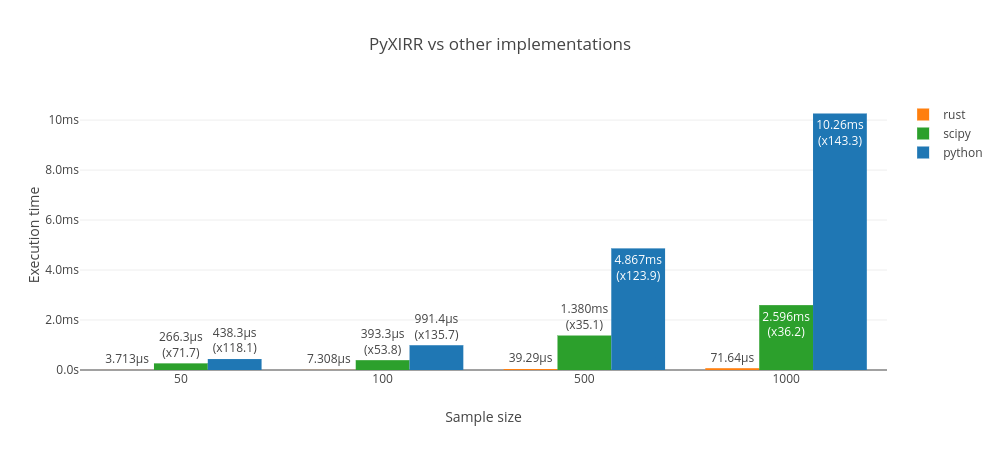 + +PyXIRR is ~10-20x faster in XIRR calculation than the other implementations. + +Powered by [github-action-benchmark](https://github.com/rhysd/github-action-benchmark) and [plotly.js](https://github.com/plotly/plotly.js). + +Live benchmarks are hosted on [Github Pages](https://anexen.github.io/pyxirr/bench). + +# Examples + +```python +from datetime import date +from pyxirr import xirr + +dates = [date(2020, 1, 1), date(2021, 1, 1), date(2022, 1, 1)] +amounts = [-1000, 750, 500] + +# feed columnar data +xirr(dates, amounts) +# feed iterators +xirr(iter(dates), (x / 2 for x in amounts)) +# feed an iterable of tuples +xirr(zip(dates, amounts)) +# feed a dictionary +xirr(dict(zip(dates, amounts))) +# dates as strings +xirr(['2020-01-01', '2021-01-01'], [-1000, 1200]) +``` + +### Numpy and Pandas + +```python +import numpy as np +import pandas as pd + +# feed numpy array +xirr(np.array([dates, amounts])) +xirr(np.array(dates), np.array(amounts)) + +# feed DataFrame (columns names doesn't matter; ordering matters) +xirr(pd.DataFrame({"a": dates, "b": amounts})) + +# feed Series with DatetimeIndex +xirr(pd.Series(amounts, index=pd.to_datetime(dates))) + +# bonus: apply xirr to a DataFrame with DatetimeIndex: +df = pd.DataFrame( + index=pd.date_range("2021", "2022", freq="MS", closed="left"), + data={ + "one": [-100] + [20] * 11, + "two": [-80] + [19] * 11, + }, +) +df.apply(xirr) # Series(index=["one", "two"], data=[5.09623547168478, 8.780801977141174]) +``` + +### Day count conventions + +Check out the available options on the [docs/day-count-conventions](https://anexen.github.io/pyxirr/functions.html#day-count-conventions). + +```python +from pyxirr import DayCount + +xirr(dates, amounts, day_count=DayCount.ACT_360) + +# parse day count from string +xirr(dates, amounts, day_count="30E/360") +``` + +### Other financial functions + +```python +import pyxirr + +# Future Value +pyxirr.fv(0.05/12, 10*12, -100, -100) + +# Net Present Value +pyxirr.npv(0, [-40_000, 5_000, 8_000, 12_000, 30_000]) + +# IRR +pyxirr.irr([-100, 39, 59, 55, 20]) + +# ... and more! Check out the docs. +``` + +### Vectorization + +PyXIRR supports numpy-like vectorization. + +If all input is scalar, returns a scalar float. If any input is array_like, +returns values for each input element. If multiple inputs are +array_like, performs broadcasting and returns values for each element. + +```python +import pyxirr + +# feed list +pyxirr.fv([0.05/12, 0.06/12], 10*12, -100, -100) +pyxirr.fv([0.05/12, 0.06/12], [10*12, 9*12], [-100, -200], -100) + +# feed numpy array +import numpy as np +rates = np.array([0.05, 0.06, 0.07])/12 +pyxirr.fv(rates, 10*12, -100, -100) + +# feed any iterable! +pyxirr.fv( + np.linspace(0.01, 0.2, 10), + (x + 1 for x in range(10)), + range(-100, -1100, -100), + tuple(range(-100, -200, -10)) +) + +# 2d, 3d, 4d, and more! +rates = [[[[[[0.01], [0.02]]]]]] +pyxirr.fv(rates, 10*12, -100, -100) +``` + +# API reference + +See the [docs](https://anexen.github.io/pyxirr) + +# Roadmap + +- [x] Implement all functions from [numpy-financial](https://numpy.org/numpy-financial/latest/index.html) +- [x] Improve docs, add more tests +- [x] Type hints +- [x] Vectorized versions of numpy-financial functions. +- [ ] Compile library for rust/javascript/python + +# Development + +Running tests with pyo3 is a bit tricky. In short, you need to compile your tests without `extension-module` feature to avoid linking errors. +See the following issues for the details: [#341](https://github.com/PyO3/pyo3/issues/341), [#771](https://github.com/PyO3/pyo3/issues/771). + +If you are using `pyenv`, make sure you have the shared library installed (check for `${PYENV_ROOT}/versions/<version>/lib/libpython3.so` file). + +```bash +$ PYTHON_CONFIGURE_OPTS="--enable-shared" pyenv install <version> +``` + +Install dev-requirements + +```bash +$ pip install -r dev-requirements.txt +``` + +### Building + +```bash +$ maturin develop +``` + +### Testing + +```bash +$ LD_LIBRARY_PATH=${PYENV_ROOT}/versions/3.10.8/lib cargo test --no-default-features --features tests +``` + +### Benchmarks + +```bash +$ pip install -r bench-requirements.txt +$ LD_LIBRARY_PATH=${PYENV_ROOT}/versions/3.10.8/lib cargo +nightly bench --no-default-features --features tests +``` + +# Building and distribution + +This library uses [maturin](https://github.com/PyO3/maturin) to build and distribute python wheels. + +```bash +$ docker run --rm -v $(pwd):/io ghcr.io/pyo3/maturin build --release --manylinux 2010 --strip +$ maturin upload target/wheels/pyxirr-${version}* +``` + + + +%package -n python3-pyxirr +Summary: Rust-powered collection of financial functions for Python. +Provides: python-pyxirr +BuildRequires: python3-devel +BuildRequires: python3-setuptools +BuildRequires: python3-pip +BuildRequires: python3-cffi +BuildRequires: gcc +BuildRequires: gdb +%description -n python3-pyxirr +[](https://www.rust-lang.org/) +[](https://github.com/Anexen/pyxirr/blob/master/LICENSE) +[](https://pypi.org/project/pyxirr/) +[](https://pypi.org/project/pyxirr/) + +# PyXIRR + +Rust-powered collection of financial functions. + +PyXIRR stands for "Python XIRR" (for historical reasons), but contains many other financial functions such as IRR, FV, NPV, etc. + +Features: + +- correct +- supports different day count conventions (e.g. ACT/360, 30E/360, etc.) +- works with different input data types (iterators, numpy arrays, pandas DataFrames) +- no external dependencies +- type annotations +- blazingly fast + +# Installation + +``` +pip install pyxirr +``` + +# Benchmarks + +Rust implementation has been tested against existing [xirr](https://pypi.org/project/xirr/) package +(uses [scipy.optimize](https://docs.scipy.org/doc/scipy/reference/generated/scipy.optimize.newton.html) under the hood) +and the [implementation from the Stack Overflow](https://stackoverflow.com/a/11503492) (pure python). + + + +PyXIRR is ~10-20x faster in XIRR calculation than the other implementations. + +Powered by [github-action-benchmark](https://github.com/rhysd/github-action-benchmark) and [plotly.js](https://github.com/plotly/plotly.js). + +Live benchmarks are hosted on [Github Pages](https://anexen.github.io/pyxirr/bench). + +# Examples + +```python +from datetime import date +from pyxirr import xirr + +dates = [date(2020, 1, 1), date(2021, 1, 1), date(2022, 1, 1)] +amounts = [-1000, 750, 500] + +# feed columnar data +xirr(dates, amounts) +# feed iterators +xirr(iter(dates), (x / 2 for x in amounts)) +# feed an iterable of tuples +xirr(zip(dates, amounts)) +# feed a dictionary +xirr(dict(zip(dates, amounts))) +# dates as strings +xirr(['2020-01-01', '2021-01-01'], [-1000, 1200]) +``` + +### Numpy and Pandas + +```python +import numpy as np +import pandas as pd + +# feed numpy array +xirr(np.array([dates, amounts])) +xirr(np.array(dates), np.array(amounts)) + +# feed DataFrame (columns names doesn't matter; ordering matters) +xirr(pd.DataFrame({"a": dates, "b": amounts})) + +# feed Series with DatetimeIndex +xirr(pd.Series(amounts, index=pd.to_datetime(dates))) + +# bonus: apply xirr to a DataFrame with DatetimeIndex: +df = pd.DataFrame( + index=pd.date_range("2021", "2022", freq="MS", closed="left"), + data={ + "one": [-100] + [20] * 11, + "two": [-80] + [19] * 11, + }, +) +df.apply(xirr) # Series(index=["one", "two"], data=[5.09623547168478, 8.780801977141174]) +``` + +### Day count conventions + +Check out the available options on the [docs/day-count-conventions](https://anexen.github.io/pyxirr/functions.html#day-count-conventions). + +```python +from pyxirr import DayCount + +xirr(dates, amounts, day_count=DayCount.ACT_360) + +# parse day count from string +xirr(dates, amounts, day_count="30E/360") +``` + +### Other financial functions + +```python +import pyxirr + +# Future Value +pyxirr.fv(0.05/12, 10*12, -100, -100) + +# Net Present Value +pyxirr.npv(0, [-40_000, 5_000, 8_000, 12_000, 30_000]) + +# IRR +pyxirr.irr([-100, 39, 59, 55, 20]) + +# ... and more! Check out the docs. +``` + +### Vectorization + +PyXIRR supports numpy-like vectorization. + +If all input is scalar, returns a scalar float. If any input is array_like, +returns values for each input element. If multiple inputs are +array_like, performs broadcasting and returns values for each element. + +```python +import pyxirr + +# feed list +pyxirr.fv([0.05/12, 0.06/12], 10*12, -100, -100) +pyxirr.fv([0.05/12, 0.06/12], [10*12, 9*12], [-100, -200], -100) + +# feed numpy array +import numpy as np +rates = np.array([0.05, 0.06, 0.07])/12 +pyxirr.fv(rates, 10*12, -100, -100) + +# feed any iterable! +pyxirr.fv( + np.linspace(0.01, 0.2, 10), + (x + 1 for x in range(10)), + range(-100, -1100, -100), + tuple(range(-100, -200, -10)) +) + +# 2d, 3d, 4d, and more! +rates = [[[[[[0.01], [0.02]]]]]] +pyxirr.fv(rates, 10*12, -100, -100) +``` + +# API reference + +See the [docs](https://anexen.github.io/pyxirr) + +# Roadmap + +- [x] Implement all functions from [numpy-financial](https://numpy.org/numpy-financial/latest/index.html) +- [x] Improve docs, add more tests +- [x] Type hints +- [x] Vectorized versions of numpy-financial functions. +- [ ] Compile library for rust/javascript/python + +# Development + +Running tests with pyo3 is a bit tricky. In short, you need to compile your tests without `extension-module` feature to avoid linking errors. +See the following issues for the details: [#341](https://github.com/PyO3/pyo3/issues/341), [#771](https://github.com/PyO3/pyo3/issues/771). + +If you are using `pyenv`, make sure you have the shared library installed (check for `${PYENV_ROOT}/versions/<version>/lib/libpython3.so` file). + +```bash +$ PYTHON_CONFIGURE_OPTS="--enable-shared" pyenv install <version> +``` + +Install dev-requirements + +```bash +$ pip install -r dev-requirements.txt +``` + +### Building + +```bash +$ maturin develop +``` + +### Testing + +```bash +$ LD_LIBRARY_PATH=${PYENV_ROOT}/versions/3.10.8/lib cargo test --no-default-features --features tests +``` + +### Benchmarks + +```bash +$ pip install -r bench-requirements.txt +$ LD_LIBRARY_PATH=${PYENV_ROOT}/versions/3.10.8/lib cargo +nightly bench --no-default-features --features tests +``` + +# Building and distribution + +This library uses [maturin](https://github.com/PyO3/maturin) to build and distribute python wheels. + +```bash +$ docker run --rm -v $(pwd):/io ghcr.io/pyo3/maturin build --release --manylinux 2010 --strip +$ maturin upload target/wheels/pyxirr-${version}* +``` + + + +%package help +Summary: Development documents and examples for pyxirr +Provides: python3-pyxirr-doc +%description help +[](https://www.rust-lang.org/) +[](https://github.com/Anexen/pyxirr/blob/master/LICENSE) +[](https://pypi.org/project/pyxirr/) +[](https://pypi.org/project/pyxirr/) + +# PyXIRR + +Rust-powered collection of financial functions. + +PyXIRR stands for "Python XIRR" (for historical reasons), but contains many other financial functions such as IRR, FV, NPV, etc. + +Features: + +- correct +- supports different day count conventions (e.g. ACT/360, 30E/360, etc.) +- works with different input data types (iterators, numpy arrays, pandas DataFrames) +- no external dependencies +- type annotations +- blazingly fast + +# Installation + +``` +pip install pyxirr +``` + +# Benchmarks + +Rust implementation has been tested against existing [xirr](https://pypi.org/project/xirr/) package +(uses [scipy.optimize](https://docs.scipy.org/doc/scipy/reference/generated/scipy.optimize.newton.html) under the hood) +and the [implementation from the Stack Overflow](https://stackoverflow.com/a/11503492) (pure python). + + + +PyXIRR is ~10-20x faster in XIRR calculation than the other implementations. + +Powered by [github-action-benchmark](https://github.com/rhysd/github-action-benchmark) and [plotly.js](https://github.com/plotly/plotly.js). + +Live benchmarks are hosted on [Github Pages](https://anexen.github.io/pyxirr/bench). + +# Examples + +```python +from datetime import date +from pyxirr import xirr + +dates = [date(2020, 1, 1), date(2021, 1, 1), date(2022, 1, 1)] +amounts = [-1000, 750, 500] + +# feed columnar data +xirr(dates, amounts) +# feed iterators +xirr(iter(dates), (x / 2 for x in amounts)) +# feed an iterable of tuples +xirr(zip(dates, amounts)) +# feed a dictionary +xirr(dict(zip(dates, amounts))) +# dates as strings +xirr(['2020-01-01', '2021-01-01'], [-1000, 1200]) +``` + +### Numpy and Pandas + +```python +import numpy as np +import pandas as pd + +# feed numpy array +xirr(np.array([dates, amounts])) +xirr(np.array(dates), np.array(amounts)) + +# feed DataFrame (columns names doesn't matter; ordering matters) +xirr(pd.DataFrame({"a": dates, "b": amounts})) + +# feed Series with DatetimeIndex +xirr(pd.Series(amounts, index=pd.to_datetime(dates))) + +# bonus: apply xirr to a DataFrame with DatetimeIndex: +df = pd.DataFrame( + index=pd.date_range("2021", "2022", freq="MS", closed="left"), + data={ + "one": [-100] + [20] * 11, + "two": [-80] + [19] * 11, + }, +) +df.apply(xirr) # Series(index=["one", "two"], data=[5.09623547168478, 8.780801977141174]) +``` + +### Day count conventions + +Check out the available options on the [docs/day-count-conventions](https://anexen.github.io/pyxirr/functions.html#day-count-conventions). + +```python +from pyxirr import DayCount + +xirr(dates, amounts, day_count=DayCount.ACT_360) + +# parse day count from string +xirr(dates, amounts, day_count="30E/360") +``` + +### Other financial functions + +```python +import pyxirr + +# Future Value +pyxirr.fv(0.05/12, 10*12, -100, -100) + +# Net Present Value +pyxirr.npv(0, [-40_000, 5_000, 8_000, 12_000, 30_000]) + +# IRR +pyxirr.irr([-100, 39, 59, 55, 20]) + +# ... and more! Check out the docs. +``` + +### Vectorization + +PyXIRR supports numpy-like vectorization. + +If all input is scalar, returns a scalar float. If any input is array_like, +returns values for each input element. If multiple inputs are +array_like, performs broadcasting and returns values for each element. + +```python +import pyxirr + +# feed list +pyxirr.fv([0.05/12, 0.06/12], 10*12, -100, -100) +pyxirr.fv([0.05/12, 0.06/12], [10*12, 9*12], [-100, -200], -100) + +# feed numpy array +import numpy as np +rates = np.array([0.05, 0.06, 0.07])/12 +pyxirr.fv(rates, 10*12, -100, -100) + +# feed any iterable! +pyxirr.fv( + np.linspace(0.01, 0.2, 10), + (x + 1 for x in range(10)), + range(-100, -1100, -100), + tuple(range(-100, -200, -10)) +) + +# 2d, 3d, 4d, and more! +rates = [[[[[[0.01], [0.02]]]]]] +pyxirr.fv(rates, 10*12, -100, -100) +``` + +# API reference + +See the [docs](https://anexen.github.io/pyxirr) + +# Roadmap + +- [x] Implement all functions from [numpy-financial](https://numpy.org/numpy-financial/latest/index.html) +- [x] Improve docs, add more tests +- [x] Type hints +- [x] Vectorized versions of numpy-financial functions. +- [ ] Compile library for rust/javascript/python + +# Development + +Running tests with pyo3 is a bit tricky. In short, you need to compile your tests without `extension-module` feature to avoid linking errors. +See the following issues for the details: [#341](https://github.com/PyO3/pyo3/issues/341), [#771](https://github.com/PyO3/pyo3/issues/771). + +If you are using `pyenv`, make sure you have the shared library installed (check for `${PYENV_ROOT}/versions/<version>/lib/libpython3.so` file). + +```bash +$ PYTHON_CONFIGURE_OPTS="--enable-shared" pyenv install <version> +``` + +Install dev-requirements + +```bash +$ pip install -r dev-requirements.txt +``` + +### Building + +```bash +$ maturin develop +``` + +### Testing + +```bash +$ LD_LIBRARY_PATH=${PYENV_ROOT}/versions/3.10.8/lib cargo test --no-default-features --features tests +``` + +### Benchmarks + +```bash +$ pip install -r bench-requirements.txt +$ LD_LIBRARY_PATH=${PYENV_ROOT}/versions/3.10.8/lib cargo +nightly bench --no-default-features --features tests +``` + +# Building and distribution + +This library uses [maturin](https://github.com/PyO3/maturin) to build and distribute python wheels. + +```bash +$ docker run --rm -v $(pwd):/io ghcr.io/pyo3/maturin build --release --manylinux 2010 --strip +$ maturin upload target/wheels/pyxirr-${version}* +``` + + + +%prep +%autosetup -n pyxirr-0.9.0 + +%build +%py3_build + +%install +%py3_install +install -d -m755 %{buildroot}/%{_pkgdocdir} +if [ -d doc ]; then cp -arf doc %{buildroot}/%{_pkgdocdir}; fi +if [ -d docs ]; then cp -arf docs %{buildroot}/%{_pkgdocdir}; fi +if [ -d example ]; then cp -arf example %{buildroot}/%{_pkgdocdir}; fi +if [ -d examples ]; then cp -arf examples %{buildroot}/%{_pkgdocdir}; fi +pushd %{buildroot} +if [ -d usr/lib ]; then + find usr/lib -type f -printf "/%h/%f\n" >> filelist.lst +fi +if [ -d usr/lib64 ]; then + find usr/lib64 -type f -printf "/%h/%f\n" >> filelist.lst +fi +if [ -d usr/bin ]; then + find usr/bin -type f -printf "/%h/%f\n" >> filelist.lst +fi +if [ -d usr/sbin ]; then + find usr/sbin -type f -printf "/%h/%f\n" >> filelist.lst +fi +touch doclist.lst +if [ -d usr/share/man ]; then + find usr/share/man -type f -printf "/%h/%f.gz\n" >> doclist.lst +fi +popd +mv %{buildroot}/filelist.lst . +mv %{buildroot}/doclist.lst . + +%files -n python3-pyxirr -f filelist.lst +%dir %{python3_sitearch}/* + +%files help -f doclist.lst +%{_docdir}/* + +%changelog +* Tue Apr 11 2023 Python_Bot <Python_Bot@openeuler.org> - 0.9.0-1 +- Package Spec generated @@ -0,0 +1 @@ +4e008e732f169502c0eaf037939dbad6 pyxirr-0.9.0.tar.gz |