1
2
3
4
5
6
7
8
9
10
11
12
13
14
15
16
17
18
19
20
21
22
23
24
25
26
27
28
29
30
31
32
33
34
35
36
37
38
39
40
41
42
43
44
45
46
47
48
49
50
51
52
53
54
55
56
57
58
59
60
61
62
63
64
65
66
67
68
69
70
71
72
73
74
75
76
77
78
79
80
81
82
83
84
85
86
87
88
89
90
91
92
93
94
95
96
97
98
99
100
101
102
103
104
105
106
107
108
109
110
111
112
113
114
115
116
117
118
119
120
121
122
123
124
125
126
127
128
129
130
131
132
133
134
135
136
137
138
139
140
141
142
143
144
145
146
147
148
149
150
151
152
153
154
155
156
157
158
159
160
161
162
163
164
165
166
167
168
169
170
171
172
173
174
175
176
177
178
179
180
181
182
183
184
185
186
187
188
189
190
191
192
193
194
195
196
197
198
199
200
201
202
203
204
205
206
207
208
209
210
211
212
213
214
215
216
217
218
219
220
221
222
223
224
225
226
227
228
229
230
231
232
233
234
235
236
237
238
239
240
241
242
243
244
245
246
247
248
249
250
251
252
253
254
255
256
257
258
259
260
261
262
263
264
265
266
267
268
269
270
271
272
273
274
275
276
277
278
279
280
281
282
283
284
285
286
287
288
289
290
291
292
293
294
295
296
297
298
299
300
301
302
303
304
305
306
307
308
309
310
311
312
313
314
315
316
317
318
319
320
321
322
323
324
325
326
327
328
329
330
331
332
333
334
335
336
337
338
339
340
341
342
343
344
345
346
347
348
349
350
351
352
353
354
355
356
357
358
359
360
361
362
363
364
365
366
367
368
369
370
371
372
373
374
375
376
377
378
379
380
381
382
383
384
385
386
387
388
389
390
391
392
393
394
395
396
397
398
399
400
401
402
403
404
405
406
407
408
409
410
411
412
413
414
415
416
417
418
419
420
421
422
423
424
425
426
427
428
429
430
431
432
433
434
435
436
437
438
439
440
441
442
443
444
445
446
447
448
449
450
451
452
453
454
455
456
457
458
459
460
461
462
463
464
465
466
467
468
469
470
471
472
473
474
475
476
477
478
479
480
481
482
483
484
|
%global _empty_manifest_terminate_build 0
Name: python-sap-xssec
Version: 4.0.0
Release: 1
Summary: SAP Python Security Library
License: Apache Software License
URL: https://github.com/SAP/cloud-pysec
Source0: https://mirrors.aliyun.com/pypi/web/packages/8b/3b/5de30698e865b41cbfcc892d238970535453c4b697305359cd82624b521e/sap_xssec-4.0.0.tar.gz
BuildArch: noarch
Requires: python3-deprecation
Requires: python3-httpx
Requires: python3-urllib3
Requires: python3-six
Requires: python3-pyjwt
Requires: python3-cachetools
Requires: python3-cryptography
%description
[](https://api.reuse.software/info/github.com/SAP/cloud-pysec)
# Description
This project is a python client library called *sap_xssec* for validation of *OAuth access tokens* issued by the *XSUAA*.
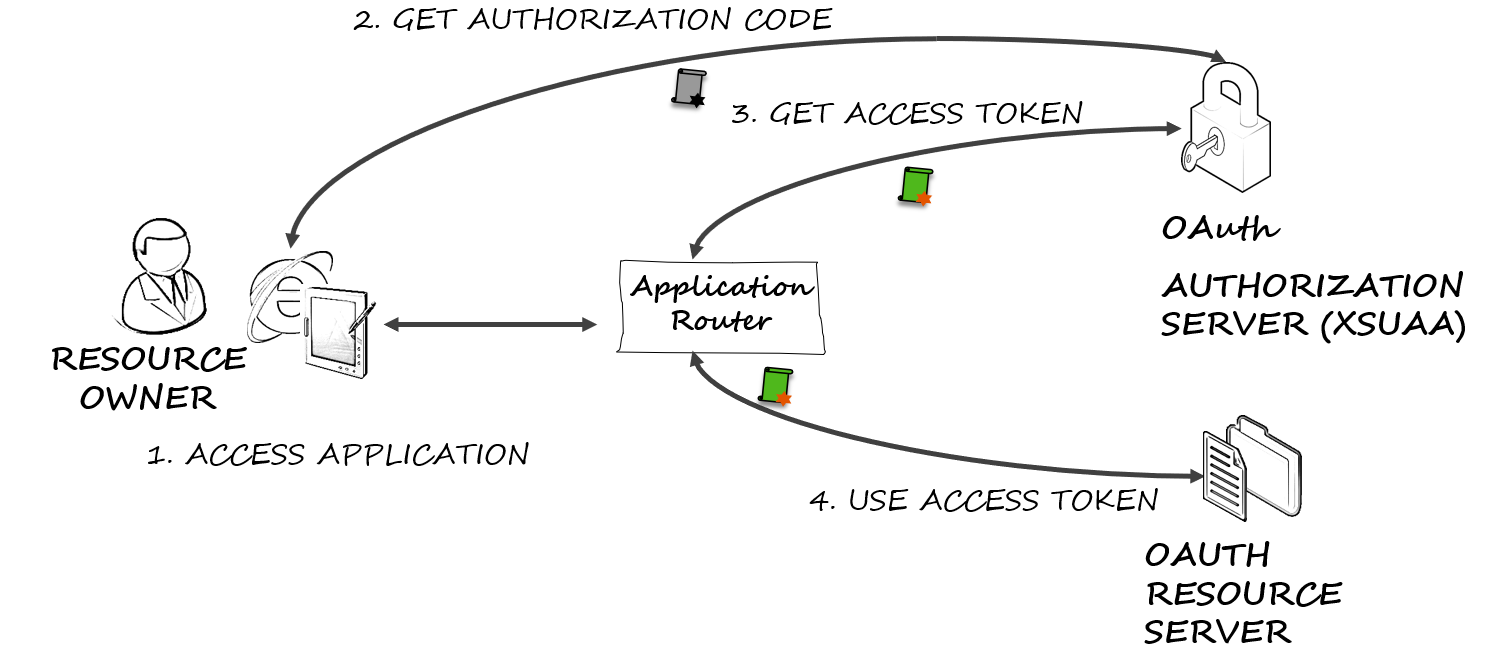
### OAuth Authorization Code Flow
The typical web application use the OAuth authorization code flow for authentication, which is described as follows:
1. A user accesses the web application using a browser.
2. The web application (in typical SAP Cloud Platform applications, this is an application router) acts as OAuth client and redirects
to the OAuth server for authorization.
3. Upon authentication, the web application uses the code issued by the authorization server to request an access token.
4. The web application uses the access token to request data from the OAuth resource server.
The OAuth resource server validates the token using online or offline validation.
For this validation libraries like sap_xssec are used.
### Usage
For the usage of this library it is necessary to pass a JWT access token that should be validated to the library.
The examples below rely on users and credentials that you should substitute with the ones in your context.
The typical use case for calling this API lies from within a container when an HTTP request is received and it must
be checked if the requester is authorized to execute this method.
In this case, the access token is contained in the authorization header (with keyword `bearer`).
You can remove the prefix `bearer` and pass the remaining string (just as in the following example as `access_token`) to the API.
```python
from sap import xssec
from cfenv import AppEnv
env = AppEnv()
uaa_service = env.get_service(name='<uaa_service_name>').credentials
security_context = xssec.create_security_context(access_token, uaa_service)
```
**Note:** That the example above uses module [`cfenv`](https://pypi.python.org/pypi/cfenv) to retrieve the configuration of the uaa
service instance.
`uaa_service` is a dict that contains the necessary client information and looks like:
```
{
'clientid' : 'example_clientid' // the id of the client
'clientsecret': 'example_clientsecret' // the secret of the client
'url': 'example_url' // the url of the uaa
'uaadomain': 'example_uaadomain' // the domain of the uaa
'verificationkey': 'example_verification key' // (optional) the key used for the verfication of the token
}
```
If the `uaadomain` is set in the `uaa_service` and the `jku` and `kid` are set in the incomming token, the key is requested from the uaa. As a fallback, the `verificationkey` configured in `uaa_service` is used for offline validation. Requested keys are cached for 15 minutes to avoid extensive load on the uaa.
The creation function `xssec.create_security_context` is to be used for an end-user token (e.g. for grant_type `password`
or grant_type `authorization_code`) where user information is expected to be available within the token and thus within the security context.
`create_security_context` also accepts a token of grant_type `client_credentials`.
This leads to the creation of a limited *SecurityContext* where certain functions are not available.
For more details please consult the API description in the wiki.
For example, the `security_context` object can then be used to check if a user has a required scope:
```
security_context.check_scope('uaa.user')
```
or to receive the client id of a user:
```
security_context.get_clientid()
```
More details on the API can be found in the [wiki](https://github.com/SAP/cloud-pysec/wiki).
### Offline Validation
sap_xssec offers offline validation of the access token, which requires no additional call to the UAA.
The trust for this offline validation is created by binding the XS UAA service instance to your application.
Inside the credentials section in the environment variable `VCAP_SERVICES`, the key for validation of tokens is included.
By default, the offline validation check will only accept tokens intended for the same OAuth2 client in the same UAA identity zone.
This makes sense and will cover the vast majority of use cases.
~~However, if an application absolutely wants to consume token that were issued for either different OAuth2 clients or different identity zones,
an *Access Control List (ACL)* entry for this can be specified in an environment variable named `SAP_JWT_TRUST_ACL`.
The name of the OAuth client has then the prefix `sb-`, the content is a JSON String, containing an array of identity zones and OAuth2 clients.
To trust any OAuth2 client and/or identity zones, an * can be used.~~
⚠️From version 2.1.0, the `SAP_JWT_TRUST_ACL` environment variable is no longer supported.
If you want to enable another (foreign) application to use some of your application's scopes, you can add a ```granted-apps``` marker to your scope in the ```xs-security.json``` file (as in the following example). The value of the marker is a list of applications that is allowed to request a token with the denoted scope.
```JSON
{
"xsappname" : "sample-leave-request-app",
"description" : "This sample application demos leave requests",
"scopes" : [ { "name" : "$XSAPPNAME.createLR",
"description" : "create leave requests" },
{ "name" : "$XSAPPNAME.approveLR",
"description" : "approve leave requests",
"granted-apps" : ["MobileApprovals"] }
],
"attributes" : [ { "name" : "costcenter",
"description" : "costcenter",
"valueType" : "string"
} ],
"role-templates": [ { "name" : "employee",
"description" : "Role for creating leave requests",
"scope-references" : [ "$XSAPPNAME.createLR","JobScheduler.scheduleJobs" ],
"attribute-references": [ "costcenter"] },
{ "name" : "manager",
"description" : "Role for creating and approving leave requests",
"scope-references" : [ "$XSAPPNAME.createLR","$XSAPPNAME.approveLR","JobScheduler.scheduleJobs" ],
"attribute-references": [ "costcenter" ] }
]
}
```
# Configuration
~~To configure whether the *sap-jwt* or the *py-jwt* library should be used for validation of the jwt token,
change the `USE_SAP_PY_JWT` environment variable to `true`.~~
⚠️From version 4.0.0, the `USE_SAP_PY_JWT` environment variable is no longer supported and therefore only *py-jwt* is supported.
# Requirements
*sap_xssec* requires *python 3.6* or newer.
# Download and Installation
As this package is deployed to PyPI, you can simply add `sap_xssec` as a dependency to your python project or
install this package by running `pip install sap_xssec`.
# Known Issues
# How to obtain support
Open an issue in GitHub.
%package -n python3-sap-xssec
Summary: SAP Python Security Library
Provides: python-sap-xssec
BuildRequires: python3-devel
BuildRequires: python3-setuptools
BuildRequires: python3-pip
%description -n python3-sap-xssec
[](https://api.reuse.software/info/github.com/SAP/cloud-pysec)
# Description
This project is a python client library called *sap_xssec* for validation of *OAuth access tokens* issued by the *XSUAA*.
### OAuth Authorization Code Flow
The typical web application use the OAuth authorization code flow for authentication, which is described as follows:
1. A user accesses the web application using a browser.
2. The web application (in typical SAP Cloud Platform applications, this is an application router) acts as OAuth client and redirects
to the OAuth server for authorization.
3. Upon authentication, the web application uses the code issued by the authorization server to request an access token.
4. The web application uses the access token to request data from the OAuth resource server.
The OAuth resource server validates the token using online or offline validation.
For this validation libraries like sap_xssec are used.

### Usage
For the usage of this library it is necessary to pass a JWT access token that should be validated to the library.
The examples below rely on users and credentials that you should substitute with the ones in your context.
The typical use case for calling this API lies from within a container when an HTTP request is received and it must
be checked if the requester is authorized to execute this method.
In this case, the access token is contained in the authorization header (with keyword `bearer`).
You can remove the prefix `bearer` and pass the remaining string (just as in the following example as `access_token`) to the API.
```python
from sap import xssec
from cfenv import AppEnv
env = AppEnv()
uaa_service = env.get_service(name='<uaa_service_name>').credentials
security_context = xssec.create_security_context(access_token, uaa_service)
```
**Note:** That the example above uses module [`cfenv`](https://pypi.python.org/pypi/cfenv) to retrieve the configuration of the uaa
service instance.
`uaa_service` is a dict that contains the necessary client information and looks like:
```
{
'clientid' : 'example_clientid' // the id of the client
'clientsecret': 'example_clientsecret' // the secret of the client
'url': 'example_url' // the url of the uaa
'uaadomain': 'example_uaadomain' // the domain of the uaa
'verificationkey': 'example_verification key' // (optional) the key used for the verfication of the token
}
```
If the `uaadomain` is set in the `uaa_service` and the `jku` and `kid` are set in the incomming token, the key is requested from the uaa. As a fallback, the `verificationkey` configured in `uaa_service` is used for offline validation. Requested keys are cached for 15 minutes to avoid extensive load on the uaa.
The creation function `xssec.create_security_context` is to be used for an end-user token (e.g. for grant_type `password`
or grant_type `authorization_code`) where user information is expected to be available within the token and thus within the security context.
`create_security_context` also accepts a token of grant_type `client_credentials`.
This leads to the creation of a limited *SecurityContext* where certain functions are not available.
For more details please consult the API description in the wiki.
For example, the `security_context` object can then be used to check if a user has a required scope:
```
security_context.check_scope('uaa.user')
```
or to receive the client id of a user:
```
security_context.get_clientid()
```
More details on the API can be found in the [wiki](https://github.com/SAP/cloud-pysec/wiki).
### Offline Validation
sap_xssec offers offline validation of the access token, which requires no additional call to the UAA.
The trust for this offline validation is created by binding the XS UAA service instance to your application.
Inside the credentials section in the environment variable `VCAP_SERVICES`, the key for validation of tokens is included.
By default, the offline validation check will only accept tokens intended for the same OAuth2 client in the same UAA identity zone.
This makes sense and will cover the vast majority of use cases.
~~However, if an application absolutely wants to consume token that were issued for either different OAuth2 clients or different identity zones,
an *Access Control List (ACL)* entry for this can be specified in an environment variable named `SAP_JWT_TRUST_ACL`.
The name of the OAuth client has then the prefix `sb-`, the content is a JSON String, containing an array of identity zones and OAuth2 clients.
To trust any OAuth2 client and/or identity zones, an * can be used.~~
⚠️From version 2.1.0, the `SAP_JWT_TRUST_ACL` environment variable is no longer supported.
If you want to enable another (foreign) application to use some of your application's scopes, you can add a ```granted-apps``` marker to your scope in the ```xs-security.json``` file (as in the following example). The value of the marker is a list of applications that is allowed to request a token with the denoted scope.
```JSON
{
"xsappname" : "sample-leave-request-app",
"description" : "This sample application demos leave requests",
"scopes" : [ { "name" : "$XSAPPNAME.createLR",
"description" : "create leave requests" },
{ "name" : "$XSAPPNAME.approveLR",
"description" : "approve leave requests",
"granted-apps" : ["MobileApprovals"] }
],
"attributes" : [ { "name" : "costcenter",
"description" : "costcenter",
"valueType" : "string"
} ],
"role-templates": [ { "name" : "employee",
"description" : "Role for creating leave requests",
"scope-references" : [ "$XSAPPNAME.createLR","JobScheduler.scheduleJobs" ],
"attribute-references": [ "costcenter"] },
{ "name" : "manager",
"description" : "Role for creating and approving leave requests",
"scope-references" : [ "$XSAPPNAME.createLR","$XSAPPNAME.approveLR","JobScheduler.scheduleJobs" ],
"attribute-references": [ "costcenter" ] }
]
}
```
# Configuration
~~To configure whether the *sap-jwt* or the *py-jwt* library should be used for validation of the jwt token,
change the `USE_SAP_PY_JWT` environment variable to `true`.~~
⚠️From version 4.0.0, the `USE_SAP_PY_JWT` environment variable is no longer supported and therefore only *py-jwt* is supported.
# Requirements
*sap_xssec* requires *python 3.6* or newer.
# Download and Installation
As this package is deployed to PyPI, you can simply add `sap_xssec` as a dependency to your python project or
install this package by running `pip install sap_xssec`.
# Known Issues
# How to obtain support
Open an issue in GitHub.
%package help
Summary: Development documents and examples for sap-xssec
Provides: python3-sap-xssec-doc
%description help
[](https://api.reuse.software/info/github.com/SAP/cloud-pysec)
# Description
This project is a python client library called *sap_xssec* for validation of *OAuth access tokens* issued by the *XSUAA*.
### OAuth Authorization Code Flow
The typical web application use the OAuth authorization code flow for authentication, which is described as follows:
1. A user accesses the web application using a browser.
2. The web application (in typical SAP Cloud Platform applications, this is an application router) acts as OAuth client and redirects
to the OAuth server for authorization.
3. Upon authentication, the web application uses the code issued by the authorization server to request an access token.
4. The web application uses the access token to request data from the OAuth resource server.
The OAuth resource server validates the token using online or offline validation.
For this validation libraries like sap_xssec are used.

### Usage
For the usage of this library it is necessary to pass a JWT access token that should be validated to the library.
The examples below rely on users and credentials that you should substitute with the ones in your context.
The typical use case for calling this API lies from within a container when an HTTP request is received and it must
be checked if the requester is authorized to execute this method.
In this case, the access token is contained in the authorization header (with keyword `bearer`).
You can remove the prefix `bearer` and pass the remaining string (just as in the following example as `access_token`) to the API.
```python
from sap import xssec
from cfenv import AppEnv
env = AppEnv()
uaa_service = env.get_service(name='<uaa_service_name>').credentials
security_context = xssec.create_security_context(access_token, uaa_service)
```
**Note:** That the example above uses module [`cfenv`](https://pypi.python.org/pypi/cfenv) to retrieve the configuration of the uaa
service instance.
`uaa_service` is a dict that contains the necessary client information and looks like:
```
{
'clientid' : 'example_clientid' // the id of the client
'clientsecret': 'example_clientsecret' // the secret of the client
'url': 'example_url' // the url of the uaa
'uaadomain': 'example_uaadomain' // the domain of the uaa
'verificationkey': 'example_verification key' // (optional) the key used for the verfication of the token
}
```
If the `uaadomain` is set in the `uaa_service` and the `jku` and `kid` are set in the incomming token, the key is requested from the uaa. As a fallback, the `verificationkey` configured in `uaa_service` is used for offline validation. Requested keys are cached for 15 minutes to avoid extensive load on the uaa.
The creation function `xssec.create_security_context` is to be used for an end-user token (e.g. for grant_type `password`
or grant_type `authorization_code`) where user information is expected to be available within the token and thus within the security context.
`create_security_context` also accepts a token of grant_type `client_credentials`.
This leads to the creation of a limited *SecurityContext* where certain functions are not available.
For more details please consult the API description in the wiki.
For example, the `security_context` object can then be used to check if a user has a required scope:
```
security_context.check_scope('uaa.user')
```
or to receive the client id of a user:
```
security_context.get_clientid()
```
More details on the API can be found in the [wiki](https://github.com/SAP/cloud-pysec/wiki).
### Offline Validation
sap_xssec offers offline validation of the access token, which requires no additional call to the UAA.
The trust for this offline validation is created by binding the XS UAA service instance to your application.
Inside the credentials section in the environment variable `VCAP_SERVICES`, the key for validation of tokens is included.
By default, the offline validation check will only accept tokens intended for the same OAuth2 client in the same UAA identity zone.
This makes sense and will cover the vast majority of use cases.
~~However, if an application absolutely wants to consume token that were issued for either different OAuth2 clients or different identity zones,
an *Access Control List (ACL)* entry for this can be specified in an environment variable named `SAP_JWT_TRUST_ACL`.
The name of the OAuth client has then the prefix `sb-`, the content is a JSON String, containing an array of identity zones and OAuth2 clients.
To trust any OAuth2 client and/or identity zones, an * can be used.~~
⚠️From version 2.1.0, the `SAP_JWT_TRUST_ACL` environment variable is no longer supported.
If you want to enable another (foreign) application to use some of your application's scopes, you can add a ```granted-apps``` marker to your scope in the ```xs-security.json``` file (as in the following example). The value of the marker is a list of applications that is allowed to request a token with the denoted scope.
```JSON
{
"xsappname" : "sample-leave-request-app",
"description" : "This sample application demos leave requests",
"scopes" : [ { "name" : "$XSAPPNAME.createLR",
"description" : "create leave requests" },
{ "name" : "$XSAPPNAME.approveLR",
"description" : "approve leave requests",
"granted-apps" : ["MobileApprovals"] }
],
"attributes" : [ { "name" : "costcenter",
"description" : "costcenter",
"valueType" : "string"
} ],
"role-templates": [ { "name" : "employee",
"description" : "Role for creating leave requests",
"scope-references" : [ "$XSAPPNAME.createLR","JobScheduler.scheduleJobs" ],
"attribute-references": [ "costcenter"] },
{ "name" : "manager",
"description" : "Role for creating and approving leave requests",
"scope-references" : [ "$XSAPPNAME.createLR","$XSAPPNAME.approveLR","JobScheduler.scheduleJobs" ],
"attribute-references": [ "costcenter" ] }
]
}
```
# Configuration
~~To configure whether the *sap-jwt* or the *py-jwt* library should be used for validation of the jwt token,
change the `USE_SAP_PY_JWT` environment variable to `true`.~~
⚠️From version 4.0.0, the `USE_SAP_PY_JWT` environment variable is no longer supported and therefore only *py-jwt* is supported.
# Requirements
*sap_xssec* requires *python 3.6* or newer.
# Download and Installation
As this package is deployed to PyPI, you can simply add `sap_xssec` as a dependency to your python project or
install this package by running `pip install sap_xssec`.
# Known Issues
# How to obtain support
Open an issue in GitHub.
%prep
%autosetup -n sap_xssec-4.0.0
%build
%py3_build
%install
%py3_install
install -d -m755 %{buildroot}/%{_pkgdocdir}
if [ -d doc ]; then cp -arf doc %{buildroot}/%{_pkgdocdir}; fi
if [ -d docs ]; then cp -arf docs %{buildroot}/%{_pkgdocdir}; fi
if [ -d example ]; then cp -arf example %{buildroot}/%{_pkgdocdir}; fi
if [ -d examples ]; then cp -arf examples %{buildroot}/%{_pkgdocdir}; fi
pushd %{buildroot}
if [ -d usr/lib ]; then
find usr/lib -type f -printf "\"/%h/%f\"\n" >> filelist.lst
fi
if [ -d usr/lib64 ]; then
find usr/lib64 -type f -printf "\"/%h/%f\"\n" >> filelist.lst
fi
if [ -d usr/bin ]; then
find usr/bin -type f -printf "\"/%h/%f\"\n" >> filelist.lst
fi
if [ -d usr/sbin ]; then
find usr/sbin -type f -printf "\"/%h/%f\"\n" >> filelist.lst
fi
touch doclist.lst
if [ -d usr/share/man ]; then
find usr/share/man -type f -printf "\"/%h/%f.gz\"\n" >> doclist.lst
fi
popd
mv %{buildroot}/filelist.lst .
mv %{buildroot}/doclist.lst .
%files -n python3-sap-xssec -f filelist.lst
%dir %{python3_sitelib}/*
%files help -f doclist.lst
%{_docdir}/*
%changelog
* Thu Jun 08 2023 Python_Bot <Python_Bot@openeuler.org> - 4.0.0-1
- Package Spec generated
|
